Townspeople, 1763

I have this friend, DC: I can call him a friend now, but when we worked together, he was more of a nemesis, mostly because of his OCD tendencies, intense perfectionism, and complete inability to meet deadlines. It was a classic example of Mr Failure-to-Plan working poorly with Miss Contingency-Plan-Required. We literally knocked heads installing an exhibition, and I can still feel the hollow ringing pain. But it’s been six years, and with that distance, friendship is possible.

I'm only in this for the cannon.
I’m only in this for the artillery.

But he’s got this idea.  In August 1763, Boston celebrated the Treaty of Peace ending the Seven Years War (known here as the French and Indian War). There are fantastic descriptions of the celebrations and Thanksgiving Proclamations issued by the colonies, and you can read more about it in the Boston Gazette 8-15-1763.

My friend’s idea is to re-create this celebration, complete with cannons and volleys, and to that end he has enlisted local re-enactors, including a unit he didn’t realize I was part of when he asked me if I had a 1763 impression. True to form, we are asking questions he’s not yet prepared to answer… including, what sort of people do you want these townspeople to be? With the calendar as packed as it is, stitching up militia and my own clothes needs to start now, what with the regular regimental requirements due in June and again in August, and oh yes, actually maintaining life and a tolerable standard of cleanliness in the home.  (DC is moving to Europe in the Fall. After this event, when he leaves North America, I expect we’ll be better friends.)

Jean-Etienne Liotard (1702-1789) Portrait of a Woman called Lady Fawkener circa 1760

The reason I want an answer now is simple: I want a hat. After steaming and cramming The Hat onto Mr S’s head, I deeply desire my own Hat. I don’t covet much, really, and a hand-made piece of headwear made by someone you know and respect seems a very innocent thing to covet, even if coveting is wrong.  But to give the Favorite Hatmaker time to create a hat like the one at left, and me time to trim same, I need to know rather soon if I should be a lady or a cherry-seller.

I started a Pinterest board (when all else fails, collect images) of 1763 ideas. It’s a pretty simple thing, really, gown with robings, cap, blah blah petticoats blah blah, but: isn’t it all about the fabric? And the trims? And, lest we forget, the coveted hat!

Paul Sandby, London Cries: Black Heart cherries... ca. 1759. YCBA,  B1975.3.206
Paul Sandby, London Cries: Black Heart cherries… ca. 1759. YCBA, B1975.3.206

The Sandby cherry seller can probably be replicated with an open gown with robings made from B&T’s Virginia cloth; the question is merely of color, drape, and patience waiting for swatches. (Wish Wm Booth still had that yellow and blue striped linen, but my blue and white linsey-substitute would have to do.) This is simple enough, really; I have a cap like the cherry-seller’s cut out, somewhere, or linen to make one, anyway.
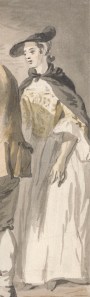
Paul Sandby, London Cries: The Fishmonger (detail), 1759. YCBA B1975.3.210
Paul Sandby, London Cries: The Fishmonger (detail), ca. 1759. YCBA B1975.3.210

Maybe the compromise is this, yellow, with a black hat. I suspect this hat is straw, but perhaps I could combine the hat above with this idea. The black hat and black cape are very appealing. The answer, of course, is all in research: find out about the men in Thomas Marshall’s Boston Militia, and from there I can find out about, or make intelligent surmises, about the women. But that’s irritating, as military/militia-based history often is–to be dependent on the men. Perhaps the less annoying route lies through JSTOR…. and following up on the memory of a Boston widow-businesswoman.

In the end, I’m realistic enough to know that I shall be lucky to get a new hat trimmed at all, given all the menswear there is to complete between now and August. Even my plans for chitzy sewing this week turned late yesterday into, “Oh, but I thought you liked the Adjutant. We’re going up Saturday for fitting.” I suppose that means they think I’ll finish something enough for fitting.

How Now, Brown Gown?

Finished. Hope it fits, right?

Finished, that’s how, with holes in my fingers and a split in my thumb.

Sure hope it fits…I have tried it on along the way, and it is an open robe, so chances are good it will fit. But after I dressed Cassandra, I did have that “What if…?” moment of dread. There’s a lot of this that’s like art school. Hours laboring alone, hours of studying precedent, craft/technique and theory, and then you have a presentation, i.e. you wear the thing in public. I try not to think about it too much.

I could take this apart for you (the sleeve is more ‘modern’ than the cuff; gowns are not known to have been bound at the hem, though petticoats were; didn’t finish the matching petticoat; did I use the fabric the wrong side out?) but Gentle Reader, I suspect you can supply your own quantity of anxiety, and need not borrow a cup or quart from me.

Let’s talk about the fun parts:

For a while, I hated this gown. Seriously. The closer I got to being done with it, the more I flat-out despised it and found it ugly. Why? Too nice. That’s a respectable gown, that is. It’s the gown your mother would tell you to wear, or the one she thought you ought to change into when she said, “You’re going out in that?” As if you were planning to run away in a red and black calico gown… And I hated the color. Then I thought the wool was too heavy.

Mrs Sylvanus Bourne, JS Copley, 1766. MMA, 24.79

I am not this old. My impression is not this wealthy. My dress is not silk. But when I look at what I’ve managed to make, and I look at this (my own white apron is coming; I almost finished it yesterday, but the alarm company called and I had to go deal with an early-morning bat) I feel better. I have white mitts, a white kerchief, and there will be a white apron, bats or no bats.

It’s a neat presentation, the brown and white will look well together, and with a black hat or black bonnet. And by the time I’ve sat on dirt and ground some soil into the skirt, and burned a hole into the hem, I’ll probably like this gown.

But it seems so…proper…and that just doesn’t seem like me.

Getting My Mitts On: HSF #7

Mitts, 18th Century. MMA, C.I.44.8.9a, b

I got in a lather about not having mitts. I have been trying to knit a pair from the Mara Riley pattern for some time, as in well over a year. It’s just an unfortunate thing. I understand the pattern, I like the yarn I have, the needles are authentic enough for events, and yet: I cannot get these things done. As a result, I get cold. (I don’t mean that to sound whiny.)

There’s debate in some circles about whether or not knitted mitts were worn in New England, though there is a nice pair of black frame-knit mitts at the MFA, with a history of use in Lexington, MA. That’s a long way from what I can knit, a fair distance from what lower-middling Kitty would wear, and vastly unsuitable for a woman following the army. Still, I want mitts.

In the Fall, I tried to make myself a pair. It did not go well.

‘Camblet’ lined with linen, linen lined with cotton. More pix on flickr.

Fortunately I have developed more patience or bloody-mindedness since then. This allowed me to spend the time scaling up the pattern in Costume Close-Up. That’s where I started in the Fall, but things went better this time, and I actually have a pair of mitts.

Two pairs. I have problems, I try to solve them with sewing.

The Challenge: HSF # 7: Accessorize.

Fabric:
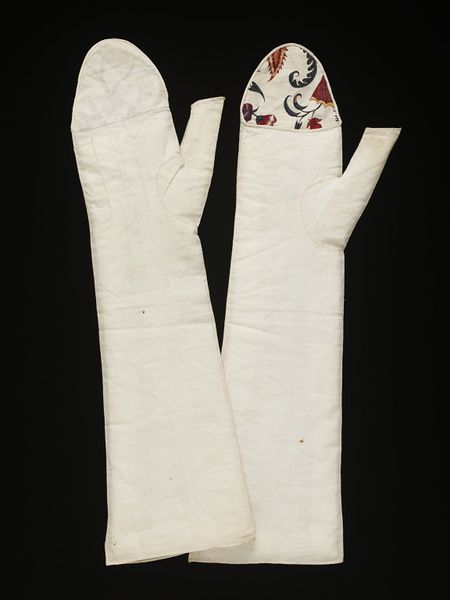
Left: Silk and wool “camblet,” lined with light-weight linen, both from Burnley & Trowbridge
Right: White linen from Fabric-Store.com, lined with printed cotton from Wm Booth Draper.

Pattern:
My own, scaled up from Costume Close-Up, available here for you if you have large hands,  print it at 100% on 11 x 17 paper. You will need to tweak the thumb placement. Make a muslin. Make two muslins. It’s worth the effort.

Year:
1750-1800. Narrower than that I cannot get, yet.

Notions:
None.

Mittens, 1790-1800. V&A,

How historically accurate is it?
Say 8/10, since I have never examined a pair and don’t know exactly how they were made. Yes, I’ve read the descriptions in Costume Close-Up and Fitting and Proper, but at this foggy insomniac moment, I couldn’t tell you much about those descriptions.

Hours to complete:
The bulk of the time was in the patterning, which took a couple of evenings and 4 muslins. But once you have a pattern that works for you, finishing a pair from cutting to wearing is about 3 hours all by hand. You could cut that significantly using a machine instead of hand back-stitching, and add decorative embroidery, which I really cannot do. Really. Photos to come.

First worn:
To be worn April 13…probably the white linen pair.

Total cost:
Nothing, really, as all fabric was left over in the stash. The pretty printed scraps came in handy.

Garters! Jo-Ann plus Wm Booth Draper, but so far no implosion

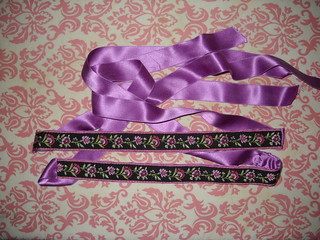
Oh, I made some garters, too. Easy-peasy. Use the Pragmatic Costumer’s Ten Minute Tutorial. Completely makes up for whatever project you think you just screwed up. The main lilac ribbon is silk, the decorative ribbon is so not silk. These are better than no garters, but I expect my stockings will still droop around my ankles, as required by the laws of physics and reenacting.

Over(h)alls, Trousers, & Breeches, oh, my!

Trousers, ca 1793. MMA,1988.342.3

Gentleman can agree to disagree on the attributed date of this garment, just as gentlemen might agree to differ on whether to call these trousers or overalls. It’s all in the crotch length, friends, and we’ll just back away.

But before I return a book of letters to the lender, I wanted to record some of the details that struck me.

Right from the start, the John Buss Letters, edited by Ed Nash, are filled with details. I got excited because, in a slightly random and not at all fabric-hoarding way, I purchased a remnant of grey striped woolen goods from Wm Booth, with the intention of making a jacket or trousers from the fabric.

This notion was rejected by my resident tenant farmer, who has particular ideas about his appearance and the quality of goods which should encase his limbs. Rebuffed from my historic fashion fantasy, I turned for solace to the John Buss letters, determined to make it all up by learning the history of the tenant farmer’s new regiment.

And lo, on page 9, in the very second letter, John writes home to his parents in Leominster, MA on October 1, 1776, saying that “my trowis has got very thin, I should be very glad if mother would make me a pare of striped wooling trowis as son as you can…” My tenant farmer was not impressed by my excitement.

Yes, all my fantasies are documented. But look: John Buss’s trousers are thin, not his breeches. And he’s clear about the difference between trousers, overhalls and breeches. In a February 22, 1778 letter from Valley Forge, Buss tells how he drawd from stores in Bennington “one frock, one Jacket, one Pare overhalls, one of stockings, one Pare of shoes and one shirt. Albany, October 25th., 1777, I drawd a  Red Jacket Quemans Pattern. November 5th., I drawd a pare of Braches and a pare of fresh shoes that was not worth tow shillings.”

Later, Buss requests lining (linen) to make breeches, as he is hot. So he draws clear distinctions between these garment forms. This is a costumer’s dream, really, and for me–oh, those striped wooling trowis! Now I have to make them. Look out, Young Mr…they’re headed your way. And lucky me, I have documentation for that red broadcloth remnant I bought in a random and utterly non-fabric-hoarding way.