Way Finding & the Social Museum

open storage at the Met Museum
Open Storage: Luce Center at the Met

I can’t say this enough: museums are best when they are social experiences. The happiest moment of my day came early, when I was in the Ipswich room of the American wing. Another iPad toting guy and I talked about the lowness of the ceiling, the large fireplace, the bed, and how cozy the room was. (I told him to go to Plimoth if he got a chance.) but it was exciting to talk and share: that’s the best part of discovery, and that’s what museums are about. They’re about finding things, or yourself, or ideas.

The Luce Center was nearly empty of people. A school passed through on their way to someplace else, but I had it pretty much to my self. None of the computers were being used. I saw very few of any screened devices used in the Museum, aside from personal devices.

baby rattle at the Met
Late 17th-early 18th century rattle. Appears to be missing its coral

The Met collection is astounding, no doubt. But I was pleased to see that there are some finer pieces in Rhode Island storerooms and museum rooms. And I think that the way finding could use some real attention. The MFA, last time I was there, had it down: interns, stationed throughout the galleries, to ask if you needed directions whenever you looked lost. NY, not so friendly but maybe more necessary. Also, the galley number for one show I wanted to see was not even included in its web listing. That was a serious annoyance, but I was able to find it eventually.

Replica furniture at the MFA Boston
American Wing at the MFA Boston

The installations are excellent, though standard and in some cases unimaginative. I know: I just dissed the Met. And I’m sticking with that. The exploded chest in the Luce storage wing was one of the best items spotted. I’d say that when it comes to furniture, American furniture, the MFA bests the Mets installation. And I like some other period rooms just as well. Like my own. They just need to be cleaner. What’s wrong with those housemaids? Oh, right. One’s in England, and the other one’s exhausted from her trip back from New York.

To the Right Face!

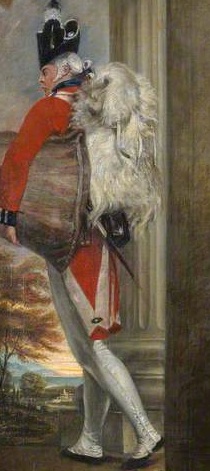
Capt. John Clayton Cowell, 1st Battalion, 1st (or the Royal) Reg't of Foot, ca. 1796. NAM. 1963-11-133-1
Capt. John Clayton Cowell, 1st Battalion, 1st (or the Royal) Reg’t of Foot, ca. 1796. NAM. 1963-11-133-1

That’s Captain Cowell’s right, if you were wondering. You can learn more about his biography here, from the National Army Museum London website (where my very dear friend is lucky I have not begged, implored and entreated her to go, since she is vacationing in London, basically at the very instant you are reading this.)

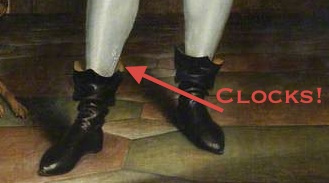
Clocks!
Clocks!

What I am interested in is what the painting shows us. Like The Drowsy Dame, there’s fun the details quite aside from the those slouchy boots. Inside those boots are silk stockings with clocks, a lovely detail that that shows you what class level should be wearing clocked silk stockings in perfect repair in the British Army. Anyone else not of the class that could afford a commission might want to think about having second-hand silk stockings…and, since we’re at the floor level, nice dog. I think he wants walkies, Captain.

The 18th-century fit is clear, too. Those arms may look sheathed in lycra, but they’re in wool; since the Captain served on St. Thomas, it is probably not just very fine but also lightweight. Portraits are idealized, so the Captain may not have been so very superman looking, but the fit of his breeches and coat probably served to accentuate, if not create, his graceful and refined form.  And then there’s the soldier.

Detail of soldier, NAM. 1963-11-133-1

What caught my eye first on the soldier were his overalls, since I’m so frequently stuck with them in my sewing basket. These fit him closely, too, and are probably shaped much like these at the Met. There are six buttons on the placket at the ankle, and the strap under the instep is forward of the placket. The soldier’s feet look small (not unlike some regiments I know…) but the tongue of the overalls fits perfectly over his foot. It’s easier to do in paint than in linen, but I’ve seen them fitted this well, and the gentle cyma curve of the outseam is what you want.

On his back, the soldier has a knapsack that’s clearly made of a goat. I don’t know why they’re goatskin (this is not my army) but it’s startlingly goat-like. Other regiments carried them (see here for Troiani on the 33rd Reg’t of Foot), but I suppose the goatskin made a natural pouch shape and was water resistant (after you’d eaten the goat?). What you see on reenactors are mostly the square skin knapsacks, but when we go to Monmouth I will have to keep my eye out for the goat-shaped packs.

The large sack he’s carrying is also intriguing. The material looks to be striped, or woven with a purposeful variegation, which raises questions beyond linen-or-wool. Why trouble to die the material? Are the colors significant? On a practical level, the bag or sack probably contains any extra clothing and his blanket; it looks too light to contain much else. We can’t see his haversack,but we can see his cartridge box (the shiny black square under the goatskin) and his bayonet. But where’s his musket?

The more I look at and think about this painting, the more I wonder not just about the quotidian details we can pick up, but about the symbolism and the meaning. It has the look of “job well done, headed home” as the soldier carries his kit away, and the Captain sheaths his sword. Maybe that’s what we’re shown: tour of duty over, the Captain Cowell and troops head home, and the dog will finally get his walkies.

For a look at earlier British ‘dogs of war’ let slip in America, you might want to read Don Hagist at All Things Liberty, as well as Hugh T. Harrington, for dogs on the other side.

The Drowsy Dame

The Drowsy Dame, 1769. LWDL, 769.00.00.11+

Like many people, I could sleep better. Lately, the middle-of-the-night waking has been caused by the Young Mr sneaking down the creaking stairs at 2:30, ostensibly to get a drink. Sounded more like a snack to me, but either way, I was awake at in the middle of the night and am yawning this morning.

The 18th century prints are full of domestic details not always found in formal portraits– and certainly this is  an image never to be found in a formal portrait. Prints gave artists a chance to play with light in a different way; lithographs, by their nature, allow this kind of chiaroscuro imagery and informality.

knittingNeedles 1768

On the table next to the “Drowsy Dame” is what really caught my eye: the stocking. This print, from 1769, goes very nicely withWm. and Joseph Russell’s ad in the Providence Gazette and Country Journal, 1768. That ad included knitting needles.

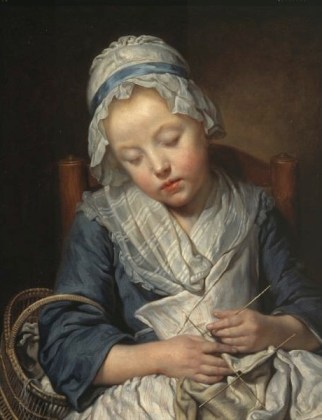
Young Knitter Asleep, Jean-Baptiste Greuze, ca. 1759. Huntington Museum, 78.20.8

At this time, needles are slender steel rods, not bamboo or wood or anodized aluminum (or plastic) we use today. Hand knitting is done in the round, as you can see in the hands of this sleepy young knitter. (Is it the repetitive nature of stockings that lulls these knitters to sleep?) For more in historical knitting, there’s Colleen Humphrey’s blog, Mara Riley’s website, as well as English sources. It’s not my thing–I’m able, but like these women, I cannot finish a stocking, though there are plenty of published patterns.

Aspirational Shopping

So, I always thought that window shopping was a product of the late 19th or early 20th century, the plate glass windows of the Bon Ton, and The Lady’s Paradise.

Providence Gazette and Country Journal, 4-18-1772

I was wrong.  Check out the last line in this ad from the Providence Gazette and Country Journal of April, 1772:

“Any Person not wanting to purchase, but having a Mind to see the greatest Pennyworths, shall be waited on with great Chearfulness, by their very humble Servant, PAUL ALLEN.”

In case we forget, the past is there to remind us that the consumer culture started much, much earlier than we think it did. Stop blaming Don Draper: I give you Paul Allen.