Animal Apples

apple-tree-056fb57ed927bf3668ef04e5b9850e99363b87fe-s6-c30The neighborhood where we live is part of the old rural past of our college town: it’s up the hill from the oldest settlement area, and slopes downhill to a plateau that runs out towards the other river, where the land drops precipitously. The house we live in was built in the 1920s, about the time of the junior high school and the stadium below us. The streets are named for the people who settled and farmed here, and two of the early houses remain, one frame and one stone.

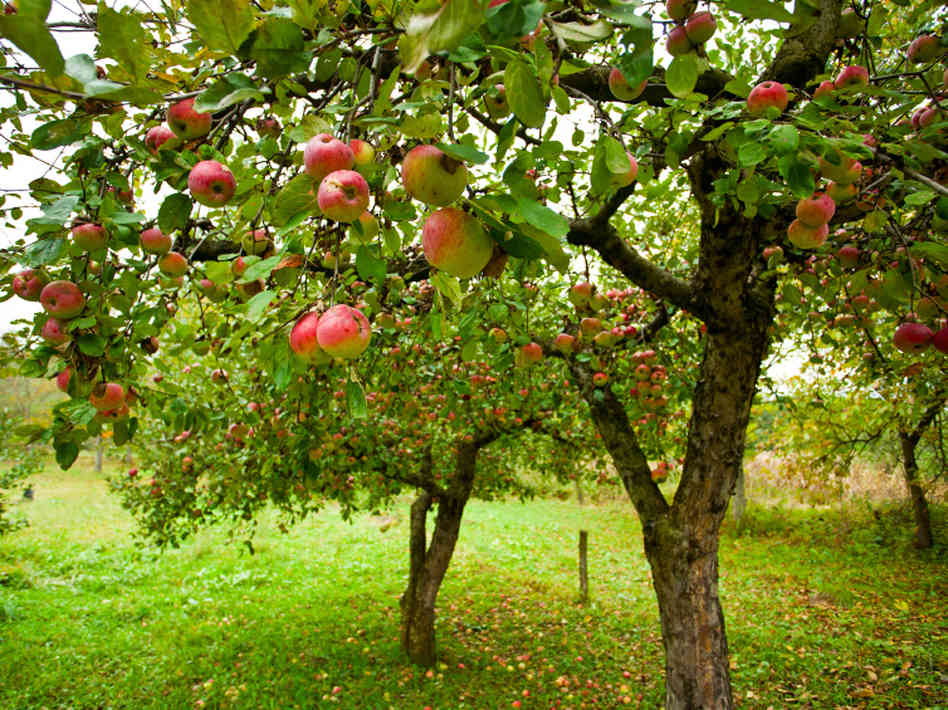
Even into the 1940s, there was a dairy farm in this area, and a milk wagon; paintings from the first quarter of the twentieth century show an orchard named for one of the settlers, and there’s possible physical evidence of an earlier existence: apple trees in the verge around the corner from us.

I don’t know if these are new trees or old, though apple trees can live a long time. Well established and productive, the apples look like Paula Reds, but then again, so do Devonshire Quarrendens. (Paulas are a 1968 apple introduction, based on McIntosh apples.) What I do know is that they’re early season and good for eating, though we don’t like to pick too many: it feels like stealing, though no one ever seems to picks them. Mr S finally heard why: they’re Animal Apples.

1-squirrel-apple

A man and his son were on bikes at the corner under the tree; the man told his son the apples were not for eating: “Those aren’t for people. Those are animal apples.

Those apples are delicious, and if it didn’t feel like stealing, I’d go up there with a basket. So many go to waste, and I suppose it’s because people have this “animal apple” idea.

There’s good foraging in the city, if you look, blackberries and raspberries in scrub ground, the apple trees, and the lettuce I let go to seed that flourished in the cracks of the walk down the side of our house. The idea that apples on a city tree aren’t for people  is sad. I ate mulberries off the tree in our yard in Chicago, where we grew rhubarb in the yard that fronted a busy street.

I don’t know what I find most disturbing about Animal Apples: the possibility that we’re so far removed from food that people can’t tell the difference between eating apples and ornamental apples, or that we’re so far from where our food originates that we fear anything that’s not assembled, processed, or obviously tamed and presented for our consumption.
What (Cheer) to Wear?

JBs HousekeeperIt’s 1800. Do you know what your housekeeper is doing? I don’t. Or, more accurately, I can’t decide.
I’m hung up on stays, and not wanting to make another pair. I’m indecisive about style, and though Mrs Garnett has her charms, it’s her bonnet I love more than anything.

Here’s what I’ve found, in servant-land:
18th-century-kitchen-servants-prepare-a-meal-jane-austen-cookbook-cover-page

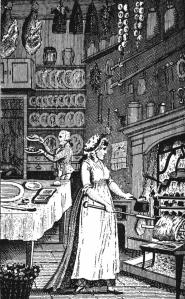
Note that this woman is, in the kitchen, wearing an open robe and quilted petticoat.The style of her bodice–which looks  like a cross-over bodice–and the train of the robe suggest the 1790s. Score one for style.

That open robe, where have I seen that before? Why, yes, Mr Sandby showed us that style for a nurserymaid. (It’s interesting, too, that both images show women with their hair quite visible under their caps, and not pulled up and out of sight.)
20130109-061710.jpg

Why does “robe stye” matter? Because I only found 3 and a quarter yards of a brown fabric I like, and even with the most careful cutting, that’s unlikely to make a full gown. However, I have some lightweight black wool that will make a decent petticoat. The bodice style is a bit of a stumper, though: the wool has good drape, so it might work for something other than the usual bodice I make. I did consider whether a very smooth, edge-to-edge, front-closing style of the 1780s would be more appropriate, but I think that I can move the bodice style forward, style-wise, and be correct.

138263

Brown gowns are a fine tradition in the sartorial habits of questionable servants. This young housemaid twirls her mop dry while wearing a brown gown over what could be a dark blue or a black quilted petticoat. The red “bandannoe” is a nice touch, though I don’t think I’ll wear one myself for this event.

In all this there is a compromise: using fabric I like, in a style I know I can make and document, perhaps even without having to make new stays. That would be ideal, because although it’s four weeks to the event, I’ll lose a week of sewing time to other commitments. Three weeks to pattern and hand sew a petticoat, gown, apron and cap seems just manageable.

You Wear What You Are

Part two of a series

Mrs Garnett, Housekeeper, oil on canvas by Thomas Barber. NTPL Ref. No. 42286
Mrs Garnett, Housekeeper, oil on canvas by Thomas Barber. NTPL Ref. No.
42286

I’m minding my own business checking out my friends’ business on Facebook, when Mrs Garnett appears on Joanna Waugh’s blog. Mrs Garnett had been rattling around in my head as “Wait, there’s that housekeeper painting, and she’s got, like, this great bonnet…” which is the art historical equivalent to an ear worm.

Yes, the Kedleston Hall housekeeper. A bit grand for Mr and Mrs Brown, if you compare a fine mansion in Providence to a English County House with a Collection and its Own Catalog, but not too grand if you compare John Brown’s House to Jeremiah Dexter’s, or Stephen Hopkins’.

We are talking about a man who asked his son-in-law to fetch back marble busts from Versailles, during the time of the French Revolution when the scent of blood was, literally, in the air. Mr Brown had pretensions.

This is tough to hang on to because I see that house every week and it is now so familiar that I don’t see it: it’s background. This is both good and dangerous: I need to hold on to the magic and mystery of the overwhelming high style decorative arts of the house, while also feeling ownership and pride in that house. The catch is that the meaning is so different to me now than it would have been to me then. Though to be honest, being a curator is not so different from being a housekeeper. Curator has its roots in the Latin “cura,” to care, and in that root lies the similarity of roles.

So I will care for the house, and care how I represent it: those are keys, I think, that, as Sharon Burnston says, point to a solid, sober-colored worsted. She referred me to the Francis Wheatley “Cries of London” series, which you may recall from earlier posts.

Again, it is hard to shake the familiarity with the street vendor/woman of the army/runaway apprentice chaser I am accustomed to being. But I think the solution to my desire for playfulness lies in thinking closer to 1800 in style, and in a contrasting petticoat. Also, a bonnet. You can never have too many bonnets.

But this is academic, in a way, until I get my fabric samples. I shall will myself to patience, and instead keep sewing the Wasmus Coat for Saratoga. Yes, I realize my idea of a brown gown and pale blue petticoat will replicate the contrast of the coat body and facings. But I do really love those coats!

You are What You Wear

Kyoto Costume Institute. Right: Robe a l'anglaise, 1790-95, England.
Kyoto Costume Institute. Right: Robe a l’anglaise, 1790-95, England. AC5065 85-3-1

(Part one of a series)
Or do you wear what you are?

Both statements seem true, but what I know is this: dressing for the October 5 event has me stymied.

I am stuck on fabric. Sharon Burnston’s advice last Saturday was very helpful: Think Ralph Earl. She’s right: Earl’s iconic images give you the shape and accessories of southeastern New England dress in the last decades of the 18th century.

The tricky part for me is that Earl’s portraits don’t show you the maid or the housekeeper.

The character I’m playing is interesting to me: she’s invisible but powerful, respectable but not refined, loyal but detached. We don’t need to get into my familiarity with any of these paradoxes, but this might be a comfortable discomfort. What could this have to do with fabric? A great deal, as it happens.

_JDK4293

The first thing I thought I should do was to figure out the “when and why” of my character’s style choices. After talking with Sharon, I thought I understood our characters’ relationship better, and at the very least, what her character would expect of mine. And let me tell you, it is much harder to imagine being a naughty maid when you like and respect your mistress!

But I like my work to be playful: authenticity does not preclude wit, and in the late 18th century, I would argue that authenticity, at some levels, requires wit. So, how does one visually signal respect for one’s employer and playfulness?

Good lord, when is she going to talk about fabric? Right now, that’s when!

With fabric, and with style and fit, that’s how you can signal the respectful/playful combination.

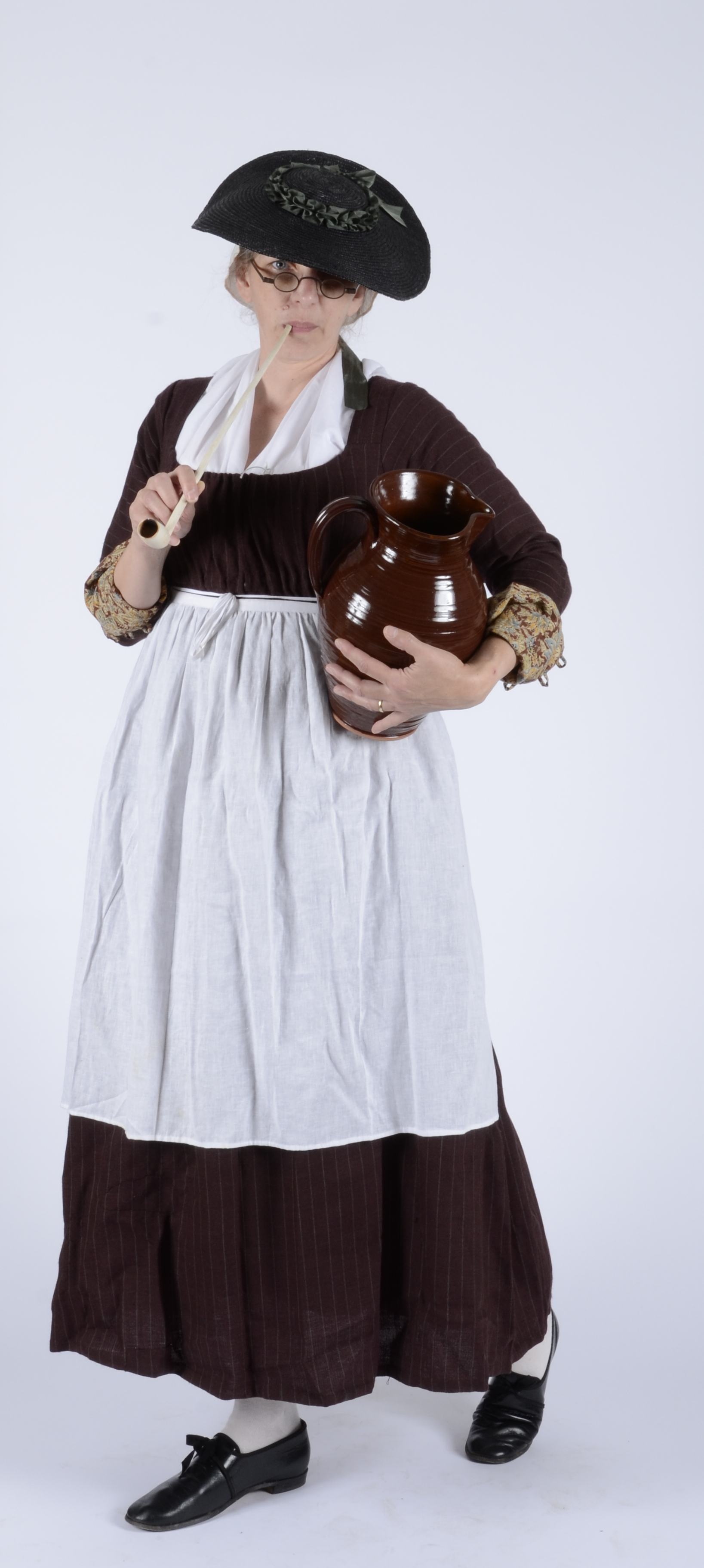
And fabric is where I’ve been stuck. The gown in the photo (aside from some interesting odors and a few unidentifiable splotches) is made of a sober and suitable wool fabric. The sleeves are partially lined with an Indian block print fabric to provide a non-itchy surface and a little contrast. But I think the gown’s style is a little forward for my character as I understand her in relationship to Sharon’s character. It was also made short for working at the farm, and needs a pressing.

Potential yellow linen petticoat with potential block print cotton round gown.

Still, an earlier style in a solid light-weight wool feels a little too sober to me. It feels more like the Fortnightly Dances, and less like me or my character. A possible compromise? Style like Ralph Earl, fabric like the KCI gown.

Thanks to the Strategic Fabric Reserve, I have some black cotton block print yardage and in looking for that, I rediscovered the yellow linen.

BLOCK-PRINTED COTTON British, ca. 1780–90. Cora Ginsburg.
BLOCK-PRINTED COTTON
British, ca. 1780–90. Cora Ginsburg.

Why this particular fabric? Aside from my whimsy and the KCI inspiration, dark grounds come into fashion in the late 1780s, and as a servant, I will lag a bit, style-wise. Could I have a cheaper version of the fabric at left (a child’s dress, 1780-1790, at Cora Ginsburg)? Barbara Johnson’s book at the V&A contains samples of dark ground prints from 1787 on; they’re different the vine-like print at left, but floral prints on black or dark brown are popular in these last decades.

I’m not committed to the black ground gown for this event. I’ve ordered swatches of Burnley & Trowbridge’s new light-weight wools, and we’ll see. Color and hand could convince me, and I can always line the lower part of the sleeves with a cotton print.