What would you carry?

The V&A’s extensive article includes many hints about what might be in woman’s pockets.
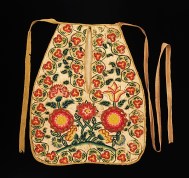
Pocket ca. 1784, American cotton, wool Brooklyn Museum Costume Collection at The Metropolitan Museum of Art,  Gift of the Brooklyn Museum, 2009; Bequest of Marie Bernice Bitzer, by exchange, 1996  MMA 2009.300.2241
Pocket
ca. 1784, American
cotton, wool
Brooklyn Museum Costume Collection at The Metropolitan Museum of Art,
Gift of the Brooklyn Museum, 2009; Bequest of Marie Bernice Bitzer, by exchange, 1996
MMA 2009.300.2241

Sharon Burnston, on the Historic New England site, points out that “Pockets thus represent the kind of dilemma that objects of material culture can present to scholars. Much is known about how and when these items were made, but evidence of how they were used remains fragmentary and tantalizing.”

Fragmentary and tantalizing indeed!
Another scholar posits that “Pockets empowered women in many ways: they allowed them to carry possessions around with them for practical and personal uses, and gave them rights of ownership and privacy. I argue that decorative pockets also heightened women’s self-esteem by making them to feel more attractive – and that they esteemed their pockets in return.

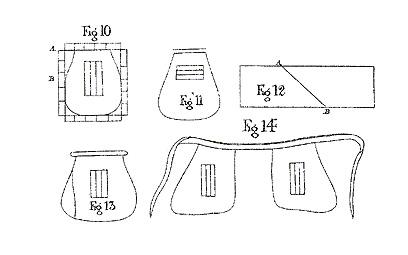
From the Workwoman’s Guide

As we can see from this diagram from the Workwoman’s Guide, pockets could take many shapes, and the extant evidence bears this out. There are oblong pockets, and more rectangular pockets, rounder pockets, longer and shorter and wider pockets. One suited one’s self, and cut one’s pattern to one’s cloth.

The identification of pockets with self, with intimacy and privacy, is explored in Women’s Pockets and the Construction of Privacy in the Long Eighteenth Century, by Ariane Fennetaux.
Fennetaux’ article and the V&A page on pockets were particularly useful in enumerating more specific kinds of items that might be carried in an 18th century woman’s pocket.

Nutmeg grater ca. 1690, British Cowrie shell, silver Gift of Irwin Untermyer, 1968 MMA 68.141.278
Nutmeg grater
ca. 1690, British
Cowrie shell, silver
Gift of Irwin Untermyer, 1968
MMA 68.141.278

Using cases from the Old Bailey, we can begin to draft possible contents lists.

A pair of silver buttons
A pair of buckles
A pen knife
Thimble
Coins
A silver spoon
A pair of scissors
Keys
Needlecase
Biscuit
Nutmeg and grater
Smelling bottle
An orange or an apple
A pocketbook
Comb
Snuff box
Jewellery
Needlebook
Pocketbook
Paper
Pen or pencil

When Pamela runs away, she takes with her, in her pocket, two handkerchiefs, two caps and five or six shillings.

Of all the listed things, what might Bridget have carried? Some of the things she carried would be needed, but others would be wanted.

Any old Shirts?

DSC_0041
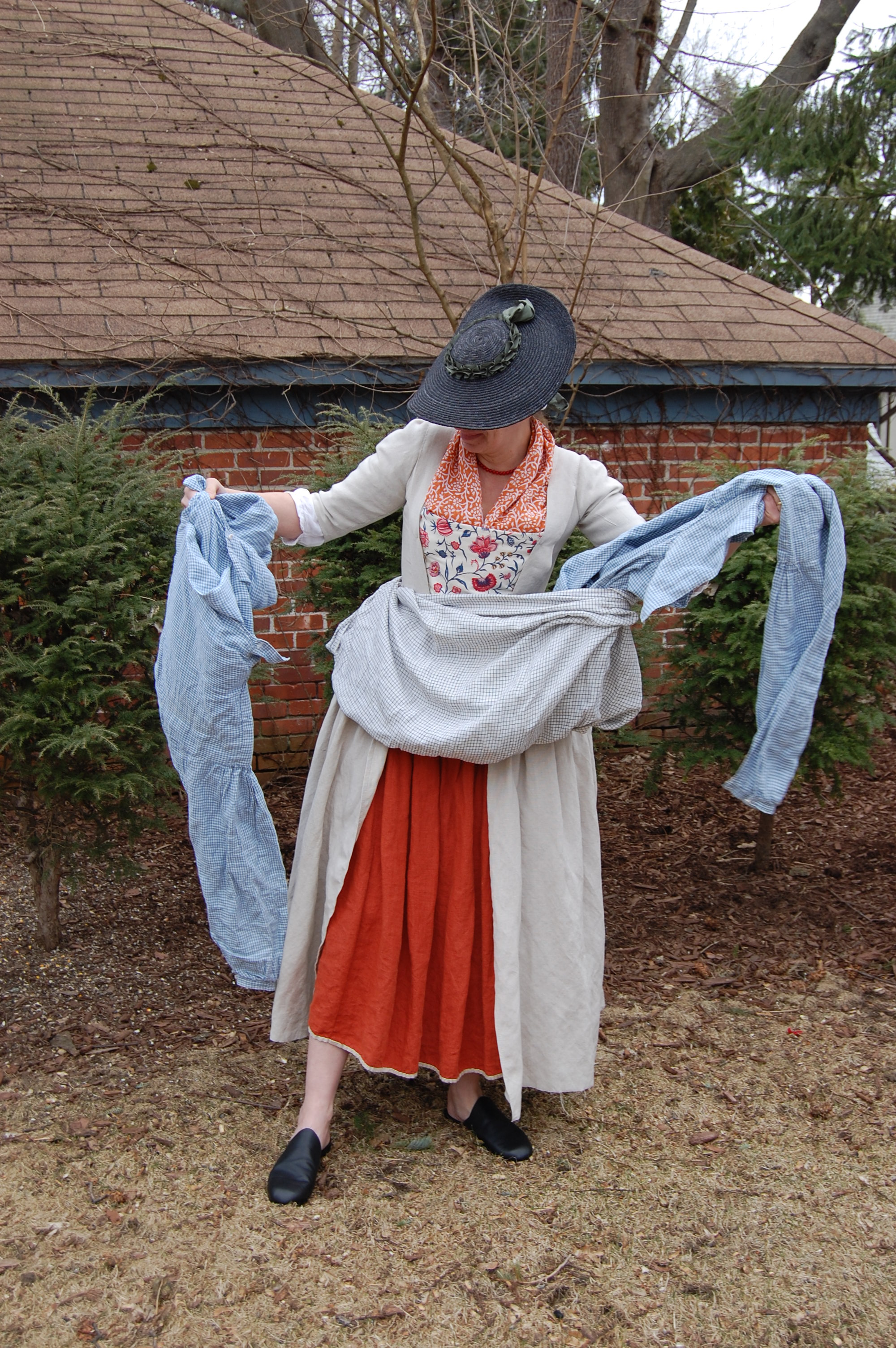
The photos people have of the Millinery Conference at Williamsburg– well, they’re a little envy-inducing. All the silks gowns on such a beautiful site are a little overwhelming if you like historic costumes, but if I was all about silk gowns it might be harder to do what I am doing.

I did discover a fool-proof way to unnerve the teenager in the living history household. If you get dressed in your 18th-century clothing early enough on a Sunday morning, the child will ask, “Um, Mom? Are you just fitting, or do we have an event?” You get one glorious moment to decide whether or not to torture the child before he figures out that even you are not crazy enough to go to an event in March without stockings.

Bridget’s gown is done, but for the hem, which is turned up and about a quarter sewn. I tried it on yesterday to make sure it fit. I threw most caution to the wind and made up the new Golden Scissors English Gown pattern without making  a muslin because I’d checked my own self-fitted pattern pieces to the English Gown pieces and found them nearly identical. Anything likely to need work– shoulder straps– I knew could be done in the lining and not matter terrifically.

Why, you ask, did I bother with a new pattern? In part because my own has migrated (my backs have been trending too wide of late) and because I needed a solid, step-by-step guide to more correct assembly. The sleeve pleats still annoy me, mostly because they get done on a dress form and not on me, but they allow movement and that really counts. DSC_0047

The stomacher front style is a compromise: I want to be able to wear this at events earlier than 1782, so I’m working on the assumption that Bridget didn’t migrate to the more fashionable center-front closing style in the 1780s because she couldn’t.

The accessories are chosen because they were affordable ways to upgrade appearance: it takes hardly any chintz for a stomacher, and a handkerchief is bright but small. The hat is more common than a bonnet among working women, and the mules were chosen because they appear in an engraving of a crippled soldier and his family. All Sandby’s women wear heeled and buckled shoes in styles not to be found ready-made in my size, so  mules are my compromise.

I still think Bridget looks too clean and too pretty, but until I find fabric I like for a bedgown, this will have to do. The details, should you care for them:

Hat, Burnley and Trowbridge, lined with a Wm Booth remnant, trimmed with B&T ribbon. My hair is out up with straight pins from Dobyns & Martin, and under the hat in a lappet cap with the strings tied on top of my head.

The coral necklace is from In the Long Run, I’ll replace the grey poly ribbon with black silk ribbon once it’s in from Wm Booth.

The neckerchief is from B&T, again, and selected because the pattern was similar to the one worn by the young woman in the Domestick Employment: Washing print.

DSC_0051The gown fabric is from the second floor discount loft at the Lorraine mill store in Pawtucket. It’s 100% cotton, yes, it really does flame, and I’ll just have to be careful. (The women who cook in cotton at OSV are probably vastly more graceful than I, and do not fall into things.) It’s a light brown and white tiny check weave, and looks a great deal like a homespun gingham. I chose it because it tends to wrinkle badly and should show the dirt well: in short, I chose it because I don’t expect it to wear particularly well.

The petticoat is from the last of some ‘madder’ linen Burnley & Trowbridge had a few years ago, and the mules are from them; I think the apron linen was, too, but I can’t remember.

Those shirts are blue and white check from Wm Booth, and I have no idea how they got into my apron. Stop asking, or I’ll get my stick.

Open to Interpretation

Interpretation: I’ve been thinking about it a lot lately, reducing it to basics. Beverly Serrel challenges exhibit designers to articulate the one Big Idea about their work; one sentence that describes what your exhibition is about. I’ve been thinking about the Big Ideas for some upcoming exhibitions and programs at work, and in my personal work.

Some seem easy: Slavery in Rhode Island: Everyone was involved, everyone is connected. Slavery is part of our shared past. We are all part of the web of complicity. (Pick one, they’re all related.)

For the house museum, and the living history day at the house museum, it’s a little more complicated. We tried an involved story line last year and it didn’t seem to matter to visitors who were mostly intrigued by watching pretty costumes in a pretty house.

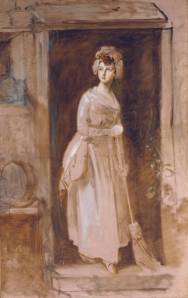
Thomas Gainsborough, The Housemaid. 1782-86. Tate Museum, Presented by Rosalind, Countess of Carlisle 1913, N02928

What I’ve settled on for now is a crude variation of “it takes a village,” in that a complex web of food and support networks was necessary to sustain an elegant 18th century mansion. (Our theme this year is Rhode Island Seascape and Landscapes, AKA Surf & Turf.) I begin to imagine diagrams that support that theory: small holding farmers and dairymen and fishermen who sold supplies to the wealthy, the merchants importing goods, the sailors and captains and shipbuilders needed to bring the barrels of china, boxes of sweets and tea and nankeens back to Rhode Island to support the scenes of elegant perched at the very top of the social pyramid.

Then I come to my personal interpretation and Bridget Connor. What is that story about? A Bridget with a troubled past and nothing left to lose? Poor women struggled to survive in an unstable war economy? Or simply that not everyone in the Revolution was a hero?

The Shurts off there Backs

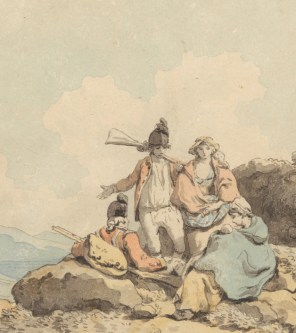
Francis Wheatley, 1747-1801, British, Soldiers and Country Women, undated, Pen and black ink with watercolor on medium, smooth, cream wove paper, Yale Center for British Art, Paul Mellon Collection

Among the things I wondered about Bridget Connor and her court martial was from whom she’d bought that “publick shurt.” Why would a soldier have an extra shirt, or be willing to sell an extra shirt?

There are some circumstances in which it is plausible.

ClothingRegs1776_77

While shirts could have been sent from home,  regulations established in 1777 called for soldiers be issued two shirts, or an equivalent bounty. A soldier who wanted cash for alcohol or other non-regulation and non-issued goods or services might sell his second shirt, or steal a shirt to sell.

With the context of what soldiers should have been issued, we can  begin to tease the story out of the orderly books.

Regimental Orders July 15th 1782

At a Court Martial whereof Capt Dean was pre
sident, was tried Paul Pendexter & Titus Tuttel
soldiers in the 6th Company 10th Massachusetts Regt
For Stealing a Shurt and Disposing of the Same
ware Both found Guilty and Sentancd to Sixty Lashes
on there Naked Backs—the Colo approves
the opinion of the Court and orders it to
take this Evening and the prisoners to Return
to Duty——-The Court Martial of
which Capt Dean is president is Desolvd

The quote above is a full seven days before Bridget appears at her own Regimental Court Martial “for purchasing a publick Shurt from a Soldier.”

Paul Pendexter and Titus Tuttel were just the guys to get caught, until Bridget was discovered. It does make me wonder if there was an extensive ring for black market shirts (and where did they go once Bridget had them? Did she try to sell them back into the public stores, i.e. the quartermaster)?

Criminal masterminds these people weren’t, but it does seem possible that the Shirt Ring was fairly busy before it was collared.