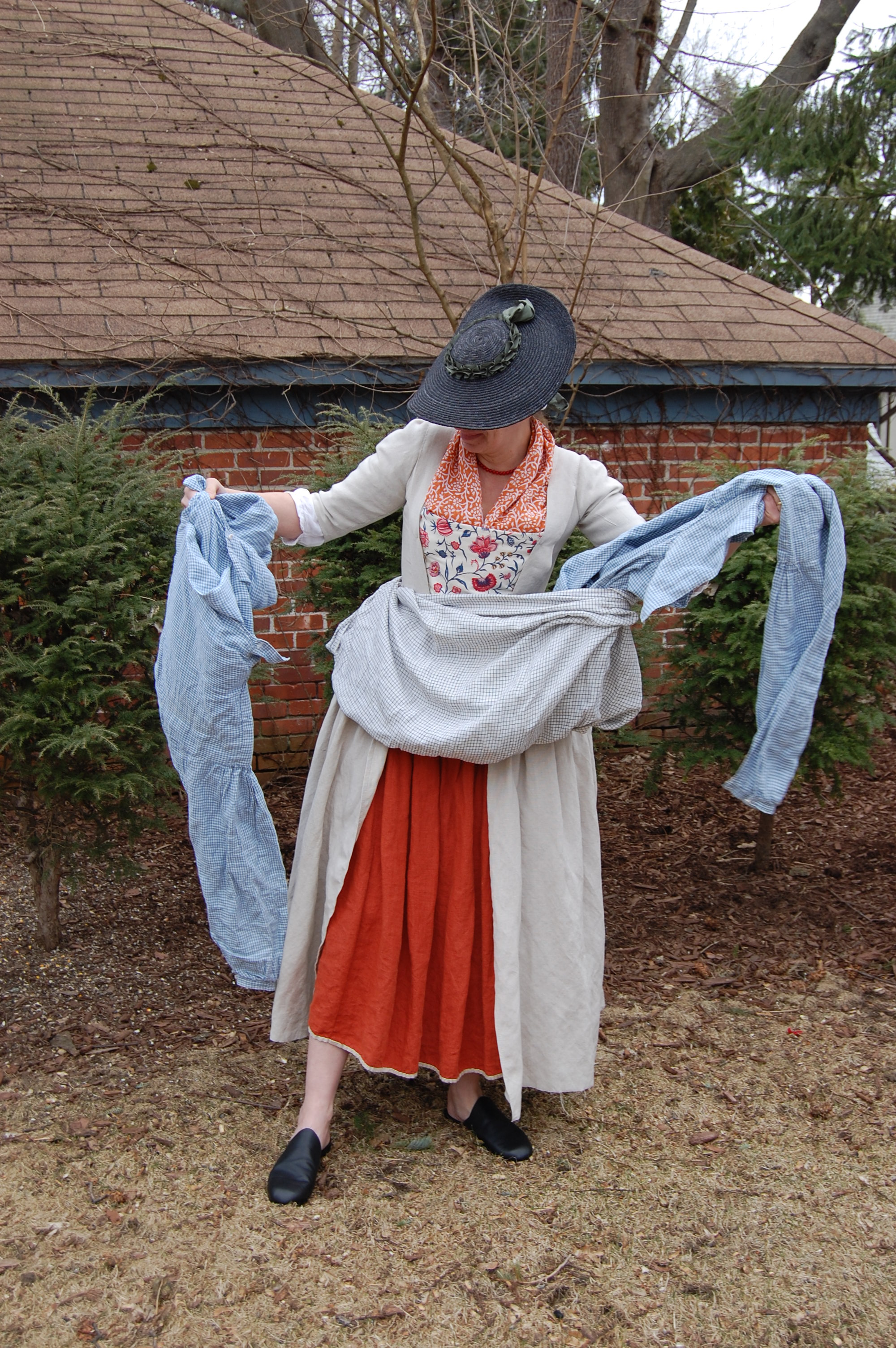
On Saturday morning, I gave a presentation at the BAR School of Instruction on Interpretation. The slides are above, and the presentation (with my notes) is here.
The handouts and bibliography I used in thinking about Bridget Connor an be found on the Interpretation 101 page.
This weekend, we’ll be at the Brigade of the American Revolution’s School of Instruction, taking anxiety to the Hudson Highlands as I give a presentation on interpretation. Sure, it’s part of my day job to interpret objects and documents and even, sometimes, to do costumed interpretation, but experience has never prevented me from worrying. It has allowed me to focus my worries more productively and specifically. One of the things we’ll be trying, or attempting to try, are vignettes based on the shirt-stealing and selling ring of 1782.
Soldiers Steal a Shirt and dispose of same (~July 13-14, 1782)*
Cast: Two soldiers, officer who catches them
Props: shirts
Court-Martial July 15, 1782: Paul Poindexter and Titus Tuttle, for theft of a shirt
Cast: Two soldiers, accusing officer, three officers of the court
Props: Shirt; table and seats, orderly book (optional)
Discovered buying a shirt (~July 21-22, 1782)*
Cast: Bridget, soldier selling shirt, officer who catches them
Props: Shirt(s), money
Court-Martial July 23, 1782: Bridget tried for buying a ‘publick shirt’
Cast: Bridget, accusing officer, three officers of the court
Props: Shirt & money; table and seats, orderly book (optional)
Insolence to Officers of the 10th Mass (~July 23-24, 1782)*
Cast: Bridget, officers (two preferable, one adequate)
Props: None required, large stick probably handy
Court-Martial July 25, 1782: Bridget tried for insolence
Cast: Bridget, accusing officer, three officers of the court
Props: Table and seats, orderly book (optional)
Expelled from camp, July 25, 1782*
Cast: Bridget, drummer, officer(s), jeering onlookers; Francis skulking at the edge
Props: Drum, Bridget’s chattel
* Events are extrapolated from the Orderly Book as things that must have happened to cause the events that followed.
We’ll see…in the meantime, I’m finishing up a shirt for the Young Mr, so that his small clothes will no longer be too-small clothes, and so we have extra shirts for this black market ring.
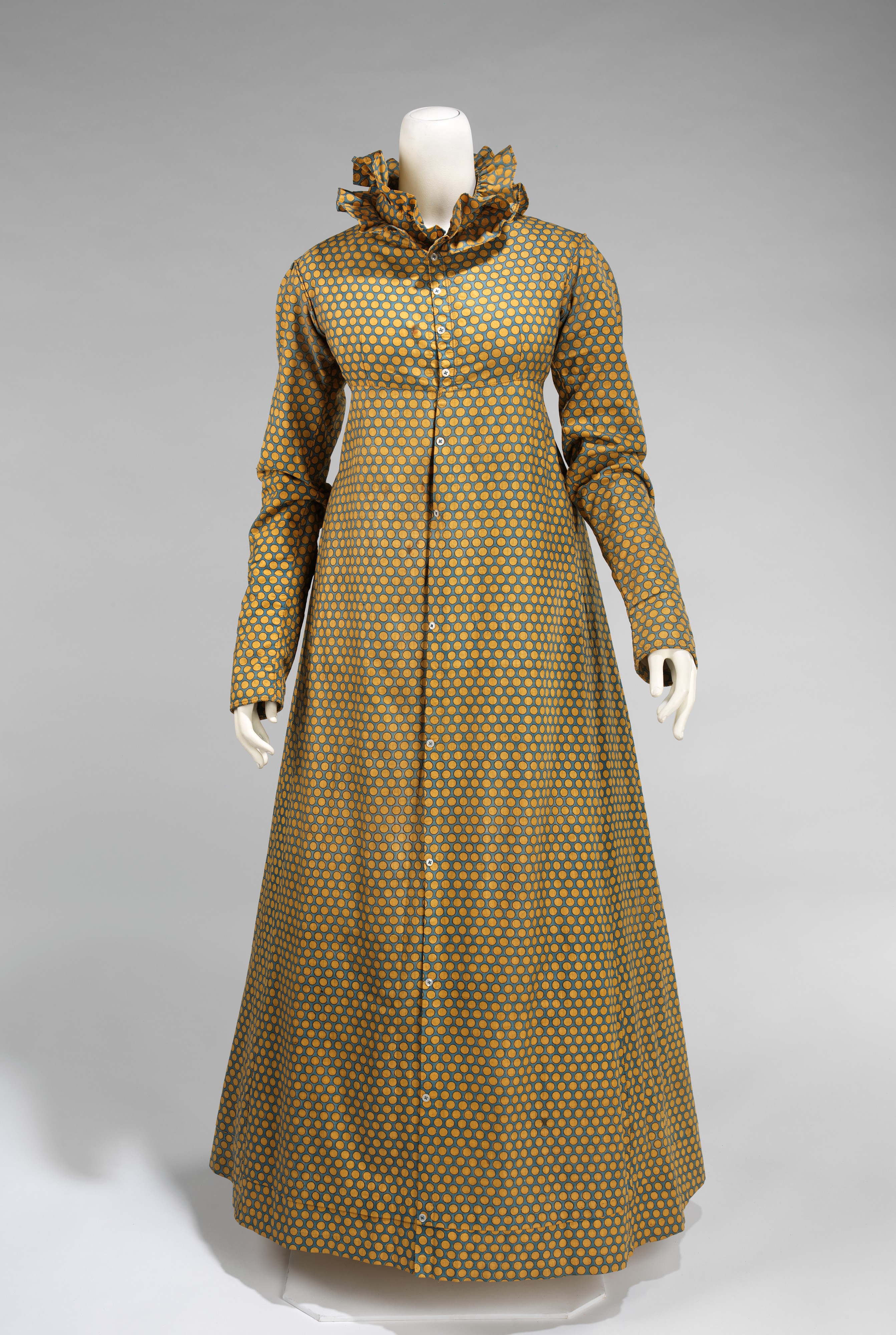
Dress Date: ca. 1815 Culture: American Medium: cotton Dimensions: Length at CB: 54 in. (137.2 cm) Credit Line: Brooklyn Museum Costume Collection at The Metropolitan Museum of Art, Gift of the Brooklyn Museum, 2009; Gift of Florence Inniss, 1970 Accession Number: 2009.300.943
In typical museum fashion, whilst looking for something else, I found something I didn’t know I wanted.
I’ve been asked to portray an 1812 milliner in Salem this coming August (which feels like next year but will soon be Ohmygoodness that’s TOMORROW) so I’ve been getting a start on images of bonnets and hats and gowns and things because you know I’ll have to have something new. Have to. And there at the Met was this garment, unassuming and bronze-looking in the thumbnail of catalog hits and ever so much more so when you get up close.
I recommend getting quite close to really appreciate the print. I’m pretty sure I’ve seen something similar in the quilting cottons, Amy Butler or Kaffe Fasset, and of course I’m tempted. Wouldn’t you be? How often do you get to mix historic costumes and Op-Art?
John André’s self-portrait, 1780. George Dudley Seymour Papers, Manuscripts and Archives, Sterling Memorial Library, Yale University
Like all the other history-obsessed Rev War reenactors with basic cable, Mr S and I have been watching ‘Turn’ on AMC, and like some other reenactors, I’ve been lurking on the fringes of the Facebook feeds trashing the show, but hoping a contrarian view would be possible, just to keep things interesting.
So we watched last night with the best intentions: I would not think about shoulder seams, drawstring-neck shifts, circular caps, obvious mascara, white linen shirts on farmers, shirts with neck bands but not collars, a lilac silk cloak on a farmers’ wife, the amazing amount of light candles throw, beards on smugglers who look like they escaped from a spaghetti western… Mr S has learned to live with this and I have learned to keep quieter. He learns best visually, so he really had hopes for this show. I think we all did, even given what we know Hollywood does to historical realities.
Mr S keeps asking, “Where’s the war? Where are the soldiers?”
I keep asking, “Why is Tallmadge allowed to be on his own for so long, and what the heck is wrong with his uniform facings? And he’s a dragoon, where the heck is his horse?”
The low shoulder seams on Woodhull’s leather(?) jacket still make me nuts, though I think Anna serving in the tavern in a pristine white apron over a cranberry silk button-front gown really took the cake last night, costume-wise.
The dialogue howler I enjoyed the most (i.e. caused the final outburst) was Major Andre and his “player” girlfriend who is so not pumping him for information (horrid pun intentionally retained).
If you were the suave Major, you would respond with complete candor to the charming (mascara-eyelashed, obvious foundation-wearing, look out for the lip-gloss) woman’s question: “You will tell me where you’re going on your next secret mission, won’t you?” “Why, sweetie, yes, and let me use my time machine to bring you the Enigma machine and a smallpox vaccination.”
I expect and grudgingly tolerate:
Bad costuming
Odd set dressing (highly suspicious table in the church-stable; suspect it would be happier in Amistad)
The incredible candlepower of candles
Non-18th century speech rhythms
Changes to actual events for increased drama
But patently absurd, asinine dialogue on top of all that goes beyond my patience.
I should give it up: Two Advil PM at 8 and I’ll no longer spend an hour every Sunday night performing mental alterations on TV costumes. (Those shoulder seams really annoy me, and could someone try pressing the facings?)
But no; next week, Fort Lee should fall and chances are good Mr S will lead the screen-shouting…


 Kirsten Hammerstrom
You must be logged in to post a comment.