A Whale-Safe Bonnet

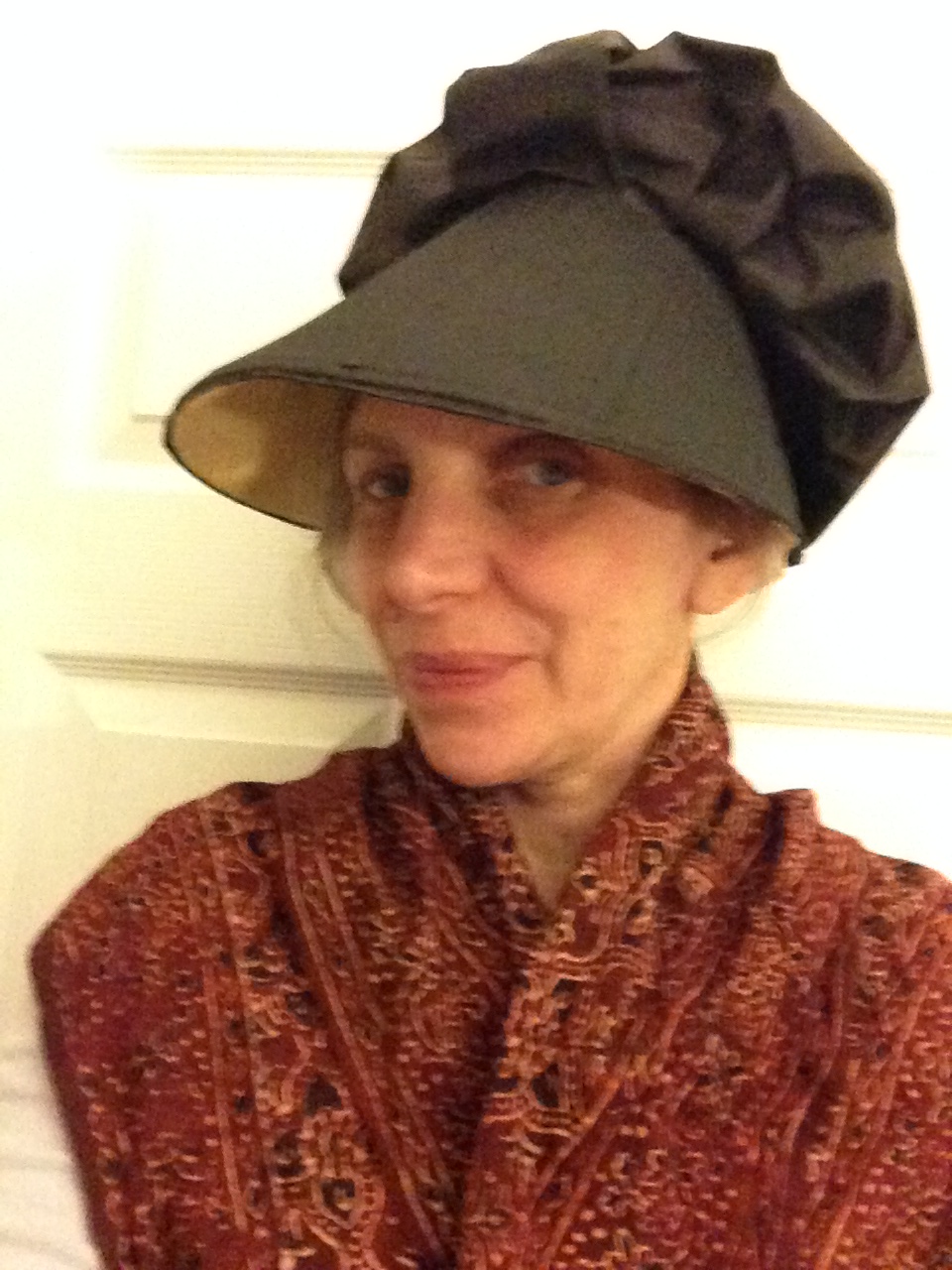
Complete with my interpretation of "Hat Face"
Complete with my interpretation of “Hat Face”

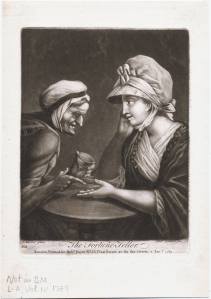
As promised, my interpretation of the ribbed bonnet in the 1789 engraving. There are a few problems with this beyond the model. (Which is not to say that I don’t like this bonnet– I do!)

I used the Kannik’s Korner bonnet pattern (view F, I think) as the basis for this because I already had a brim, lining, and caul cut and in a drawer. Given my current medicated state, using something pre-cut seemed advisable. That means I didn’t play with the brim to create the line of the Williamsburg bonnet, or the curve of the brim in the “Fortune Teller” engraving.
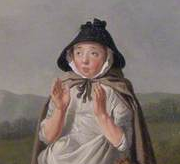
Detail, The Marquis of Grandby

Is this style acceptable for the period I typically interpret (1775-1783)? Well… there are other examples of the lampshade-style bonnet, as in the Edward Penny painting of the Marquis of Granby. This painting is dated “after 1765” so there’s some room for interpretation there…too much room. But if that’s 1765-1770, and the “Fortune Teller” is 1789, I think we have comfortably covered the 1775-1783 time frame, even if it is a bit like a queen-sized blanket on a twin bed.
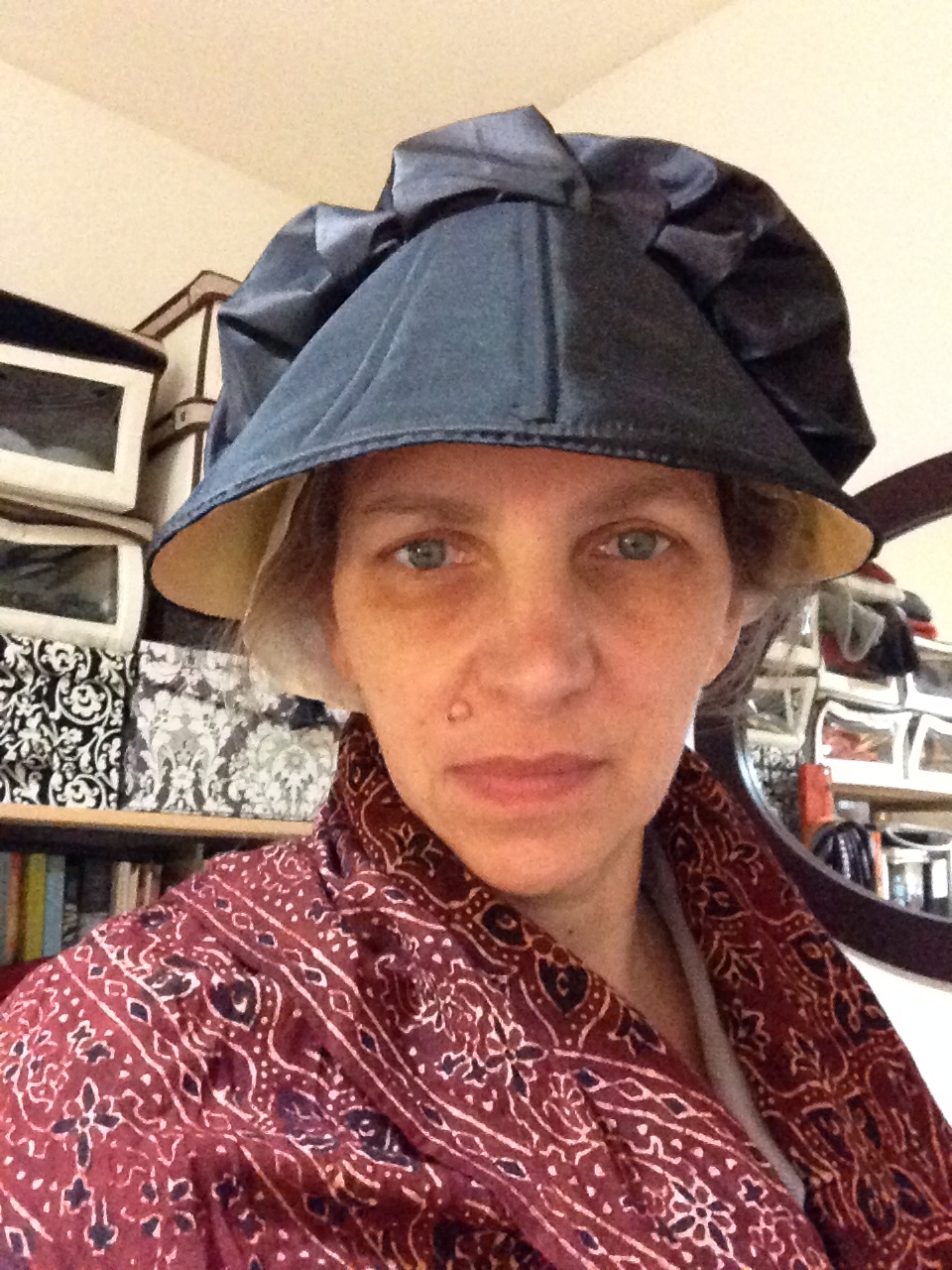
Front view: more lamp-shade like.

As you can see, the bonnet does have some lamp-shade-like tendencies on my head, which I consider a benefit. I like the way the ribs are visible, even if I remain unconvinced by the caning. I think it’s a little too wide, and lacks resiliency, though to be honest, I have only felt baleen at the New Bedford Whaling Museum, where there is a large sample on the second floor.

To compensate for the disappointing cane in the brim, I slipped a piece of millinery wire into the pocket underneath the cane. The layers in the brim are:

  • black taffeta
  • horsehair canvas
  • linen buckram
  • yellow taffeta

The channels are all hand-sewn, and then the cane was slipped in. I stitched the black taffeta caul to the first three layers, and then lapped the yellow taffeta over the raw edges and stitched it down to finish the brim/caul seam.

No, I didn’t take any in-process pictures…probably because this took considerable snake-eyed concentration last weekend. IMG_1477 IMG_1476

Usually, I line the cauls of my bonnets, but through shear laziness or distraction, I opted not to this time, and I think I’ll leave it this way for a while. You will also note that I have not trimmed this: I have some black silk ribbon coming, and I may try that. I don’t have enough black taffeta left to cut self-fabric ties, and there do seem to be some plain examples. A plainer, lamp-shade-like bonnet may be just the ticket for Bridget.

What would I do differently? Next time I would definitely play with the brim shape using a paper template. I’d like a lower, curvier, brim. Once I had the shape worked out in paper, I would use that as a template to cut the taffeta and horsehair or light buckram layers.

The Edenton Tea Party

I’d also try zip ties. I know: not period correct! But short of risking federal prosecution resulting from a trip to New Bedford with some shears, I’m not sure that anything other than plastic will have the resiliency and spring that baleen has, and that made these bonnets so special. I thought of them while making this bonnet, but I think Mr S used them all at work in the past two months. A Facebook friend has been thinking of zip ties, though, and has a hankering for one of these bonnets. I can’t say that I blame her– and honestly, I think I might join her.
Hat Face

The Fortune Teller, 1789. Lewis Walpole Librray. 789.1.2.1

I like hats; I think it’s been made clear here before that I have a bit of a bonnet problem. As it stands, I have something in the neighborhood of a dozen bonnets, and really need to get my Etsy store up and running…

But as in life as in the Richard Scarry story, there’s always room for one more, and more to learn, so my collection hasn’t stopped me. I blame my Grandmother Elsa, who owned a dress shop, collected shoes, and had a particular face for trying on hats.

Black silk bonnet, 1770*1780. Colonial Williamsburg 1993*335

I’ve been thinking about bonnets because I lately came across some engravings showing what might be called baleen bonnets. At left above, a bonnet that is clearly reminiscent of the bonnet in the Colonial Williamsburg collection on the right. The CW bonnet (1993-335) has seven baleen bones, and a baleen rib around the bonnet brim.

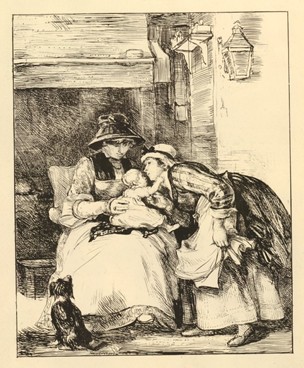
It is strikingly similar to the bonnet in the 1789 engraving, down to the decoration. In “Kissing the Baby,” a lithograph in the collection of the British Museum, the older woman appears to be wearing a ribbed black bonnet in the style my friend calls “lampshade,” and that others call “bucket.”

Kissing the Child. Lithograph by David Wilkie, 1800-1841. British Museum, 1852,1211.134

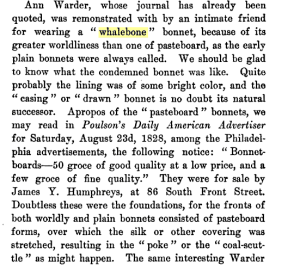
There are more bucket or lamp-shade-like bonnets depicted in engravings and paintings, and it is possible that flamboyant style was the one that got Ann Warder in trouble in 1788. I remembered this passage on page 223 of Amelia Mott Gummere’s book, The Quaker, A Study in Costume,:whalebone quote

Whalebone bonnet? Interesting… so, having an interest but no whalebone, I send the Young Mr to the basement for the remaining stock of caning I’d used for stays, and came up with a plan to replicate a “whalebone” bonnet, which I will describe and show you next time!

Frivolous Friday: Fashionable Reading

Anna Maria von Phul’s delicate watercolors of Saint Louis in 1818 (example at left) remind us that cities in the hinterland of America have never been as far behind the times as coastal dwellers might imagine. As a former resident of the Great Fly Over, I know how defensive people can be about their relative sophistication, and that could be why our Young Lady here appears slightly defensive in her posture.

The young lady is certainly fashionable in that white gown, and literate, too, though we cannot see what she is reading; perhaps Maria Edgeworth.

It took some doing to find a similarly posed and dated fashion plate with a book, for fashion has always been more fantasy than reality.

The HFF: Historical Food Fortnightly

2f053ddd402318588e6c094c0ec0e6b4Every now and again Facebook proves itself useful: without following Dobyns & Martin Grocers, I would not have known about this interesting cook-along, the Historical Food Fortnightly.

The challenges look interesting, and I particularly like the seasonal fruit/vegetable one. This seems like a wonderful chance to cook historical recipes using seasonal, local ingredients, and I do like to remind people that historical eating is grounded in seasonal, local, eating. Plus pounds of raisins and sugar and gallons of alcohol.

Your local historical archive (or whichever one contains the works relevant to your interests) can be a great place to get started assembling documentation on local eating. Receipts for foodstuffs can be mixed into other accounts (cotton for your daughter, a parasol, a pair of shoes for your wife, 5/8 yard pink silk satin self) but you can still quantify tea, sugar, spices, Madeira, and flours. I find fresh produce somewhat harder to track–you won’t count what is growing behind your house– but fear not, New Englanders! Some of that hard work has been done for you.

A bill of fare for August

J.L. Bell of the fantastic Boston 1775 blog wrote the book-length historic resource study General George Washington’s Headquarters and Home—Cambridge, Massachusetts, which I read before we went up to the “Washington Takes Command” event last July. (That sentence just seemed crazy, even to me…yes, I read 650 pages plus the event program to prepare for a 6-hour event…)

The report can be downloaded as a PDF, and if you’re looking for food, where you want to go is Chapter 6, Daily Life at Washington’s Headquarters (page 173 and following). On pages 195-197 the Steward’s Purchases are listed, sorted by Fruits, Vegetables and Grain, Spices and Flavorings, etc.

While Washington was maintaining (or causing to have maintained for him) a Genteel Household, the list of purchases is helpful in documenting the variety and types of foods available in Cambridge. I suspect that similar kinds of documentation exist in the historic resource reports or room use studies for places like Gunston Hall.

I cannot manage to keep up with the Historical Sew Fortnightly right now– things went pear-shaped in December— but we have to eat, historically or otherwise!