History is Not a Competition

IMG_1583
Drilling by the Sergeant

Saturday was my first post-operative foray into costumed interpretation, up to Paul Revere House on Flag Day. This went much better than my first attempt at Paul Revere House, which ended in ignominy as I missed the train. In April, I managed to convince Mr S to drive in Boston, which he usually refuses to do (in fact, he nearly abandoned me once at the Old State House one Saturday after a miserable drive that had us stuck in the Downtown Crossing vortex).

I’m so glad we managed this, Despite anticipatory near-tears and epic pouting by the Young Mr, we managed to have a rather nice time.
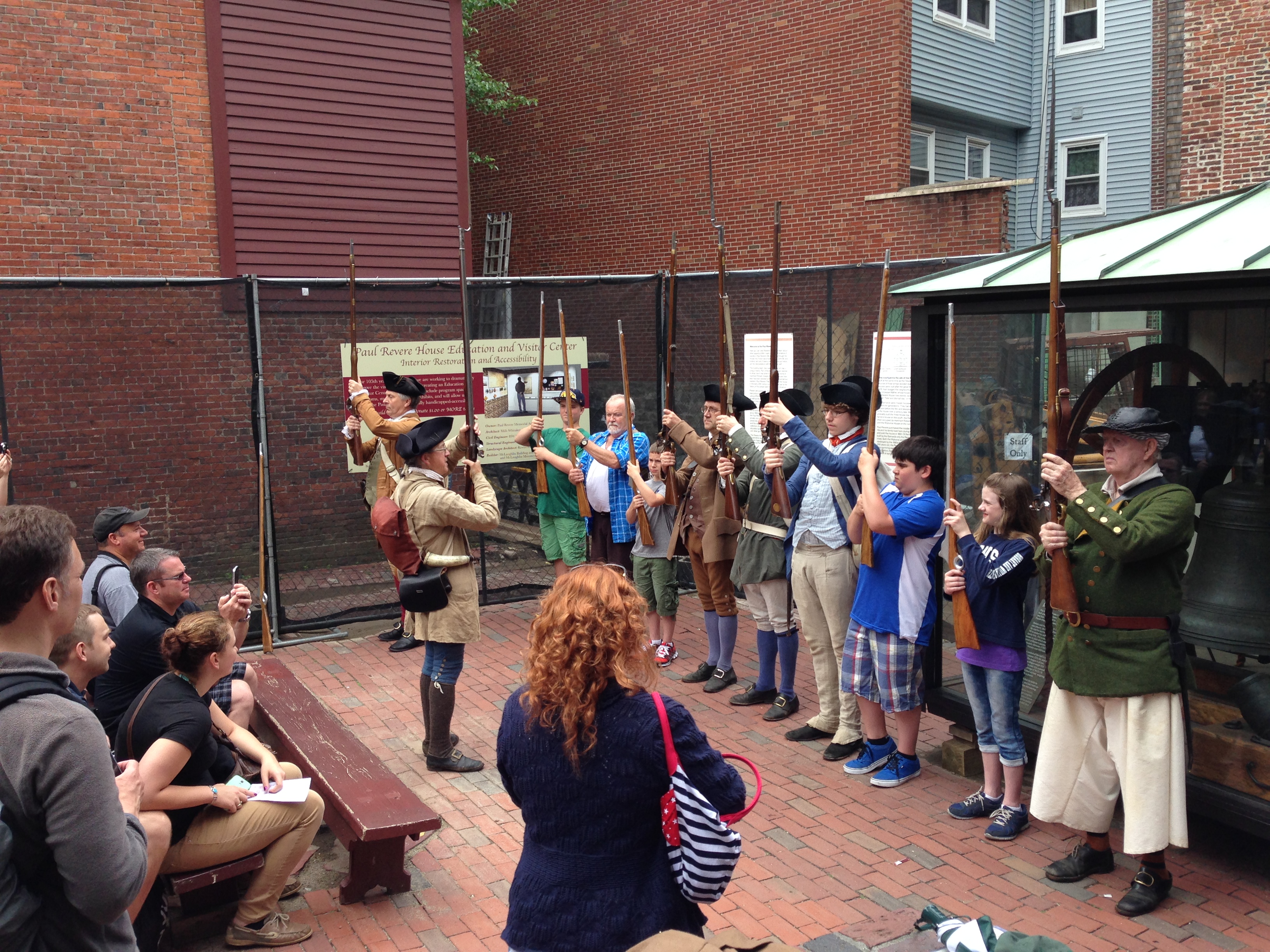
Poise, with extra elevation by the Young Mr

We were in the courtyard, and Mr HC and Mr FC told the story of Amasa Soper’s company and its members several times to the streams of tourists. They solicited recruits and ran them through the 1764 drill using the nicest wooden muskets I’ve ever seen, though with mixed results. Some new volunteers held their muskets backwards, and the Young Mr’s ramrod got stuck in the barrel, though that is a known issue with that particular musket.

I sat on my ladder-back chair near the house and made the tiniest hems I could on Mr S’s next shirt, which will be for best. People asked about the sewing and my clothes, and I had a chance to talk about what women wore, typical fabrics and fibres, supplying the army, and who made what.

The day was warm, but fortunately not overwhelming, and as a museum person, I found the crowd quite interesting. This is a facet of Boston I don’t usually see: the tourist experience.

In one memorable moment, a pair of young women stood just outside the door to the house.
Young Woman Number One: “Is this really his house?”
Young Woman Number Two: “Yes, this is where Paul Revere lived.”
YWNO: “Oh, my God! I’m so excited! This is so neat!”
Kitty Calash: <eats heart out with jealousy> “Why can’t my museum do that?”

The celebrity factor of Paul Revere is undeniable. There were tourists with guide sheets in Chinese, and tourists who made me wish I still remembered my college German. Some seemed to be hitting every Boston landmark they could in one day, carrying white cardboard pastry boxes; some seemed to be going more slowly, looking, and trying to figure out what they were seeing, and what it meant.
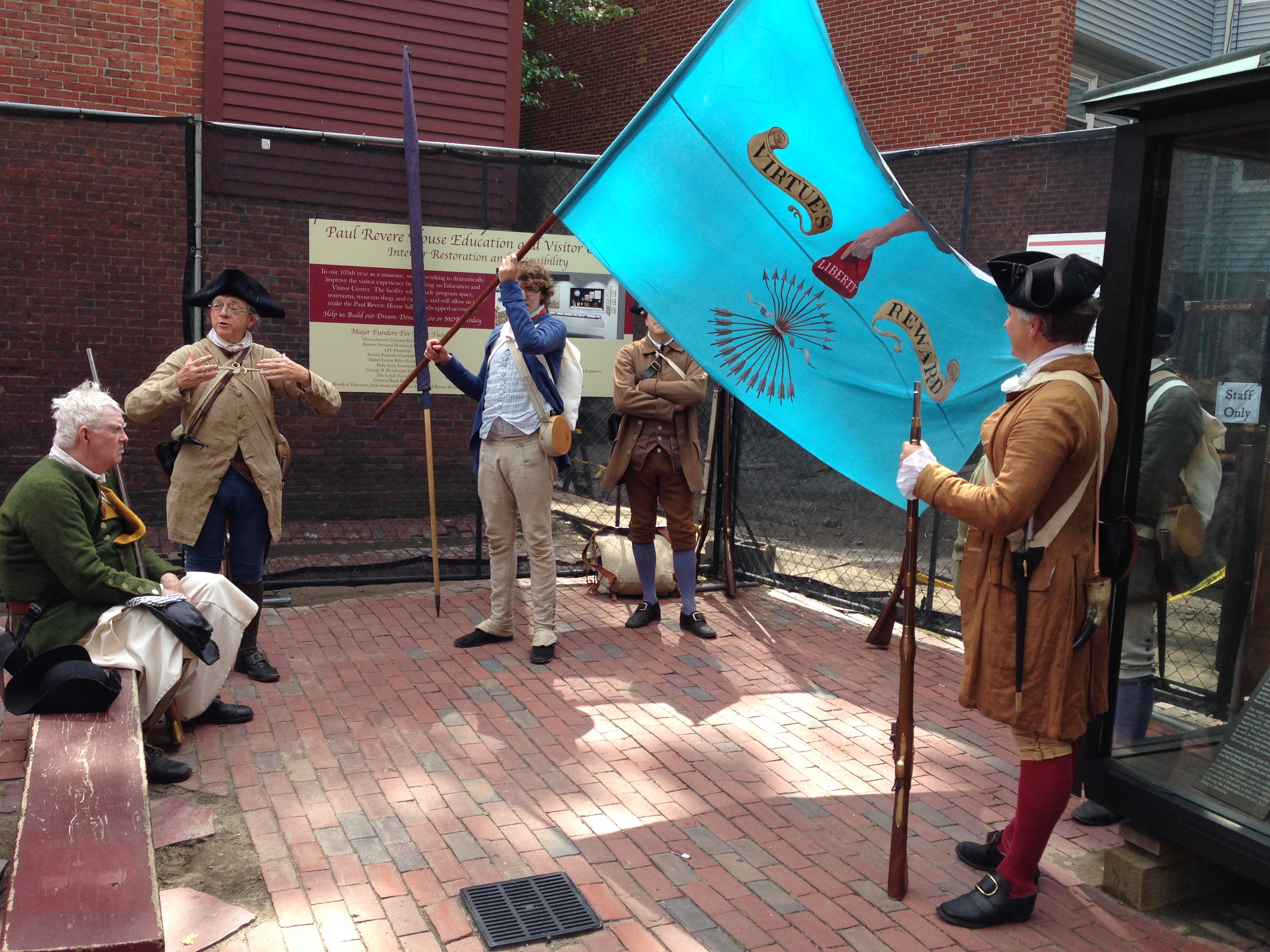
Virtue Rewarded
Virtue Rewarded

What living history means is something I’ve been thinking about lately, or trying to. It’s tangled up with questions of authenticity and appropriateness, but what I learned on Saturday, or re-learned, was how very happy this business makes me. I like history, and historic costume. It doesn’t matter to me if we are talking Revolutionary War or New Republic or Lewis and Clark.

My favorite visitors were a mother and daughter from Steamboat Springs, Colorado, visiting Boston for the first time with a young man from New Hampshire. The mother said, “There’s so much more history here than where we’re from. Our town’s only 100 years old.”

That’s a challenge I’m always ready for, so I asked where they were from. Colorado to me means Native American settlements reaching back a thousand years, Spanish explorers and conquistadors, French, and then American, fur traders. It means hundreds of years of history, and a chance to remind people this isn’t a competition for “oldest” or “mostest.”

Knowing where our country came from is important: so yes, please visit Boston, and Paul Revere House, and Providence and Newport, too! But knowing where you are is just as important. There’s history all around you, and your local historical site, society and museum would love to tell you about it.

More than Just a Pretty Hat

While pretty hats were pretty important parts of the milliner’s trade, many more things were sold in a millinery shop.
Colonial Williamsburg’s Margaret Hunter shop is probably the best-known living history milliner’s shop, and they provide a nice definition and explanation of the trade. But that’s never enough: what’s the primary source information for New England milliners?

While there is documentation of a Rhode Island milliner in the 1830s, and even a thesis on her work, Sew 18th Century and I are working on an earlier shop. I started with Rhode Island newspaper advertisements, because I like the sound of “lately arrived from Providence,” and because I understand that context.

The Rhode-Island American, December 25, 1810. III:20, p. 1
The Rhode-Island American, December 25, 1810. III(20), p. 1

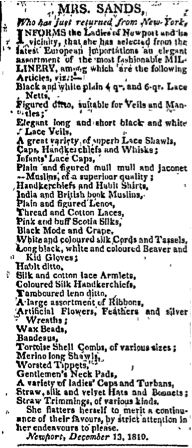
Here is Mrs. Sands, just returned from New York to Newport and vicinity, with a long list of things for sale, “selected from the latest European importations, an elegant assortment of the most fashionable MILLINERY.. viz,:–” (you have the love the punctuation, which is like the Chicago Manual of Style on New Republic crack)

What is she selling? In addition to what we think of as traditional millinery, the “variety of ladies’ Caps and Turbans, Straw, silk and velvet Hats and Bonnets; Straw Trimmings of various kinds,” listed at the bottom of the ad, Mrs. Sands carries:

  • Lace Shawls
  • Caps, Handkerchiefs and Whisks;
  • Infants’ Lace Caps
  • Plain and figured mull mull and jaconet
  • –Muslins, of a superior quality;
  • Handkerchiefs and Habit Shirts,
  • India and British book Muslins,
  • Plain and figured Lenos,
  • Long black, white and coloured Beaver and Kid Gloves;
  • Silk and cotton lace Armlets,
  • A large assortment of Ribbons,
  • Artificial Flowers, Featehrs and silver Wreaths
  • Tortoise Shell Combs of Various sizes;
  • Merino long Shawls
  • Worsted Tippets
  • Gentlemen’s Neck Pads

Whew! That’s a lot of stuff, and many different kinds of things, though all broadly in the ‘accessories’ or supplies range. I am delighted to see Habit Shirt on the list, as I buy my chemisettes, and I am intrigued by the range of handkerchiefs and by the Tortoise Shell combs, in part because I did not buy an assortment of them at a shop in western Rhode Island a month ago (kicks self).

Newport Mercury, December 11, 1811. L:2593, p.1
Newport Mercury, December 11, 1811. L(2593), p.1

In the December 21, 1811 Newport Mercury, Mrs Sands again advertised her goods lately arrived from New York. This is a less exhaustive, but no less interesting, list. “Ladies elegant green velvet mantles, with and without spencers” is particularly intriguing for a Spencer fan, and not particularly clear to me.

November 21, 1812. Essex Register

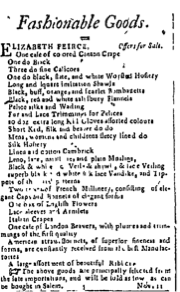
In Salem, which is where we will be in August, Elizabeth Pierce advertises her “Fashionable Goods” for sale. She, too, has a long list of things she will sell, from Canton crapes to imitation shawls, hosiery, lace sleeves and armlets, one box of English flowers, and American Straw bonnets.

I suspect that just as retailers do today, milliners of the late 18th and early 19h century probably had an assortment of things designed to bring buyers in to shop (new bonnet styles), and small items to tempt them into impulse purchases (English flowers). You can’t buy a new bonnet every week, but you can refresh an old one.

Back Bump: The Regency Silhouette

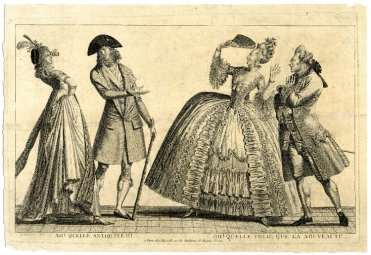
Ah! Quelle antiquité!!! Oh! Quelle folie que la nouveauté ... Engraving, 1797. 1892,0714.755 British Museuem
Ah! Quelle antiquité!!! Oh! Quelle folie que la nouveauté … Engraving, 1797. 1892,0714.755 British Museum

Regency, Federal, Early Republic:  we use these terms to cover (roughly) the period from 1790-1820, though technically the Regency period would mean only 1811-1820, when George IV served as Prince Regent, ruling for his incapacitated father, George III. In the United States, “Regency Costuming” is a bit of misnomer if you’re copying early American gowns, but it does serve as a handy short-hand we all tend to understand.

Grossly, the principles of dress are rooted in neo-classicism and republicanism rising from the American and French Revolutions. Specifically, we see a turning away from the heavily-boned, panniered, and formal gown styles to the looser, short-stayed, flowing, simpler gowns.  The transition is summed up for me in this satirical print.

So, you’re no longer side-to-side wide, baby: you gotta have back.

How do you get back? There are a couple of perfectly authentic tricks that do not require you to stuff a cat into the back of your dress, though you can do that if you want. The combination I have found to work is two-part: a small, crescent-shaped pad, and the method of pleating. How you deploy the pad and the pleats will give you the silhouette you desire.

First, though: which silhouette? In really the 1790s, the silhouette is rounder than you might think. It really is a round gown.

To get that look, I use a small rump pad, bustle pad, or bum roll (call it what you like), which is stitched to the inside of my petticoat.

That’s the white IKEA curtain petticoat I made during the extended snow days of last year, and which I have worn with the red curtain-along open robe and under the petticoat and open robe for What Cheer Day. The pad is the same natural light-weight linen I use for a many gown linings, filled with bamboo stuffing. If I’d had wool on hand in the small hours of the morning I made this pad, I would have used it, but all I had was bamboo in the rush to finish up and have something to wear for a photo shoot.

The other key factors are pleating styles and fabric weight. Pleats can add lift, but in general, the lighter the fabric, the more lift a small pad will give you.

1780_1790
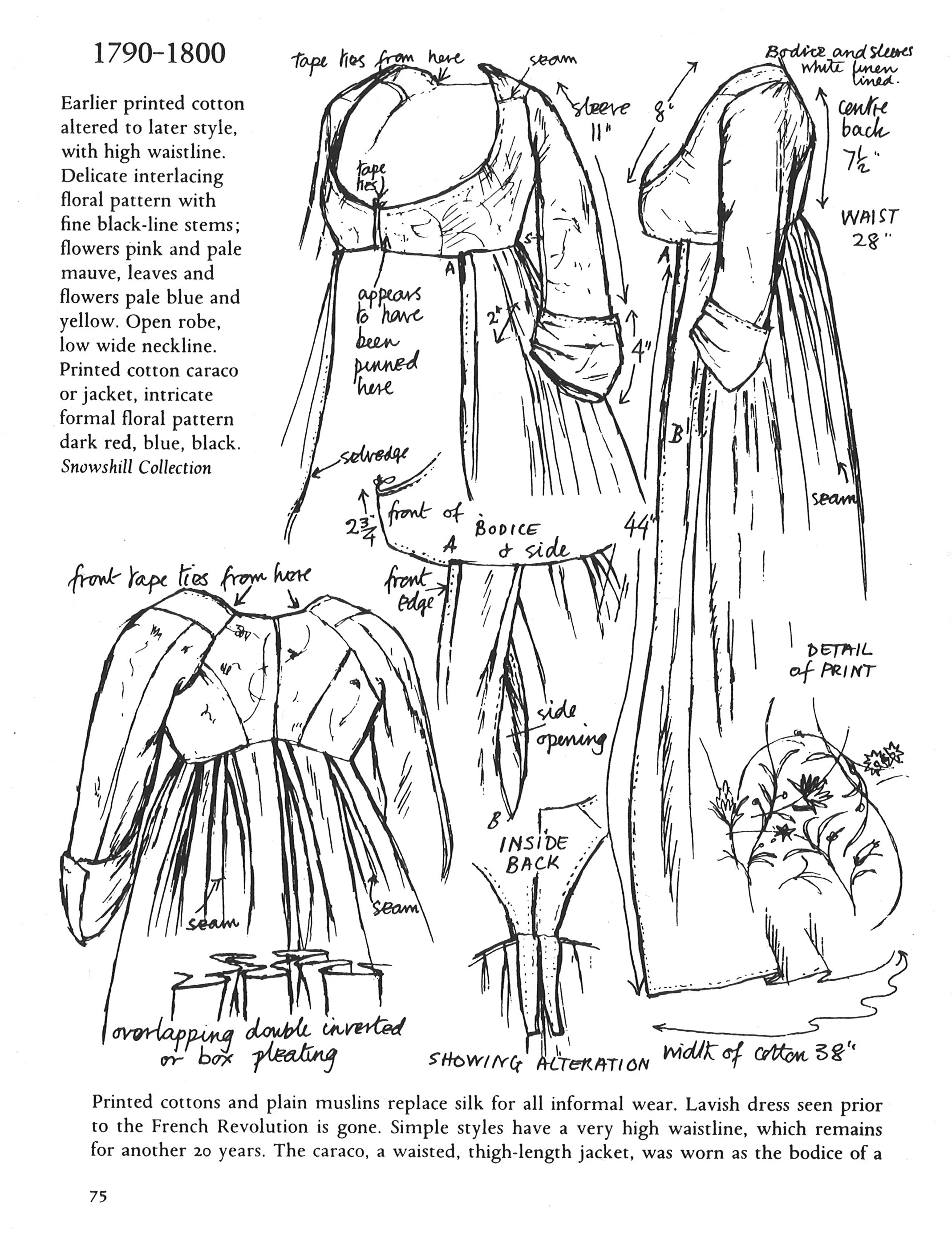
I’m particularly fond of the pleats used for the gown shown on page 75 of Nancy Bradfield’s Costume in Detail. I’ve used this as a guide several times, and I am very pleased with the results. They do vary, of course, depending on fabric weight, fibre, and length. Stiffer cottons, like the Waverly Felicity of the curtain-along gown, will make a round shape; tropical weight wool does fairly well, also, but the most amazing 1790s rendition I have achieved to date is the light-weight India print cotton short gown.

Now that’s 1790s back. The bustle-like shape surprised (OK, shocked) me, but on the whole, I think I’m pleased. So there you are: pad, petticoat and pleats: that’s how you get back.

The East Indies Trade

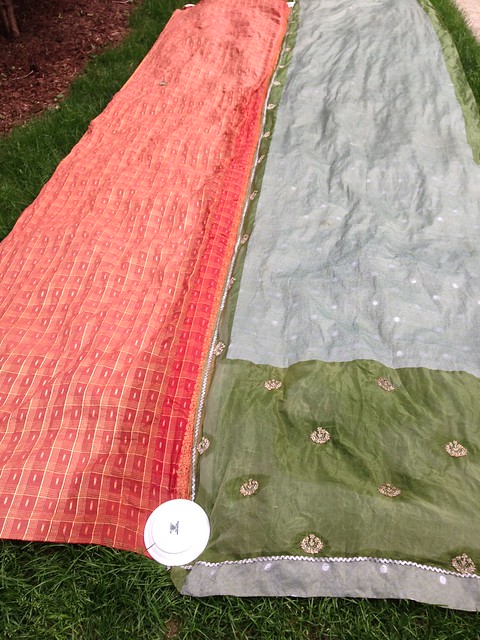
Saris drying after a vodka bath

Like any good Rhode Island trader, I am pleased to announce the acquisition of some India silks. To be fair, I have not burn tested these, so while they were sold as pure and not ‘art’ silk, one never knows till one puts fabric to flame.

As reported elsewhere, these did have an odor (as most vintage and used textiles do) but a bath in vodka and cold water solved that. They seemed color fast, and brighter after washed. It’s really nice when what you read on the interwebs is true, isn’t it? Thanks to the Laced Angel blog entry, Mr S and I found ourselves at the liquor store asking for the cheapest vodka they had. It came in a plastic bottle, and we were compelled to explain we were going to be cleaning with it. The manager seemed pleased to get the tip, since his wife has a collection of her aunt’s doilies and  things in their garage… I think Mr S was glad to drag me away, but he does get more human contact than I do, these days.

Samuel Ames, May 19, 1796

Besides just loving the fabrics and the potential for gowns and waistcoats, trading on Etsy with women in India pleases me logistically and historically. I retain a Huckle Cat fascination and delight with mail services, and am just astonished that a woman in New Delhi can wrap these up and put them into the India mail service and a week later they’ve made it to Rhode Island. How many trucks and airplanes does that take? And in the 18th and early 19th centuries, how many carts and ships and wagons?

Lopez and dexter 1809

By May 1796, the partnership of Brown & Francis was probably faltering (they dissolved that August, probably due to John Francis’ ill health), but Samuel James might well have boughtthe goods he advertised at wholesale from Brown & Francis. There were other importers, of course, in other Rhode Island ports, as Lopez & Dexter in Newport, advertising goods in 1809. Five cases of India silks! Four cases of fancy Prints!

It’s astonishing, the quantity of goods brought from the East, as astonishing in its way as the quantity of goods we bring from the East today. The range of colors, prints, and textures must have been incredible! For all the white muslin gowns of the Early Federal/Regency period that remain in collections, there must also have been numerous patterned gowns, shawls, and Spencers, and fancy ribbon trims, not to mention fancy silk waistcoats made up from the silks.   I think we underestimate the rich texture of the past at multiple class levels– these ranges of goods hint at how colorful and acquisitive our ancestors were.