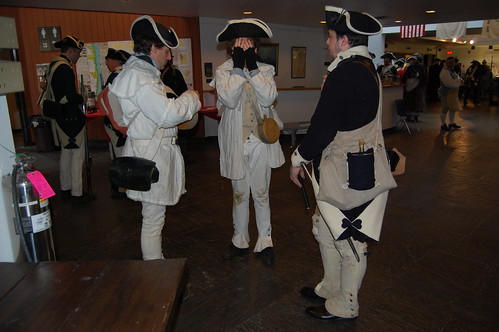
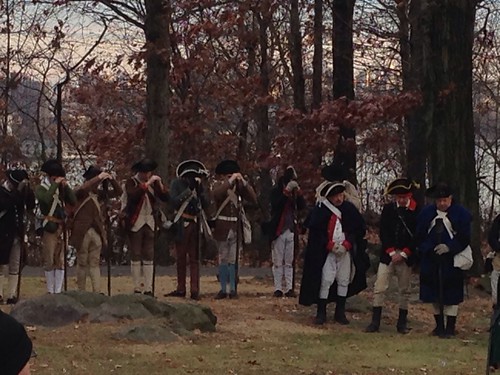
Pushing Interpretation Forward

Dare I say progressing?

servant mannequin in 18th century room
That’s no ghost, that’s my kid

In the past decade, museums, particularly historic house museums, have been challenged to refresh and reinvent their interpretations and presentations. The most notable challenge has come from the Anarchist Guide to Historic House Museums (AGHHM), and the Historic House Trust of New York’s executive director, Franklin Vagnone.

I re-read a number of Vagnone and Deborah Ryan’s papers recently (including this one), thinking not just about What Cheer Day in a historic house, but about reenacting, living history, and costumed interpretation.

To make a historic house museum (HHM) seem more inhabited and real takes a lot of stuff: clothes, dishes, shoes, stockings, toys— all the stuff that surrounds us now, but correct for the time of the HHM, and arranged in a plausible manner, not like a sitcom set, where chairs before a fireplace face the visitor and not the hearth.
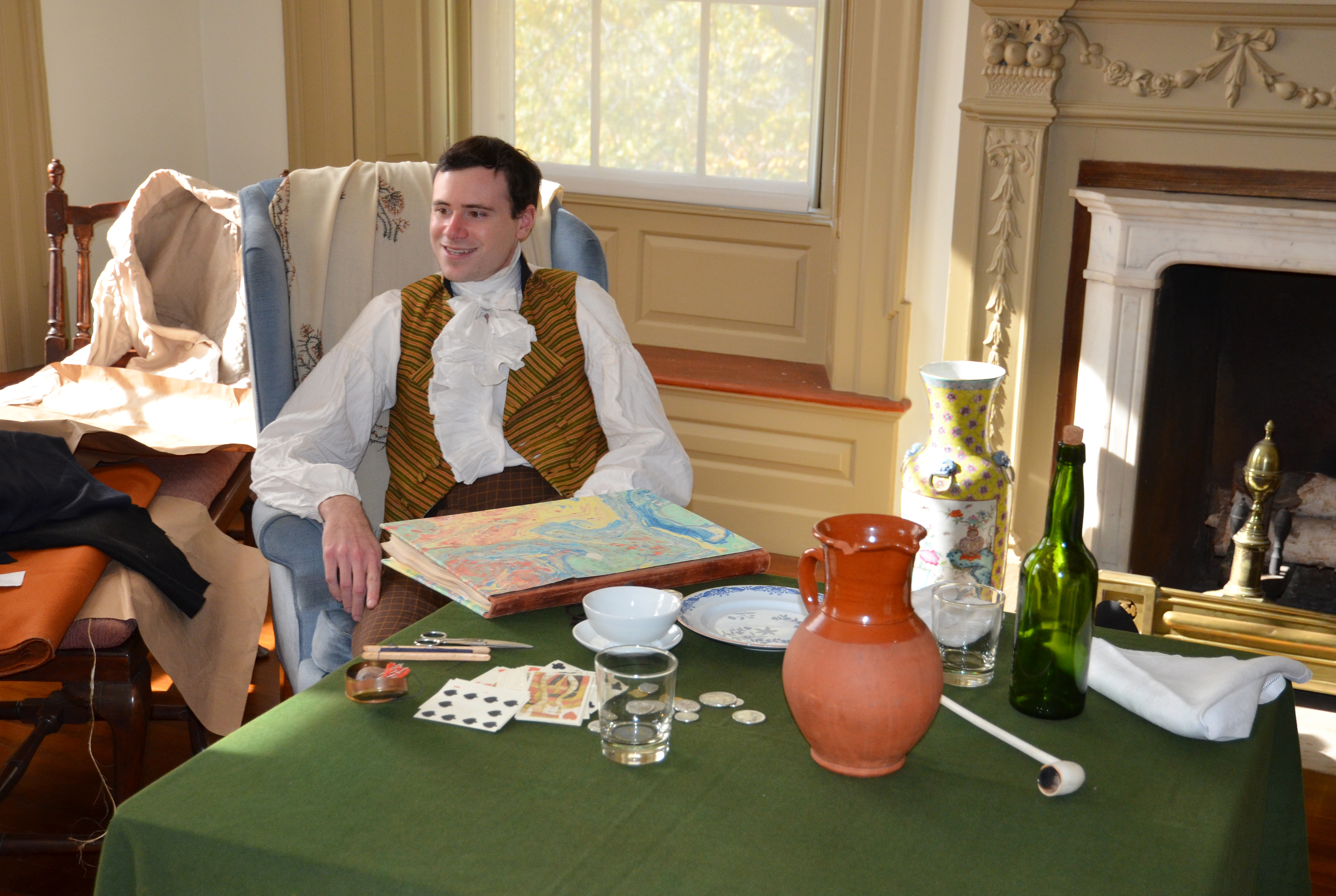
Man with cards, glasses and pipe in 18th century room
Stuff makes a house

To a degree, this is set-dressing, but set-dressing for a still-life, or real life, if the habitation will be by costumed interpreters. It has to be accurate to be authentic, whether it’s a HHM or a living history event that is striving to create a moment, or series of moments, in time– immersive moments.

We cannot step into the past unless we believe the representation we’re seeing, and that’s true no matter where we are: that’s why fabric matters, sewing techniques matter, tent pins and kettles and canteens matter. The world is made up of tiny details that we do actually notice without even knowing it: we see more than we realize, faster than we think. We’ll trip on the different, and stop.

A variety of coats can tell a variety of stories

But what we want to do, as interpreters, is to have the visitor catch the right difference: not the one about which canteen and why, but the larger interpretive point. In one hypothetical example, wooden canteens are a way to talk about defense contracting and supplying the American army, just as over-dyed captured coats are a way to talk about the American Revolution as an international, and not just a civil, war.

An encampment is, in a way, a neighborhood of HHMs turned inside out, with each regiment a separate family within the larger neighborhood. Each regiment tells a story about itself and its history, and is a lens through which visitors see the larger story.

14999323655_5d9dcf2259_o

That’s why accuracy matters: you don’t want to debunk Ye Olde Colonial craft in camp, or cotton-poly polonaises (poly-naises?) worn by purported women on the ration: you want to focus on the larger interpretive point. When not everyone plays by the same rules, it is better to focus on your own accuracy and authenticity and to ignore Ye Olde Annoyances.

Tell the larger story, the story of your own regiment’s people: that’s your interpretive goal.

A Matter of Interpretation

On the way to Southbridge, Mr S and I were discussing the last “big” event for the year, and whether or not we wanted to go. It’s an annual event grounded in ceremony, and somewhat repetitive.

The landing of the British forces in the Jerseys on the 20th of November 1776 under the command of the Rt. Honl. Lieut. Genl. Earl Cornwallis. Watercolor, attributed to Thomas Davies. NYPL

Mr S would like to go if he had the proper wool coat– it will be easy enough to make, once he gets a kit– but which he does not now have. I find it’s usually a day alone wishing I was across the river in a museum or fabric shop. In the end, it’s a long drive to a day spent in the cold and wind followed by a dash home in the dark, with Sunday spent catching up on chores and cleaning muskets, and now with an added measure of homework stress.

I have painted this as a grimmer day than it usually is, but considering that it’s been 7 months since we had any non-medical time off from work, squeezing this into a busy and stressful schedule is not as appealing as it once was. In part, I think it is because there is a lost opportunity in the interpretation, which is surely limited by the size and nature of the site, and by the loss of the historic fabric of the area.

Nestled in a densely settled and very urban area, the park site has a block house, hut, and fortification as well as a museum. Sutlers and others set up in the museum for the day, including some demonstrations of women’s work…like spinning. Spending the day inside spinning is not for me: not only can I not spin, I cannot imagine fleeing the British with a spinning wheel, which is an annoying contraption to move even with assistance, plenty of time, and a Subaru.

The Young Mr hides

But more than my impatience with Ye Olde Colonial Spinning Wheel at too many military camps this past year, I think what stops me from wanting to go is the repetitive formality of the interpretation, with the the march to the monument and the post-prandial “battle” for the blockhouse, with the Americans sometimes winning, despite the fact that the fall of this site marked the beginning of Washington’s retreat to Pennsylvania, and despite the fact that three days earlier, when the companion fort across the river fell to the British and Hessian troops, nearly 3,000 Americans were taken prisoner in 1776, and of those, only 800 survived. In what way is this ritualistic commemorative event remotely authentic? And if the only way people get the actual history and importance of the event is through the event narration or museum exhibit, hasn’t the reenactment or living history portion then failed?

Ritualistic, commemorative.

The more I think about interpretation and presentation, the more Ye Olde Colonial things annoy me and the more important I think it is to be accurate and correct.

Forcing a passage of the Hudson River, 9 October 1776. oil on canvas by Thomas Mitchell from an original by Dominic Serres the Elder. Royal Museums Greenwich

That does not mean that I expect a naval engagement (though a girl can dream) or a cross-Hudson rowing affair, but I do think it could be interesting to see troops at a fort packing up and evacuating the site, with the confusion that could result. But it’s not my circus, and not my monkeys, and in any event, I shall probably stay home to make sure that homework and housework alike are done in this current century.

Why Do We Buy Things?

The Sunday, November 9th Guardian had a series of short articles on collecting, including one on why people collect things. This was similar to the New York Times’“Room for Debate” series on Why We Collect Stuff.

Chair, table, chair.

I liked the Guardian’s “Love, anxiety or desire?” question, and asked it of myself: why do I collect?

Collecting is something that I had given up for a while, given that so much of what Mr S and I had collected was stashed in boxes in our basement after an apartment move nine years ago. Nine years! If you haven’t unpacked in that time, do you really even care about those things?

No, not really. Many the things I unpacked recently as we went through the basement again are destined for Etsy: McCoy pottery vases, colorful Pyrex, FireKing glassware. I bought it at a time when I liked green pottery—it was an outgrowth of the blue and yellow creamware I’d begun collecting when I first lived in Rhode Island.

But now, I’m done with it: done with the mid-century modern, and going back to the early American things. There’s an aesthetic quality I like in both styles: simple lines, bright colors.

The most recent acquisition is a drop-leaf table in a very country Sheraton style, with a tiger maple skirt. I watched this table for months before finally committing to it, and dragging Mr S up there late Saturday afternoon. He was game, and in the past day the table has grown on him.

Why did I want it? For one thing, it reminds me of a maple drop-leaf Sheraton-style table my mother has, so perhaps there’s an element of nostalgia, or a desire for approval. I also imagined it exactly where it is, though it will require some adjustment in lighting. Did I buy a piece not only of the American past, but of my own? Is this what adulthood looks like? Or am I just responding to shape and color?

The table and chairs are low, and not comfortable in the way that modern furniture is: I wouldn’t want to sit in the chairs or work at the table every day, but these things give me pleasure, whether bought for love, anxiety, or desire.

Things Won’t Make You Happy…

DSC_0455except when they do.

I try hard not to be acquisitive, though our home is perhaps more crowded than it might be if I were better at the task or cleaned at work less and at home more. Around the time of What Cheer Day, I became rather obsessed with teapots.

At the local antique mall, I found an attractive Chinese export porcelain cylinder or barrel-form teapot with crossed strap handles, suitable in design and shape for use in 1800 Providence. I made a special mid-week trip fully intending to buy the teapot and free poor Mr S from ever hearing “teapot” again in endless conversation. When the item was out of the case, though, it turned out to have a mended crack right across the bottom, and as I told the woman, “It matters because I intend to use this.”

DSC_0450In the end, I did not have my fabulous teapot for What Cheer Day. In fact, my fabulous teapot arrived just this past Thursday, after patient stalking on eBay. It arrived with a bonus of five cups and a saucer, most with mends, but the pot itself has just a handle flaw or mend (typical, and seen, along with wear, in some museum pieces, too). The quantity of cups suggests that the previous owner had a relationship with them not unlike the one you might develop with a large litter of kittens you were fostering…adopt one, get another! Just to get them out from underfoot.

DSC_0470The cups and pot reminded me of the difficult meals and teas Elizabeth Bennett takes with Maria Lucas and Lady Catherine whilst visiting Mr Collins and his new bride Charlotte Lucas. There’s a tension in these cups, some combination of the dainty and the strong, some slightly misshapen (not all makers were equally skilled) that calls to mind the polite verbal combat of tea parties.

I washed the cups, and was reminded of the duties of maids to clean and care for these delicate items, the kind of thing they were unlikely ever to acquire, though there were grades of china then as now: what sat on John Brown’s table was not what sat on the Dexter’s table, or at least not in the same quantity.

DSC_0452The quantities of china coming into Providence and the rest of the Eastern seaboard after 1788 were enormous: in 1797, dinner sets of 172 pieces could be ordered at Canton for $22, and included 6 dozen large flat plates, 2 dozen large soup plates, 2 dozen small dessert plates, 8 pudding dishes, 2 large tureens, dishes and tops, 2 smaller ditto, 16 dishes of various sizes, 6 sauce boats and stands, and 4 salt cellars. Tea and coffee sets of 81 pieces were bought in Canton for $6 to $9! Just for dinner and tea, you could have 253 pieces of china, and we haven’t even begun to get into custard cups, cache pots, and garnitures!

DSC_0473The indifferent pieces I have acquired may have started out as kaolin, feldspar and quartz in Ching-te-Chen, 200 miles west-southwest of Shanghai. There were important porcelain manufactories there, and porcelain wares traveled by road and boat to Canton, where sets were customized to meet specific orders and then loaded onto ships bound back to America, six months or so after the order was placed in Providence, Salem, or Boston. It’s a lot of work for a fashionable sip of Hyson or oolong, and no wonder cups and pots were mended, saved, and reused.