Peale’s Progress, or, High on History

No, we didn’t go, and I have regrets. Six weeks before the event, I thought I was working on January 3rd, and by the time the schedule changed, it was too late. Instead, you can read about Drunktailor’s experience.

Reenactors portraying Philadelphia Associators take part in the real time tour of the Battle of Princeton, Princeton, NJ, January 3, 2015. Beverly Schaefer, Times of Trenton
Reenactors portraying Philadelphia Associators. Beverly Schaefer, Times of Trenton

The background is interesting, similar to the kind of events and projects we’ve been talking about here in RI: site- and time-specific events that combine commemoration, history, and experimental archaeology, or an emotional and social archaeology, if you will.

From event co-organizer Dave Niescior, quoted in the Rutgers-Camden News Now: “The goal is to gain a better understanding of the hardships endured by individuals who lived and made a critical moment in history.It is one thing to write ‘the troops marched overnight to Princeton,’ it is yet another to understand what that physically and mentally meant to the men who had to put one foot in front of the other all night long.” Co-organizer Matt White told NJ.com, “We’re trying to stage a number of vignettes to give people a sense of what was going on in the Continental Army in this period between late December and early January of 1776 and 1777.”

that’s cold. From Daily Reenactor

These and other collected images help convey a sense of the event,  which–as far as I can tell– did provide participants with the kind of transcendent experience I know I enjoy and hope to find at events.

This is the kind of event that I think proves a belabored (and elsewhere belittled) point: accuracy matters. It is just about ALL that matters.

On a now-defunct phone, I had an old video of the Young Mr with a now-deceased reenactor of whom I was quite fond, despite our wildly divergent politics. In it, Mr D shows his Charleville to the Young Mr on the front porch of an 18th century home and asks, “Do you know what this is?” The Young Mr shakes his head, and Mr D answers, “It’s a time machine.”

Although I remain committed to reducing the degree to which living history is musket-centric, there’s truth in that statement: Mr D had an original, period Charleville and a fairly well-cut uniform, considering his generous figure. Using, showing, and interpreting actual period pieces and well-made, correct replicas is the single best way to connect the present, and the public, to the past. Accuracy matters because it’s the literal key to the past: you have to cut the pattern right.

Accurate impressions rendered in a place of shared value will transport you to the past, and give you insights you did not expect. That is the point of these exercises: insight and understanding. It’s how to get high on history.

In Tents Tuesday*

You know The Tent Article, don’t know? You do, if you’re camping 18th century private soldier style in your hand-sewn coat.

Scene of the Camp on Hampton Green, 1781

The Tent Article (hereafter The Document) pulls together documentation and research assembled by a team of living history enthusiasts dedicated to replicating the 18th century enlisted army experience in an accurate manner. Though the PowerPoint format affects the overall length, be warned: we are talking 300+ pages here.

No strangers to the pursuit of the accurate and never ones to shy away from an arduous task involving pointy objects and string, the 10th Mass assembled on Saturday afternoon for a round of tent sewing.

I first read The Tent Article in 2012, and was promptly ashamed of our hand-me-down tent which had everything to recommend it in terms of price, but wanted in terms of accuracy. In response, I began making 1/8″ scale models of tents to figure out how much linen I would need to buy in order to make a truly correct tent. Finally, all that edumacation in art and architecture had utility! Alas: distractions arose, cost overwhelmed, our then-primary regiment scoffed, and I abandoned hand-sewn tent plans.

Fast forward to Tyler Putnam’s blogging on The First Oval Office project, and I was once again intrigued. I began calculating how much vacation time I might need to complete a tent by hand in our living room. Well, thank goodness for finding fellow travelers, because lo and behold! The 10th Mass had tents in want of sewing, so I could learn a great deal without filling our home with excessive yardage.

“Sails.”

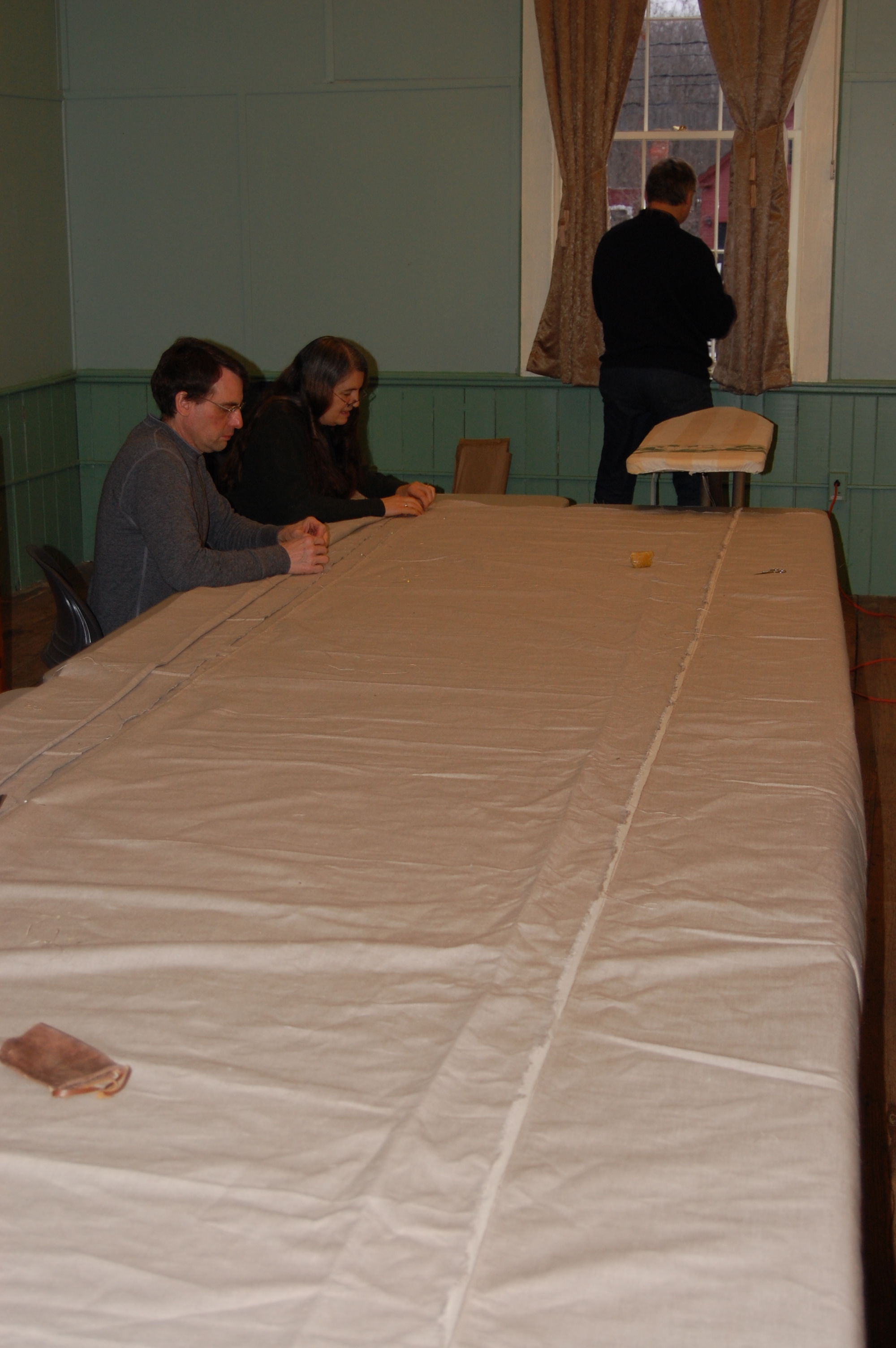
Progress was made last August in Newport, where the tents masqueraded as sails, but the canvas languished unsewn until last Saturday, when we duly assembled in Hopkinton and unfurled the vast expanse of linen. It was suggested that I might know some people with access to sail lofts (!), but in about 4 hours, a number of us managed to finish the final foot of backstitching and to flat-fell a little more than 60 feet of tent seams.

It's a vast expanse of linen.
It’s a vast expanse of linen.

The Document was consulted to make sure we were proceeding correctly, though the iPad misbehaved and forwarded us many pages to grommets. (I’m looking forward to those, as I enjoy sewing eyelets– and have just earned myself the dubious honor of sewing at least half of them, I’m sure.) We checked the images, threaded our needles, and off we went.

A few inches (feet) of felling had to be unstitched and resewn, but heavy linen is wily and some stitchers were newer to the process than others. But by the close of day, all seams were felled, needles packed, and tentage folded.

Next up, per The Document, are mud flaps. This should get interesting, as math in front of an audience usually is.


IMG_2728

I promised a pun, so here’s the worst. Somehow we got on to unfortunate reenactorisms, which collided with Star Wars, and brought us to the realization that what we needed were light sabres… ’cause it’s the 10th Massachusetts Regiment Light Infantry Company. We were punished for this hilarity by having to drive home on untreated roads into snow that looked like we were trying to take the Millenium Falcon to hyperspeed.


*It really happened on Saturday.

Whimsical Whiskered Wednesday

A quintetto. Musical Amateurs. Hand colored etching by Piercy Roberts, after George Moutard Woodward, 1803. British Museum1981,U.199

E’en Age itself is cheard with Music. It wakes a glad Remembrance of our Youth, Calls back past Joy’s and warms us into Transport. Vide Rowe read the lines at the top of this engraving, and while I’m fairly confident the Rowe referred to is Nicholas Rowe, I have not connected the quote to him.

Instead, you’re treated to the image that struck me as I searched for 1820s maids at the British Museum. Happily, my household is one cat and one cockatoo short of this reality, but it pretty much sums up breakfast time Chez Calash, when I am too slow with the breakfast portions, and the beasts begin to sing.

Happy Thanksgiving, American readers. I’m taking a short break from museum thinking to wrangle our dinner to the table, attempt to finish a gown, and catch up on some sleep.

Preservation or Petrification?

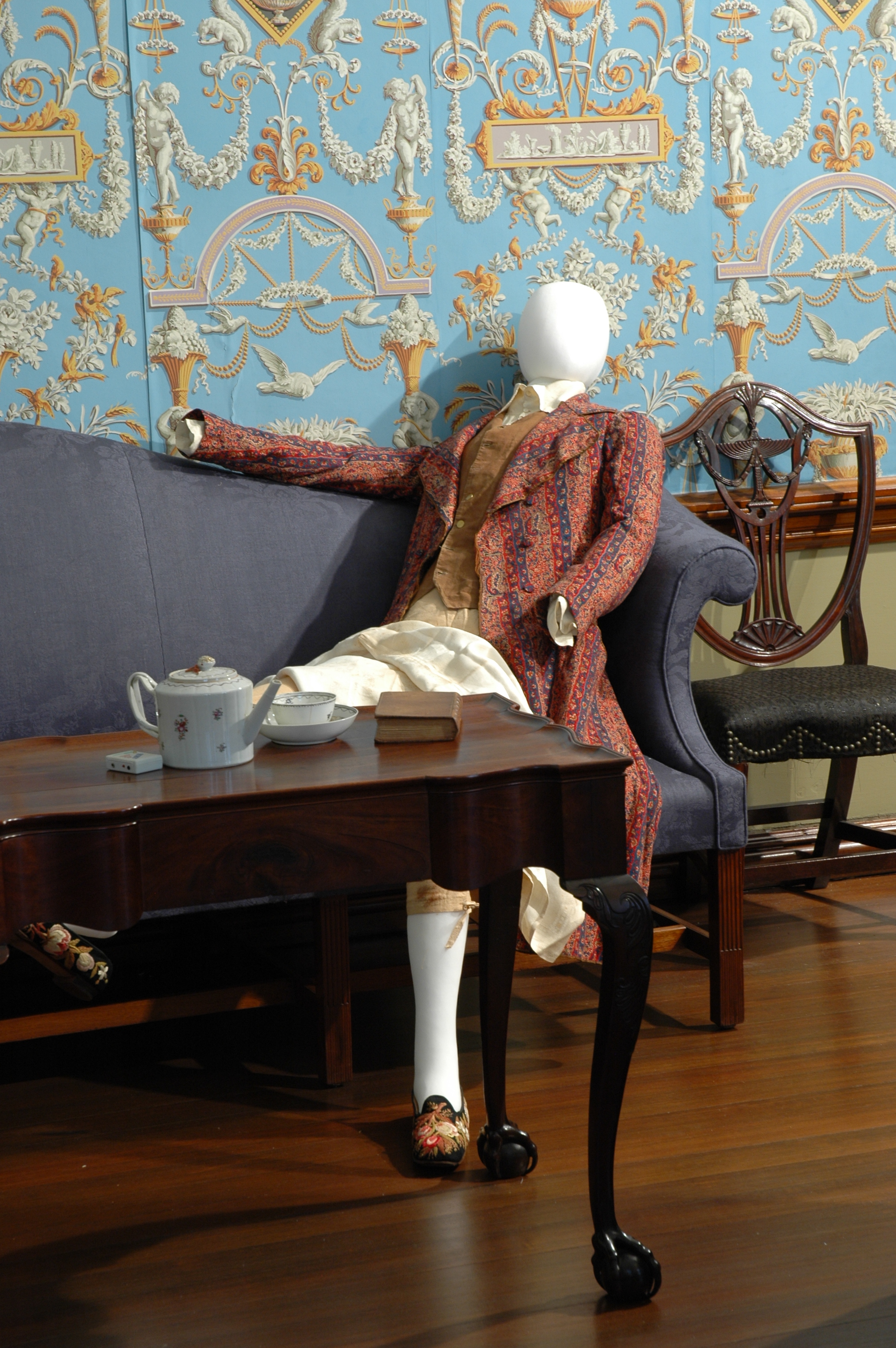
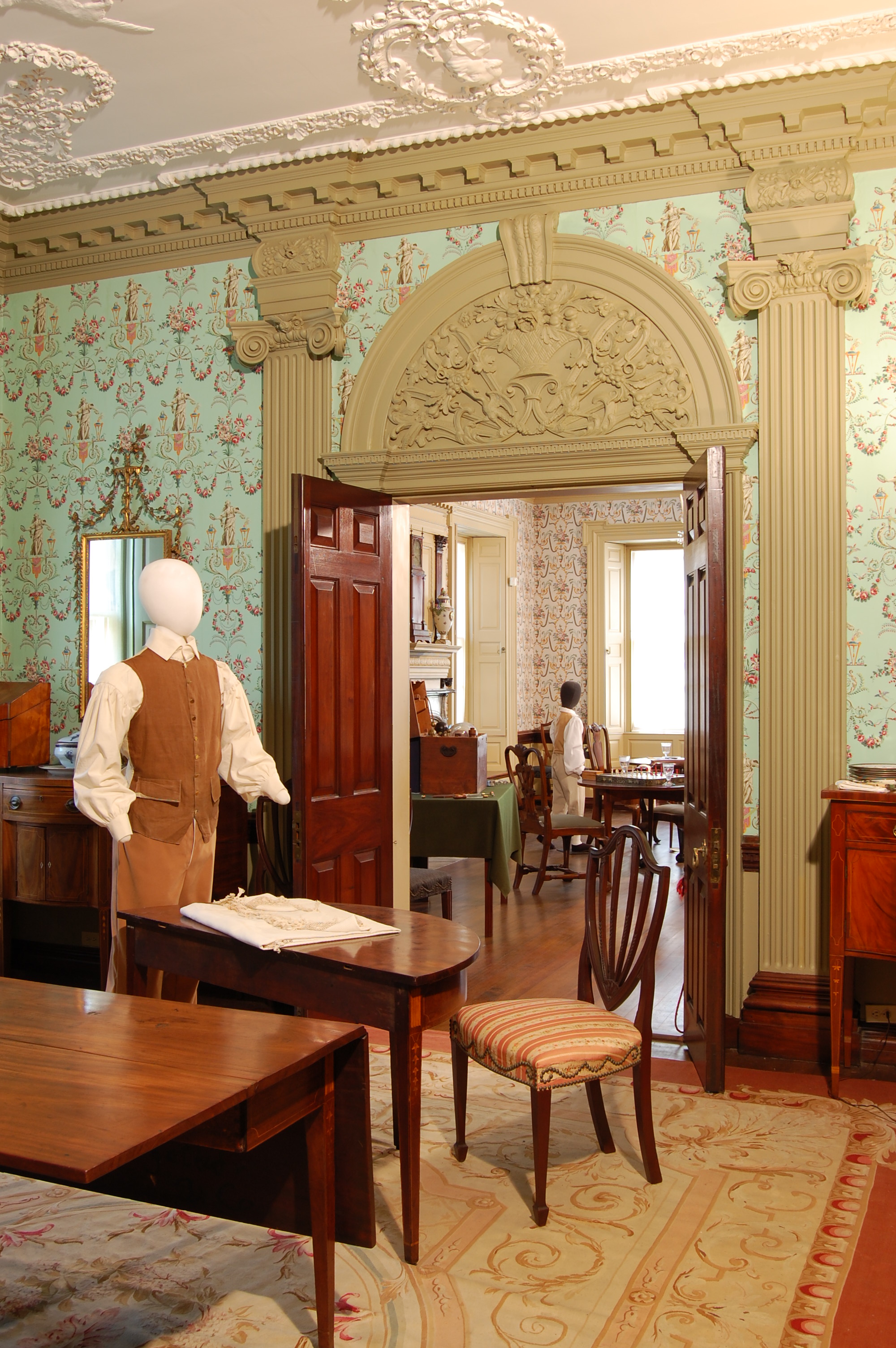
For almost ten years, I’ve been working on the re-interpretation and re-presentation of the HHM that is part of my employer’s stable of properties. We’ve had mixed results: guides who refuse to look me in the face, guides who quit because a piano got moved, guides who hissed “hedonism!” at the site of a lounging mannequin, and guides who were made incredibly sad by the representation of a sick (dying) child.

James, recovering from a party the night before
James, recovering from a party the night before, angered some guides (2007)

Me, I consider all those things successes.
The people who had to deal directly with that fall out, maybe not so much.

Change is hard and scary, and every one has a different tolerance for risk. As you have probably guessed, mine’s fairly high. I blog, I go out into the world in some pretty funny clothes, and inhabit characters I am not. I expect to fail regularly: it’s a reliable way of learning.

Change is hard to maintain, it’s hard to continually evolve and push an interpretation forward. It takes time, focus, and money; it takes cross-disciplinary collaboration and communication between curators, educators, and docents or guides.

Taking risks in spaces full of very expensive furniture is particularly daunting, but especially rewarding when you see how a house looks, inhabited and, to a degree, used.

Alice receives the mantua maker's letter
They’re sitting in real, accessioned chairs. (2014)

The job of museums is to preserve, but we sometimes seem determined to petrify, to freeze a perfect moment in amber, to freeze our visitors with fear of touching, photographing, asking, and to freeze and understanding, all in a fluid world.

If we reject the beautiful and untouchable past to embrace the messy human past, we can juxtapose the fine mahogany-furnished rooms of the merchant elite with the work to create those rooms and make the picture more whole by including slaves, servants, workmen and tradesmen.

More of us would have been working than lounging
More of us would have been working than lounging (2006)

Most of us would not have lived the way the merchants did: to a degree, our historic house visits are backwardly aspirational, as we wish for nostalgia that is more false than most nostalgia.

I am not advocating favoring the smelly past, or descriptions of unpleasantness, over exultations about carvings and upholstery—except that I am—because I see these pendulum swings as a part of the process of creating more complete and honest representations and recreations of the past, in museums, at historic sites, and in living history presentations.

It’s past time for me to work again on re-imagining the house under my care: I acknowledge that. Synthesizing what I learn in living history with the work I do in museums, and vice-versa, will improve and enhance the public experience of history inside and out.