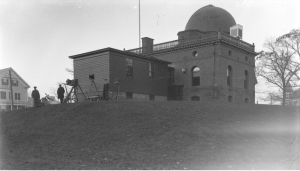
Ladd Observatory, 1898, back of the transit room. Brown University image
On Tuesday, after a long hiatus, the local observatory was, at last, able to open to the public. Between the Snow on Monday theme of this winter, and the tendency to clouds and rain in what New England calls Spring, Ladd had been closed, and sending plaintive and apologetic emails, for weeks.
We walked up shortly after the 8:00 PM opening to find long lines, and a crowd as large or larger than the Halloween open house nights, when the staff and students turned the Observatory into a haunted house, neighborhood naughties swiped too much candy, and the roof deck was open for star gazing. Being Tiny Town, the Young Mr’s middle school art teacher was in line ahead of us with her young son and wife. To his credit, he did acknowledge her.
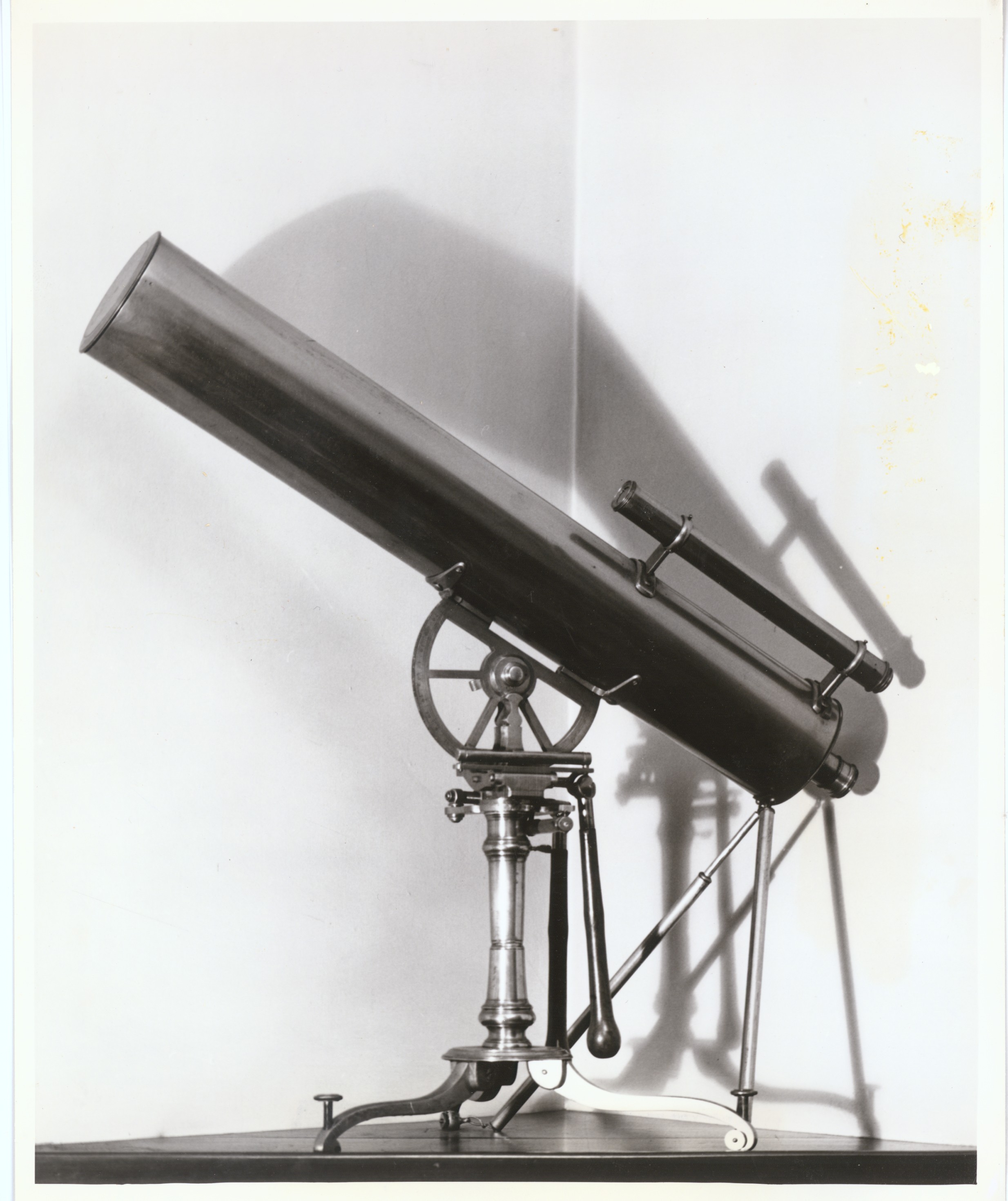
The telescope used by Benjamin West to observe the Transit of Venus, 1769. Brown University image.
There’s a long history of astronomical observation here, with a street named Transit for the 1769 Transit of Venus, observed by Benjamin West and other local notables.
It is really is a “wow!” moment, cooler even than the packages that make it here from India and astonish me. All that distance, light. How truly awesome the view through a telescope must have been in the 18th century, when we, collectively, knew less about the world and universe. How awesome it is now, to be able to see a world so far away, and to wonder what it is like.
Thomas Cromwell, Hans Holbein the Younger. The Frick Collection,1915.1.76
At last it has arrived: Wolf Hall. I waited, and did not use a proxy server to watch it early. Just as well that I watch PBS online as I have, thus far, watched the first episode three times.
At last I can understand people’s enthusiasm for historical programs some of us seethe at and cannot watch: my knowledge of the Tudors and their material world is limited enough that I am captivated and not annoyed (except by Anne Boleyn’s wrinkled silk satin bodice, which is striking in its puckers) and I read the books when they came out, and have thus forgotten enough of the details to be merely annoyed and not enraged at changes. (Other, real, critics have caught the language changes in the scene with Wolsey; Mantel is better, of course.)
The third Wolf-watching was with Mr S, who was suitably impressed by the low-light filming. As a former photographer who did a lot of night photography, improper and unbelievable lighting in film does cause an outbreak of caustic commentary. Not this time (he merely noted the fill light on Liz Cromwell’s face in one scene). With 20,000 pounds spent on candles, the BBC did this one right– and lucky for them the advance in camera technology.
But forgot the astronomical cost of all those tapers, that’s not the point: the point is what was believable and how the staging and lighting were used. I believed Wolf Hall all the more because of the low light, indoors and out, matching the time of day. I know how dim it is to light only with candles, and what a pain it is to make them, and how expensive. Light is money, whether you’re paying Ameren, National Grid, or the candlestick maker.
Aside from Hilary Mantel’s brilliant stories and all those candles, what makes this Wolf Hall good television? You know what I’m going to say: the authenticity. No, there are no Tudor accents, late or otherwise; these folks use our vernacular. And excellent arguments can be had about the historical accuracy of Mantel’s characters.
“The dull palette used – presumably in conscious contrast to The Tudors – created an ambience which, at worst, was lacklustre or, at best, homely. And it is that homeliness that concerns me most.
The homely is unthreatening. So, we are invited to view a ‘Tudor world’ as we know it or, rather, as we would like it to be. For instance, I was struck by how classless the society was – social gradation seemed to have disappeared both in the interactions and the interiors. There was little sense (as there is in the novels) of the heavy distaste for a man of such lowly birth as Cromwell’s; there was limited hauteur in a Norfolk or, indeed, the king. Meanwhile, the buildings which were home to Cromwell – still, at this point a lawyer in Wolsey’s service – seemed to lack none of the late-medieval conveniences afforded to the higher born and bettered housed. This is a world which has been domesticated for us so that it is tame, familiar and quintessentially English.”
Anne Boleyn by Unknown artist oil on panel, late 16th century (circa 1533-1536) 21 3/8 in. x 16 3/8 in. (543 mm x 416 mm) Purchased, 1882. NPG 668 [Britain}I will say that I was struck not just by the cleanliness of everything in an age before detergents (the blacksmith’s yard is remarkably pristine) and the amount of stuff in Cromwell’s house, but also by the softness of class lines. An argument could be made that depicting that much background detail would distract from the larger story, that of Cromwell and Anne and Thomas More, and the dissolution of the Catholic church in England.*
I know Cromwell ended up with riches but on the BBC he seemed to start ahead of where I thought he was at the start of the novel, mercenary and mercantile background aside.
Still: the spirit of the story and of Mantel’s Cromwell seem well-drawn here, and that’s what makes the difference between a series of living Holbeins and a gripping tale. That’s also what makes the difference between museum mannequins and costumed interpreters: emotional authenticity.
No: you cannot get costume and material culture wrong and still claim emotional authenticity as your defense. But the factor that makes a good event or site great is the believability of the characters, and that means more than a lecture on fine details. It means understanding the past, and even admitting what we don’t understand, and seek still to learn.
I think it will take a fresh generation with no memories of the 1970s to revolutionize studies of the American Revolution. What do the rest of you think, those of you who remember the 1970s as well as those of you who don’t?
They are half my age and already exceed me in sewing skill. They find new cultural nuggets I have never seen before.
I’ll see your camp kitchen and raise it a malnourished goat and acorns. (image from Drunk Tailor)
And that– younger people are finding new things–reminds me of Historiann’s post.
I could say we’re all standing on the shoulders of giants, but it is more about perspective, different ways of looking, and openness. The schisms are not just generational, but philosophical.
None of these breaks fall neatly, of course, but crack and splinter along desires and motivations. As long as you are willing to keep learning and changing (i.e. researching and making) then you’ll keep pushing at the edge of the interpretive envelope and that can only help push understanding of all kinds forward.
Where will you be on March 28th, now that the LTB muster is cancelled? How about HistoryCamp 2015? You can register here for free if you volunteer or for a nominal fee otherwise.
You can check out sessions here, but I know there’s a really good one on living history…because I’ll be presenting along with Elizabeth Sulock of Newport Historical Society in the Risky Business: Living History Events in Tradition Museums session. There’s a lot of other good stuff, too, so if you’re in the area, why not register so you can check it out?




 Kirsten Hammerstrom
You must be logged in to post a comment.