I’m really looking forward to recreating this (and to making a custom stand for it). It reminds me of the lovely brown bonnet sold by Augusta Auctions ten years ago. Poking around in fashion plates, I’d be comfortable putting a date range of 1825-1835 on this, with a likely date of ca. 1828. The two-part construction, the exuberance of the caned brim, and the color suggest to me that this is pre-1837 (when the effects of the economic crash can be seen almost immediately in smaller sleeves and tighter bonnets). Still, combing through fashion plates is never dull and I look forward to learning more in the year ahead.
One must keep up with the news (and the competition)
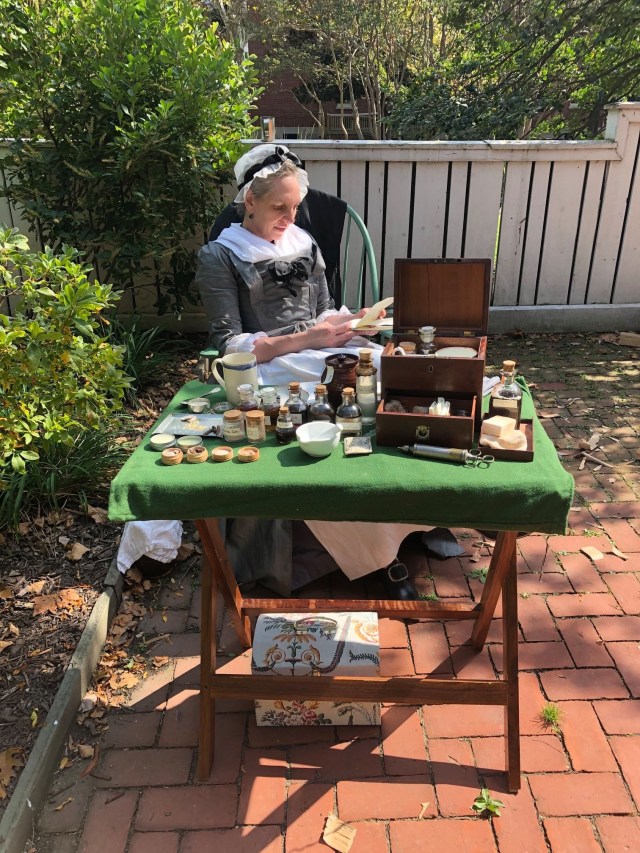
I’d call it “three times a lady,” but truly, I’ve only been a lady in Occupied Philadelphia twice. Last year and this year, I portrayed Elizabeth Weed, a widowed pharmacist living on Front Street in 1777 with her son, George. We don’t know why Elizabeth Weed didn’t leave the city along with nearly half the population. Was she a loyalist? Was her son too ill to travel? Or did she choose to stay to protect her property from the British– or the son of her late husband’s first marriage, who withheld a portion of the estate? Whatever the reason, remain she did, advertising her wares in the October 23 edition of the Pennsylvania Evening Post.
New remedies, new box, new ingredients: refining an idea
Last year, with Drunk Tailor’s assistance, I made a number of remedies using 18th century receipts, with some interesting and sometimes successful results. This year, we improved one– the yellow basilicum ointment– and added some new concoctions. The sulphur ointment for the itch (possibly scabies) worked well on the insect bites I got in the Carpenters Hall forecourt. A charcoal-oyster shell-cinchona bark-benzoin tooth powder was a new addition. I used the clove oil-scented pomatum to achieve the highest hair I’ve managed yet, but the truly satisfying work was recreating multiple recipes actually used by Elizabeth Weed.
As Drunk Tailor notes in his entry on this year’s event, we can never truly enter the 18th century mindset. Recreating the clothes, food, daily rhythms, and medicines help us experience the feel of the past, but we can never truly be those people. If you regularly cook 18th century meals, you’ll experience the palate of the past: aromatic, relying heavily on cloves, nutmeg, cinnamon, and allspice. This same range informs the aroma and flavor of the remedies from cough syrup to tooth powder.
Almost undoubtedly one of the ‘smells like Christmas, tastes like death’ tooth powders. Courtesy Jason R. Wickersty/Museum of the American Revolution
It’s a toss up which is less pleasant to the modern tongue, the Syrup of Balsam or the Syrup for the Flux. Both use the “paregoric elixir,” which some of you may recall from the medicine cabinets of old. Camphorated tincture of opium or anhydrous morphine has been used to treat diarrhea for centuries, and the ingredients for the modern version (anhydrous morphine) is remarkably similar to that for Weed’s paregoric elixir:
Weed’s Paregoric Elixir
Anhydrous Morphine (Paregoric)
8 ounces opium
Anhydrous Morphine, 2 mg
4 gallons spirits of wine, rectified
Alcohol, 45%
1 ounce oil of anise seeds
Anise oil
2 ounces Flor. Benzoin
Benzoic acid
8 ounces camphor
Glycerin
Purified water
There are some differences– most of us don’t want to ingest camphor, and “purified water” isn’t quite a thing in 1777– but the active ingredient makes these essentially the same compound. It’s an essential component of both Syrup of Balsam and Syrup for the Flux, so it had to be made first. Over the course of ten days, the elixir cleared from a yellow-orange slightly opaque liquid to a clear yellow liquid, with white sediment at the bottom of the jar (probably the benzoin).
With that in hand, I was ready to tackle Weed’s most famous (and well-protected) remedy. It appears more than once in the daybook, but both listings use the same ingredients and proportions.
One of the original receipts for the syrup for the (Bloody) Flux. UPenn Ms. Codex 1049
Syrup for the Bloody Flux
1.5 pints, simple syrup or molasses
.5 pint, elixir paregoricum
1 drachm each:
Essence of peppermint
Essence of pennyroyal
Essence of anise seed
Essence of fennel seed
tincture aromatic
“Mix them all together, and stop them up in a bottle for life.” (Or, as the other receipt says, “Mix and Digest.”
The resulting mixture is probably meant to soothe the intestinal cramps (with anise, fennel, and peppermint) while the paregoric relieves the endless diarrhea. Licorice-flavored molasses with a peppermint tingle isn’t unpleasant so much as odd to the modern palate.
Syrup of Balsam defied expectations.
On the right: Syrup of Balsam: -10/10 would not taste again.
Syrup of Balsam
1 pint, simple syrup or molasses
.5 print, elixir parigoric
1 ounce each:
Essence of fennel
Essence of anise seed
Royal Balsam
Tincture of Balsam of Tolu
“These must be mixed together, and then put up for use.”
If I attempt this again– to be fair, I have enough ingredients and more knowledge– I’ll try to get the Balsam of Tolu to dissolve more fully into the main mixture, though I doubt the separation is why the taste is so unforgettable. While it did mellow after several days, the basic flavor remained licorice cough drops dissolved in corn liquor with an afterburn of turpentine. Fortunately, the dosage is not by the spoonful, but rather ten or more drops in a wine glass of water, depending on the constitution of the patient. As a “cure for the whooping cough,” the syrup with fennel and anise was probably intended to soothe the throat, and paregoric might have helped the pain of damaged lungs. Living in the post-DTaP era, I’ve never had whooping cough, or been around anyone who did, so it’s much harder for me to imagine treating it without antibiotics (or simply not getting it).
“No, really, no antibiotics!” Photo by Jason R. Wickersty/Museum of the American Revolution
That was really illuminating to some people: antibiotics weren’t invented until 1928 (in the case of penicillin) and were not available for civilian use until March, 1945. Until then, diseases like strep throat could be fatal. Often, the best medicine in the 18th century was to help a patient be comfortable, and ease their symptoms.
British wool bunting flag said to have been given to Tecumseh. NMAI Catalog number 23/730.
When I set out to “be” Rebecca Young, I thought I knew how flags were made in the 18th century– after all, I’ve made and seen a wide range of 18th and early 19th century items. But I was surprised when I got a look at a War of 1812 flag in the collection of the National Museum of the American Indian. (This was the closest, fastest option for getting a close-up look at an original, near-period flag in wool bunting, thanks to an inside connection.)
The questions I had were:
What materials were used? (My guesses were correct: wool bunting and unbleached linen thread) What seam techniques were used? (See below) How was a flag assembled? (Sequence of parts; see below)
The conservator shared the flag’s condition and treatment report with me in advance, and it was helpful:
My sketch of the Tecumseh flag
“Based on notes written by Phyllis Dillon, 1977(?): The flag is constructed of 9″ wide panels of plain weave wool bunting (24 threads/inch) sewn together with french seams (approx. 1/4″ wide) using beige (white/red) and brown (blue/white; blue/blue) 2-ply S linen threads in a running stitch. The canton is constructed similarly using strips of white and red bunting with similar thread count. The hoist (approximately 1 1/4″ wide) is made from a plain weave, coarse, undyed linen folded over the raw edges of the seamed rows of bunting and stitched with a beige (undyed) linen thread; there are three hand-stitched grommets/eyelets at the corners and the center of the hoist which appear to use the same type of linen thread as the hoist stitching. (See analysis section for fiber ID). The blue bunting at the lower and upper edges of the flag are selvage edges, the fly edge is folded over and stitched with a 1/2″ wide hem.”
The date of the notes (42 years ago?) concerned me, and I wondered about the french seams. Most of what we see in the period are felled seams, so it seemed possible there was some confusion about the terminology. I’m confused about it after looking at tutorials and descriptions online, but perhaps that’s just me– in any case, the only way to answer this was to go and look.
What did I find?
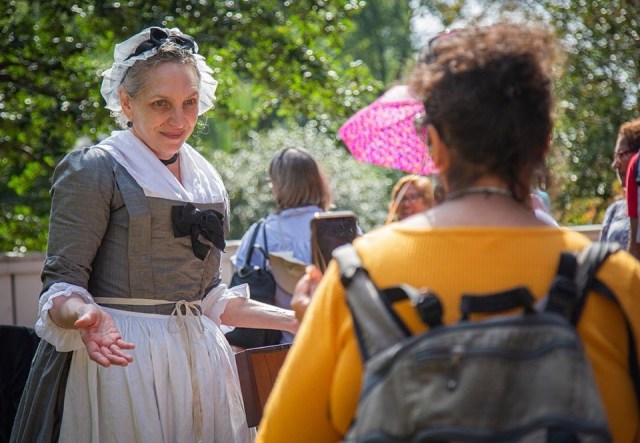
Mistress V shows visitors our modern wool bunting flag
Materials
Wool bunting and silk were the most common materials used to make flags, colo(u)rs, and standards in the 18th and early 19th centuries. Colours, as advertised by Rebecca Young, likely referred to regimental colours, though a naval “colour” could mean a national flag flown by the ship. During the Revolutionary War, there were state navies in addition to a Continental Navy, further complicating the issue. (This complication also existed in the army. There are parallels today in the state National Guard units, which operate under a state or commonwealth governor, unless called into federal service. It’s your state national guard that comes to dig you out of your car in a major blizzard, but they can also be called to serve in wars, as you may recall from such debacles as Abu Ghraib.) Bunting came from Sudbury, England, and was woven in narrow strips. The strips on the Tecumseh flag are about 9 ½” seamed, suggesting that the width was about 10” including selvedges. Narrow strips are more flexible for assembly, and allow extensive use of selvedges to make seams narrower and stronger, because they’re less likely to fray.
Techniques
The running stitches in the Tecumseh flag threw me, because I’d expected back stitches, or combination stitch at least, but when I started working with the bunting, I understood. The loose weave of the bunting will pull and distort if you apply too much tension, so a backstitch would, in the end, be less useful than a running stitch. I doubt this is true of silk flags, though; silk, being more tightly woven, would better withstand a backstitch.
Wrong Side
Right Side
Because the Tecumseh flag is mounted and framed in a plexiglas case, I couldn’t touch the seams, or see the backs, and the conservators don’t seem to have photographed both sides when the flag was being treated– or at least images were not available to me. This leaves open the question of exactly how the seams were done, but my best guess based on areas of loss is that the strips were stitched together with a slight offset, like a felled seam, and then the overlap was tucked under and stitched down with a running stitch.
This is less efficient: one person assembling an entire flag alone.
Assembly
This was probably the most delightful part of the research: figuring out how all the pieces went together. Once you see it, you can’t unsee it: flags were assembled in component parts, which were then assembled into wholes. Once we were working on the flag at the museum, the reason became clear: it’s so much quicker and easier to have multiple people working on parts, with one person assembling these parts, than to have one person per flag. This is proto-assembly line work, and it existed in 18th century workshops from tailors to cabinetmakers. Specialization equals speed, and the key to making money as a contractor supplying the army was quantity.
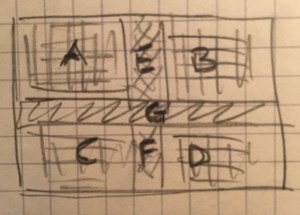
Canton components: A, B, C, D , E and F are assembled; AEB and CFD are sewn together to make two long rectangles, which are then sewn to the long sides of G.
In the case of the Tecumseh flag, there are three main components: the lower three strips, the upper three strips, and the canton, which is comprised of 7 parts. Each was assembled individually; then the canton and the three shorter strips were joined, and sewn to the long lower piece. After that, the hoist was attached and the far edge of the fly hemmed. Only then was the flag finished and ready for delivery.
Describing how strip(es) were assembled to become the Fort Mifflin flag.
The Fort Mifflin flag, 13 stripes of red, white and blue bunting, ending in red, would have been assembled in strips of two and then three, and then grouped and assembled. Working with Mistress V, the greater efficiency of assembling components became clearer. This hand-on quasi-experiment clarified some questions about how military contractors worked in the 18th century– at least the ones sewing. The system had to include multiple hands, working together in a shop or doing piecework at home for assembly elsewhere. There was just no other way to efficiently make the quantities of goods– 500 linen liners for light horse caps; 293 shirts; multiple standards and colours– at the speed the army required. The quantities also suggest that Rebecca Young was not just a widow-turned-contractor, but that she had working and organizing experience before she was widowed, along with a network of contacts who, along with some of her children, helped produce these goods.
This time, unoccupied. I’ll be representing Rebecca Flower Young at the Museum of the American Revolution’s Flower’s Artificers event this coming weekend, and to get ready, I’ve been reading research material generously shared by museum staff, as well as Marla Miller’s classic Betsy Ross and the Making of America, which mentions Rebecca Young in the context of the competitive world of Continental Army contractors in 1780s Philadelphia.
Rebecca Flower Young (1739-1819) was an older sister of Benjamin Flower (1748-1781), Lieutenant Colonel in the Continental Army. Before the war, she lived in Philadelphia with her husband, William Young, a goldsmith, and their five children. The family fled Philadelphia for Lebanon, PA in September 1777 as the British Army advanced to occupy the city; it would not have been safe for them, given their ardent Whig politics and relationship to Benjamin, commissary general of military stores. After William Young’s death in February, 1778, Colonel Flower secured a house for his sister on Walnut Street, and work as a contractor providing supplies for the Continental Army.
Rebecca made drum cases and shirts, cap linings and cartridges, and multiple Continental standards. From the quantities she produced– 500 cap linings for light horsemen– it is possible she hired assistants in addition to her children. Her 17-year-old son William made “five hundred dozen of Priming wires and brushes” in 1780, aiding the war effort through the supply chain rather than as a foot soldier, a condition that was likely a relief, given Rebecca’s status as a widow. She also let a room in the Walnut Street house, the boarder’s rent providing a relatively steady and reliable income.
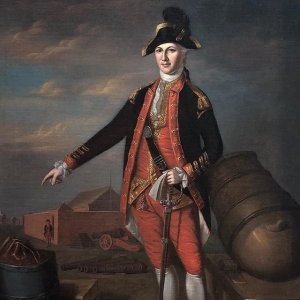
Col. Benjamin Flower, oil on canvas by Charles Willson Peale. Star-Spangled Banner House, Baltimore, MD.
We have no idea what Rebecca Young looked like, of course, though there is a portrait of her brother, Benjamin, in his uniform, as well as a portrait miniature sold at Freeman’s.
With only written sources about her work to guide me, I have waffled back and forth about Rebecca Young’s material world. In the end, I have made a much-needed new shift and cap for this weekend, as well as a gown (that, of this writing, requires only one cuff and the skirt hem). After reading Miller on Betsy Ross, I was of two minds: first, that the material world of these women was shabby and out-of-date, given the privations of the occupation and the war-driven inflation and second, that their status as contractors gave them an income that allowed them to afford new things. Still, with five children, new anything would have been a stretch, so I remain undecided and firmly ambivalent about the appropriateness of this gown. Scissors, needles, pins: those tools are much easier to understand than personal circumstances.
We approach representing the past with preconceptions that are hard to shake: the images we have in mind are dominated by representations of people at the far ends of the economic spectrum. It’s as if we had only the Saks Fifth Avenue and Old Navy websites to help us understand American clothing today. The wildly divergent economic and material situations tell us little about the people in the middle, who make up the vast majority of the population.
Research and primary source materials on Rebecca Flower Young were provided by Matthew Skic of the Museum of the American Revolution; compiled information used by gallery educators at the MoAR was compiled and provided by Katherine Becnel of the MoAR.








 Kirsten Hammerstrom
You must be logged in to post a comment.