Making up Monday

From Jaipur, darling.

Sometimes you’re a jerk without meaning to be, usually because you can’t see past your own limited self. I was that jerk on Friday, when my obsession with a missing package led to unfortunate words with both a supplier and worse, my sweetheart, about an unexpected length of fabric lately arrived from India. Would that my brain would work faster, for by the time I’d figured out what to make of it, the conversation had turned, and an additional 300 miles lay between me and the recipient of my confusion and dismay.

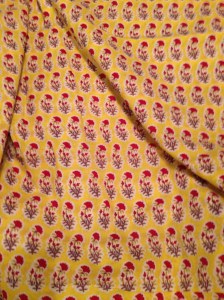
Despite my best intentions and resolve, I am a sentimentalist. This instinct sometimes conflicts with a devotion to honesty, for kindness often lies in elision. Confused? Short story: I don’t wear yellow, but a package arrived Friday with a dress length of printed Indian cotton, red and green flowers on a yellow ground.

“But Kitty,” you say, “Don’t you crave the hideous, the clashing, and the correct? You applaud Our Girl History’s choice of 1770s fashionable pink, though she prefers blue. Yellow is the haute couleur of the 18th century, fashionable everywhere, even in North America. You should leap at the chance to wear it.” (I was not thinking fast at all on Friday evening.) What made me bend my resolve– what will always makes me bend my resolve?

Petticoat fragment. Note yellow, with crudely printed lining. Wintherthur Museum 1959.0118.004
Petticoat fragment. Note the bright yellow, with crudely printed lining. Wintherthur Museum 1959.0118.004

Sentiment, of course, backed by research.

April, that cruel month, brought obsessive searches for Indian cotton print appropriate for the 18th century, as I looked at sample books and extant garments, searching for material to create frankly annoying clothing. Orange and green check with clashing Spencer and bonnet lining isn’t enough: I want to push my representation of the fashion sense of the past closer to truth. People in the past weren’t as matchy-matchy as we are, and their ideas of stylish, attractive, and fashionable were very different from ours. Loud was ladylike, and that’s a style statement I can get behind. Along the way, I ordered fabric in a pink and green (a departure itself) floral print on white ground, yardage now long overdue.

Textile Sample Book, British, 1780. MMA156.41 P34

A friend has been dabbling in these same waters, and made up a new gown for Mount Vernon, satisfyingly loud and clashing with our modern sensibilities about the past. Our mutual friend, also at Mount Vernon, assisted her in choosing a dress length for me, and reader, I was confused and lacking when it arrived. But like any good curator in a social history museum, it was the story that got me. How can I resist a gift from a fellow enthusiast in a pattern chosen by my sweetheart, on the grounds that I don’t wear the color? Reader, I cannot.

Think of Cranford, of lengths of dress muslin requested and never received, and the sentiment embodied in that fabric. Think of women in Providence craving an India print gown, of lovers, husbands, sons, ordering dress lengths at trading ports thousands of miles and long months from home. Think of the affection and thoughtfulness embodied in textiles brought back months after they were requested. Complex meaning is woven into that cotton, giving this dress length interpretive meaning before it is even a garment.

Now what? Now I have to decide which century/event this gets made up for: 1812-1817, 1778, 1804, 1768. There are many choices, but with the meaning embedded in the fabric, I’m most inclined to make something I’d wear often– not that this is particularly housekeeper-appropriate.

And about the research you ask? Yes, small floral print on colored ground is documentable to the 18th century. While early and European, here’s an example of an Indian motif translated by Dutch makers for printing in Sweden. Rhode Island merchants traded in the Baltic, so given the early date of this fabric sample, its arrival in North America could predate 1788 and John Brown’s first ship to China and the far east trade. Possible? Yes. Probable? We can have a lively discussion, in which I will point out the Brown’s love of all things French and French translations of bright, small motif print patterns. The printing factories in Sweden ran until 1771 and produced at least two relevant prints. Would my successful Presbyterian farmer have bought something like this for me in New York or Philadelphia? Would I have worn something so bright and loud? Am I overthinking this? Perhaps, but yellow is a new thought for me.

With especially fond thanks to Miss N and Drunk Tailor, to whom I also owe an apology.
Wicked Inspiration

You know that musical? The one you can’t get tickets to unless they were willed to you by your grandmother because she was lucky enough to stumble out of the Tardis right at the box office on opening day, but had to buy them for, like, six years from now, and they’re actually for the Kansas City production? The one in which the founding fathers are, you know, brown? My friends and family assumed I’d hate the whole idea, but I don’t. Like so many people, I love it, and not just for the music, though my preferred method of psyching myself up for GeeDubs1790 or What Cheer Day is listening to the Stones or the Beastie Boys all the way up.

So, what then, interests me in “Hamilton,” and why do I think it relates to interpretation? This: the way that the show filters the concerns of the late eighteenth century through the lens of the twenty-first could make for enlightening listening.

My Shot gives me goosebumps: why? Is it because history and civics are finally sexy?

Maybe. But “Hamilton” as a whole, per Rebecca Mead in the New Yorker, “is a hymn to the allure that America promises the immigrant who aspires to reach its shores; it is also an argument for the invigorating power that this nation’s porous borders, and porous identity, have always offered.”

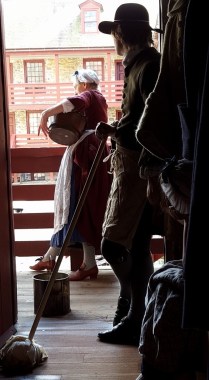
Porous identity. That’s part of why I’m fascinated. But just as “Sleep No More” and Occupy Providence (really really) were partial inspirations for What Cheer Day, “Hamilton” strikes me as the kind of production worth paying attention to. No, I am not suggesting that the paunchy reenactors start channeling their inner Biggie, though I might well pay to see that.

No, what I’m suggesting is that we reconsider what it is we’re doing out there on the field and in the historic houses, and not just what but how and why. Hamilton takes an unexpected approach to history and it’s going gangbusters, while Amazing Grace tanked. So it’s not about the costuming authenticity, though I implore you not to give that up. It’s about the passion. It’s about coming at things sideways.

What makes you love doing laundry, drilling with precision, telling local gossip, making soap, or whatever it is that you love best about your place in the past? Why does all this matter to you so much? What is it that we can learn about today as you teach us about the past? Let loose that love and passion, share those insights, and ten to one you’ll have more fun and excite more visitors.

Maintain an Even Strain

IMG_6471

Dude: I am conflicted. There are folks out there doing excellent work, but after reading some recent posts around the interwebs, I kept thinking, “Stockholm Syndrome much?”

I’m as much of a narcissist as the next person, and I think I recognize some of the folks being called out in various places for being critical of women’s roles in living history events. So, organize my own events? Come up with my own things to do?

Cool: challenge accepted.

I am, in fact, throwing down for the pleasure and pain of running a farm in late June. No, I didn’t organize it, but I was asked to take on a challenge and I have accepted, roping my favorite tailor into the effort as well. It’ll mean a bunch of studying, but in a pinch, I can always clean the house. We can rake, make refugees stay in the yard, and try as hard as we can to keep Quakers from putting radical ideas in the slaves’ heads. I think it will be hard, unpleasant, and uncomfortable—and that’s what I don’t like about the suggestions in the otherwise honestly well-intended and meant-to-inspire posts.

Playing at Quadrille. Oil on canvas by Francis Hayman. Birmingham Museums and Art Gallery

They’re so nice. They reinforce women’s subordinate roles in the past and present. Children’s activities? I might die, really, I might. If that’s your bag, go for it, please! We need it. It’s simply not something I can do.

No more can I talk about What People Wore. It’s not that I don’t care (y’all know I do) but that I want to move past the surface.

It’s not enough just to look great.

The Heir: Tom Finds New Wealth. William Hogarth.

Dive deep: find the dirt. Find the hard stuff. You don’t have to be nice. That’s my personal problem with what I’ve been reading: between the lines I keep hearing a voice suggesting that we be nice girls, that we simmer down. No, I’m sorry. I can’t. Reader, if you can, go for it.

But if you can’t, I want to tell you: Keep pushing. Keep asking. Keep speaking up. Challenge the status quo. Our Girl History did a great post on Well Behaved Women, and I fully support the work people are doing to represent the Well Behaved and the marginalized (shout out to the veteran with the knife-grinding cart: well imagined, sir!).

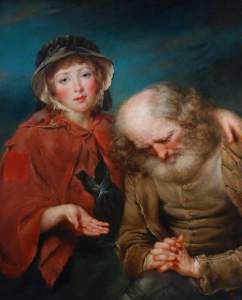
Russell, John; The Blind Beggar and His Granddaughter; The Bowes Museum;
John Russell. The Blind Beggar and His Granddaughter, oil on canvas, 18th century. The Bowes Museum UK.

Bring it. Bring the ordinary.

But if you can’t be ordinary or run the children’s games or be subservient or show how women dressed, that’s okay. For the love of god, someone, be desperate.

Be hungry, be angry, be resentful, be religious.

Whatever you do, don’t be afraid to speak your mind.

Of Chamber Pots and Train Seats

DSC_0361
Why yes: I was able to carry all my loot.

The Northeast Regional: Bane and delight of my existence, for while the night train at least allows you to sleep through the agony of an eight hour trip, and although the quiet car allows some solid time to for reading and writing, one’s seat mate can be unpredictable.

I am not a good seatmate. My legs are long, and I have a marked tendency to cry through several station stops (or states) when leaving someone I love. But the foolproof way to maintain seat independence is writing: reading over someone’s shoulder is rude enough that I feel little guilt in writing all the things I write about. On train 86, it was chamber pots.

DSC_0367
How fantastic will that look with blue?

Part of my southward trip was to the Market Fair at Fort Fred, where I was pleased to visit old and make new acquaintances in addition to shopping. Handkerchiefs: can you ever have enough? I think not, and was delighted to find one pretty much guaranteed to clash with any blue gown.

You can never have too much to read.

Thread is always useful, and I find it easier to purchase in the flesh, when I can get a better sense of gauge and color. I’d had a request for a period-appropriate notebook and a replacement pocket knife, and was delighted indeed to find one (I bought two) that will hurt less to lose.

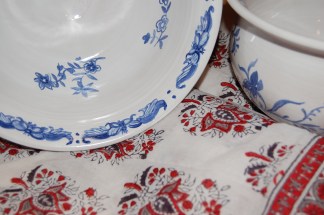
But, reader, best of all was the pottery. I possess enough self restraint to know I cannot venture near the mocha ware, for I might take leave of all common sense and purchase more than I can carry on the train, fit in my already full cupboard, or reasonably afford. Still, there was a custom punch bowl to see, kindly ordered for me some months ago, and, by the same potter’s hand? A chamber pot.

DSC_0363
Because I can, that’s why.

Not for me the lighthouse coffee pot (though of course I covet one). No, sir: the blue floral decorated chamber pot caught my eye, and have it I must. So I do.

I realize I have a bit of an obsession, and that one might consider this an unholy interest, but the utility of the device is not lost upon me, having had occasion to use one. Whilst staying in a 1787 house that remains unplumbed, I woke one Sunday at 2:00AM to pouring rain outside, and the urgent call of nature inside. Privies don’t faze me, but I lacked adequate rain protection and a fireproof light source. Happily, I had discovered a chamber pot in the house when I poked around it, and was able to find it by candlelight.

Two hip replacements make some activities more challenging than others, hence my tip: put it on a chair. Your floor will thank you.