Hell is a Hand Basket

Gentle Reader: Remember the post on semiotics? We need to go back to that once more.

Just what are we looking at here?
copley_john-singleton-mrs-daniel-rogers-middleton-collection

John Singleton Copley.
Portrait of Mrs. Daniel Rogers (Elizabeth Gorham Rogers), 1762
50 X 40, oil on canvas.
Middleton Collection, Wake Forest University
HC1991.1.1

Hmm…. 1762. Does that dress look like 1762 to you? Or does it resemble a 17th century garment? Check out those sleeves: scallops. The shift sleeves: super full. The line of the gown at the neck: a shallow scoop. The front of the bodice: closed.

Are those the hallmarks of a typical 1762 gown in New England, England, or France? You are correct, sir: They are not.

What’s happening here? What is Copley doing, and why?

He’s making his subject look good, reflecting her wealth and status. He’s flattering her by painting her in a faux-17th century gown, a “Vandyke costume, a popular artistic convention in England related to the vogue for fancy dress and masquerade.”* 1762 seems a trifle late for this convention, but in 1757, James McArdell produces a mezzotint of Thomas Hudson’s portrait of the Duchess of Ancaster. Henry Pelham wrote to Copley in 1776 that he had purchased one of those mezzotints, suggesting their use as references for Colonial American painters. Reynolda House has a nice explication of this style of dress in the Thëus portrait they own of Mrs. Thomas Lynch, shown below.
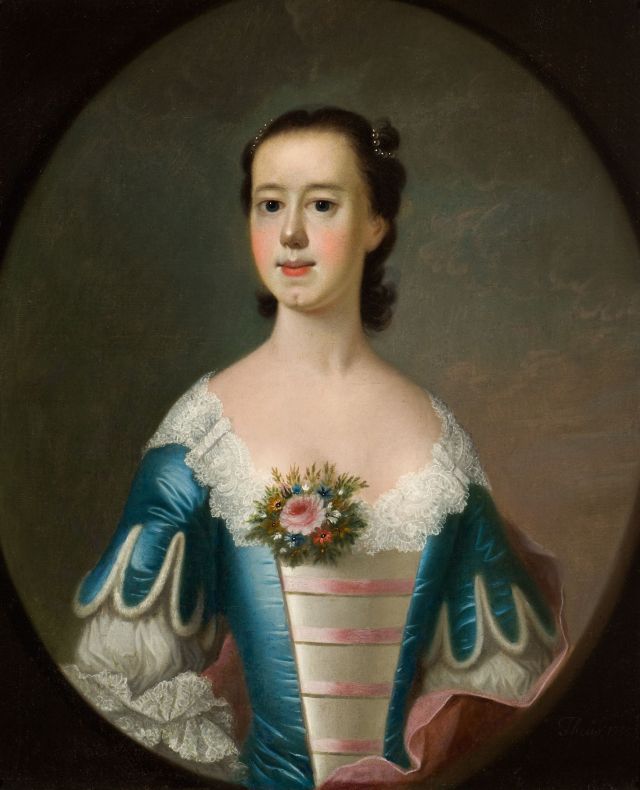
Mrs. Thomas Lynch, oil on canvas by Jeremiah Thëus, 1755. Reynolda House, 1972.2.1

There was also a convention of portraying women in “timeless draperies,” following the school of Peter Lely and Godfrey Kneller, both late 17th-century English painters who produced portraits with generalized costumes.
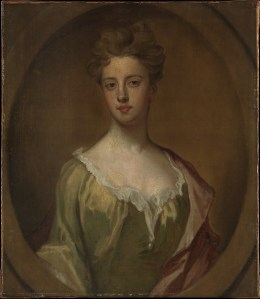
Lady Mary Berkely, wife of Thomas Chambers. oil on canvas by Sir Godfrey Kneller, ca. 1700. Metropolitan Museum of Art, 96.30.6

This portrait by Kneller (born in Germany, he worked in England) explains a lot, doesn’t it? And this timeless convention persists for some time, and the stylization of the facial features and hair is copied by English and colonial American painters. John Smibert, long familiar to many of you, was a leading practitioner of this style of portrait, and his work would have been well known to Copley and his sitters.
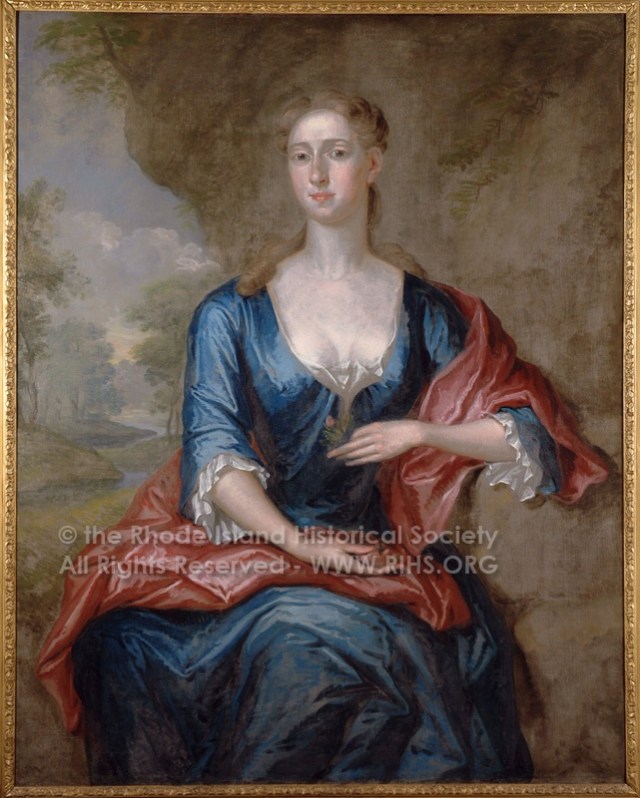
Mrs Samuel Browne by Smibert, RIHS 1891.2.2

Blackburn’s portrait of Mary Sylvester adopts two conventions at once, in a way: she’s in timeless-style drapery and fancy dress as a shepherdess. Let’s remember, too, that there’s symbolism in the shepherdess imagery, referencing pastoral innocence and Mary Sylvester’s unmarried, presumably virginal, status. Don’t believe me? Read the catalog entry, written (at the very least) under the supervision of actual, degree-toting art historians.

Mary Sylvester, oil on canvas by Joseph Blackburn, 1754. Metropolitan Museum of Art, 16.68.2

Where does that leave us with Mrs. Rogers? She’s portrayed in what is essentially fancy dress, holding her straw hat in her left hand (much as Mary Sylvester is) with a basket over her right forearm. You will note the open work of the basket, the delicate arches and the fineness of the base. What’s in it? Something gauzy, as light as the drape around her shoulders, with a square of dark blue silk and a fine white silk ribbon. Honestly I am not entirely certain — the resolution of the image is dreadful.

But what’s NOT in the basket? A redware or pewter mug, sewing, keys, bottle, food, candy, toys, or, really, anything of a very concrete or practical nature.

Is this image a justification for carrying a [nearly empty ] basket on the streets of Boston? Of course it is–as long as you justify walking the streets of Boston in imaginary or fancy dress.

*p.106, Ribeiro, Aileen. “‘The Whole Art of Dress’: Costume in the Work of John Singleton Copley.” John Singleton Copley in America, Metropolitan Museum of Art, 1995.

Mop It Up

"Useful occupations: Women's work, sewing, spinning, washing, ironing etc," illustration from Basedow's 'Elementary Work', 1770. Etching by Daniel Chodowiecki — at LACMA
“Useful occupations: Women’s work, sewing, spinning, washing, ironing etc,” illustration from Basedow’s ‘Elementary Work’, 1770. Etching by Daniel Chodowiecki — at LACMA

Mrs. Boice is at it again, folks: you can register now for a workshop in just a few weeks where you can learn more than you thought you’d ever want to know about getting ready for winter, laundry, caps, games, and dancing. Thought honestly, I think you can never know too much about these things, which is why I keep trying!

Yes, it’s what I think about: how did women prepare houses for winter? How did they get things clean? It was a lot of hard work, and is often underrepresented in historic sites both domestic and military.

You can learn more about the weekend online or download the detailed flier.

Documented Fantasies

It was three years ago on a warm August afternoon in the museum room we’d turned into a photo studio when I quipped, “All my fantasies are documented.” It’s been hard to live down ever since.

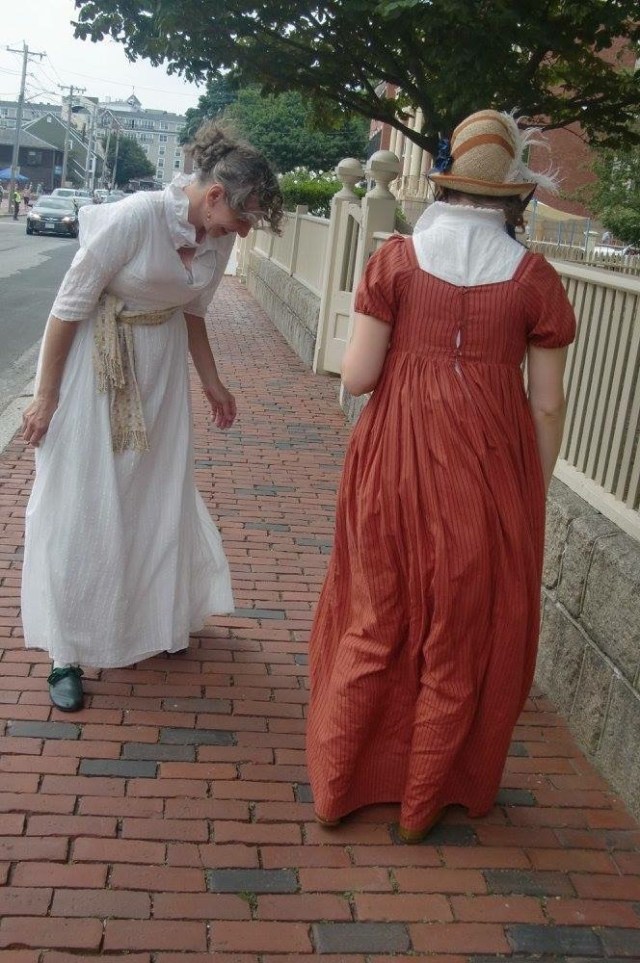
With Mrs B watching Miss B self-perambulate upon the sidewalk.

Documentation, research: we all do it, everyone who reads this blog does it. What matters is how you use it– or, maybe even more importantly, how well you understand how you are using your research. This past weekend was the Salem Maritime Festival, and round number three for me in the West India Goods Store (WIGS, which sounds far more political than it is). The year was 1804, and as you may recall, that required a new dress.

Reader, I wore it. And it survived!

Yes, it is made from an IKEA curtain. The pattern is my own, derived from examples in Janet Arnold, at Genesee, and the KCI. Once again, I discovered the power of upper body strength and leverage. It’s not that my stays are too big necessarily. The busk is too long, that I will grant you. But I think the shoulder straps are as well, and the shift– that slattern! She was rolling a la Renaissance Faire, which is completely unacceptable, of course, as she slid down my right shoulder by the end of the day when the shop had been unpacked into the conveyance.

So let us focus on the non-slattern part of the day, when a mercantile enterprise briefly overtook the WIGS.

There was some custom, though numerous debts were recorded in the ledger.  (Somehow, there are no images of Mr K sweating over the figures in the book, though I recall them clearly.)

IMG_7634 (1)

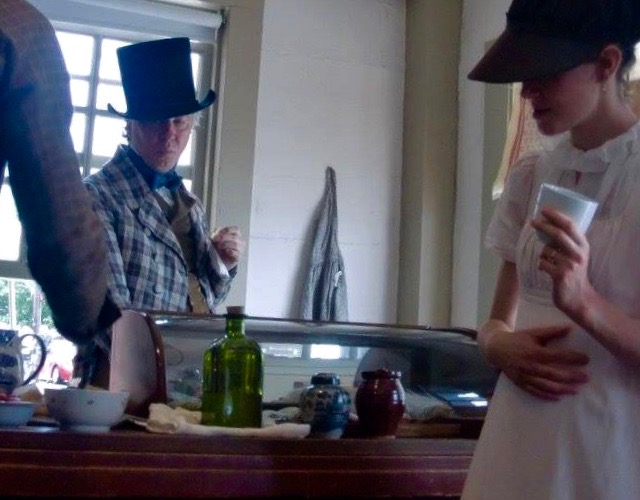
The shop was hot, but we attempted to stay fed and hydrated, as we discussed the various kinds of goods imported to places like Salem and Providence in 1804. Politics were rather difficult to discuss, as Mr K has a marked antipathy for Mr Jefferson that caused a mild agitation; expanding the country does seem a bold and perhaps unconstitutional move, given the deal Mr Jefferson has struck with Bonaparte, but perhaps this is for the best. The Indians will surely benefit from Christianity and education.*

It’s engaging in the moment, and we’ve done our research. But it’s a fantasy nonetheless, a kind of happening grounded in primary sources and material culture. I’m OK with that– I understand what I am doing– but I wonder sometimes if the people I’m watching on social media understand what they are doing with the fantasies they portray.


* To be SUPER clear, I’m staying in character here. I worked in Missouri and I have enough understanding of “manifest destiny” to disagree with this point of view.

Friday’s Fright: A Dress in White

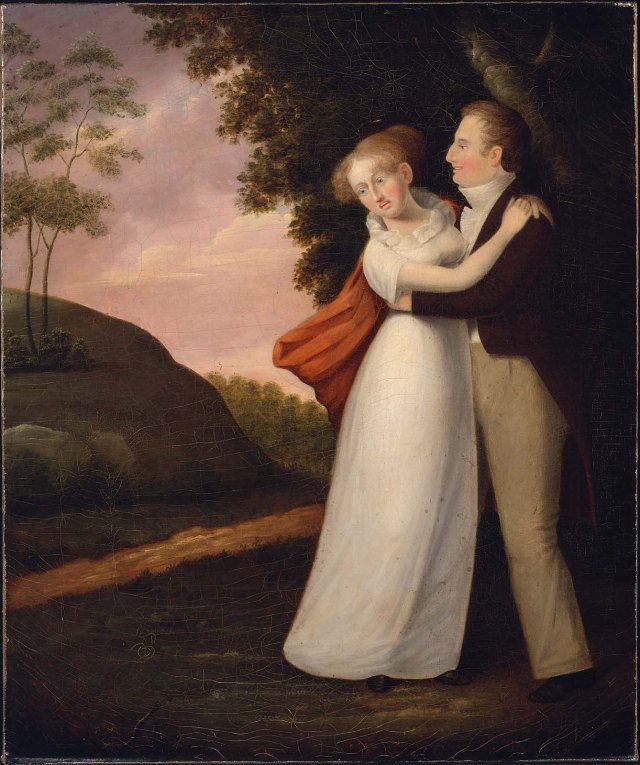
The Frightened Girl, oil on canvas by Cephas Thompson ca. 1810. MFA Boston, 1986.397

Two paths crossed for me this week, both in the early Federal era. Cephas Thompson, a self-taught New England painter, recently became very interesting to me. Although he grew up in Massachusetts, Thompson painted extensively in Virginia, but also in Providence, so of course the story resonated with me. But even more than the story, I loved the images. What a show the portraits would make– and he seems to have painted miniatures as well– so when I met with a local preservationist who turned out to be a fellow art school fugitive, wheels began to turn.

“What clothes!” my new friend said.
“I can get you a room full of people in those clothes,” I replied. And what fun would that be, a gallery opening where the people in the portraits appear to have come to life? Beats the pants off mere mannequins, but keep your Cossacks on: this one’s gonna take a while. In the meantime, what about those clothes?

Salem Register, July 14, 1803.

Saturday marks the third time I’ve been part of the Salem Maritime Festival, and once again the West India Goods Store will be the base of operations for a mercantile enterprise. Millinery has its charms, but this year, the park historian shared fascinating notes on “She Merchants” of Salem, and the Hathorne sisters really intrigued me. Drunk Tailor dug into online newspapers (harder than ever to access remotely) and found an 1803 issue of the Salem Register

That’s an incredibly helpful list of goods to sell (and to pack from the Strategic Fabric Reserve), but a new year means a new dress, of course, and for reasons still not entirely clear to me, this seemed like exactly the right time to wear white. That’s sort of where Cephas Thompson comes back into play: white dresses.

Mrs. Cephas Thompson (Olivia Leonard). Oil on canvas by Cephas Thompson, 1810-1820. MMA, 1985.22

There’s a pile of white cotton and white linen on my table, ready to be packed up this evening: with the dress on for a fitting, I felt like a bowl of whipped cream, the red silk Spencer and scarf the cherry on top. Happily, white and red are documentable to New England, though I would be mortified to be as frighted of a garter snake as the girl in Thompson’s painting. Strawberries and coffee are entirely different, and I shall probably require a bib for Saturday, lest my whipped cream be spoilt.