Bang Bang Pew

img_8896Like an energetic Golden Retriever, I need to be walked daily, almost without regard to weather, and I have a fondness for water that I fear makes me a questionable house guest-cum-nurse. Fortunately for me, Drunk Tailor has a granular knowledge of his surroundings that allows him to recalibrate his understanding of the places he likes to suit my needs: hence a Sunday trip to Fort Washington, Maryland. Plenty of room to wander, a wide* meandering river, defensive weapons installations.

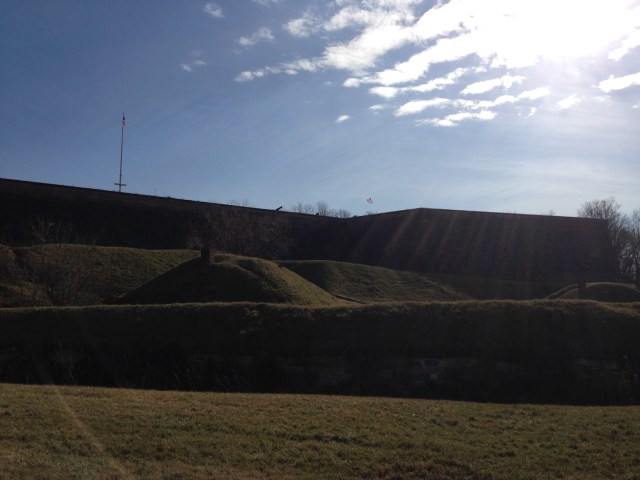
It’s a large site and we only explored the main fort structure, the shore by the lighthouse, and the visitors’ center (I’ve seen plenty of Endicott batteries before, both on the Potomac and on Narragansett Bay). It started out well enough: the curious tripping stick figure sign warned us of the wooden bridge into the fort, and reminded me of a friend with a fondness for fonts and curious graphic design.

img_8890Guardhouse, batteries, masonry walls, stables, earthworks, former ditches, the remains of powder houses: all good stuff. The signs were what one comes to expect from the NPS: UV-damaged labels, slightly behind the times graphically, indicative of the slow pace and underfunding of the preservation of our national heritage.
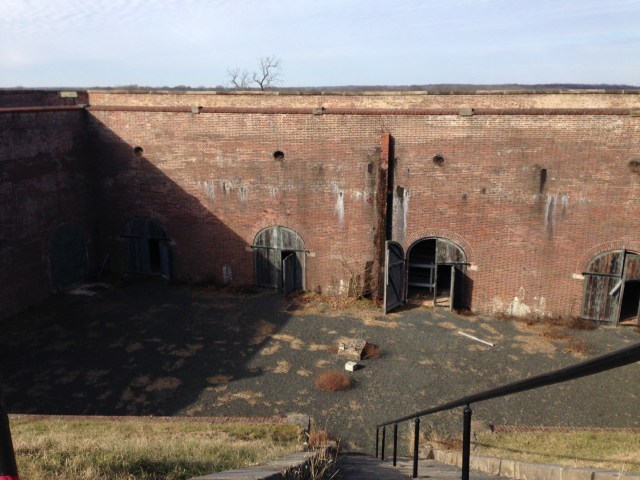
img_8894

Drunk Tailor’s memories of Fort Washington include a first-person living history event set on the (literal) eve of the Civil War, with men portraying member of a Texas-based unit wondering how they would ever get home, and responding to a woman’s inquiries about General Lee and Grant with the suggestion that reading Harper’s would bring her up to date with current events. Now, we are in January and my expectations are low in the cultural heritage off-season: this is the time for maintenance, upgrades, rest and refurbishment.

img_8903
All the pew. Plus some spinning.

What I did not expect– though I should have– was the leftover daily event roster from some time in 2016.

Boom! Goes the cannon, et cetera. Because Boom! is easy. Add in a side of spinning and we are good to go, right? We got something for the ladies. (You know where this is going, right?)

The best thing I can say for Fort Washington is that I was spared endless racks of brown sticks displayed with only the barest of identifying labels and no interpretation**. But here we are at a site with over 200 years of history and just the vaguest hints in the visitor center of decades of use and change over time. And I like military history. I like weapons. But the more I visit the more I marvel at the way we underestimate our visitors’ capacity for understanding and interest in the past.

img_8889
Bigger Booms

As we drove away from Fort Washington, I began to think that once again, we are asking the wrong questions. Instead of questions that can be answered, “Guns Got Bigger,” why not ask some of the following:

  • What was daily life like for the men stationed here?
  • What material differences did officers and enlisted men experience?
  • Could enlisted men get married? Where were their wives?
  • How much did soldiers get paid?
  • What was the typical term of enlistment? Did that change over time?
  • Where were the stables? What were the horses used for?
  • How was the fort supplied? Where were the kitchens?
  • Where were the mess halls? What was a typical diet?
  • How did rations differ for men and officers?
  • Did any of the British officers or enlisted men remember the area around Washington, D.C. from their service in the Revolutionary War? To what degree might that have influenced the way the War of 1812 was fought?
  • What about that court martial, Captain Dyson? How was it run? What testimony did Dyson give?

Why did I have to go to the Fort Washington website to learn about the Adjutant General’s school, and the WAAC detachment? And why is it a PDF instead of a webpage?


Perhaps the most salient question to ask, on the Monday of inauguration week, is why do we care so little for our shared past that we accept the level of funding and staffing that gives us this level of interpretation? Don’t we, as a people, and our history, matter more than this?


*For the East Coast. The Potomac ain’t no Mississippi.

** I’m looking at you, West Point Museum.

My Life as a Chair, or, Warm in Winter

Can I get an “Aw, yiss” for being warm outdoors?

img_8826
After the aftermath. Photo by Drunk Tailor.

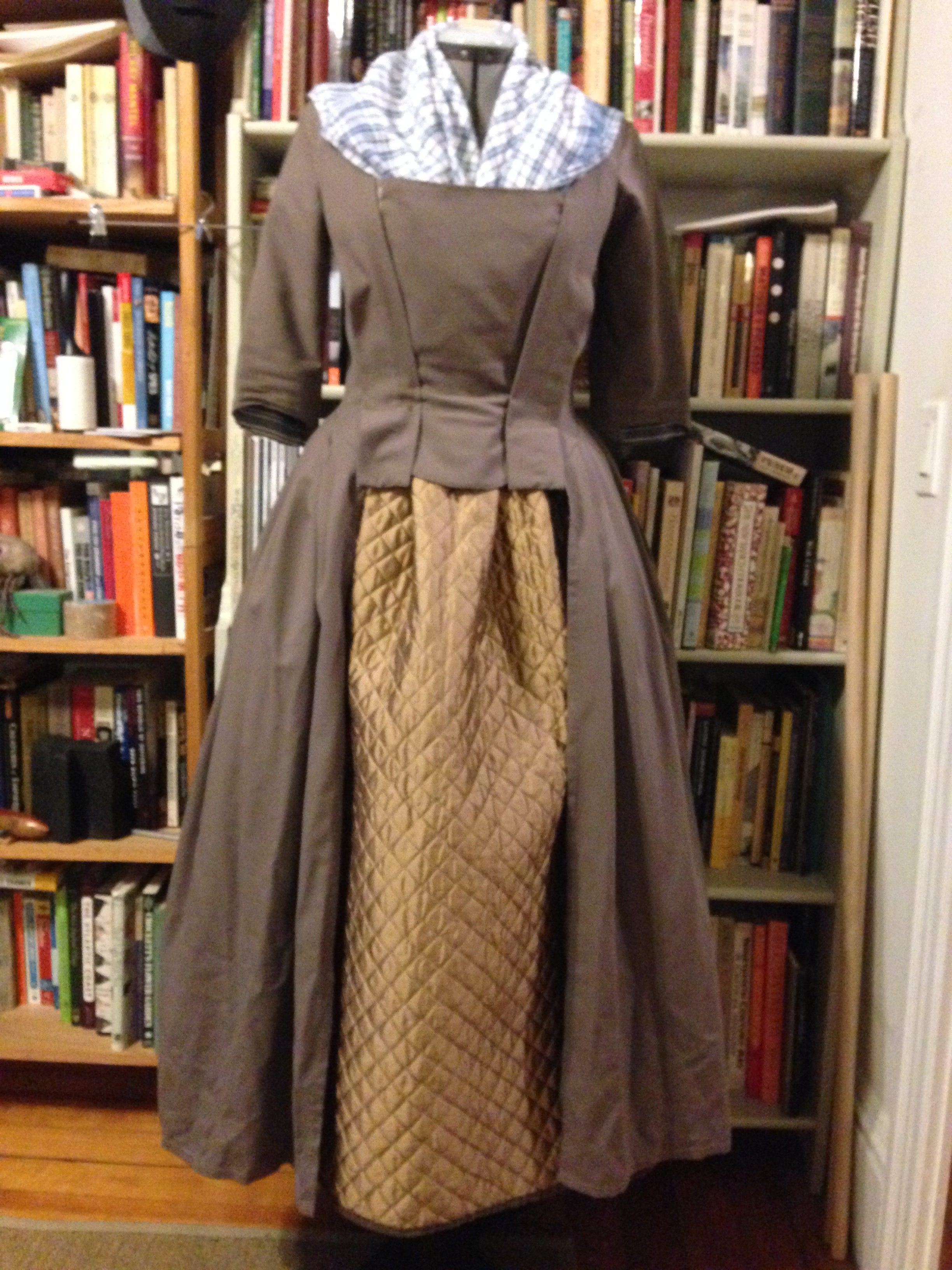
They may not be the most accurate <cough>machinestitchedoffabolt<cough> quilted petticoat and waistcoat, but they sure do make a difference.

These aren’t exactly base layers– a white wool flannel shift would not be amiss–but the quilted layers make a big difference to a day in the cold. When I added up the layers, I came to 8 without counting accessories like neck handkerchiefs and stockings:

  • Shift
  • Stays
  • Waistcoat
  • Lightweight Wool Petticoat
  • Heavy Wool Petticoat
  • Quilted Petticoat
  • Gown and Stomacher
  • Cloak

It isn’t always pretty, but in cold, wet weather, function trumps fashion (not that I’m not pretty pleased with this upholstery). The waistcoat ties on, so you have some adjustment should your weight or shape fluctuate. The petticoat, in this case, works like every other petticoat, with the sole exception of a short pocket slit on one side due to operator impatience (this was finished just a few days before it needed to be packed for Princeton).

img_8823
Thanks to Drunk Tailor for more patience.

The quilted fabric (originally intended, I am sure, for a bedspread) is lined with a plain weave wool for extra insulation and body; the waist band is bound with wool tape, as is the hem. Down in the basement, there’s a camblet- wool batting- linen lining sandwich on a frame, ready for quilting, if I only I would drag it up stairs and start, and I know it would be both more insulating and more accurate.

Does it all fit? Well…pretty much! An open robe with stomacher makes it easier to fit all these layer underneath, and, happily, I don’t have the best sense of my own size, so my clothes tend to be a little bigger than they must be. Fortunately, historical clothing generally involves adjustable closures that make fluctuations and layering easy to accommodate.

After Anna B’s and Anna K’s comments on the overview of the event, I was reminded that these are the confessions of a known bonnet-wearer, and I will humiliate self for history, so in case you are wondering: no, I didn’t wear drawers of any kind, or leggings, or long underwear. A pair of silk stockings under a pair of wool stockings kept my lower extremities warm, but my nethers were sometimes chilly, in a highly specific, localized, but small way. I think this may be where the wool shift comes in– or one that fits a bit better than my current garment, which is a tad too large.

On the porch at Morven, a range of head coverings. Photo by Matt White
On the porch at Morven, a range of head coverings. Photo courtesy Matt White

When it comes to ears, you can see that we adopted a range of solutions. Ear-covering caps under bonnets, under straw hats, and under kerchiefs, were worn by some. At far left, my cap perched on top of my head, so I tied my bonnet on with a kerchief and pulled my hood over all of that. Mistress V (at far right) wore a cap, a kerchief and a hat (which was summarily removed in the afternoon, by Mistress S at her left). Mistress F, holding the cream colored blanket with a wide black stripe, wore a wool hood over a cap and under her straw hat. Wear enough layers– and the right layers, meaning mostly wool and silk– and you will be warm, perhaps even sweaty if you’re active. Still, I might trade in my “Hobo Woman of Princeton” look for a quilted silk hood if the right one came along.

Occupy Princeton

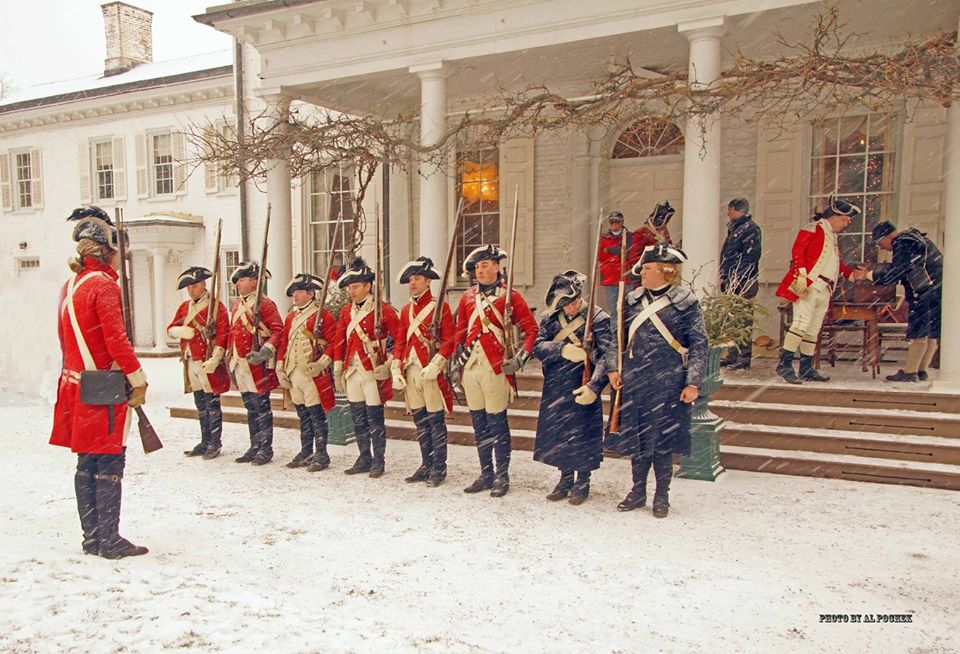
Morven Museum (Richard Stockton's house) under occupation. Photo by Al Pochek
Morven Museum (Richard Stockton’s house) under occupation. Photo by Al Pochek

What if they had a reenactment and there was no battle? Can you really interpret military history without a battle?

Why yes; yes, you can. And you can do it well, engaging and exciting visitors and interpreters alike.

Last Saturday, Princeton was under British occupation once again, as we recreated the winter of 1777 this past weekend. I joined the planning for this  back in October– I double checked– and it really started months before that. Many hands (and imaginations) make events like this work, but for me, the most exciting part was helping to produce an essentially civilian day of programming that interpreted the Revolutionary War in New Jersey. Yes, there was “a musket thing” mid-day, but that wasn’t the focus of the action.

The ink froze, but oaths were to be signed anyway. Photo by Al Pochek.
The ink froze, but oaths were to be signed anyway.

HM 17th Regiment made their base of operations/occupation the porch of Morven House (formerly Richard Stockton’s residence) while the populace of Princeton attempted to go about their daily lives in Palmer Square. Quakers found themselves pressed to sign the Oath of Allegiance to King George III, despite their protestations that they could not take sides in a war.

Quakers and citizens, surrounded by occupying troops, listen to the officer's exhortations. From instagram @thebentspoon
Quakers and citizens, surrounded by occupying troops, listen to the officer’s exhortations. From instagram @thebentspoon

Some citizens seemed all too eager to sign the Oath, though rumor had it that one had previously pledged his loyalty to the rebel cause. (Sources have it that by the summer of 1778, this miscreant will be exacting revenge upon his neighbors as a Retaliator.)

Vignettes were drawn from documentation like the Brief Narrative of the Ravages of the British and Hessians at Princeton, 1776-1777:

“Triumph on that Days Victory the noted third day of January 1777 when they took two men and a Woman that could not stand Prisoners one of the men being much younger then the other & haveing shoes on made his Escape The Woman being unable to march they left her so they had in truth none from Princetown to Crown their Conquest with but the poor Old Captive without shoes. This is the Renowned Victory Obtained that day near Prince- town Which (it is said) is amply set forth in one of the New York newspapers 1 to be a Compleat victory obtained by the Regulars over the Continental Army so far as I have Related is true according to best Information that I can get, And so far I agree with that news Paper that the Regulars gained a Victory over two men and one woman. …. In takeing these three Prisoners they violated three of their Officers Protections for the two men had Each of them one, and the Womans Husband had another Besides they are all Reputed Quakers…” (Brief Narrative pp 18-20)

Lance Corporal Becnel proved himself in the afternoon.
Lance Corporal Becnel proved himself in the afternoon. Photo by Al Pochek

The constant snow kept our shoes on, but goods were stolen, occupants assaulted, soldiers beaten, prisoners taken, and justice served.

Hardy visitors followed us from Morven to Palmer Square and back, and one of the most exciting moments of the day for me was when a visitor said, “Wow, so the [British] soldiers didn’t really protect you, did they? You couldn’t count on them to keep you safe!” This seemed a pretty good summation of our interpretive goals:

  • The British failed to win the “hearts and minds” of New Jersey residents because they turned liberation into occupation.
  • The British lost the war in New Jersey because they treated everyone as a traitor.
  • The revolutionary war in New Jersey was as much a civil war as a rebellion against the crown.

I count that a major win for living history.

Trigger Warnings

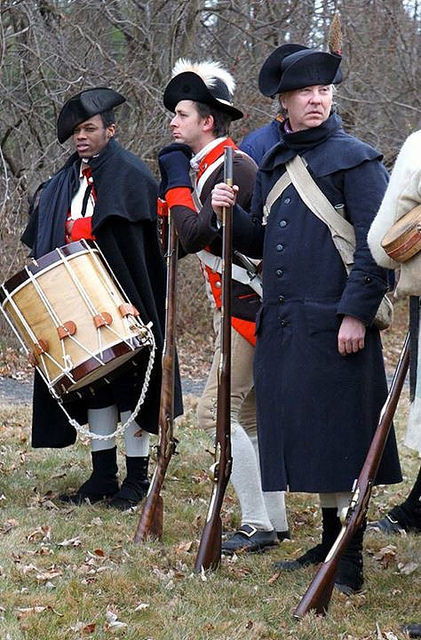
Reenactors portraying Philadelphia Associators take part in the real time tour of the Battle of Princeton, Princeton, NJ, January 3, 2015. Beverly Schaefer, Times of Trenton
Philadelphia Associators January 3, 2015. Beverly Schaefer, Times of Trenton

It’s upon us, this Princeton event, and Peale’s, too. And the overnight march I missed two years ago. I’m so glad to be part of this, and I’m interested in seeing where it goes from here– partly for me, and partly for the way we do living history. Now, I’ll miss some of what I’d like to see (like Mr. White’s tour of the second battle of Trenton, but when you’re plundering in Princeton, you’re committed.) A formal media release may be downloaded here.

A little more than two years ago I was asked if I wanted to join the Peale’s March to Princeton. I said no, because women couldn’t march and that was the experience I wanted. Someday, I will have the hallucination that allows me to square experiential learning with authenticity, and, at the same time, the world will care about having a women’s Tour de France.

Anyway: there’s a point. This event became a pivot point for me in thinking about accuracy and authenticity of all kinds.

Accurate impressions rendered in a place of shared value will transport you to the past, and give you insights you did not expect. That is the point of these exercises: insight and understanding. It’s how to get high on history.

Test run: bedspread petticoat. Girl's gotta keep warm.
Test run: bedspread petticoat. Girl’s gotta keep warm.

In Palmer Square and at Morven, that means stealing (from each other), soldiers arresting Quakers, Loyalists and Whigs insulting each other, arguments about loyalty oaths, and women being attacked. (When you see the grey gown grabbed off the square by the red coat, please know that this is acting.) It means rough justice in a drum head court martial.

Will it work? I think so. Will it change my life, the way not attending two years ago did? That will depend on what I regret.