It’s not done, it’s as simple as that. I had a shift in hand for HSF #2: UFO. Along the way, I made significant progress: side seams sewn up, sleeve seams sewn up, and all of them flat-felled, until, at last: One sleeve band and a hem stood between me and completion. Whatever week that was, on that Sunday evening, reader, I slept. Work does that to me.
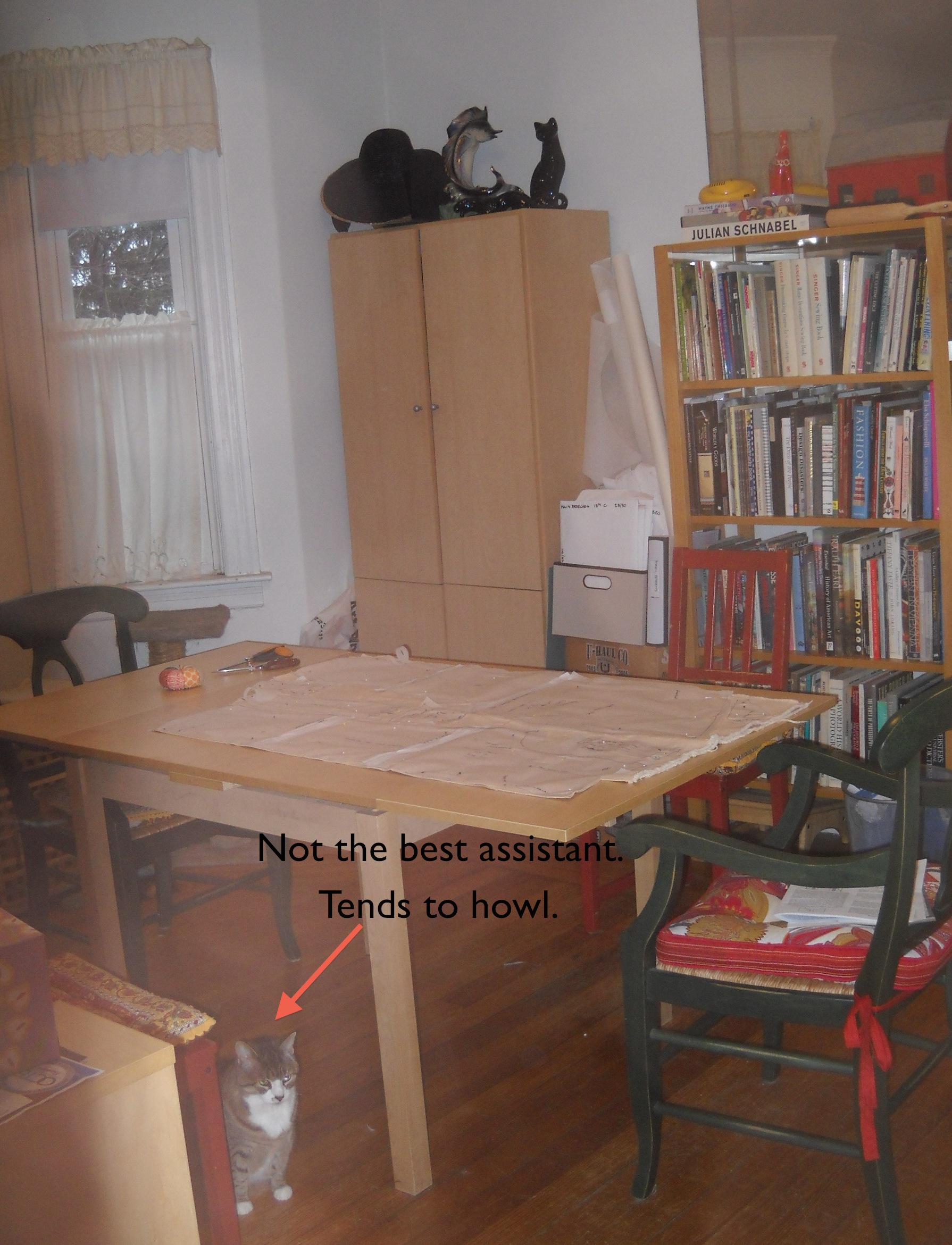
Assistant has been howling more of late
Luckily, I can kick it forward to HSF#3, Under it All, because that petticoat isn’t cutting itself out. It’s not its fault: there’s homework piled on top of the table, a bill from the dentist, and other assorted bonnet-related chaos. All day long the linen and cotton listen to my howling assistant, then the Young Mr comes home and coughs, and what’s yardage to do? Drape over a chair, flat-out, folded, and exhausted.
It’s not history until it hurts, and I can assure you that from how my colleagues and I feel, our Library is chock-full of history goodness (along with 18,240 moved books and a great deal of newly assembled Ikea furniture).
One of things I like about the HSF series is that it keeps me sewing. It’s good to have accountability, and the challenge provides it. Structure, and deadlines: good for the soul.
And then there’s that factor known as work. We’ll call it that, as the effects are often described in language not suitable for the New York Times, last bastion of manners. Poor William Shawn spins as each New Yorker is printed: he’d never let //platform.twitter.com/widgets.js” target=”_blank”>douchebag pass.
But I digress.
Things changed in the schedule and now I don’t have to sew delicious frock coats and corduroy breeches for February. The good news is that I will not have to wrangle the unwilling to be fitted immediately, and I will be that much more skilled by Fall, when the clothes will be wanted. It also means (sort of) that there is actually time to sew for me. This is a very good thing, as I am planning to attend Dress U and even to teach (heaven help us all) two classes, one on using museum records and collections online and in person, and another on what Reenactors and Costumers can learn from each other. So while I’m thinking about 1790s wool jackets and trousers, a Battle Road-worthy wool gown (pfft! Gowns seem easy now!), Battle Road men’s wear (a little queasy, not so easy) and at least one more pair of overalls (unprintable, really) I am also thinking about how much I don’t want to be the tiara-less, non-sparkly girl again.
What does that mean? That means silk, and the Curtain-Along Gown, which I think I have figured out. (Figuring out the silk part will come later, I’m just happy to have gotten this far…)
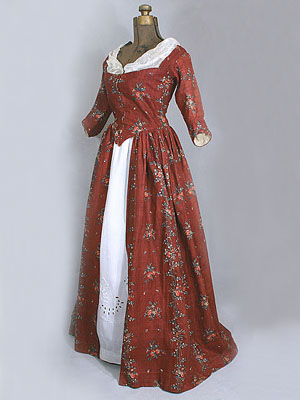
1780-1790 chintz gownFairfax House
Historical Sew Fortnightly #3 Under It All: I meant to do my shift, but that changed. Voila, petticoat. I have Ikea cotton curtains that will make a lovely petticoat that can be worn with a Curtain—Along gown of the dark red Waverly chintz, which I plan to make in the style of one of these gowns. An all-cotton, all-curtain ensemble makes me laugh: I am a Carol Burnett fan.
If I get the petticoat done, then I will have to make the pretty dress, at least eventually, which should be sometime between overalls (April 20) and Dress U (May 31).
10th Mass LI at Nathan Hale
That leaves time for something wicked regimental this way comes by June 15. Oh, yes, I expect Monmouth is in my future, humidity, turnpike and all. Why would I miss that?
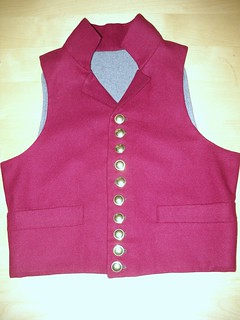
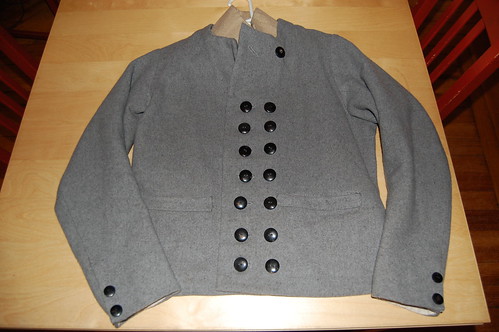
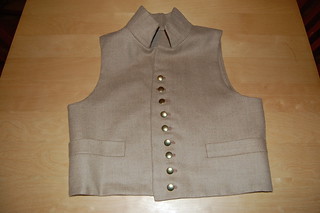
Fabric: Fronts, 100% wool leftover yardage from a petticoat. Back, wool broadcloth left over from remnant (is that a remnant remnant?) purchased for Mr S’s short jacket. Lining, heavy-weight linen.
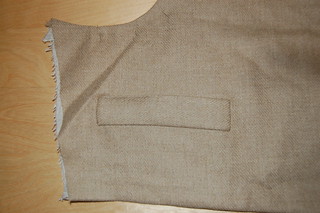
How historically accurate is it? Well…the pattern has good documentation and the fabric is within reason for the period. The waistcoat is entirely hand-sewn, and the coarse linen pocket linings match extant garments in collections. So I know that’s good. And as it turns out, I completely and inadvertently made…this! So excited to find this! More excited than you’d expect! First quarter 19th century means 1813 is A-OK!!Also, that waistcoat is HOT! So I think I have achieved pretty accurate, even if it will be used in a time machine back to 1799.
Hours to complete: This was much faster than the first one. 12 hours for cutting and sewing, with about 3 hours just on button holes.
First worn: To be worn by the new owner (The Young Mr) January 19, at the Winter Frolic
Total cost: Since I used fabric left over from a petticoat and the jacket, I’d say the cost was really only in the buttons, so $14.50.
Challenge garment peers from jacket. Calm thyselves, fellow authenticity hounds. New buttons for jacket are on order.
(Actually, the jacket was bloody where I jabbed myself with the needle inserting the sleeve, but that’s fun for another day. And how you know your historical sewing project is complete. I bled for this, man.)
The Challenge: #0, Starting Simple
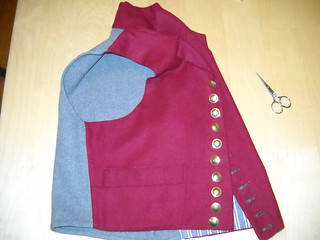
Fabric: Body: ¾ yard remnant from Wm Booth Draper WWB816 Broadcloth, light brown. Lining: Left over heavy-weight linen. Might also have come from Booth, I forget.
How historically accurate is it? Well…the pattern has good documentation and the fabric is within reason for the period. The waistcoat is entirely hand-sewn, but the button holes were apparently accomplished by drunken crack-headed monkeys, which is what you get for trying to finish a garment on New Year’s Eve. I was neither drunk, nor on crack, and have no helper monkeys, but all the same…thank god for jackets to hide the sins of my buttonholes.
Best welt I ever made–aside from butting heads with a colleague once.
Hours to complete: Don’t ask. It’s a soul-robbing number. The buttons and buttonholes alone took 1 full and two half Abbot & Costello movies, and two “Monarchy” episodes. Probably 25 hours total (I started in November, but stopped sewing after December 2). Total time may include naps taken when I fell asleep while sewing.
Total cost: Blood, sweat, tears… sorry, wrong war. Buttonholes bring that out in me.
Fabric: $13.50
Lining: Leftover, hence not factored in.
Buttons: Used 9, but bought 10 because I’m not as simple as I look, so $12.50
Pattern: Also from Wm Booth, $16.
That puts the cash outlay at $26 for materials, and $16 for pattern, which I will use again starting yesterday. Yes, sports fans, another bloody waistcoat to sew. Lucky for me, it’s red, so the blood won’t show. Checking the HSF schedule, I can see that the only 1813 garment I can make is another waistcoat (1790-1815, remember?) for the Young Mr, who needs a full set of clothes made by January 19. Waistcoat underway, pattern pieces assembled and two more pieces of broadcloth remnant order for a jacket, leaving trousers to wrestle with. At least I have fabric.





 Kirsten Hammerstrom
You must be logged in to post a comment.