
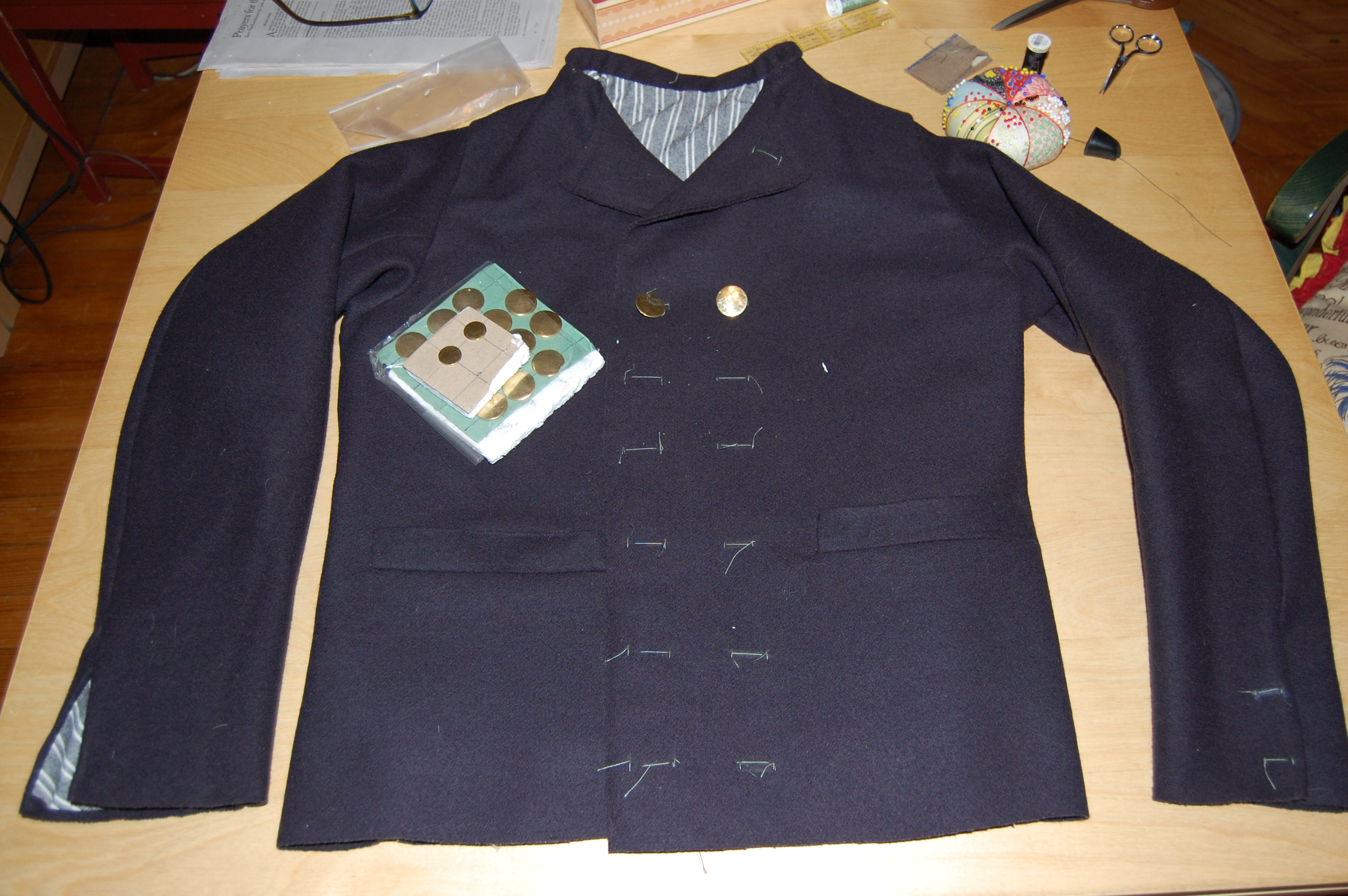
HSF #5: A Peasant’s Jacket

WIth the buttons to be installed

A Workman’s Jacket…not quite done. I had to work Saturday, so there went 7 hours; I got sick, I got tired, so it’s an almost, oh-so-close jacket. Buttons and buttonholes are all we lack. Of course, for a man’s jacket, that’s, you know, a significant lacking. However, I don’t want to have the crack-addled monkey buttonholes again, so I’m not doing them until I’m not rushed or distracted.

You’ve seen it already here, and know that it has chamois pockets. The Facts:

Buttons, with button holes to come

The Challenge: Peasants & Pioneers

Fabric: Blue wool broadcloth, with a blue and white striped linen lining

Pattern: Kannik’s Korner Double-Breasted Short Jacket

Year: It will be worn for 1775, but can be worn from 1760-1800.
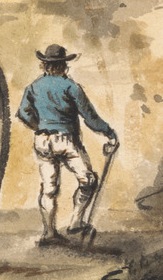
Paul Sandby, A Sandpit. YCBA B1975.3.930

Notions: Linen thread, brass buttons, interfacing, cotton twill stay tape

How historically accurate is it? Well…the fit is a trifle off. It’s better than the base pattern, as I altered the shoulders, but it could use another round of alterations and fitting if the intended wearer would tolerate it.  Still, like the man to the left, the kid is supposed to be working in this, so he’ll need some room.

The edges of the wool are unfinished, as I’ve seen in originals, with the lining turned back. It is all hand sewn. But, I don’t have any documentation for the striped linen lining, (it’s fine for quilted petticoats) so I would not go above 8/10 for this.
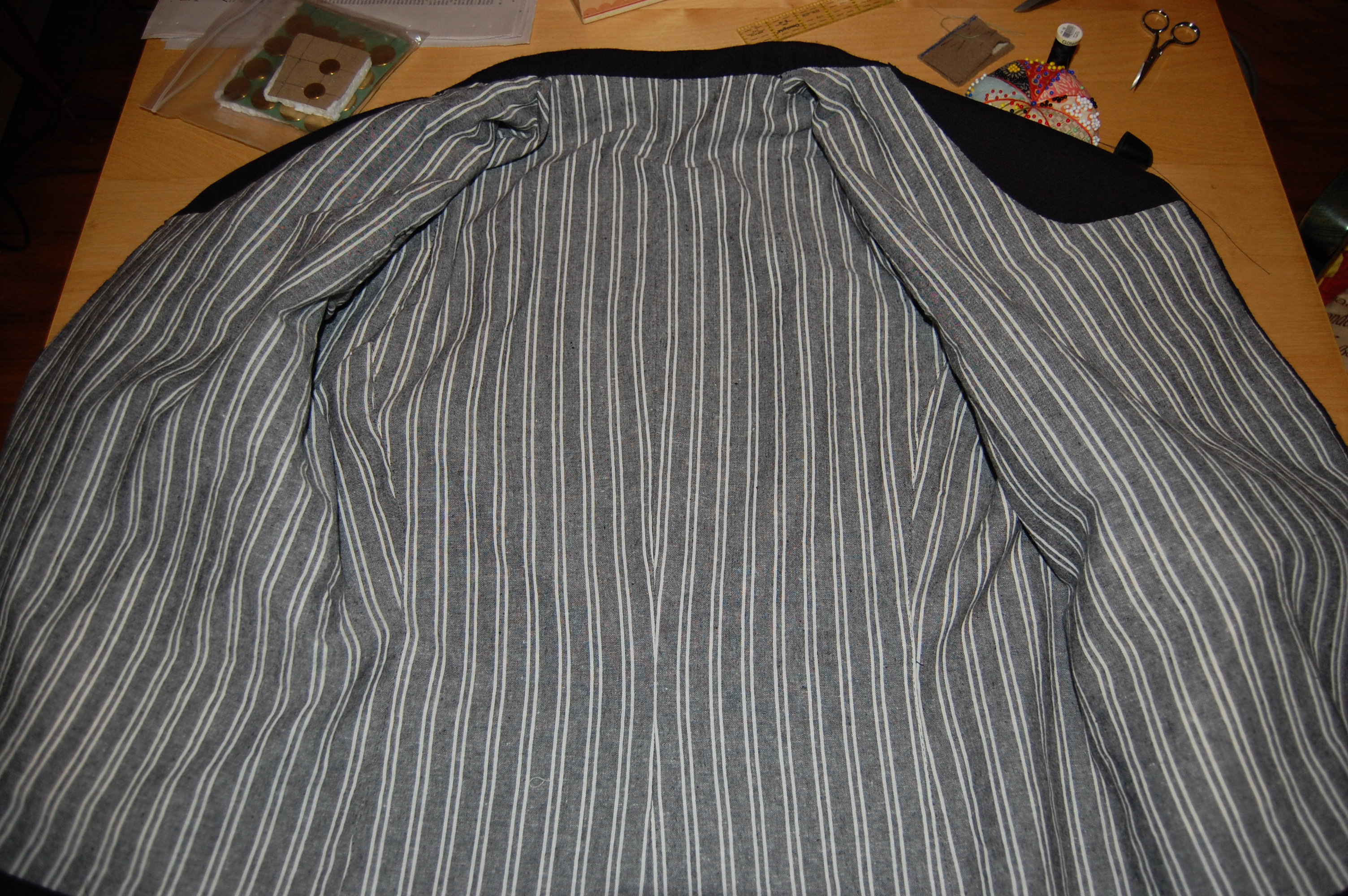
Stripes!
Stripes!

Hours to complete: I can remember about 18 to this point, and the buttonholes will add another 5 to 7. They’re about 20 minutes each, with 16 – 18 to do, plus sewing on buttons. Total time likely to be 22-24 hours.

First worn: To be worn April 13, 2013.

Total cost: $79.36 can be accounted for in materials. The broadcloth was purchased from Wm Booth’s remnants and the buttons are Burnley & Trowbridge: those I have numbers for. The striped linen, purchased at Jo-Ann Fabrics,  was in the stash.
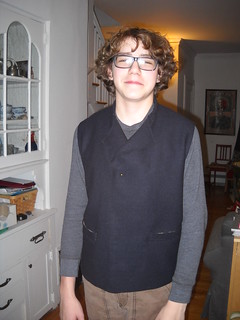
Work, work, workman’s jacket

It fits! It might be painful, though.

Ah, yes. Work. It continues on the workman’s jacket for the Young Mr to wear at Battle Road, and for next week’s HSF deadline. There are some additional views of him in the same pose here. I tacked the lapels down because I have seen that detail on an original garment, and because if I don’t, they’re likely to bother the kid.

The nice thing about a workman’s jacket is that a waistcoat is optional underneath it. This short, only post-RevWar waistcoats look alright. So for Battle Road, long underwear may be in order. It wasn’t last year, but who knows?

Paul Sandby, A Sandpit. YCBA B1975.3.930
Sandby, Roslin Castle detail, YCBA, B1975.4.1877
Paul Sandby, Roslin Castle detail, YCBA, B1975.4.1877

The form is authentic, thank goodness, for working men’s clothes; on the left, in a detail from Sandby’s A Sandpit, is a jacket in blue. On the right, in a detail from Roslin Castle, Midlothian, is another jacket that looks short, worn without a waistcoat. It may not be as short, but I am encouraged by the lack of waistcoat, though I will insist on shoes…

The form persists for a long time, and is seen in military wear as well, in light infantry and dragoon troops, as well as in sailor’s clothing.


What’s in your pocket?

A typical rough linen lining

My son’s pockets used to be full of acorns: he collected them at the bus stop, but I don’t know if it was because he planned to feed the squirrels, or if he thought he was a squirrel. Later, he moved on to rocks. Now, rocks, fish hooks, a pocket knife, change and a hankie fill the pockets of his 18th century breeches.

We’ve had some moments of unhappiness when things have gone missing from the pockets, though we’ve usually found them again. When you look at the contents list, you wonder how the linen stands up as well as it does.

There’s a clever way to upgrade pocket bags in menswear, and it’s authentic: leather bags, instead of linen. Original garments have leather bags, probably deerskin, and they’re deliciously soft and very durable. Stuff all the heavy, sharp things you want to in that pocket, and it will probably take it.

1895.4.3A-C
1895.4.3A-C

Based on a suit in the RIHS Collection, I decided to modify the pocket bags on the Young Mr’s new workman’s jacket-in-progress, which I plan to have finished by March 11 for HSF #5, Peasants and Pioneers.

Made of a heavy, rough-finished brown broadcloth (possibly manufactured in New England), both jacket and breeches pocket bags are made of deerskin.

Pocket bag in progress.

To recreate this, I took a trip to the auto parts store, and purchased a large chamois.  Instead of cutting the bags from linen, I cut them from the chamois and trimmed the seam allowances: chamois won’t ravel, so the seam won’t need to be folded over at the top.

A little fuzzy, but you get the idea

I backstitched the bag seam, and in general, I’m pleased with the way it has turned out. I think I’ll look into additional leather options, but otherwise, it seems like a fairly successful experiment.

The real test, of course, will be user testing. How many sharp, heavy things can the kid load in a pocket before it gives out?

HSF # 3: Under it All: A shift, and a petticoat

Done at last: the shift. Plus bonus bonnet

Remember that shift I couldn’t finish in time for HSF # 2, UFO? I did get it finished for HSF # 3, and a bonus petticoat as well. They don’t go together, but in honor of the excessive amount of snow we got this weekend, they’re both white. The snow is also how they got done: nothing like snow days and travel bans to keep one home and sewing.

How ‘Bout Them Facts?

Fabric:

  • For the shift, lightweight linen, probably this one.
  • For the petticoat, one of a pair of Ikea curtains found on sale one day. The light-weight cotton appealed to me and suggested filmy late 18th century petticoat better than anything I had seen at a fabric store.
The petticoat, over another petticoat. It’s that sheer.
Back view (again with cat bowl)

Pattern:

Shift:

Year:

  • Shift: 1775-1783
  • Petticoat: 1795-1800

Notions: Both: Just thread. And some left over white cotton twill tape.

How historically accurate is it?

The shift is pretty close. The fabric is, well, not the linen they had, but it’s as fine as I could afford. It is entirely hand-sewn, and the sleeves have bands and tie closed.

The petticoat is also hand sewn, and uses a historic garment for a basis. (I also looked at bodiced petticoats at the Met.) However, it is made from a curtain and while I unpicked all the seams, the machine stitching holes remain. It gets the job done that I wanted it to do, though: fluffy white stuff.

Hours to complete:

Shift: Killer. Started it last August and have worked on it off and on since then. It went to so many events in the basket that it smelled like woodsmoke. Intensively completing it probably took 24 -30 hours, so it could be a 40+ hour shift. After a while I stop paying attention.

Petticoat: Like candy. Started it Saturday morning, finished it Sunday afternoon. Best guess, about 10 hours.

First worn:

Shift, probably April 13.

Petticoat? Probably Dress U.

Total cost:

No good way to know…the fabric was bought so long ago! The petticoat curtains, when not on sale, are $20, so $10, because I only used one. For the shift, it’s harder to say. I piece aggressively when cutting out, so I bought less than the pattern recommends. Remnants were used for the petticoat bodice and various linings, including the Curtain-Along robe currently underway.