Mr. Turner, out now on iTunes and elsewhere, won’t be for everyone: M’damsel isn’t treated very well– artists are, you know, often narcissistic, driven users– but the landscapes thrill.
We talk sometimes about going to the antique store in historical clothing and asking why our chattel is for sale. I toy with similar naughty thoughts about visiting historic house and other museums, but Mr Turner inspires a dream of a simpler pleasure: dressing in period clothes to visit a period gallery.
Classic Mr Turner in the salon
Possibly my companion would grunt as Turner does, but we might also unnerve guards by pointing walking sticks at salon-hung still lifes or reacting with disgust at the sight of an Impressionist work. (Might as well take it all the way.)
Everybody’s a critic
No takers yet for this diversion, which is just as well. I expect it would be a quick way to meet security and police staff if you didn’t coordinate with the museum/gallery in advance. Still: what a stunt. Someday I’ll pull it off.
Madora [sic] water color by Maria Caroline Temple ca 1800. Inscribed Maria C. Temple. delt.’ and ‘Vide “Young Philosopher.” British Museum 1869,0612.599
I was looking for images of maids in 1800, and came across this in the British Museum. Having no idea what Maria Temple meant by Vide Young Philosopher, I went searching. Turns out the answer is surprisingly easy: It’s a novel published in 1798 by Charlotte Smith. So it seems that what Maria Caroline Temple did was to draw a scene from a novel she’d read. I was delighted by this, as something I used to do a long time ago was to draw scenes from books I had read and loved.
With a publication date of 1798, I think we can feel pretty confident in the British Museum’s ca. 1800 date; what I was looking for was a non-satirical illustration of a maid in 1800: what did she wear, how did she comport herself? not because I haven’t been a maid in 1800 before, but because I need to be a better maid in 1800.
The things to love in this image, aside from the clothes, are the checked slipcover and window drape, the brass lock on the heavy wooden door, and the view through those wavy panes of glass. I don’t love the wallpaper, but I appreciate the evidence of it– but not as much as I appreciate the hint of drape matching that raucous slipcover.
Now I just need to hunt down an affordable copy of this clearly dramatic and romantic work of early fiction, and to find out exactly what books were being read in 1800 Rhode Island.
A companion pl. to BMSat 9813. A pretty young woman wearing a décolleté négligé, stands with her back to the fire, her gown raised to leave her posterior naked. She holds a book: ‘The Monk – a Novel by M’ [‘G. Lewis’, cf. BMSat 9932]; another is open on the floor: ‘Œconomy of Love by Dr Arm[strong’, 1736]. A cat rolls on its back. On a table are a decanter of ‘Creme de Noyau’, and an open book: ‘The Kisses’. On the mantelpiece are flowers and an ornate clock with embracing cupids. A picture partly covered by a curtain represents Danaë receiving the golden shower. The room, apparently that of a courtesan, is luxuriously furnished. 26 February 1801 Hand-coloured etching, British Museum, 1935,0522.7.12
I’ve left that caption intact, though it seems quite long enough for a blog post itself. This image turned up on Twitter (you can follow me there @kittycalash, expect randomness) and delighted me at the end of a long, tough week. I’m particularly taken with the cat, which resonates with an lolcat that floated about the interwebs last winter. The interwebs can be a strange place…
But aside from that silly cat, there are a wealth of details in this image, some of which are explicated in the caption.
What struck me- after the cat– was the slipcover on the sofa. How lame is that– but it’s true. Floral print, I suspect, but possibly woven, it’s loosely draped and long. I’m more familiar with the checked linen slipcovers seen in representation of New England interiors, so the floral really struck me. I suppose those linen checks symbolize all the puritanical uprightness and restraint of early Federal New England dons (if you believe in that kind of thing), while the loose floral print drapery tells you everything you need to know about our Rumpford friend.
We all see what we want to see…cats, slip covers, or courtesans.
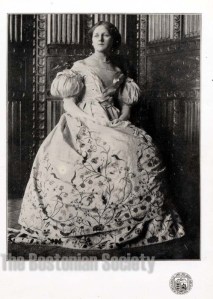
Elizabeth Bull Price’s Wedding Dress. Bostonian Society, 1910.50.35
On Tuesday evening, sensibility won over sense as my friend and I boarded the T for Boston to make a long day longer. The trip was worth it, though, for the One Night Only engagement of Elizabeth Bull’s wedding dress at the Bostonian Society. In truth, I bought the tickets for the event before I was even back at work and navigating our Fair City on my own– and who wouldn’t? That dress is amazing! (Tons more images of the embroidery are in the catalog record.)
Perhaps even more wonderful than the 14-year-old ElizabethBull’s needle skills is that the dress remains with us today. Kimberley Alexander and Tricia Gilrein reminded us on Tuesday of the many ways this dress, and other remnants of Bull’s wardrobe (oh, the petticoat, and the wonderful kerchief) connect us to the past in surprising ways. Elizabeth Bull was wealthy, married to Roger Bull, a Church of England official 22 years her senior: though they lived in Boston, they were British. (They were married in the 1730s, and Elizabeth died in 1780 at about 67.)
It’s a little hard to see past the 1830s alterations, but the embroidery of the gown helps chart that course, as well as the petticoat. As important to remember is that this wedding gown was not white: it has faded from a celadon green to its current off-white color. Wedding dresses weren’t white in the 18th century, or even long into the 19th, and it’s helpful to remember that as we look at what remains and reconstruct this in our mind’s eye.
It’s easy to forget we were British first here in the United States, and that the American War for Independence did not have a foregone conclusion. We forget, too, that churchmen and their wives were socialites as much as they were people of the cloth. Put Mr Collins out of your mind, and remember (my favorite minister & fashion maven) Reverend Enos Hitchcock and his pink satin waistcoat and suits of black silk.
Photograph of the altered gown. Bostonian Society, 1910.0050.057
Like many 18th century gowns, this one was remodeled in the 19th century, its shape altered to reflect the current fashion. We are lucky to have so much preserved, not just in the gown but also in the petticoat. Paths to understanding of women’s education, the customs and habits of Boston’s colonial elite, and the persistence of past can all be found within this object.



![Madora [sic] water color by Maria Caroline Temple ca 1800. Inscribed Maria C. Temple. delt.' and 'Vide "Young Philosopher." British Museum 1869,0612.599](https://kirstenhammerstrom.com/wp-content/uploads/2023/03/89c0c-an00291773_001_l.jpg?w=640&h=610)
![A companion pl. to BMSat 9813. A pretty young woman wearing a décolleté négligé, stands with her back to the fire, her gown raised to leave her posterior naked. She holds a book: 'The Monk - a Novel by M' ['G. Lewis', cf. BMSat 9932]; another is open on the floor: 'Œconomy of Love by Dr Arm[strong', 1736]. A cat rolls on its back. On a table are a decanter of 'Creme de Noyau', and an open book: 'The Kisses'. On the mantelpiece are flowers and an ornate clock with embracing cupids. A picture partly covered by a curtain represents Danaë receiving the golden shower. The room, apparently that of a courtesan, is luxuriously furnished. 26 February 1801 Hand-coloured etching, British Museum, 1935,0522.7.12](https://kirstenhammerstrom.com/wp-content/uploads/2023/03/0cd30-rumpford.jpg?w=640&h=898)

 Kirsten Hammerstrom
You must be logged in to post a comment.