Family’s here (OK, my mother; we’re a small family) and it’s time to pay attention to the people in the room instead of writing. So to celebrate winter, and the shorter days (tell that to a child waiting for Christmas), here’s one of my favorite paintings by Rhode Island native Gilbert Stuart.
The majority of us do not consider the chicken. We may consider whether the package of chicken we purchase is free range, organic, cage-free, grain fed, cruelty free. But we are unlikely to think about the implications for the physical being, the essence of chicken-ness, that the chicken’s conditions create for it.
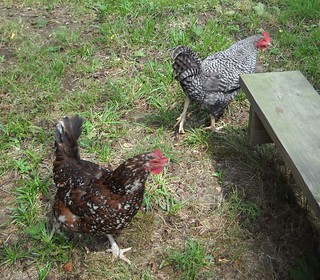
And I am here to tell you that the cage-free, organic, free-range chickens and chicken parts that you purchase at Whole Foods or your other large vendors bear little to no relationship to the actual free-range, catch-as-catch can, ne’er-do-well chicken of the historic barn yard. For one thing, living history chicken is ripped.
It’s well-developed physically, with strong, sturdy bones and robust ligaments. Its musculature is tight: this is not a bird in need of a personal trainer. Its meat, when cooked, is not white. It is dark meat, not so dark meat, and sort-of white meat. Its taste was described to me as gamey, but I disagree. It was chicken, but earthy, sweet and fresh and rich.
But all that came after the meeting of human, knife, and chicken.
Disassembling the chicken fell to me; I declined rubbing butter into flour having prevented a fall down cellar stairs by putting my hand in fresh goose guano, so I after I washed my hands, I addressed the chicken in its bowl, and took up a knife.
By this time, post-carrots, -parsnips, -squash, -string, -tallow and -suet, the knife lacked the purest essence of knife, that is, sharpness. But it functioned well enough for the task, with some persuasion. The skin was much thicker and more resilient than a store-bought chicken, and greasier, though not in an unpleasant way at first. The muscles were well-developed, and pink. Rosy pink, deep pink, dark like wine. There were no large slabs of the shiny, flaccid, pale meat you find on the chickens in the store. Those aren’t chickens any more: those are products.
The process of quartering the chicken took strength and pressure on the knife, and the strength of my hands. I did have to rip joints apart, and break the carcass’s back. All of this had a sound, and a mild smell of chicken, mixed with the melting tallow. But it was the sound that, with the greasy, slick knife, and the grease that soon covered my hands and wrists, that kept bringing me back to what I was doing, and that, when the bird was broken apart and in the pot and my hands washed, again (they itched), send me outside and up the hill for air and sky.
We boiled the chicken in a kettle we’d already boiled crook neck squash in; later, we added sage, thyme, parsnips and carrots. It was delicious. The broth was incredible, and the whole meal very simple. That’s the whole of the recipe: boil a chicken, add herbs and root or fall vegetables, boil until done, serve. Use any uneaten broth and bones/meat for stew, pie or other dishes. That’s it.
The product chickens from the market are bred to fall apart. They haven’t got what a running, pecking, eating everything chicken’s got in muscle, ligament, and tendon.
On Sunday, after we came home, I looked at the food in our cupboards. There were boxes, cardboard, plastic, layers of packaging. The cheese was square. These things came from the good market, but were they food, or were they products? I felt like a passenger on the ship in Wall*E, and I was appalled.
Meet the cursing baking mommy! On Friday last, she started a full day of work that included a reenacted regiment backing out of the major event at work, a panic attack during her physical, a camera crisis during the visit of an Ambassador, as well as the full complement of broken things, paperwork, Section 106 reviews, and requests for meetings. So of course she came home with a plan to bake, in addition to packing up a full kit of 18th century camping equipment and finishing buttonholes and hems on overalls and that devil dress.
I did bake, actually. I tried a recipe I found on Let’s Burn Something, lavender tea bread.
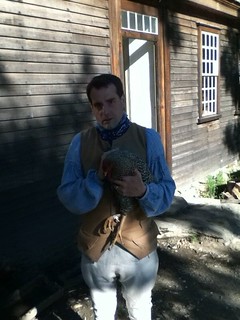
Nooning with the Reg’t. They enjoyed the tea bread.
The recipe is pretty simple; the cursing part came in when I discovered that baking distracted has its dangers. Yes, I forgot to chop the lavender blossoms before steeping them in the milk. I did it after wards, and then tipped them back into the milk. You’d think the final result would look like, well, a loaf of pound cake with mouse excrement baked in, but it doesn’t. The little flowers look like seeds, so if you’re OK with a Rich Seed Cake, this will be fine, too.
Oh, I also used too much butter. Fortunately, that turned out to be fine, as too much butter usually is. And no, I don’t know my cholesterol levels, but let’s eat some more cake before the test results come back!
Heat milk with lavender almost to a boil, then steep until cool.
Mix flour, baking powder and salt together in bowl.
In another bowl cream butter and gradually add sugar, then eggs, one at a time, beating until light and fluffy.
Add flour mixture alternately with lavender milk, in three parts. Mix until batter is just blended, do not overbeat.
Pour into prepared pan and bake for 50 minutes, or until toothpick inserted in center comes out clean. Let cool in pan 5 minutes, then remove to a wire rack to cool.
When completely cool, drizzle with a simple sugar glaze or sprinkle with confectioners’ sugar. Garnish with sprigs of fresh lavender.
I skipped both the sugar glaze and the confectioners’ sugar on the basis of sugar being expensive in the 18th century, and because I thought the final result would be less conducive to transport. It seemed fine, though with white linen uniforms, you wouldn’t notice the powdered sugar if it spilled. It’s just be the informal markings of the Second Helping Regiment.
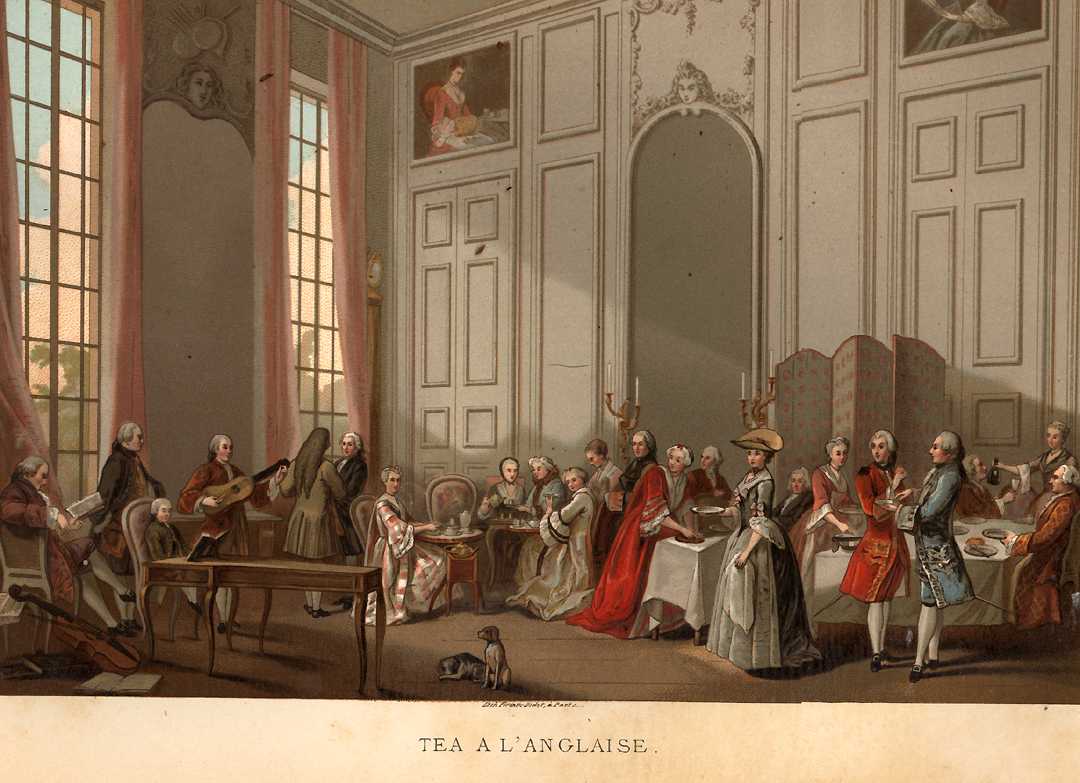
When you think of 18th century dining, which image comes to mind, tea on the left, or the sea captains to the right?
While I did not carouse with sea captains this weekend, at dinner today, I found myself deeply envious of someone’s skill in eating from a knife. I shoveled food onto my spoon yesterday with abandon. I coveted the last three pieces of quince tart today despite knowing that one of those pieces was for my husband. And I am not ashamed. Ok, not too ashamed.
The best part of living history is always what you learn, and I feel a separate blog post should deal with “the public, god love ’em.” What I learned this weekend was less about quilting and more about living old school. Ok, and maybe more about the public’s…breadth….than depth…
The most instructive thing was about being hungry and thirsty. Thirsty as in my lips are dry and I know I need to drink, which means being past thirsty and at dehydrated. Yesterday I went all day without peeing and that’s not right. Both yesterday and today I left the farm hungry, not because there was not food but because I ate mindful of leaving enough for those eating after me. The goose pie was delicious and seriously worth eating standing up in the kitchen. I’d fight for that pie.
Eating boiled dinner (ham, parsnips, carrots and turnips) along with a pudding, with 18th century utensils was challenging. Two-tine forks have great sticking ability but not much carrying ability. Spoons are your friend. Knives may be better as trowels than cutting implements. No one really cares about your manners, they are too hungry to notice. Boiled pudding is this season’s smash hit.
Coggeshall Farm uses Amelia Simmon’s American Cookery, which I started reading last week. It is full of useful receipts based on American ingredients and I recommend it. Here is the receipt for the fantastic, sliceable pudding we had today:
A boiled Flour Pudding_.
One quart milk, 9 eggs, 7 spoons flour, a little salt, put into a
strong cloth and boiled three quarters of an hour.
There were hot words about those “7 spoons” from the kitchen staff and to be honest, I did not quiz them fully on the size of the spoons they used. But whatever magic they worked, it was truly delicious with and without the molasses cream sauce. Sliced and eaten with spoon or fingers (I snitched some later in the kitchen), it a consistency of solidity like the best parts of a Swedish rice pudding, though smooth.
It is hard to countenance how hungry people must have been much of the time in the past. More than the extreme hunger of the soldiers (like Greenman and Plumb Martin), I think common people experienced days of lacking, and accepted them, with the seasons. Food was not constant, but in flux, and even at harvest, I think, or hope, that one was mindful of the needs of others.






 Kirsten Hammerstrom
You must be logged in to post a comment.