The HFF: Historical Food Fortnightly

2f053ddd402318588e6c094c0ec0e6b4Every now and again Facebook proves itself useful: without following Dobyns & Martin Grocers, I would not have known about this interesting cook-along, the Historical Food Fortnightly.

The challenges look interesting, and I particularly like the seasonal fruit/vegetable one. This seems like a wonderful chance to cook historical recipes using seasonal, local ingredients, and I do like to remind people that historical eating is grounded in seasonal, local, eating. Plus pounds of raisins and sugar and gallons of alcohol.

Your local historical archive (or whichever one contains the works relevant to your interests) can be a great place to get started assembling documentation on local eating. Receipts for foodstuffs can be mixed into other accounts (cotton for your daughter, a parasol, a pair of shoes for your wife, 5/8 yard pink silk satin self) but you can still quantify tea, sugar, spices, Madeira, and flours. I find fresh produce somewhat harder to track–you won’t count what is growing behind your house– but fear not, New Englanders! Some of that hard work has been done for you.
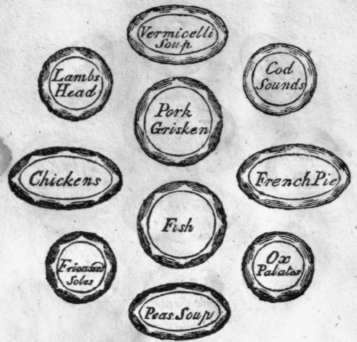
A bill of fare for August

J.L. Bell of the fantastic Boston 1775 blog wrote the book-length historic resource study General George Washington’s Headquarters and Home—Cambridge, Massachusetts, which I read before we went up to the “Washington Takes Command” event last July. (That sentence just seemed crazy, even to me…yes, I read 650 pages plus the event program to prepare for a 6-hour event…)

The report can be downloaded as a PDF, and if you’re looking for food, where you want to go is Chapter 6, Daily Life at Washington’s Headquarters (page 173 and following). On pages 195-197 the Steward’s Purchases are listed, sorted by Fruits, Vegetables and Grain, Spices and Flavorings, etc.

While Washington was maintaining (or causing to have maintained for him) a Genteel Household, the list of purchases is helpful in documenting the variety and types of foods available in Cambridge. I suspect that similar kinds of documentation exist in the historic resource reports or room use studies for places like Gunston Hall.

I cannot manage to keep up with the Historical Sew Fortnightly right now– things went pear-shaped in December— but we have to eat, historically or otherwise!
Dirt Stew & The King’s Oreo

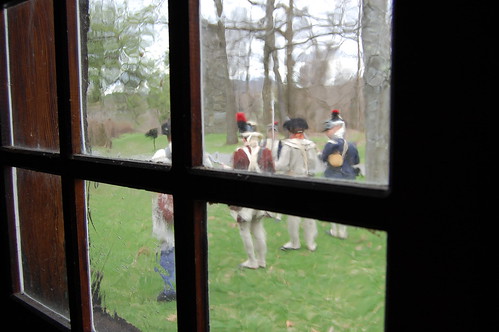
What Lights through Temple window Break?

What do you do when the kettle tilts off the pothook and spills onto the floor?
Scoop the food back in and keep cooking.

That’s how you make dirt stew, with just enough ash to keep the texture interesting at the bottom of your bowl, plus ham, onion, turnips, parsnips, potatoes and carrots. If you wash the inside of the kettle later in your motel bathtub, you will add to the list of very bad things you’ve done in the bathrooms of temporary accommodations.

On Saturday, the original event plan called for a camp kitchen demonstration; this was nixed because a long string of permissions could not be obtained in time, so we fell back on bringing the three sticks and two kettles. Outdoor fires of all kinds were nixed Thursday because of red flag warnings, and after downpours Friday night followed by rain on Saturday afternoon, we ended up cooking in the back room of the Temple building.

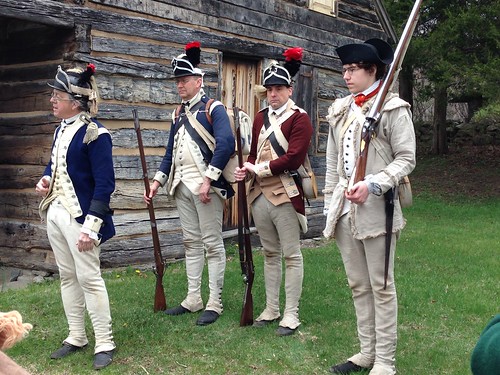
Third from the left, Mr S in the ‘Ugly Dog’ coat.

Some of us were too focused on getting food into the kettle to tidy up the surroundings, and that is why you need several people in any group: someone has to keep their head and clean up the wreckage of previous occupants. Fortunately for us, Mr McC managed that while the Young Mr swarmed around like a cat wanting its dinner, I cut vegetables and Mr S stewed about spilling the stew.

In the end it was a cozy evening boiling roots and hearing stories. I took no photos because that would have ruined it, but Mr S kneeling before the fireplace in the Ugly Dog coat and overalls as the last of the light came through the watery glass made a Vermeer-like and beautiful sight.

On Sunday morning, Our Musician Friend (who has turned his coat, and now sports yards and yards of lace and a bearskin hat nicknamed Lamb Chop), produced a package of Oreos from his haversack, and the Young Mr and I took the King’s Oreo with pleasure and no commitment.

An 18th Century Feast

from Jane Austen’s World blog

On Saturday last, we were delighted to attend a long-anticipated and much delayed birthday celebration for George Washington, combined with a quarterly unit meeting and workshop. We are multi-taskers, because it is pretty easy to talk and sew, and talk and eat, though sewing and eating is more challenging and potentially more dangerous.

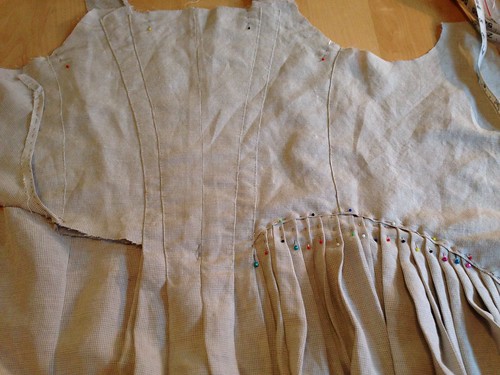
I got some progress made on Bridget’s gown, Mr S started a knapsack, the Young Mr played video games with the other boys and they all took the adjutant’s dog for many walks. Our hosts have a very neat house with fireplaces that work, and a bee hive oven that works (those of us who live with Don Draper’s Ossining kitchen may be jealous) so are able to cook in an accurate and delicious manner.

Bridget’s dress, in process.

Honestly, I don’t know where all the food came from: I would not have thought the kitchen could hold so much, as I do not think ours could! Roast chicken, fish cakes, carrot pudding (of which I am quite fond), brown bread and beans, turnip sauce, more bread of a different recipe, a chocolate torte, onions and apples, and surely more things I have forgotten.

We had a lovely time, talked about a lot of things, and came home well-fed. On Wednesday, I made ‘buttered onions another way,’ since the Young Mr deigned to eat it, and thought it would be delicious another time. Apples and onions  go well with pork, and someday, when I have time, I’ll try Indian pudding. Just because I have a 1960s kitchen with all-electric appliances doesn’t mean I can’t try.

Shopping at Dobyns and Martin

A Range of Goods, lately Arrived from Maryland.

In the not-too-distant past of up till last week, I was still under the impression that I would be doing two living history presentations on tea at the end of March, but through a series of maddening-for-a-colleague circumstances, that is not the case. To begin preparing for these programs, I had started secondary and primary source research on tea and tea parties, as you may recall. I also ordered some things from Dobyns and Martin, thinking how nice it would be for people to see and smell and sample historically correct teas.

Friday was a happy day chez Calash, coming home at the end of a long week to three days off and packages! Though I won’t need the teas for work, it does seem to me that they will be quite suitable for other living history presentations, and I can always ‘steal’ some from an officer if I get tired of the black market in shirts.

In addition to tea and lump sugar (which will fit nicely in Bridget’s pocket), I ordered soap. The lavender wash ball seems suitable for officers and the better sorts, while a cake of lye soap will vastly upgrade our dish-, self- and clothes washing in camp. While I’m game to make my own soap, a lack of ingredients and facilities hinders production.

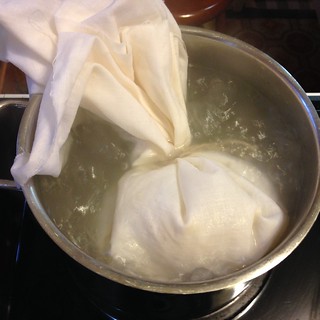
Carrot pudding Trial One. Verdict: Too much nutmeg.

And, finally, the rose water. I’m looking forward to enhanced baking, a good activity in the weather we’ve had lately. While I don’t think the rose water would have saved the way-too-much-nutmeg carrot pudding, it will certainly be welcome in dishes future. I’m motivated to get a boiled pudding right, and in the field, because I know the Enos Hitchcock ate pudding and venison as a chaplain in the war.