Measure for Measure

or, a boiled Flour Pudding in two tries.

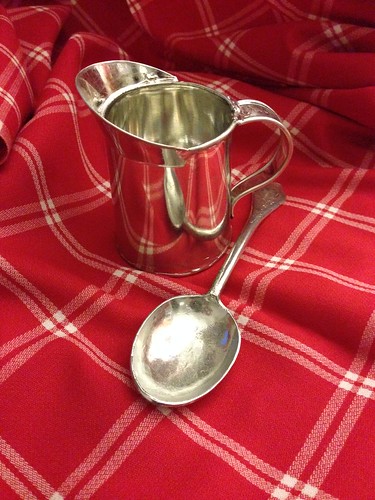
Alone in my Ossining ca. 1962 kitchen, I decided to tackle Amelia Simmons. The first task seemed to be to establish measurements, and then proportions, so I took stock of the tools and containers I would have in a typical camp. Spoon, mug, half-pint: these are plausible items, though we have tin cups that hold exactly 8 ounces, so the measure is unnecessary. The spoon was cast from a 1780 mold, so it seemed like a reasonable place to start for “how much is a spoon?” It will hold exactly one tablespoon if you scrape it flat across or are measuring liquid. Handy to know.

Next, I checked the recipe again.

A boiled Flour Pudding.
One quart milk, 9 eggs, 7 spoons flour, a little salt, put into a strong cloth and boiled three quarters of an hour.

This is not a popular receipt, so you won’t find it on History is Served, nor will you find this version on other popular sites; you can find a boiled pudding with suet, but that’s not what I’m after: I’m after a receipt that starts with a portion of the ration of flour soldiers received, and adds only eggs, milk, and available seasonings.

You have to remember that Simmons corrected the 7 spoons to 9 spoons of flour and increased the boiling time; you also have to remember that eggs were smaller then.
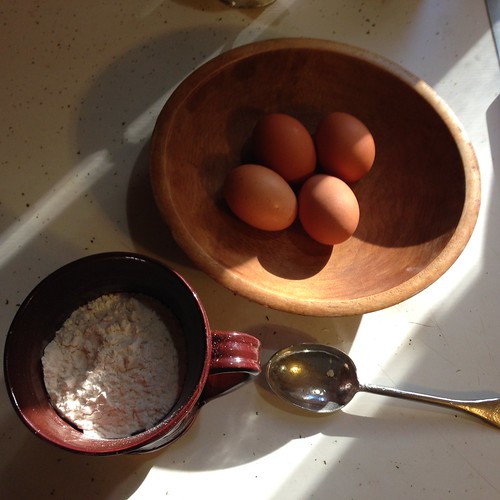
redware mug and wooden bowl with egggs
Halfsies.

I thought I’d try a half receipt first. There are no directions as we think of them– American Cookery sometimes has that “put your lips together and blow” feeling–but this is not too complex. The eggs and milk must be beaten together, and then combined with the flour. For this first attempt, I got it a bit backwards, adding the spices to the eggs, which I beat in the large wooden bowl.

That left me scooping the egg-and-milk with the measure into the flour, which I had in a smaller wooden bowl, remembering too late the method for scones.

egg and flour mixing in wooden bowls
Fuzzy photo, fuzzy logic.

And then it was really too late: I added just too much egg-and-milk, and it became more like batter than dough. This was not correct, and I knew it, but I didn’t dump it and I didn’t add more flour. Now it’s clear that 7:00 AM is not my best time for baking experiments (it was also quite early the day I made gingerbread without any eggs).
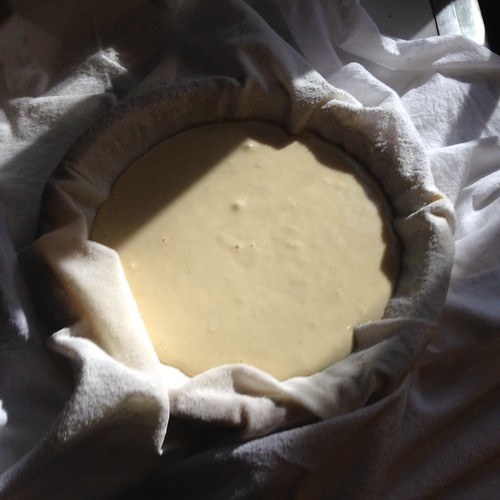
pudding mixture in cloth
Well, it took a decent photo.

I buttered and floured a cloth anyway, and poured the mixture into it. After tying the gathered neck of the cloth with string, I boiled the whole business for 45 minutes.

I did not take a photo of the mess I found when I unwrapped the bag. It wasn’t pretty, and it was clear that while some portions of the pudding were ‘done,’ they constituted about 5% of the whole, which otherwise resembled steaming cottage cheese. Really, truly, awful.

But from time to time I am undeterred by my failures, and instead of consigning the mess to the trash and sticking with store-bought bread*, I rinsed the cloth and regrouped.

This time, I went smaller: 1 cup of flour (about five spoons), two eggs, and a scant two spoons of milk. I also managed to put the flour, salt, and allspice in the regular sized wooden bowl, crack the eggs into the mug and beat them there with the milk. When I mixed the egg-and-milk into the flour, the mixture was far too stiff, so I added more milk, but kept the mixture stiff.
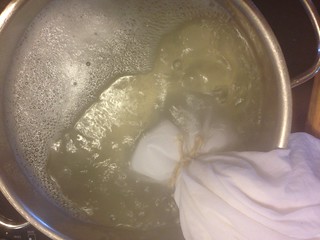
pudding bag in boiling water
Patience is required for pudding

Once more into the buttered cloth, once more into the water, once more boiling for three-quarters of an hour. This time was better, though. The results actually looked and tasted much more like what I’ve had before.
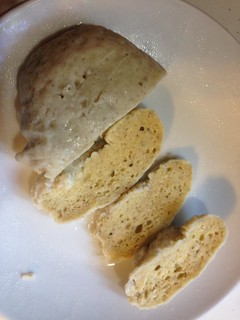
sliced boiled flour pudding
A boiled Flour Pudding

So, where does this leave me? Knowing that I’m the only documented fan of this in the regiment, I’ll stick with the smaller receipt: five spoons flour; two eggs, beaten; and three or four spoons of milk.

My plan is to boil this in whatever stew or stew-like device we have for supper on Saturday, and then eat it sliced with the stew. The plain flour-egg-milk mixture will pick up some of the flavors of the stew (think dumplings), but these could also have been served with a sauce, if made at home.

I’m also going to go back to the Experienced English Housekeeper, and see what she has to say.

* Years in ceramics classes taught me to knead all the air out of plastic material, so my bread tends to be better for building than eating. Even the dog wouldn’t eat the biscuits I made while in grad school…
Coats and Cooking

And happy not to be walking to Walloomsac, since we can’t leave till Friday.

Before we leave, there’s plenty to done, of course, and most of it in men’s wear.*

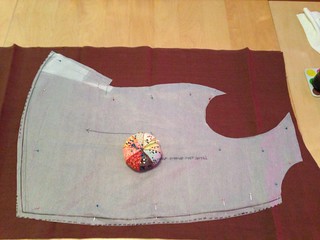
The first piece on brown linen

The Young Mr needed a new jacket, a proper one, with pockets and everything, correct for a scalawag. So that meant patterns and muslins and fittings and questions, until neither of us could really stand the other and his father called me an ambush predator of fittings. The only way to fit these wily creatures is, as they amble through the room, to leap out and toile someone.

With the pattern more-or-less fitted to the wiggly Young Mr, I cast about for fabric: there was not enough of a striped piece for both waistcoat and jacket; waistcoat won, because matching stripes on a jacket seemed too risky in this great a hurry. Instead, I sacrificed the last yardage once meant for a gown.

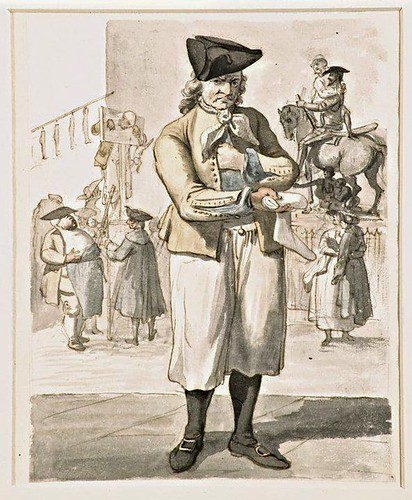
The Stocking Seller, by Paul Sandby, 1759

This is the inspiration for the kid’s new garment, along with Sandby’s fish monger. It seems a plausible garment to work from, and the brown linen is in keeping with the brown linen jacket at Connecticut Historical Society and the unlined linen frock coat recently sold at auction. It will also match his trousers, but this is what happens when you sew from the stash.

One pair of breeches altered, one waistcoat wanting the last seven newly-made buttons, one waistcoat in production, one jacket in production: you’d think that would be enough to get done. But I’m also working to expand my cooking repertoire, as bread and cheese gets tiresome and scrounging broken ginger cakes from the Sugar Loafe Baking Co.— while potentially good theatre–is not a solid plan for sustenance.

half pint and spoon measures
Half-pint and spoon

Boiling food in summer- sounds awful, right? But it’s an easy and correct way to cook,once you translate recipe measures and control the amount you’re making. I like to use Amelia Simmons’ cookbook, because it is specifically American, and my more skillful friends cooked from it at the farm.

From Enos Hitchcock’s diary, I know that he ate a boiled flour pudding with some venison stew (near the Saratoga campaign, I think) so I consider this a plausible recipe for the field, pending eggs, of course.

A boiled Flour Pudding.

One quart milk, 9 eggs, 7 spoons flour, a little salt, put into a strong cloth and boiled three quarters of an hour.

Simple enough, though Simmons later corrected the receipt to 9 spoons of flour, and boil for an hour and a half. I got out the spoon, and looked online at modern boiled pudding recipes, and will give a modified version a whirl sometime this week (always better to fail at home than in the field). Boiling the pudding in a linen cloth in a stew would make a savory bread substitute…and I really liked the one we had at the farm. Will the gentlemen at Bennington like it? Perhaps we’ll find out. If we’re not cooking with hosewater, almost anything should be edible.

*Yes, it’s a terrible and terribly dated show, but I always hear  this in Mr Humphries‘ voice from Are You Being Served?

Stony Point Part the Second

DSC_5121

No, it’s not my photo of the Young Mr: I didn’t even take a real camera on this trip. These top two photos are thanks to Gary V’s Flickr stream.

Here the kid is eating. I think he spent most of the weekend eating. There are some fine calves in the 10th Mass, aren’t there? Look what a well-fitted pair of overalls can do for you.

10th MA and 2nd RI: Mr S, Mr HC, Mr P, YM, Mr FC, Mr B, Mr  H

We all benefited from hanging around Niel DeMarino’s historic bakery. Broken cookies are just as delicious as whole, if not better, and the ginger cakes were the best I’d ever had. It’s a pity that one can’t really bake in camp…

Mr S thinks I should tell the story of my 90-minute stint in solitary at Stony Point, but I’m not quite prepared for that.

Instead, I shall recount the Hose Water Coffee.

As fans of the 18th century know, orange water and rose water are not uncommon flavors in the receipts found in Hannah Glasse or Amelia Simmons‘ cookbooks.

Hose water is something else again. It is not improved with age.

At Stony Point, there was water at a stone ‘bubbler’ (props to those who used this Rhode Island term for the street furniture known elsewhere as a drinking fountain), which was hard to see in the gathering dusk the night we arrived. There was also a hose, proximate to a saw horse with a sign for Pedestrian Only traffic, and just down the path from our tents.

Colonial breakfast on a rock
Our kitchen, dining table, and parlour

Following Heather’s excellent advice, I planned to make cold coffee overnight so that we could be caffeinated in the morning. Lazily and unwisely, I used the hose to fill the pitcher of doom that first evening.

What is the essence of tire? L’eau latex? That’s what we had: strong coffee with a strong base note and unmistakable top note and bountiful middle notes of hose. Did we drink it? Of course we did: we were up at 5, and coffee was not provided until 8:30, when we all had second breakfast.

Saturday night, I skulked back to the bubbler and filled the pitcher again for Sunday’s coffee. This time, the clear, strong liquid was redolent only of coffee, and was judged better than the hot coffee (which had, in fairness, not been made with hose water, either). I’ll definitely repeat the coffee experiment, though I think I can use a little less coffee to water– not that I measured.

An Insomniac Dreams of Pudding

Thomas Rowlandson, 1756–1827, British, Gypsies Cooking on an Open Fire, undated, Watercolor and with pen and brown ink and pen and gray ink on medium, slightly textured, cream wove paper, Yale Center for British Art, Paul Mellon Collection

Once again, I’m sleeping 18th-century-style, but without of the luxury of sleeping late. What wakes you in the middle of the night? Whatever woke me, I finally fell back asleep after 4:00 thinking of what to make for Stony Point.

This will be a cold camp, with very limited cooking, which presents a stiff challenge for the caffeine-dependent, as I must confess I am. (There are gentlemen in the expected party who are also not quite themselves until they’ve had their coffee, too, and they know who they are.)

I’m up against it, this time, given how I will be spending the week leading up to Stony Point (very busy) and that Friday (giving a talk in Newport, instead of baking). As a devoted fan of breakfast, I usually spend the Fridays before a weekend event baking and assembling the provisions for the weekend; this time, however, I will be crossing and re-crossing a bridge.

As I considered prepping a pork-apple-and onion pie Thursday night for Mr S to bake on Friday morning, and the logistics and food safety concerns associated with transporting and eating meat, it finally came to me: Indian pudding. Simpler, easier, filling: all the remains to be done is to talk the Young Mr into eating it, though when presented with no other option, he may acquiesce, at last, to reality.