Camp Cooking

Our first overnight, camping-in reenactment went fairly well. Why the artillerists had to bring a concertina to a gunfight, I’ll never know, but a 2:36 AM rendition of “Good Night Ladies” was truly unnecessary.

The most important thing I can emphasize about reenacting in high summer is to stay hydrated. We brought the big white water pitcher we used at the House Cleaning in April, sliced a lime into it, and filled it repeatedly at the town pump. The Young Mr doesn’t like lime in his water, so he filled the coffee pot for himself, but the rest of our Regiment and members of the 10th Mass helped themselves liberally. It was well worth bringing.

The meals we ate were simple: apples, bread, ham and cheese for breakfast and lunch (I forgot to bring the eggs…) and beef stew for dinner. The stew is the most interesting part of the business. Mr S bought the meat, and without even realizing it, he picked up the appropriate amount of rations. Men were supposed to be issued a pound of beef and a pound of flour or bread a day; women, half that, and children a quarter. The amount we packed was a pound and three quarters. Seemed like too much when I packed it into the cooler, but as it turned out, we ate it all.

Enhanced Ration Stew (feeds 3 to 4)

  • 1.75 pounds beef stew meat
  • 3 carrots, sliced
  • 1 very large onion, roughly chopped
  • 4-5 small, firm, potatoes, cubed
  • Half a small kettle of water
  • 2 packets or cubes of portable soup (beef boullion)

Note: start the fire and get it hot before you bring the meat out…

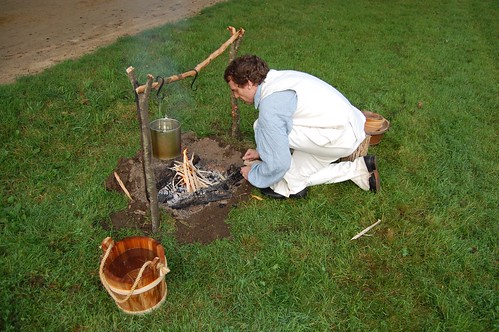
Cut the meat into smaller chunks, add to the kettle, and place over the fire. Brown the meat on all sides; note that this will take as long as it takes.

When the meat is browned, add the onions and cook until they start to get soft. Add the rest of the ingredients, stir, and cover.

Bring to a rolling boil for at least twenty minutes; stir occasionally. Be sure to add wood to the fire to keep it hot. I think we cooked our stew for about 2.5 hours, but it’s hard to say exactly, as we were not wearing timepieces. We started the fire after the battle, which would have been at about 3:30 or 4:00, and ate around 6:30.

I used my pocketknife to slice the vegetables first, and arranged them in our wooden bowls. Then I sliced the beef into smaller chunks, using a piece of firewood as a cutting surface—since it gets burned, you don’t have to wash anything but the knife in hot water. Thanks to the 40th Foot at the SOI for demonstrating that technique.

Summer Eating

What to eat in the field in August? Redcoats & Rebels approaches, and food must be prepared. This time, we are camping over. That means that pretty much everything must be ready by 1:30 on August 3, and there is nothing like a deadline to focus attention.

To start with, I turned to The Compleat Housewife: or Accomplished Gentlewoman’s Companion, published in 1739. The author presents seasonal menus, because one important thing to remember is that historical eating was seasonal and local. (This concept may sound familiar to fans of Alice Waters or Mark Bittman.)

The suggestions are, of course, beyond the realm of soldiers’ rations.

Westphalia Ham & Chicken.
Bisque of Fish.
Haunch of Venison, roasted.
Venison Pasty.
Roasted fowls a la daube.
White fricassee of Chicken.
Roasted Turkeys Larded.
Beef a la Mode.
Roasted Lobsters.
Rock of Snow and Syllabub.

But take a closer look: beef a la mode is a kind of pot roast, so beef in a kettle with water and veg cooked over a fire ought to do. It’s what we call “officer chow,” and what the boys ate at Fort Lee. I was mostly looking for vegetables in season, or fruits, but the farmers’ market will provide that limitation.

So here’s what I think:
Pasties made Thursday night or Friday morning for supper on Friday.
Gingerbread cake for treats.
Oatmeal and fruit for breakfast Saturday morning, or else boiled eggs, bread, and fruit.
Bread, cheese, fruit and sliced ham for lunch on Saturday.
Tea, shrub, and gingerbread cake for Saturday tea.
Beef stew for supper on Saturday.

Breakfast and lunch will be the same for Sunday, and we pack up and leave on Sunday afternoon, so I won’t need to make Sunday supper in camp.

It’s reasonably authentic to the 18th century, though not to common soldiers’ rations. But the guys won’t want to eat firecake and water.

Shrubbery

20120629-064529.jpg
Shrub, or cordial

Country Living (UK) published a recipe for strawberry cordial that is remarkably similar to the shrubs found in earlier century’s cookbooks. Here’s the recipe in my interpretation, and a review of the product.

Ingredients
Two pounds of strawberries
About two pounds of sugar
600ml red wine vinegar
Three to four days

Rinse, hull, and slice the strawberries. Place in a medium-large bowl.
Add as much sugar as will fit in the bowl with the strawberries. I was a bit short, maybe three cups and not four. Stir to coat the strawberries as evenly as possible. Cover the bowl and refrigerate for three to four days, stirring twice daily.
The strawberries will shrink as they macerate, and each time you stir, less sugar will be caked on the bottom of the bowl.
When the sugar is completely dissolved on the third or fourth day, pour the mixture into a large pan. Add 600ml of red wine vinegar (I used the store brand and it was just fine).
Heat, and allow to boil for one minute. Remove from heat and allow to sit to 10 minutes. Skim off anything that has risen to the surface—the recipes warn you to do this, but my berries were well cleaned and the sugar dissolved fully, so there was nothing to skim.

Strain through a clean cloth, and decant. If storing for up to a month, pour into sterilized bottles or jars. If using promptly, a clean glass container will do.

We mixed the cordial with cold water, and it was delicious, though it would have been even better with sparkling or soda water than flat. We also served it with prosecco, and I assume that was also delicious because it went fast at the opening and I did not get to try it at all!

The syrup or cordial is a rich ruby red, and lustrous. The taste is an interesting twist of sweet and tangy that’s quite refreshing; that same description was used by most tasters. It was not a hit with the adolescent crowd, who prefer orange soda, but adults were surprised and enjoyed the taste.

I’ll have to make it again, and soon, while berries are in season. Some recipes call for raspberries, and I may try that in a smaller batch.

Got Lemons?

20120627-063619.jpg
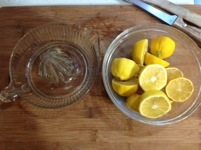
The last lemons

Make Lemonade.

I use the Joy of Cooking recipe for Lemonade Syrup.Boil for 5 minutes:

  • 2 cups sugar
  • 1 cup water
  • Rind of 2 lemons, cut into thin strips
  • 1/8 teaspoon salt
20120627-063634.jpg
Syrup, with lemon rind strips

Cool and add:

  • Juice of 6 lemons

Strain the syrup. Store in a covered jar. Add:

  • 2 tablespoons syrup

To:

  • 1 glass ice water or carbonated water.
20120627-063645.jpg
Strawberry shrub in progress

I had 10 lemons, not the umpteen required to make 7.5 cups of lemon juice if making lemonade for 100. So I tweaked the recipe, upped the sugar to 3 cups and water to 1.5 cups. We’ll see…this, plus the strawberry cordial/shrub will. Be my contribution to the “historic punch” we’re serving tomorrow evening. Cake will probably be a sponge and lemon curd recipe adapted from the National Trust (UK). I’m feeling WWII, even if that lovely dress isn’t getting made. Next week…there’s always next week.