Malaise or Ennui?

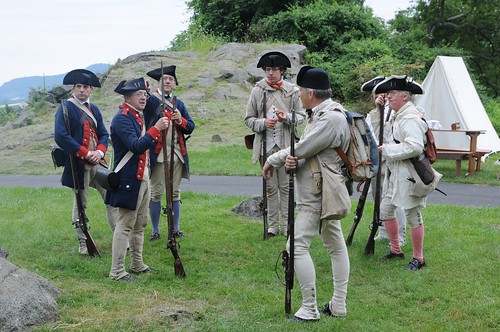
image Hard to say which, but I am ill at ease and dissatisfied with my costuming. You might even call it bratty. But I don’t wanna be like Bridget Connor!

It started the week of the Stamp Act protest, when I felt quite tired of being the shabby, unrefined woman of the regiment and street vendor, and wanted a nice cozy shop like the milliner had. I was also looking forward to being a housekeeper again, and several weeks of moving boxes and volumes with red rot at work had me feeling generally filthy and unappreciated. Bratty.

When in doubt, sew. A new dress can’t help but cheer you up, right?

Well… sort of…

Last Thursday, we did a reprise of the Williams family letters program at the Newport Historical Society. The Williams family were Quakers, and the letters were from the early part of the 19th century, so for the program in March, I made a green silk cross-front gown based on the Quaker gown in the back of Costume in Detail. (Check out the schematic on the 19thus.come page; I didn’t see this until I was mostly done with the dress, but thank goodness I got it right!)

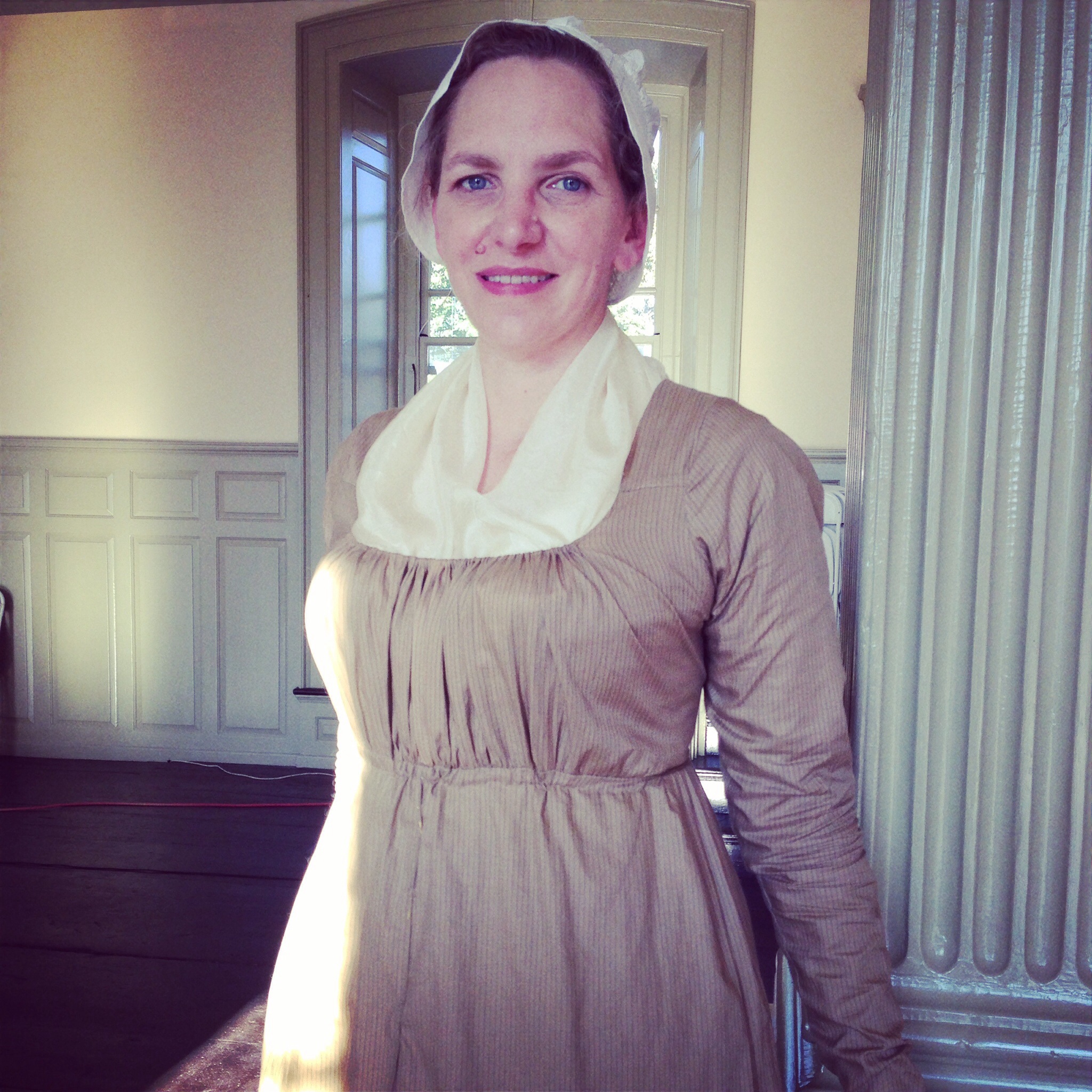
But it’s September, and Thursday was expected to be quite warm, so I salved my bureaucratic wounds in the $1.99 loft at the local mill store, and made a new Quaker gown, also suitable for a maid.

I ask you! Even though it’s my very own pattern based on sketches of original drawings, even though it fits, even though it cost $10, even though every seam is overcast and the whole thing is made with period correct stitches, it still fails to make me happy and cheerful and delighted.

image

This brattiness has resulted in a reappraisal of my approach– and a trip to Sewfisticated in Framingham. What did I buy there? Yards and yards of pink taffeta? Gold taffeta? Blue taffeta?

No.

Because they didn’t have the right colors in the right weave– too slubby– or in enough yardage. Brace yourselves: I bought brown.
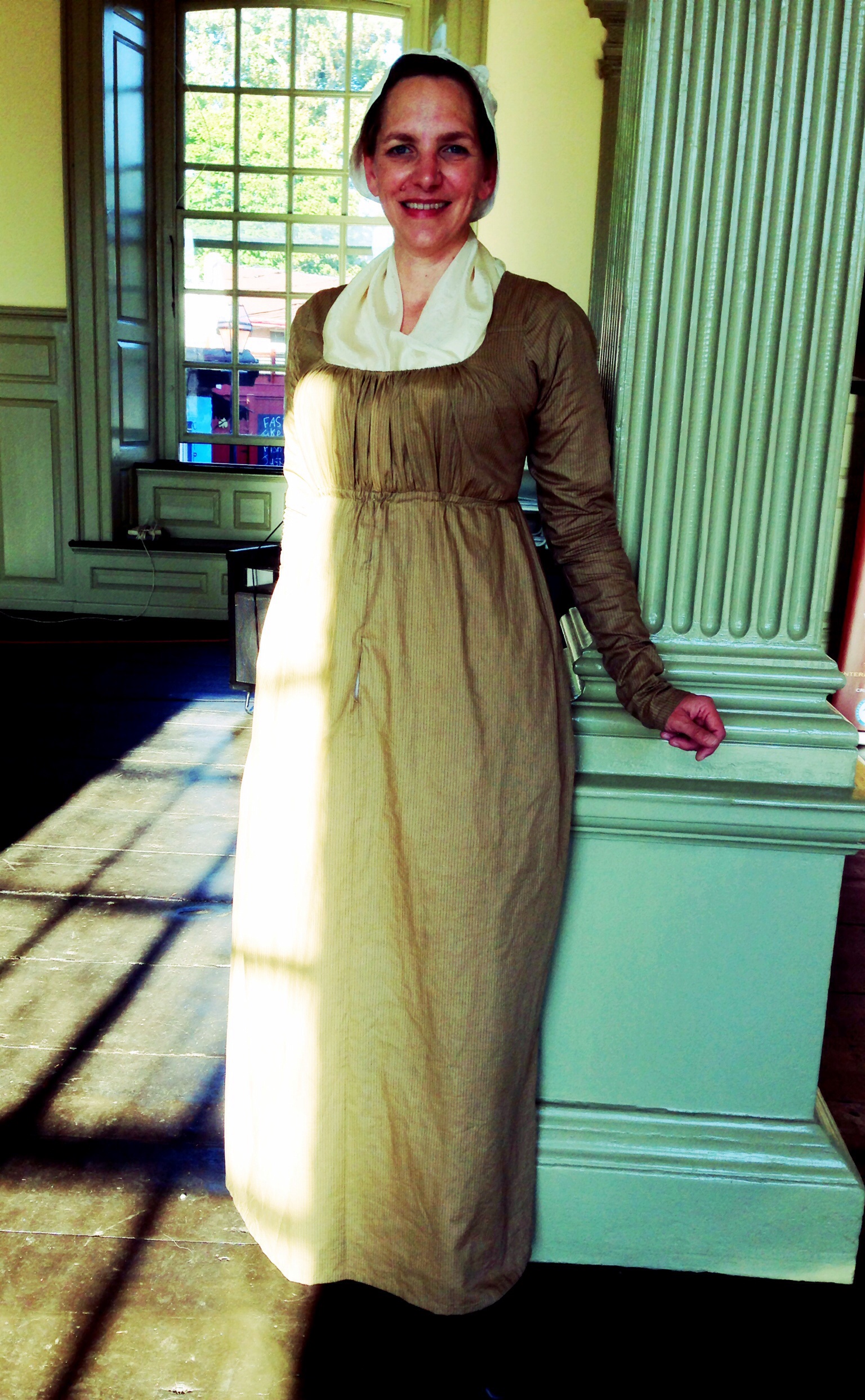
Many thanks to Sew 18th Century for taking the photos!

It appears I do not learn from my mistakes. When I think, “Gee, I’d like a pretty dress,” I end up buying fabric based on the texture as much as the color, and I have to tell you, that brown taffeta has the most wonderful l hand and sheen, and I will look much more like a Copley portrait than I ever have before, so that’s something.

It seems I have created a set of mental rules for myself, a mission, if you will, for the historic clothing I sew and the roles I take on, and I only play within those rules.


On Wanting to Quit the Hobby

Sometimes I want to quit this hobby.

It’s usually for selfish, petty reasons: for all I swear that I didn’t see the trash compactors and cars in Newport, spinning wheels, cast iron, and candelabra in dining flies made me nuts at Bennington. Why the difference? In Newport, the modern things were all backdrop and unchangeable. At Bennington, reenactors had choices.

Why would someone else’s cast-iron kitchen make me want to pack up my sticks and go home? Maybe because I’ve been very tired this summer. But more honestly, I have a streak of self-righteous grade-grubber: “I work hard at this, why can’t you?” was surely my internal whine as I surveyed the mess area at Bennington.

My emotional immaturity aside, I think that same “I get this, why can’t you?” is felt by a lot of reenactors/interpreters when they stand in their well-researched, hand-sewn, and agonized-over clothes in a Spartan camp watching the public interact with sofa-print-gown- or baggy-breeches-wearing cooks bent over cast iron in camps littered with slat-back chairs, folding tables, and candlesticks.

We feel unappreciated. We feel like no one recognizes our hard work. We are not getting the grade we deserve.

We need to get over it.

Don’t abandon the authenticity: abandon the attitude. Abandon the eye-rolling, the snubbing, the sneers, and the turning away.

Comparison is the enemy of contentment. Even when you think you’re better.

Stop playing the “I’m more authentic than you” game. It sucks. It makes people want to quit this hobby. It makes people want to skip events.

You want to have events where only people who meet your personal authenticity standards can play? Knock yourself out. Keep it private. In privacy, be as catty as you like with people who enjoy it, but keep it in the real world and not online. Online, it comes off as passive-aggressive cowardice.

Right?
Right?

Not everyone wants to play the same game. But no matter what the game is, it’s never fun to be the butt of meanness, and it’s not really fun to be mean—plus, it’s bad for your health, bad for the hobby, bad for the people around you.

We’re visual creatures: we can over-focus on what we see. We focus on the clothing being worn instead of the person inside those clothes. But really, it is the person who is important.

So maybe we should lighten up a little.

Individual choices don’t always affect a group. When choices do affect a group—cars in camp past stated removal times, weapons and fire safety violations—then I think anyone can and should speak up. But violations of published and easily accessible standards should be pointed out to event organizers, and not handled at the individual level. When there are no published and readily accessible shared standards, there’s nothing to enforce. So consider stepping down from the fashion police and enjoying yourself instead. I’ve been to very few events without redeeming factors.

Lighten up!

All that iron at Bennington? Forgotten when I focused on what I was doing: cooking something new in camp, and forgotten even more when I shared the pudding and compote with my friends.

That’s why I don’t quit this hobby: it allows me to share amazing experiences with my friends, I learn new things all the time, and I get far outside my petty worries.

Measure for Measure

or, a boiled Flour Pudding in two tries.

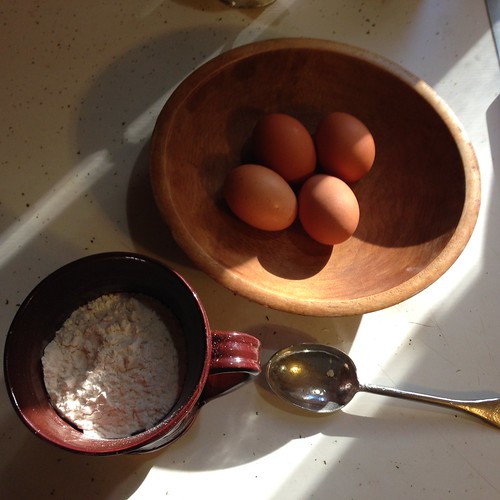
Alone in my Ossining ca. 1962 kitchen, I decided to tackle Amelia Simmons. The first task seemed to be to establish measurements, and then proportions, so I took stock of the tools and containers I would have in a typical camp. Spoon, mug, half-pint: these are plausible items, though we have tin cups that hold exactly 8 ounces, so the measure is unnecessary. The spoon was cast from a 1780 mold, so it seemed like a reasonable place to start for “how much is a spoon?” It will hold exactly one tablespoon if you scrape it flat across or are measuring liquid. Handy to know.

Next, I checked the recipe again.

A boiled Flour Pudding.
One quart milk, 9 eggs, 7 spoons flour, a little salt, put into a strong cloth and boiled three quarters of an hour.

This is not a popular receipt, so you won’t find it on History is Served, nor will you find this version on other popular sites; you can find a boiled pudding with suet, but that’s not what I’m after: I’m after a receipt that starts with a portion of the ration of flour soldiers received, and adds only eggs, milk, and available seasonings.

You have to remember that Simmons corrected the 7 spoons to 9 spoons of flour and increased the boiling time; you also have to remember that eggs were smaller then.

redware mug and wooden bowl with egggs
Halfsies.

I thought I’d try a half receipt first. There are no directions as we think of them– American Cookery sometimes has that “put your lips together and blow” feeling–but this is not too complex. The eggs and milk must be beaten together, and then combined with the flour. For this first attempt, I got it a bit backwards, adding the spices to the eggs, which I beat in the large wooden bowl.

That left me scooping the egg-and-milk with the measure into the flour, which I had in a smaller wooden bowl, remembering too late the method for scones.

egg and flour mixing in wooden bowls
Fuzzy photo, fuzzy logic.

And then it was really too late: I added just too much egg-and-milk, and it became more like batter than dough. This was not correct, and I knew it, but I didn’t dump it and I didn’t add more flour. Now it’s clear that 7:00 AM is not my best time for baking experiments (it was also quite early the day I made gingerbread without any eggs).

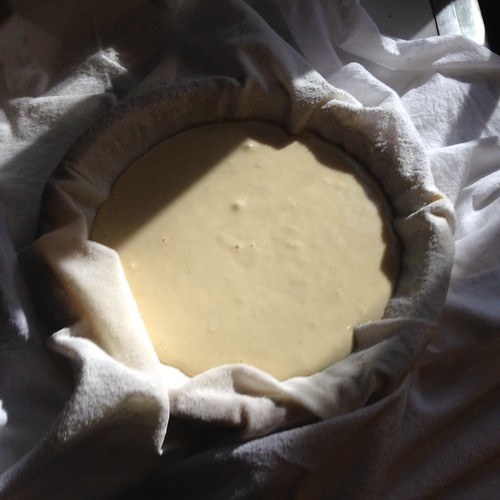
pudding mixture in cloth
Well, it took a decent photo.

I buttered and floured a cloth anyway, and poured the mixture into it. After tying the gathered neck of the cloth with string, I boiled the whole business for 45 minutes.

I did not take a photo of the mess I found when I unwrapped the bag. It wasn’t pretty, and it was clear that while some portions of the pudding were ‘done,’ they constituted about 5% of the whole, which otherwise resembled steaming cottage cheese. Really, truly, awful.

But from time to time I am undeterred by my failures, and instead of consigning the mess to the trash and sticking with store-bought bread*, I rinsed the cloth and regrouped.

This time, I went smaller: 1 cup of flour (about five spoons), two eggs, and a scant two spoons of milk. I also managed to put the flour, salt, and allspice in the regular sized wooden bowl, crack the eggs into the mug and beat them there with the milk. When I mixed the egg-and-milk into the flour, the mixture was far too stiff, so I added more milk, but kept the mixture stiff.

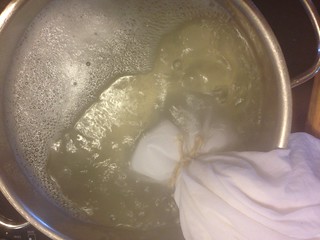
pudding bag in boiling water
Patience is required for pudding

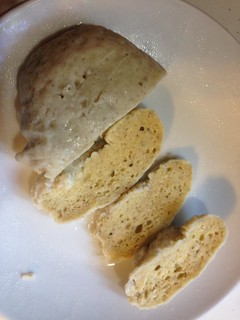
Once more into the buttered cloth, once more into the water, once more boiling for three-quarters of an hour. This time was better, though. The results actually looked and tasted much more like what I’ve had before.

sliced boiled flour pudding
A boiled Flour Pudding

So, where does this leave me? Knowing that I’m the only documented fan of this in the regiment, I’ll stick with the smaller receipt: five spoons flour; two eggs, beaten; and three or four spoons of milk.

My plan is to boil this in whatever stew or stew-like device we have for supper on Saturday, and then eat it sliced with the stew. The plain flour-egg-milk mixture will pick up some of the flavors of the stew (think dumplings), but these could also have been served with a sauce, if made at home.

I’m also going to go back to the Experienced English Housekeeper, and see what she has to say.

* Years in ceramics classes taught me to knead all the air out of plastic material, so my bread tends to be better for building than eating. Even the dog wouldn’t eat the biscuits I made while in grad school…

Stony Point Part the Second

DSC_5121

No, it’s not my photo of the Young Mr: I didn’t even take a real camera on this trip. These top two photos are thanks to Gary V’s Flickr stream.

Here the kid is eating. I think he spent most of the weekend eating. There are some fine calves in the 10th Mass, aren’t there? Look what a well-fitted pair of overalls can do for you.

10th MA and 2nd RI: Mr S, Mr HC, Mr P, YM, Mr FC, Mr B, Mr  H

We all benefited from hanging around Niel DeMarino’s historic bakery. Broken cookies are just as delicious as whole, if not better, and the ginger cakes were the best I’d ever had. It’s a pity that one can’t really bake in camp…

Mr S thinks I should tell the story of my 90-minute stint in solitary at Stony Point, but I’m not quite prepared for that.

Instead, I shall recount the Hose Water Coffee.

As fans of the 18th century know, orange water and rose water are not uncommon flavors in the receipts found in Hannah Glasse or Amelia Simmons‘ cookbooks.

Hose water is something else again. It is not improved with age.

At Stony Point, there was water at a stone ‘bubbler’ (props to those who used this Rhode Island term for the street furniture known elsewhere as a drinking fountain), which was hard to see in the gathering dusk the night we arrived. There was also a hose, proximate to a saw horse with a sign for Pedestrian Only traffic, and just down the path from our tents.

Colonial breakfast on a rock
Our kitchen, dining table, and parlour

Following Heather’s excellent advice, I planned to make cold coffee overnight so that we could be caffeinated in the morning. Lazily and unwisely, I used the hose to fill the pitcher of doom that first evening.

What is the essence of tire? L’eau latex? That’s what we had: strong coffee with a strong base note and unmistakable top note and bountiful middle notes of hose. Did we drink it? Of course we did: we were up at 5, and coffee was not provided until 8:30, when we all had second breakfast.

Saturday night, I skulked back to the bubbler and filled the pitcher again for Sunday’s coffee. This time, the clear, strong liquid was redolent only of coffee, and was judged better than the hot coffee (which had, in fairness, not been made with hose water, either). I’ll definitely repeat the coffee experiment, though I think I can use a little less coffee to water– not that I measured.