When all else fails, sew. And if that fails, sew something else. After a mad rush to get the gents into their new clothes for Saturday’s Battle Road business, I found myself at loose ends Sunday morning. I toyed with sleeves on the Space Invaders gown, and stitched a shoulder seam on the coat Mr B gave me last weekend. (It does not fit his shoulders, but his guess that it might work for the Young Mr was correct: somehow, Mr B cut a man’s coat to a boy’s frame.)
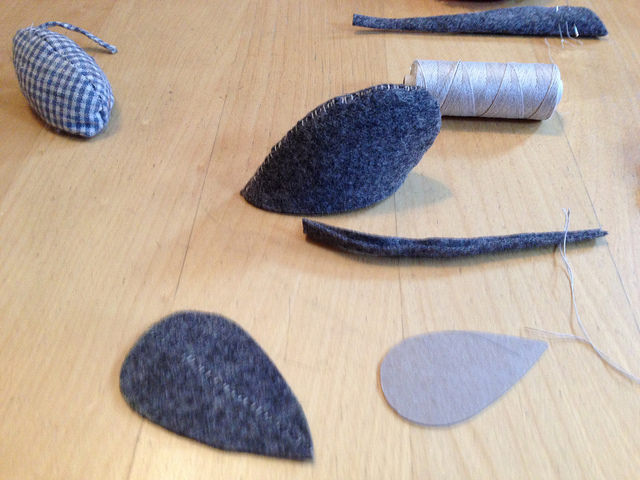
Original mouse and upgraded mouse (now with whiskers!)mouse parts
The bonus of this, aside from my amazed gratitude at a lovely coat well on its way for the boy, was an upgrade to reenactor mouse. Poor reenactor mouse was made at the farm from clumps of wool and scraps of check linen. New reenactor mouse is far fancier, being made of cleaned wool batting, catnip, and a scrap of broadcloth that is probably the $65/yard mixed grey wool I think it is. Lucky kitty, no?
The pieces are simple: two mousey-shaped backs, a roughly oval pasteboard base, a strippy scrap for a tail, wool batting, and catnip. Linen thread for stotting, whipstitching, and whiskers. Stitch the backs together (I had to piece the base from a scrap, so stotted bits to look like a mouse hide. Why not?)
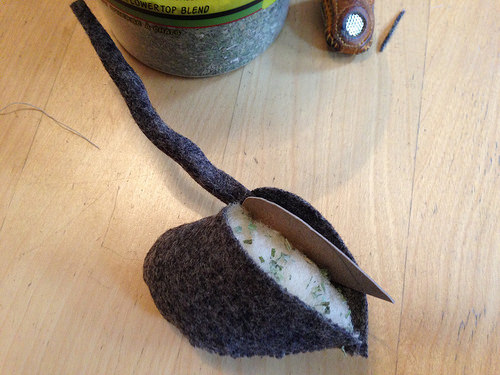
Whip stitch the tail to the inside of the mouse base. At this point, you’re ready to stuff the mouse. I rolled the wool batting in the catnip and stuffed the back, poured a little more straight catnip in, and then finished off with another bit of catnip-rolled batting.
This is where the little pasteboard or chipboard base comes in. You slide this in to the mouse sandwich before closing the last base seam. (It helps stabilize the mouse, so that it skitters across the floor more satisfactorily when batted.)
nearly there. full of wool & catnip.
Stitch the final seam. Make sure the seams are sturdy, as they’ll be going up against claws. I like to thread doubled linen thread through a large-eye needle to make whiskers; be sure to knot on both sides of the mouse’s nose.
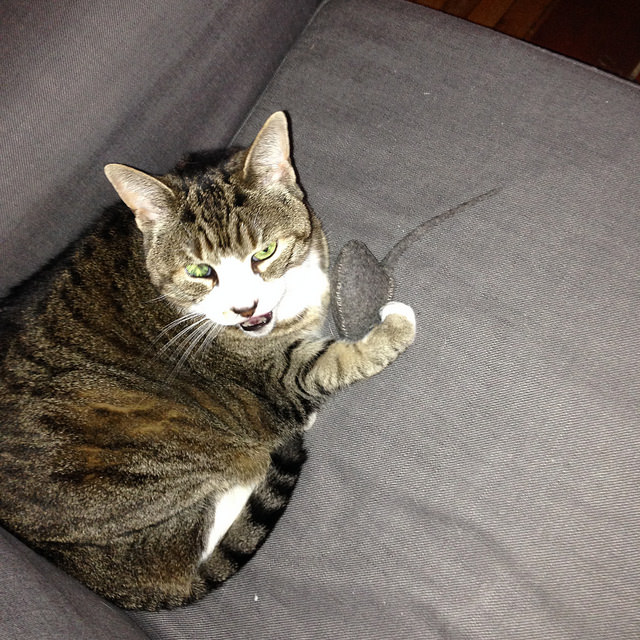
All you need to do now is hand the mouse over and back away. Kitty requests some privacy with her new mouse. There’s a flickr album if you want to see the progress photos of a quick and silly project and make your own Wooly Mouse for Progressive Pussy Cats.
If you’re reading this, you probably spend enough time on the interwebs to have picked up news about, oh, Bill Cosby and various Roman Catholic priests, and to know that sexual harassment and assault is both prevalent and under-reported in America. I don’t want to argue either of those topics, but I want to set the context for you, because sexual harassment, assault, and predation happen everywhere, even in reenacting circles; it certainly happens in cosplay: see here and here.
To be clear: I’ve only had issues with the public, not fellow reenactors, and the issues with the public involve non-sexual touching and drunken stupidity which I can avoid by never being alone in kit–which means I skip some events (Tower Park, I’m looking at you).
Most of us think of reenacting and reenactments as safe places and spaces: we do not expect to encounter predators at the museum or historic site, and I want to emphasize that, as far as I know, the visitors are not the ones being preyed upon. It’s mostly younger reenactors, and it’s rare, but it happens. And I think there are several pieces to the “why” of this.
Sometimes people are completely different away from their homes and families. Whatever secret obsessions they have may be indulged when they’re engaged in fantasy play far away from their homes. These guys (and they are usually guys) are pretty rare, and they are identifiable. The best defense against them is to monitor the vulnerable; young people who have a safety net around them are much less attractive. Once this kind of predator is identified, they have to be confronted.
Men will sometimes act more aggressively masculine (macho) in the presence of other men. There’s a defensiveness that comes to fore when women want to play in that sphere, and men will sexually harass or even assault women in an attempt to maintain dominance over what they perceive as their turf. Think of the firehouse sexual harassment cases, or what we’ve heard about at the military academies or even in some art school departments.This may be what’s behind a couple of the other stories I’ve heard.
It is unlawful to harass a person (an applicant or employee) because of that person’s sex. Harassment can include “sexual harassment” or unwelcome sexual advances, requests for sexual favors, and other verbal or physical harassment of a sexual nature.
Harassment does not have to be of a sexual nature, however, and can include offensive remarks about a person’s sex. For example, it is illegal to harass a woman by making offensive comments about women in general.
Both victim and the harasser can be either a woman or a man, and the victim and harasser can be the same sex.
Although the law doesn’t prohibit simple teasing, offhand comments, or isolated incidents that are not very serious, harassment is illegal when it is so frequent or severe that it creates a hostile or offensive work environment or when it results in an adverse employment decision (such as the victim being fired or demoted).
The harasser can be the victim’s supervisor, a supervisor in another area, a co-worker, or someone who is not an employee of the employer, such as a client or customer.
Although the law doesn’t prohibit simple teasing, offhand comments, or isolated incidents that are not very serious, harassment is illegal when it is so frequent or severe that it creates a hostile or offensive work environment.
How do we stop this? If the best defense is a good offense, what do we do?
Name the behaviour. Call the harasser out on his behaviour, state it to him, be specific.
Insist that women are equal to men, even in this masculine and militarized context.
Make clear the behavior is the issue. Say what you have to say, and repeat it if he persists. (If you are being harassed by a woman, kindly switch the pronouns; yes, it can happen. The incidents I have in mind involve male harassers.)
Listen to the people who tell you they have been harassed or assaulted. Don’t judge them.
Report harassment to your unit commander, or another trusted person, in case it’s your commander harassing you. Report harassment to a board member or your unit, umbrella organization or museum/site.
To be clear: not every guy is guilty. Not every unit has a problem. There’s more good than bad. But I’m hearing about incidents large and small, and it behooves us to be certain we are behaving appropriately and legally. That said, I’m not a lawyer, I’m a blogger, so see the disclaimer.
DISCLAIMER:
The information and materials on this site have been provided for general informational purposes only, are not comprehensive, not complete and are not legal advice. The information contained in the site is general information about sexual harassment and should not be construed as legal advice to be applied to any specific factual situation. None of the information is intended to constitute, nor does it constitute, legal advice. For information about your legal rights you should consult an attorney.
I wrestle a lot with myself, which sounds much sexier and more athletic than it is, when it’s your patience and conscience. It’s a constant fight with my own brain and animal nature, like Snowy pondering a bone.
It’s hard to keep sewing for an ever-taller young man who refuses almost all attempts at fitting. (Especially when your calloused fingertips and split thumb keep catching on the silk buttonhole twist.)
It’s hard to have program ideas and then realize you will end up as the maid, serving a meal to a group including some people you might not like. (Don’t you think that must be a fairly authentic emotion, historically?)
It’s hard to put aside plans for your first pretty silk dress because someone doesn’t want to go where you want to go.
It’s hard to embrace the importance and meaning of interpreting the ordinary in a culture that celebrates the unique.
I come to that and stop: mission.
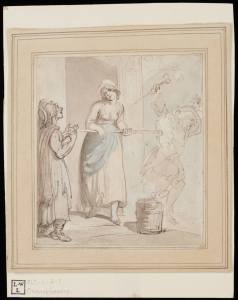
Watercolor by Thomas Rowlandson, 1785? Lewis Walpole LibraryDrawings R79 no. 7
You can take anything too far, of course, and an occasional silk gown and turn around a dance floor might make being the maid a little easier, but in the end I know that what’s important to me is representing the people who have been forgotten.
That same impulse may be part of what drives the splintering into ever-smaller groups with every-different coats, but walking the cat back also leads me to think that lace, tape, and shiny buttons may be part of the equation, too. Are those uniforms the gents’ equivalent to cross-barr’d silk sacques? As in any culture, it is easier to have your cake and eat it, too if you’re a guy.
For most of us women inhabiting the past, if we’re not baking cake, we’re serving it.
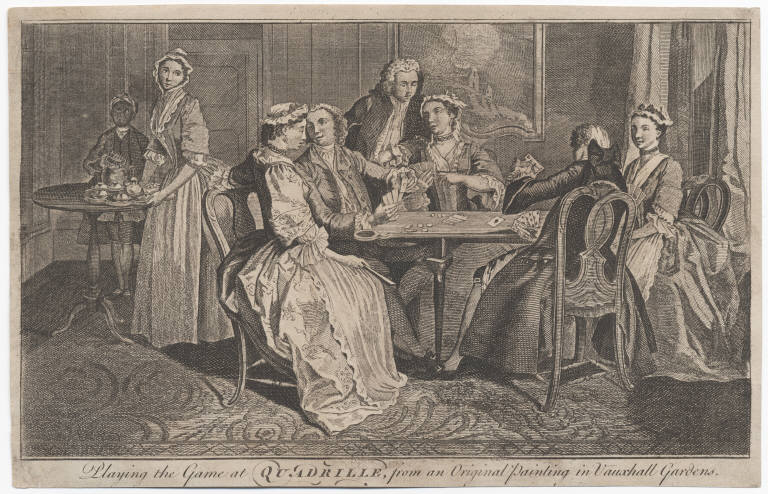
Playing the game at quadrille : from an original painting in Vauxhall Gardens. London : Robert Sayer, ca. 1750. Lewis Walpole Library, 750.00.00.14
It’s a funny thing to want a break from work you find important, but as with anything, variety and perspective are important.
She looks wistful, doesn’t she? The others are whist-full.
In a world of individualists, each trying to stand out, quotidian celebrities– cast a skeptical glance at your social media feed and tell me I’m wrong–our impulse may not be to inhabit the background. But most of us are the background. We’re large only in our own minds, stars of the movies of our lives that flicker past our eyelids. And that’s ok: that’s noble, even, to live a small, thoughtful life.
Silver Pocket Watch of Meriwether Lewis, 1936.30.5
Once upon a time, when I worked in Missouri, I was fortunate enough to spend a lot of quality time with some amazing artifacts.
Meriwether Lewis’s refracting telescope.
William Clark’s compass.
Meriwether Lewis’s pocket watch.
William Clark’s Account with John Griffin for thread, cloth and other articles including a hat for George and shoes for Mary. (July 1820, William Clark Papers, B13/F5, MHS)
Account of expenses in “horse keeping,” 1829- 1831. Request to Clark to pay to Mrs. Ingram, with request to serve as receipt. On same document: ADS Dashney to Major Graham, 26 June 1826. Order to pay William C. Wiggins. (1831 Dec 13, William Clark Papers, B14/F2, MHS).
There are letters to one of Clark’s sons, trying to get him to stay at West Point. There are bills for bolts and iron work for Clark’s house. Yes: there are amazing things in the collection as well, and historians of all kinds can do amazing work in the papers.
But they are ordinary. They are daily life played out in the first third of the nineteenth century in St. Louis, bills and accounts punctuated by letters from famous people and news of wars and explorers. But after processing the family’s collection, what struck me more than anything was how ordinary they were, how quotidian.
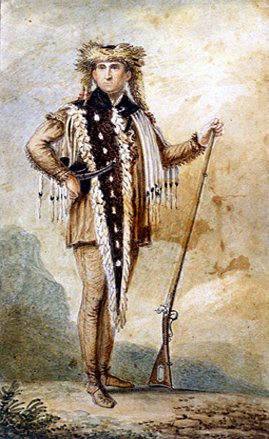
Meriwether Lewis in Indian dress. engraving after St. Memin, 1807.
Lewis was fabulous, interesting and mysterious. I don’t know what really happened on the Natchez Trace, but I know what happened in St. Louis. William Clark kept living, paying his bills and stumbling sometimes, refusing a role as territorial governor before accepting it. He got boring. And for that, I love him more than Lewis.
There’s real value in interpreting the everyday, ordinary people, in bringing work and working people to life in the past. I don’t always love repressing my ego, but I know that a nostalgic view of the past can be dangerous. I meant backwardly aspirational when I first wrote it, and I mean it now: most of us would not have been merchants wearing silks and velvets and superfine wools.
After wrestling with my ego and silk dress disappointment most of this afternoon*, I’ve found satisfaction in the thought of expanding my understanding of working class women. If really digging into interpreting the world of the marginal makes me uncomfortable, it must be worth doing, and doing well.
*Thankfully whilst performing useful tasks like running errands and thus wasting little real time on this nonsense.
When not working on the Unified Theory of Living History,* I’ve been sewing for the February program in Newport. You know about the skritchy brown gown, and then there was the Great Coat Obsession. Well, here it is, in unpressed previews.
The photographer and I had barely achieved emotional détente by the time these were taken after a foray out of doors in the late afternoon, but we survived on willpower and the promise of strong beer and here you are. Two and three quarters yards were not quite enough at this length, though perhaps the coat does not have the close in the skirt. For $13, I think I’m still okay with where this is headed, though buttons will be the very devil.
My finger tips are so calloused that working touch screens is getting hard, and silk thread practically shreds when I try to make deaths head buttons. It’s still too early to give in and buy buttons, but there will be swearing ahead.
Back to the coat: there is enough wool for a cape or two, if one is pieced or false. It’s hard to tell how warm this will be, until the buttons are on and the body lined. Wearing it outdoors on Sunday did make me think about the wool flannel shift in a collection near me, and how nicely cozy that would be for winter.








 Kirsten Hammerstrom
You must be logged in to post a comment.