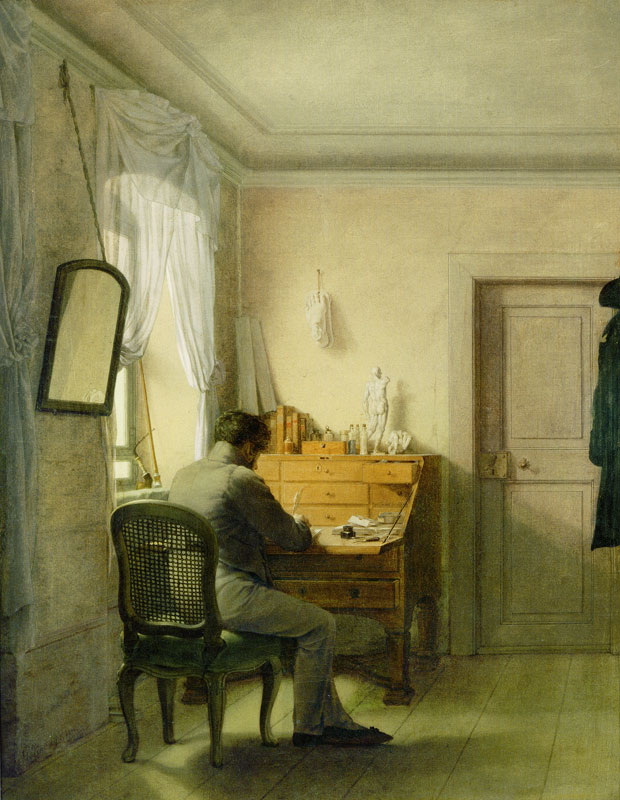
Georg Friedrich Kersting, A Man (artist) at His Desk. 1811. Klassik Stiftung Weimar, Goethe Nationalmuseum
1811 caught my eye and stopped my Twitter scrolling. Kersting never fails to please, luminous watercolors and delicate details. Summer is here, along with events in so many years I feel quite distracted.
1780 this weekend (L’Hermione in Boston). 1775 a few weeks later. 1814 in August. 1833 in September. You could get whiplash looking at waistlines and sleeve silhouettes.
What I need is to take the time to sit, like Kersting’s man, to reflect and to write and to make a plan. I’ve fallen behind on the garment-a-week program, and need to catch up quickly. The faster I sew, the less like the Young Mr can outgrow the garment before it’s finished.
One of the most common questions you get when you’re wearing historical clothing is the undying, “Aren’t you hot in those clothes?”
A heavily perspiring visitor wearing practically nothing usually asks this question, and the standard reply is a variation of “Aren’t you hot? In really warm weather, everyone is hot. But natural fibre clothing wicks the moisture from the skin and helps to keep you cool.” My internal response (vocalized only once) is, “Why yes, I am—and thank you for noticing. I work hard for this look.”
The “aren’t you hot” question is often followed by, “Wow, and they didn’t bathe, so everyone really smelled.” You try not to think of that Monty Python sketch about Britain’s deadliest joke program in WWII and move the conversation on to weekly laundering of body linen, multiple shifts, shirts, and under-drawers, and the general hygienic practices of the past.
What struck me after a sticky weekend is how much I noticed the smell of modern people.
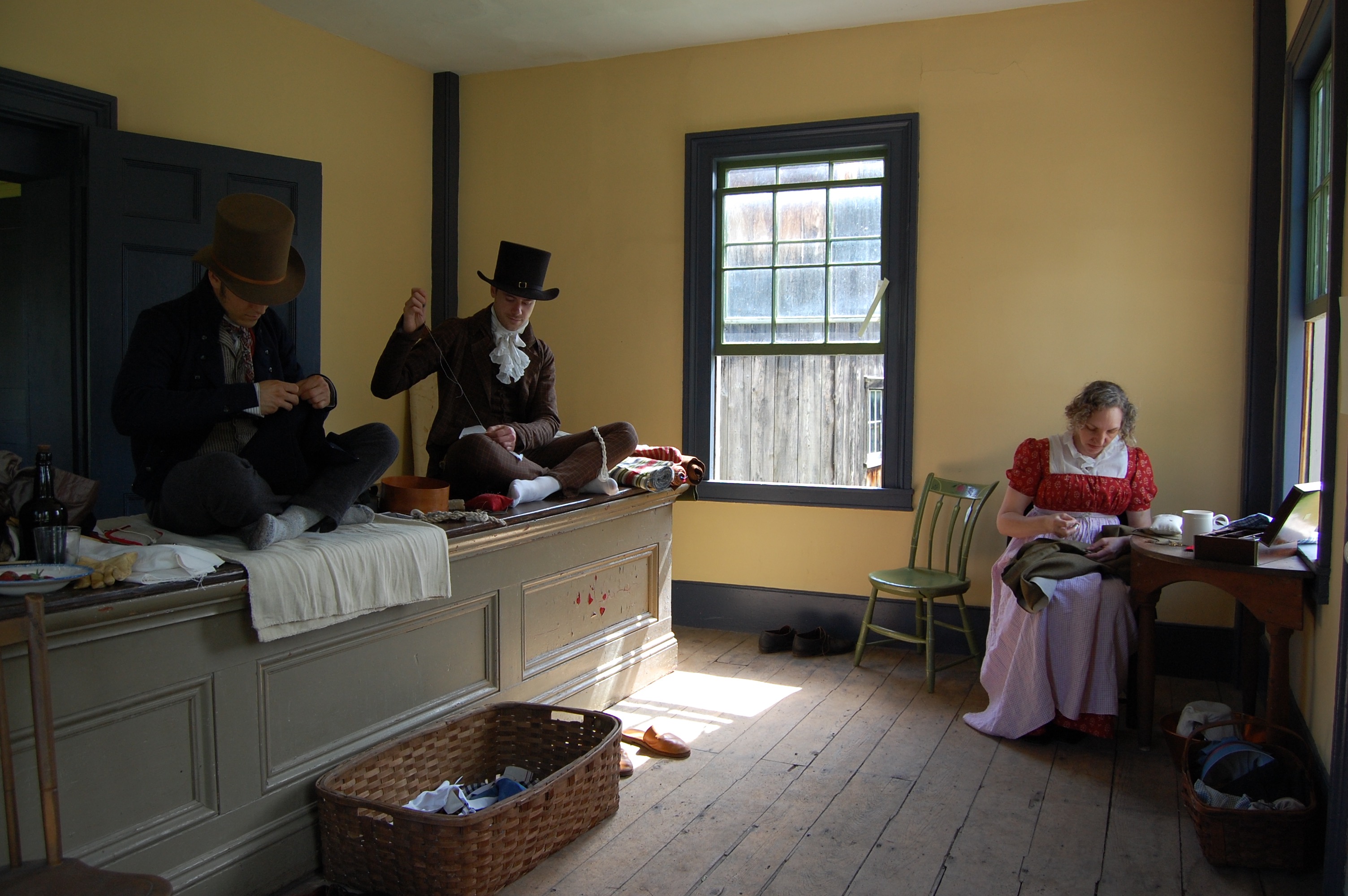
two tailors and a tailoress
My traveling companions and I bathed on Friday morning, drove for 7+ hours in muggy weather, slept in our clothes, wore wool, cotton and linen in rain and thick humidity, sweated in the tailor’s shop, slept in our clothes again, and spent another warm, close, day in muggy weather, including grave digging and pall bearing. But as feral as my shift may have been on Sunday night, I never smelled us.
Mr H reported that his wool trousers were really stinky in the rain, and I think his white Spencer was well-seasoned even before this weekend, but I didn’t notice anything. Mr S’s soaking greatcoat was whiffy only at extremely close range.
What I did smell were modern perfumes, deodorants, and hair products. Those linger around their wearers and trail behind them, sometimes eye-watering in their intensity. I encountered lingering perfume in a bathroom at the museum, and we were overwhelmed by cologne at diner Monday morning: wow, people must really smell now, of petrochemicals.
more wool
This is not to say that homeless people and sulky teenagers don’t smell of unwashed bodies and clothes, but people in the past may not have smelled quite as badly as we think. They washed, if not bathed (bathing being full immersion washing) and by changing body linen and airing their clothes, they kept reasonably clean.
There was plenty to whiff in the past: wastes of all kinds, stagnant bodies of water used as dumps, rotting foods and corpses. But I’m not convinced that we haven’t simply exchanged one set of smells for another of different origin and intensity.
I troll the interwebs in the fishing and not the under-the-bridge sense: there’s a lot to read out there. Still, I’ve kept one eye on the feather-and-flower kerfluffle that erupted in certain circles this week, but have been much more interested in documentation of one kind and another.
Miss Vernon is really my favorite image of feathers on hats, and I wish I could say that a) I have replicated this fabulous creation or b) that I have seen such a thing, but alas! I have not.
Still, scouring sundry repositories for tayloring manuals (more on that another time), I found this delightful broadside. We can’t use 1782 to document 1780, and no means of using any of these items is mentioned or implied. Still, there they are, those inflammatory terms: Feathers, Flowers.
1782 Broadside. Early American Imprints, Series 1, no. 45771 (filmed)
Mr. Turner, out now on iTunes and elsewhere, won’t be for everyone: M’damsel isn’t treated very well– artists are, you know, often narcissistic, driven users– but the landscapes thrill.
We talk sometimes about going to the antique store in historical clothing and asking why our chattel is for sale. I toy with similar naughty thoughts about visiting historic house and other museums, but Mr Turner inspires a dream of a simpler pleasure: dressing in period clothes to visit a period gallery.
Classic Mr Turner in the salon
Possibly my companion would grunt as Turner does, but we might also unnerve guards by pointing walking sticks at salon-hung still lifes or reacting with disgust at the sight of an Impressionist work. (Might as well take it all the way.)
Everybody’s a critic
No takers yet for this diversion, which is just as well. I expect it would be a quick way to meet security and police staff if you didn’t coordinate with the museum/gallery in advance. Still: what a stunt. Someday I’ll pull it off.



 Kirsten Hammerstrom
You must be logged in to post a comment.