Serious Saturday: Security Concerns

Warning: Museum Content Ahead

Woman Selling Salop. William Henry Pyne. The Costume of Great Britain. 1805.

Night watchmen. We’ve been over them before, tangentially, but never in an experienced way. Sure, sleeping overnight at museum sites, I’ve encountered the night watchman making his rounds. And as a museum visitor, I’ve met the guards who monitor how I’m wearing my messenger bag, and how close I get to various works of art.

But what I don’t think about enough, and don’t observe being thought about, is the safety of people over objects. The Museum Security Network has posts on art theft, forgery, and vandalism— all of which are important topics– but there’s a clear focus. For years, decades, that was our focus at work: stuff, buildings, not people.

That changed in our Library five years ago with one obstreperous patron who touched–didn’t hurt, but was angry, and put a hand on– one of our librarians. Now we think about books, papers, and people. But it’s hard: for as long as I’ve worked in this field, and it’s fully half my life, I’ve had the mission drummed into me: access. We preserve these materials, these objects, these sites, for the use and enjoyment of the public, and that means everyone.

The radical democracy of object care (everything we own is preserved with the best care we can provide, from 17th century basket to 21st century advertising hard hat) translated for me into the radical democracy of access: everyone gets in. (It helps that I’ve worked at places where we could provide a lot of free access, and where we continue to strive for as much free access as possible.)
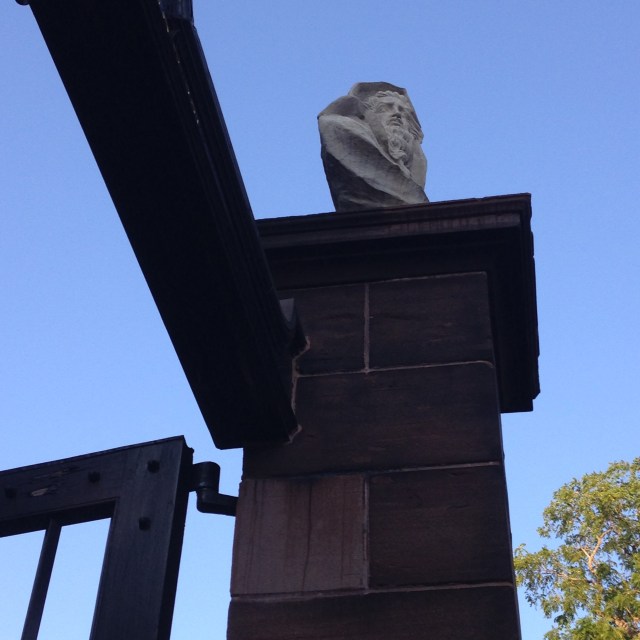
Hades atop the front gate pillar

Everyone gets in. Everyone can appreciate our shared cultural heritage. And then I met Mr Hades. That’s not his real name, but the young man who has been visiting us at the museum (after coming to the library last summer in a quieter mode) has developed an obsession with Hades. He came in Thursday, asking about the front gates, about Hades being the god of Hell, and whether the gates of hell were in our basement. I’ve heard a lot of myths about our basement, but not that one. After ten minutes, and before we could connect to 911, Mr Hades left.

But he was back yesterday, more erratic than before, sunglasses hiding his wide and striking pale green eyes, ranging through the house from front to back streaming a rap song on his phone. He paid for the tour, but left after 10 minutes in the house. He’s clearly been on a tour before.

So we met two police officers from the local substation, and we know to call them immediately if Mr Hades returns. A little research (that’s what we do) turned up a lot of interesting information about Mr Hades, and we suspect that there are officers and judges and guards who are pretty familiar with him, and that he needs help as much or more than he needs incarceration. But he disturbs our visitors, and agitates the staff, and that’s a bad visitor experience. (Thanks to my anti-anxiety meds, I don’t get anxious; I just get a stomach ache and keep talking with Mr Hades to try to keep him focused.)

But last night, talking about safety and Mr Hades with Drunk Tailor, I realized that we don’t think enough about the security of our staff. We put our visitors and our objects before the staff, and that’s not right. This incident made me put the safety of our staff above that of the objects, but we can’t help our visitors be safe unless we take care of ourselves.

oxygen-mask

If your staff members know their routines, know how to respond and have the tools they need to respond, they’ll be better able to care for and direct visitors to safety. I know we have to shift our thinking and procedures where I am; chances are your procedures are up for their annual review, too. For many of us, the new fiscal year has just begun. What better time for review and changes?

Indocent Exposure

IMG_7288 Or, Confusion into Confusion.

Docents and volunteers: the backbone of any non-profit organization, right?

Well…sort of. I’ve worked with docents for more than a decade, and along the way I’ve learned what does and doesn’t work. What does work is intensive engagement and participation, though the occasional shock to the system can be necessary and useful. For special events, though, and in cases of turf, diplomatic relations must be opened with the enemy early and often.

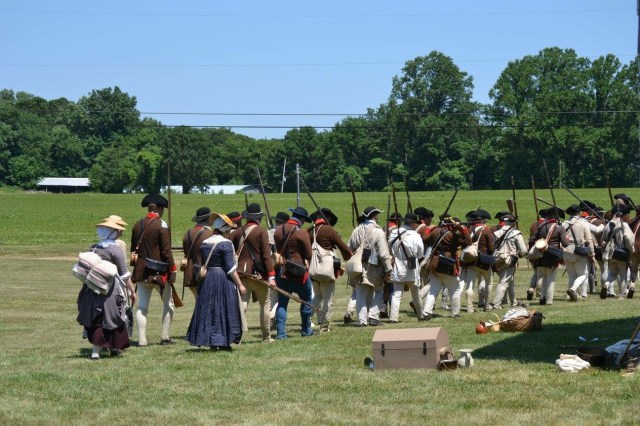
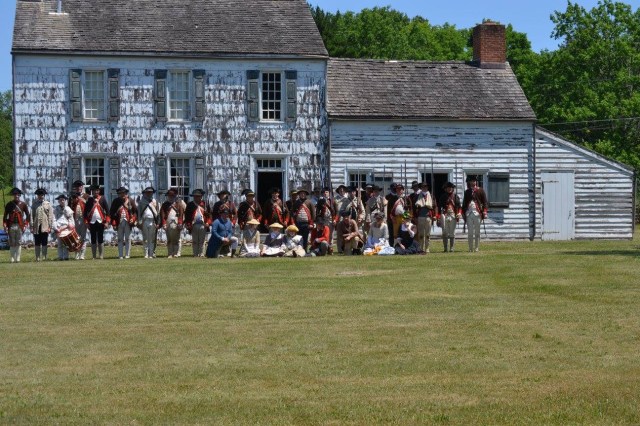
That is not to fault the organizers of the “Order Out of Confusion” event this past weekend, for I was one of the people organizing the civilian, non-marching end of things, and due to turbulence in my own life, I failed to plan adequately in the arena of Docent Relations.

IMG_7296

We had a Retaliator, a Pine Robber, a Quaker, and a Slave-Owning Patriot. We managed a debate or two over slavery. We begged people to take the Quaker home with them. But we did not occupy the house, for the house was occupied by red-shirted volunteers who gave at least some of us the five cent Condescension Tour punctuated with, “But I suppose you’re not interested in that.”

IMG_7298

Actually, that look was one of sheer disbelief, sir, at the farm implements in a bedroom, the tidy piles of perfectly formed ashen coals under the cookware in the fireplace, and the roomful of flax accented with a snake charmer’s basket. In my line of work, I enjoy house tours, but find they generally go better when tour guides don’t point out all the flaws to me. Complaining about the state (which owns the site) and onerous regulations that make repairs expensive will also increase my look of horror and disbelief. But really, if you want full-on horror, kindly inform the Quaker that Japanese POW camps “really weren’t that bad” because we are thriving on confusion today.

IMG_7297

The volunteers were thrilled by the marchers, and were clearly very positive about the event. They love Craig House, and the battlefield, but that sense of pride and ownership made it impossible for them to share the house with us, or to see us as anything but invaders– an Army of Occupation in our own right.

It’s my fault that I’m not an agile enough negotiator to convince recalcitrant octogenarians that my friends and I are safe to play with and will respect the house, and it’s my fault that I didn’t put in place all the lessons I’ve learned in the past decade. Then again, I don’t know that I would have had time to travel for meetings with the volunteers to generate buy in and support, given the maelstrom that was my life this past spring.

IMG_7289

But it’s a lesson well-learned: interpreters will read voraciously, acquire tons of material, and turn that research into appropriately-dressed characters making interpretive points, but unless you work with the site and its volunteers or staff to create agreement about presentation, you’ll get about half the value of the work you put into the planning.

Many heartfelt thanks to everyone who participated, and to the organizers for letting me try out my interpretive model. Next time, I know I have to work with the site staff and volunteers to make sure that execution matches vision.

Bloody, Bratty, Boning

File_000Sometimes I am a terrible brat, as in this past weekend, when the autocorrect on my phone insisted that the proud four-letter Anglo-Saxon words I was typing were not what I meant to say. Darn tootin’ they were.

This is not my first rodeo with stays, but somehow I’d forgotten about the special stabby hell of boning the beasts. I’m machine sewing the channels for these, mostly because I calculated the time required to completely hand-sew them and realized I would not finish them before I needed them. I’ve rationalized this by acknowledging that I’m not using the hand-woven brown wool sateen I covet, but instead a dark blue wool twill.

I know, I know: there’s a reason staymaking was a man’s trade. My hands are pretty strong, but it took some doing to figure out how to slide the pieces in neatly without jabbing the ends repeatedly into the freshly re-opened split on my thumb.

d'oh! surgical tape made this *much* better later.
d’oh! surgical tape made this *much* better later.

It takes discipline to keep doing this, the way it takes some discipline not to eat ice cream for breakfast just because you can (though I did, just this week). Spencers and dresses are so tempting, but there’s not point to making a new dress of wonder unless I have the stays to wear it over: infrastructure is required.

The stomacher and the two front pieces are boned… six more pieces plus whipping and eyelets and binding, oh, my! It’ll be a race to have them done by June 24th:  Discipline’s the thing.

Stay Thy Hand

IMG_6784

Stays. They’re infrastructure: absolutely necessary, a major time commitment, and decidedly unsexy. I am in dire need to two new pairs, one for late 18th century use and one for early 19th century, and each with deadlines looming.

I can manage 19th century attire and Genesee with the chopped-and-dropped corded stays I already have, but New Jersey will not happen at all unless new stays are made. It was like a weekend of penance chez Calash, two straight days of stay mocking up and making.

Of course I bled on them. That’s how I know they’re mine.

IMG_6786

And let’s get this out of the way: I thought backstitching the back seam was a little more difficult on this side, but ascribed it to sore fingers. Wrong! I failed to notice that I was stitching through all the layers, and not leaving one free to fold over and finish.

IMG_0806

A glass of cider and an hour later, I’d rectified the error. These are now fully bound along the bottom edge, and ready for the top edge binding. Somewhere there’s coutil for the straps, and then numerous hand-sewn eyelets later, I will have a finished pair of hand-sewn stays.

New stays deserve a new gown, and since I found this lovely image, I know what that new gown should look like (as well as a portfolio).  Happily, there’s a dress in Cassidy’s book that will serve as a reasonable basis for recreating this image. I’m still pondering the portfolio, and what it might be made of: paper or leather covered pasteboard? As the clock ticks down to June, I suspect I will be using a portfolio I already have on hand.

And then there are the the 18th century stays, with their history of woe.

File_000

I’ve gotten this far with the new 18th century pair, and an interesting business it is. I altered the front side pieces and the stomacher, but cannot see the back well enough (even with a camera and a mirror) to adjust it by myself, so further changes will have to wait until I have some assistance.

The tabs aren’t right in the back, and while the advice is to shorten the stays when the tabs flare this way, I found the fronts were still too low, once again riding at nipple-cutting height. Finally it occurred to me that the problem– slippage–might actually be one of waist. I lengthened the fronts half an inch and nipped the waist in, and found the fit more pleasing.  I suspect the back pieces need to be trimmed a bit before they’ll fit (they’re stitched closed in this version, so you know they’re too big).

Another weekend of work awaits– with focus, those early 19th century stays may be done by then, if there are no more finger injuries.