More Color, Brighter Color

Not the side I ended up using.

“More colah! brightah colah!” was the refrain of one of the printmaking professors at my undergrad program (hilariously, I met him again last summer here in the Ocean State, and nothing much had changed). This is useful advice for someone stuck in the doldrums of late winter New England. It was late January when I got some disappointing news and set off to cure my blues at the fabric store. There’s a bodice in the plaid underway for another silk gown (eventually to be sold, I think; how many can one have?), but I grew dissatisfied with the fabric. Too pale. I wanted More Color. Brighter Color.

Lucky for me, it was on sale. Fabric Mart Fabrics has been good for me in the past, and a silk sale was a success this time, too. The bright and bold dress in the FIT collection was my inspiration, and I dearly hoped I would not manage to cut the cross-barred pattern to match, so of course I pretty much did.

My tried-and-true pattern based on the 1815 roller print gown at Genesee Country Village was the base pattern for the silk gown: I know how to adjust it so that I can get dressed on my own, drawstrings the saving grace for the solitary woman who wants a back-closing gown.

I didn’t alter my pattern enough to really capture that neckline, because, in truth, I wanted to get this done! I did concede to trim, of course, and while conducting Drunk Tailor on a (fruitless for him) tour of regional fabric stores, found, at last, the trim I wanted, at the Fabric Place Basement in Natick. Good thing, too, because I was convinced that we were going to die in the traffic backup on whatever that road is in Framingham that creeps in at petty pace from day to day,To the last syllable of recorded time. But no, we lived, after I was fed, and trim was found, saving the day. (Seriously, I don’t think I have ever been on that stretch between Natick and Framingham and not been in a traffic jam since I first encountered it in 1988.)

But the dress, that’s the point. It’s done, at least enough to wear, though I did not buy enough trim for the hem and will have to trek back up to Natick for another few yards with which I can trim the hem. A lovely young woman named Tanya did get a photo of me in full regalia, down to the gloves (yes! leather opera gloves!) but I haven’t found it yet out on the interwebs, so my hotel room selfies must suffice.

What I find most satisfying– aside from the dancing– is how versatile a very simple dress pattern can be. Fabric choices, trims, hem length, minor sleeve alterations, and accessories make this one pattern work both for a day dress and a dancing dress.
Circles and Lines

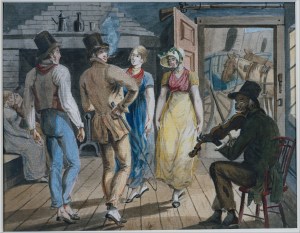
Merrymaking at a Wayside Inn, watercolor on paper by John Lewis Krimmel. 1811-1813. Metropolitan Museum of Art, 42.95.12

By some miracle, I did not have the Polecats in my head all weekend, despite spending most of Saturday only dancing. It has been some time since I danced (February’s adventure notwithstanding) and after two hip replacements, my Giant son is correct: I’m still re-training my muscles. My feet remember more than my hips do, but at least some of my muscles remember!

The Commonwealth Vintage Dancers Regency Weekend was this past weekend, and while I could only manage Saturday (Sundays are for chores when you’re expecting houseguests for Easter), I had a wonderful time and sincerely hope I can retain what I was taught. The company was very friendly and quite genteel, though I can report that I did experience a variety of partners, and, in one unfortunate case, became so confused I had to step out of the dance entirely. (Mixed rhythms and mixed-up steps became far too jumbled in my poor brain.)

The Five Positions, from An Analysis of Country Dancing, T. Wilson, 1811.

The entire day reminded me strongly of being in a novel, or, as Drunk Tailor said on hearing the description, a movie. Let us merely note that some gentleman are more enthusiastic appreciators of music than others, and that a partner can be left feeling a bit flung about in some of the figures that involve the mouliner. My rusty memories of French came in handy: mouliner and mill connect easily enough for me (seen here, in Prince Kutusoff) and the Boulanger made much more sense when I connected it to mixing bread dough. Hey– whatever gets you through the set without stepping on your own, or anyone else’s feet!

I’d like to think I will remember something of this business the next time I get to dance, whenever that may be. The patterns can be found on line in manuals (as in this description of Sir Roger de Coverly) with some occasional, bearable, videos— and, as always, resources close to home.

Next time: the dress. Until then, I’m posting more on Instagram.

Serving Delaplace

dscn4628

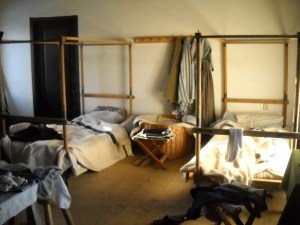
With 400 miles between us, Drunk Tailor and I have few chances to explore the past together, so I was both delighted and nervous when he agreed to join the British Garrison 1775 event at Fort Ticonderoga as one of Captain Delaplace’s servants.  Even better, we were also joined by the itinerant Deep North Yankee who wandered around the Fort (possibly seeking roofing shingles, of which he is much in need).

dscn4631

Friday nights are always magical, candle and firelight (and only the warmth of the fire) as we drink cider and talk about history. But morning always comes: Saturday, cold and clear, Mr S and I woke and blinked across the room at each other, and I wondered to what degree I really wanted to ever crawl out of bed…only hunger and an eventual need to pee (and fear of a Sergeant) propelled me.

Yup, you cook 'em on a board.
Yup, you cook ’em on a board.

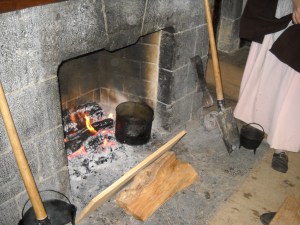
First order of business: breakfast. Mr S, supplied with his corn meal of choice, made us johnnycakes, which provided perhaps more interpretive than nutritive value. Still, they were warm and tasty and he is the only person I know who can make them; my efforts end up as FEMA disaster sites.

Captain Delaplace’s servants were tasked with cooking for his mess, so Mr S and I got a start. We had a chicken, an onion (I traded onion # 2 for some bacon), butter, carrots, potatoes, a butternut squash, salt, and some port. I don’t know where this English serving woman of 1775 encountered mis en place, but she accidentally introduced coq au vin to the Captain’s table with the dinner meal.

Captain and Mrs Delaplace dining, manservant in attendance

The Captain and his Lady dined on chicken braised in butter and bacon with root vegetables in a port sauce; we servants waited until they were done before we could eat. (Confession: I need to eat a lot, and have a sensory overload problem, so when visitors fully crowded the room, I had to dash across the parade ground for a Clif Bar and an Ativan before I could continue to wait for my dinner.) In the afternoon, dishes were washed at the table, as was common (at least in early New England), dried, and set away, while the Captain’s lady and child played in the cabbage patch between the beds.

dscn4657

When the room was empty, servants were able to eat (huzzay!) and found the meal very tasty indeed. I would certainly make this again, and learned more about cooking– a typically female task I generally try to avoid– than I had expected to. Then we had yet another round of dishes before it was time to tidy the room and make ready for tea or supper.

To that end, we cleared the table and broke it apart to reveal the floor and hearth, which needed to be swept of bread crumbs, squash peels, dead leaves, and other detritus. The best way to sweep an unfinished floor in the 18th century (per Hannah Glasse et al) is to strew the floor with wet sand and then sweep. I mixed sand with lavender-infused vinegar and threw it on the floor; this keeps the dust down as you sweep months of dust and dirt out of the corners and from behind tables and chests.

The trick is to sweep in one direction (more or less) from the back of the room to the front, and then to gather up the sand (here in a shovel) and pitch it off the landing. Much was thrown out the door and over the stair rail, just as servants would have done in 1775. (And I am told it is soothing to nearly hit the sergeant, but perhaps that’s merely hearsay, if not heresy.)

img_9478

When we were done, we restored the table (Drunk Tailor noticed the height of the ceiling, and wondered about hanging birds in cages whist awaiting the return of the tabletop), fully reset with cloth, candlesticks, plates, and knives, ready for the supper we didn’t cook, as we skipped away at the close of the day to find our own meal in Glens Falls, where live music is inescapable on a Saturday night.

A Saturday in Salem : Jane Austen Ball

Closure: green silk satin ribbon.

With many thanks to the Quintessential Clothes Pen, I was not dancing with myself Saturday last at the Jane Austen Ball in Salem. I was there on a bit of a whim, knowing that the ball happened in February and looking for something to do on a winter weekend– and, as it happened, I actually had a dress to wear. Of course, it wasn’t finished until Friday night, although I had worn it in December for a photoshoot.

Dressed for the weather: I only seem to wear this pelisse in February.

In the past year+, I’ve been trying to do more and regret less, which seems a bit contradictory: if you do more, might you regret more of what you do? The trick for me, especially in dealing with my baseline high-anxiety self, is to do more things that seem scary but are actually fun.* That’s how I found myself traveling up to Salem between snowstorms to stay in a tiny little room in a historic hotel. It’s a pretty quick ninety-minute trip on a good day, but I know myself well enough now that staying overnight is the safer, less-stressful option for an excursion like this.

Salem on a snowy Saturday was busy, streets crowded with people as I walked to the old Town Hall, feeling very much like a character in a novel. (Having just finished Remarkable Creatures, the scenes of Elizabeth Philpot walking in alone London came to mind as I did attract some attention in my pelisse and bonnet.)

The Town Hall was crowded; I arrived a little late, as dancing was beginning under patient and direct tutelage, so I had the pleasure of watching several dances before I joined in. While not everyone was wearing early-Federal/Regency clothing, the crowd still provided an excellent sense of the social mixing and festivity of a scene from the past.

Unforgivable hotel room selfie to record the dress

Joining in was even better, to be in the swirl of people and skirts, to pay attention to my feet– my shoes were a little slicker than I would like– and to count the rhythm of the music. While I spent years in ballet class, it is true that those years were surpassed by years in mosh pits and on dance floors of questionable clubs. Country dances made me think of four-dimensional math, with the patterns made by the combinations of active and helper couples, the reversals of direction, and the changing positions of partners: it was like being a living fractal.

*With some exceptions including rollercoasters and sky diving.