The Widow will See You Now

No idea how I lost that pin. Photo by Mike Cirilo. 

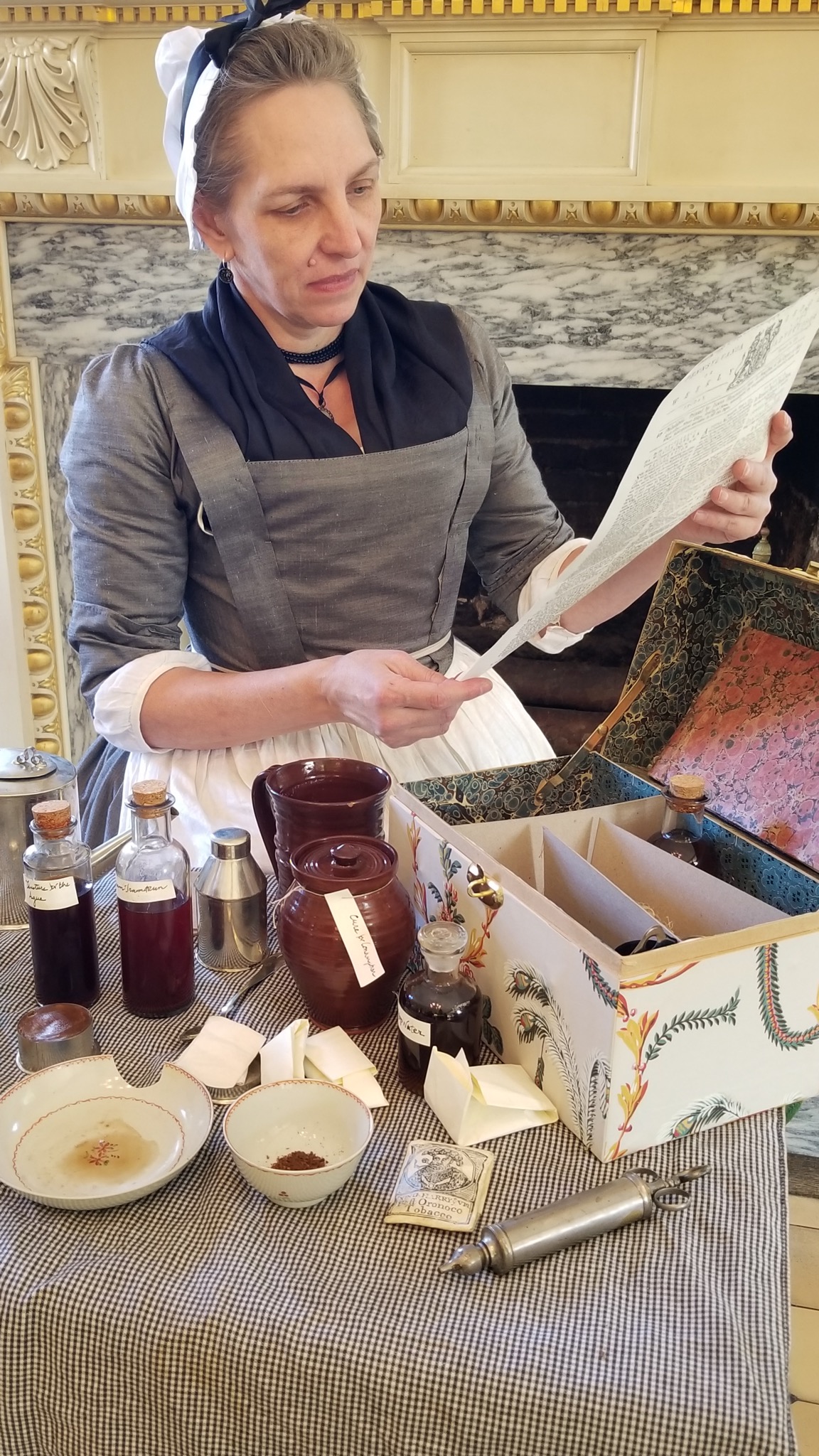
Part five: portraying Widow Weed

I almost prefer first person interpretation, largely because it catches visitors a little off-guard, excites their curiosity, and allows me to use more humor in conversation than third person. This time, though, I found that despite the research and thinking I’d put into this portrayal, I couldn’t synthesize the material fast enough to fully immerse myself in first person, having over-scheduled the days leading up to Occupied Philadelphia. 
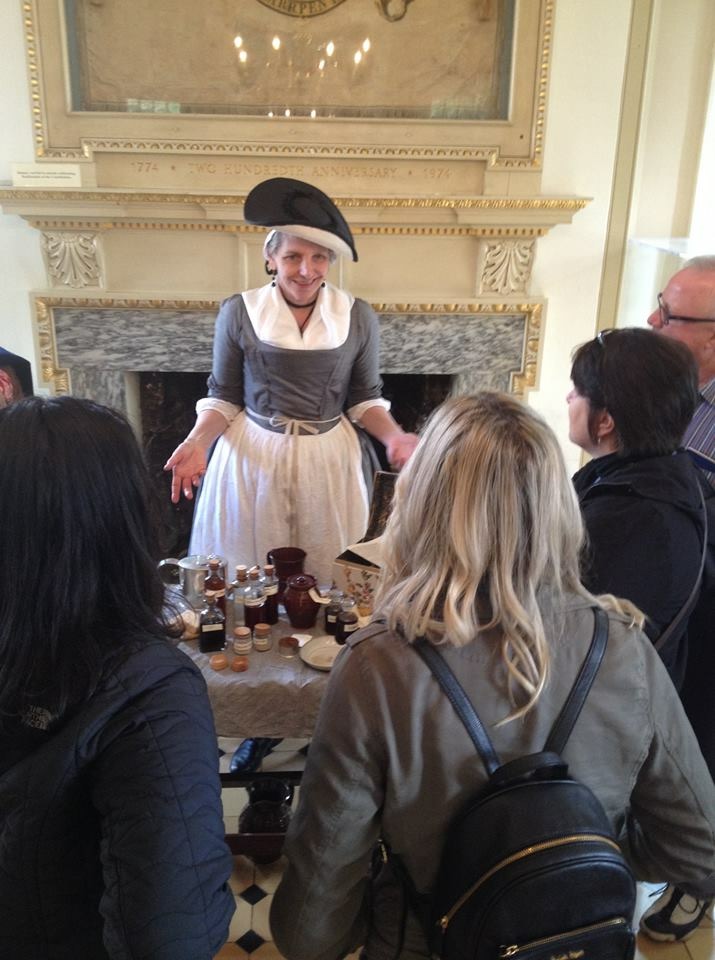
Over the course of talking to 1200 to 1500 people, I was able to synthesize the material, and refine my spiel. Talking about how the remedies could be (relatively) easily made in the kitchen, using ingredients drawn from kitchen gardens, South America, the Caribbean, India and Southeast Asia allowed me to talk about trade networks and the British Empire– a reasonable segue to complaining about a port closed thanks to Mr. Nevell, and a way to explain the effect that has on the city.

One of the most interesting aspects of this portrayal is how well women engaged with it– and enjoyed hearing about a woman with her own business. True, Drunk Tailor was steering women my way, but they also seemed to gravitate on their own. As much as I prefer in situ interpretation over the science fair table style, a table (or counter) offers enough of a barrier to make people feel comfortable approaching. On-street interactions are different, but somehow, indoors, people sometimes react as if one was perfume-spraying staff on a department store cosmetics floor. 
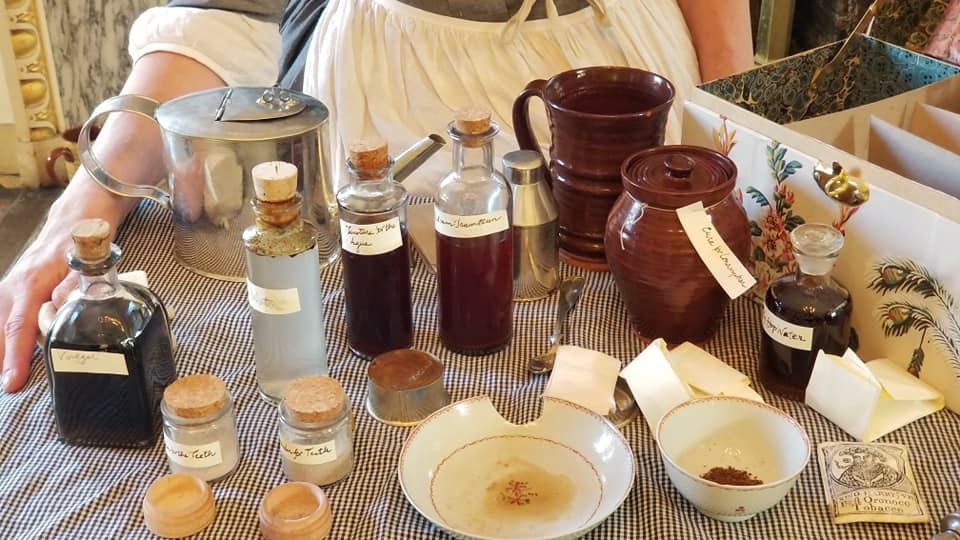
Photo by Mike Cirilo, saucer chip by me.

Not that scent wasn’t an excellent way to engage people! I couldn’t let visitors taste the remedies, but they could smell them, offering the opportunity to play “What’s that smell?” (non-feline edition) and talk about how people use the flavors they’re accustomed to in their medications and treatments. My cats never cared for bubble-gum flavored amoxicillin, but it’s bigger hit with toddlers than the straight-up medicine flavor would be. So, too, with tooth powders past: cinnamon, mace, and nutmeg are the blue raspberry of the yesteryear– though the tooth powders smell much better than they taste. I cannot recommend a weekend of use unless you wish to feel sad each time you clean your teeth.

Mr Nevell finds himself on the list of members of the Company of Carpenters

Drunk Tailor used the relationship between Thomas Nevell and Elizabeth Weed (their third marriage each) to move people around the main room of Carpenters Hall, and to some comic, as well as interpretive, effect. It’s far easier for him to say, “Six months in, six months left, of her mourning” as a means of explaining the grey and black palette of my clothes, allowing me to avoid the “You look like you’re ready for Thanksgiving!” lead in from the public. Confiding in the public that he’s had his eye on me for while lets them in on a secret, and visitors enjoyed trotting over to warn me about his interest, and that’s he’s sold his tools! I am always happy to tell them he’s just the kind of man my mother warned me about, adapting a banter we have used in multiple scenarios. While it’s broad, and nothing like how we really are together, it’s playful enough to engage the public, relax them, and get them comfortable asking questions.
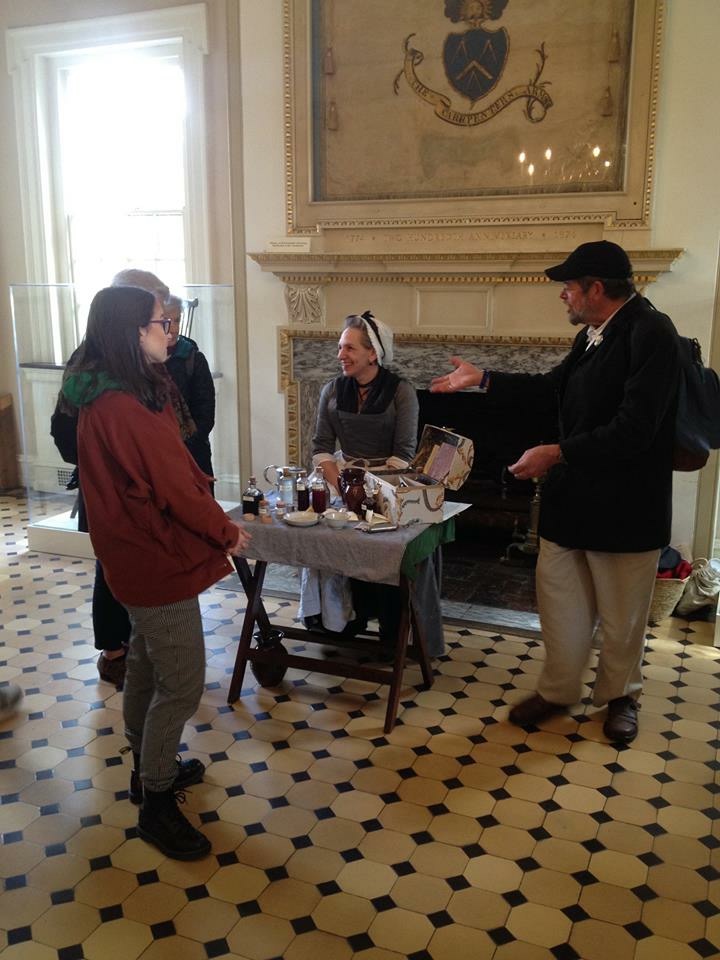
The man on the left talked to me longer than anyone else

There are, as always, things I’d like to change about this presentation. Although I’d like to work on it enough to be more comfortable in first person, I’d miss the third-person ability to refer to 1849 cholera maps and general epidemiology. I definitely need to add a couple inches to the hem of the gown, up my cap game, and trim the mantelet. I’d like to find a wooden box, and add a proper mortar and pestle to the kit– my stainless steel one is perfect for home, but won’t work in public. But on the whole, I’m pleased to have an impression of a woman roughly my age, who can interact well with a character roughly Drunk Tailor’s age. Onward to refinements. 
“may depend on being supplied”

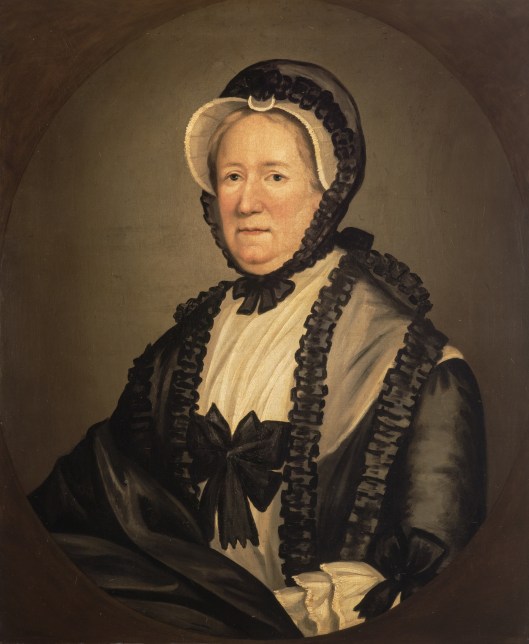
Lady Anne Stewart. oil on canvas by Ann Forbes, 1774. National Gallery of Scotland, NG 2036

Part two of a series

A newspaper ad can be a rickety thing on which to build a persona when it’s not a runaway ad. Those will give you what the person is wearing, who is advertising for them, and sometimes the skills they have. To better understand Elizabeth Weed, I turned to genealogical and contextual research.

George Weed’s estate was settled by Elijah Weed, his son by his first wife, Esther. Altogether, it was worth £1268.19.7, a considerable sum in 1777. Granted, £775 was book debt, but that cash could be called in. The remainder consisted of £132.15.2 in Medicines etc.,£100 cash, and £261.3.9 in Goods and Chattels. Of this estate, widow Elizabeth kept £55.8.3 in Goods and Chattels, all of the Medicines etc. and £50 in cash. That’s all of the medicines, 20% of the value of the “Goods and Chattels,” and half the liquid cash of the estate. This would certainly provide the supplies and capital necessary to continue the pharmacy business.


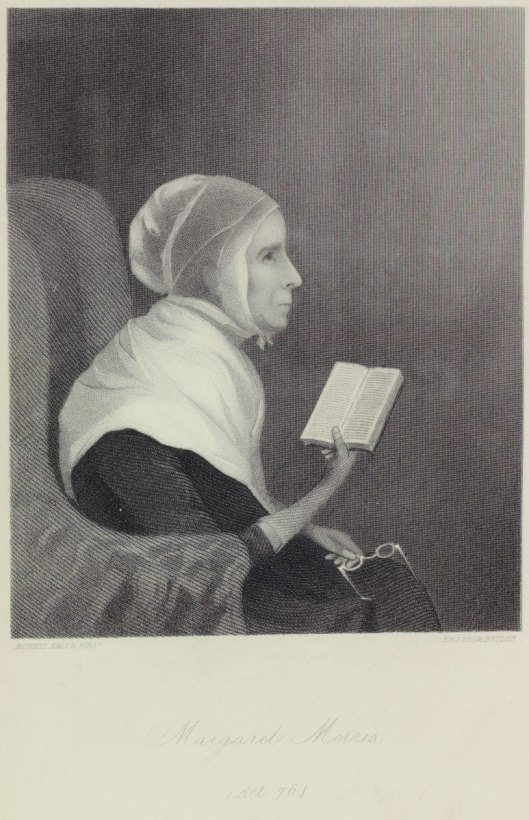
Morris, Margaret Hill, 1737?-1816., Margaret Morris / Morris Smith, pinx’t ; eng. by J.M. Butler. Library Company of Philadelphia.

But what was life like as a woman in business? How many women were in business in Philadelphia in the last quarter of the 18th century? More than you would think– mostly as shopkeepers selling dry goods, some as tavern keepers, and others as nurses, midwives, and healers, including women acting as pharmacists and “doctresses.” Patricia Cleary’s article “‘She Will Be in the Shop’: Women’s Sphere of Trade in Eighteenth-Century Philadelphia and New York” published in the Pennsylvania Magazine of History & Biography Vol.CXIX,No. 3 (July 1995) was particularly helpful in understanding women in trade.

Another useful resource was Susan Brandt’s “‘Getting into a Little Business’: Margaret Hill Morris and Women’s Medical Entrepreneurship during the American Revolution,” published in Early American Studies, Vol. 13, Number 4 (Fall 2015). Margaret Hill Morris practiced as a pharmacist and healer in Burlington, New Jersey, worried lest she “spunge” off her relatives, and anxious to support herself as a widow with a son. (Morris was the sixth daughter of Dr. Richard Hill of Philadelphia, and presumably learned some of her trade from him. Quaker women were well-educated, and participated in the scientific and philosophical life of the city. )

Brandt’s article raised helpful questions to ponder: would Elizabeth Weed have taken food and firewood in barter for medicines? During the Occupation of Philadelphia, food was scarce and exorbitantly priced, and she was feeding not just herself but also her son George, born in 1774. How difficult was it to obtain medicinal supplies when the harbor remained closed (in part because of chevaux des frises built by Thomas Nevell)? When patriots fled the city ahead of the British, did Weed’s trade suffer? Did she conduct business with the British, and how did her friends and neighbors react if she did? Only some of those questions can ever be answered. For the rest– about Weed’s particular business– we can only make inferences based on other accounts.

Codes of Conduct & Rules of Civility

These have been a tough couple of years. We are, once again it seems, in a period of polarization and increasing political violence. In times like these, when disagreements flare brighter and behavioural norms are changing, even the things we do for fun can be affected. From online fights that turn nastier than ever to onsite behaviour that runs the gamut from passive-aggressive to hostile, the real world creeps into our fantasy worlds. I have experienced and seen behaviour that I find unacceptable. It was subtle, but not acceptable. When I posted about it online, a lively discussion ensued.

From that, an idea was born: Sharon Burnston suggested a Code of Conduct, which I heartily endorsed. Drawing on her experience organizing and managing events and groups, Sharon wrote a draft code of conduct. Now, with edits and suggestions from others, it is available on her website.

“We are all here at this site/event for the same purpose, to portray events that happened here in the past for the benefit of the public, and for our own enjoyment. We agree to follow the site’s rules for fire safety, gunpowder and weapon safety, curfew, alcohol consumption, and whatever other restrictions they require of reenactors. Just as we have agreed to adhere to standards for our clothing and our kit, it is appropriate that we agree to adhere to standards for our behavior. The standards for our behavior are modern, not period. We are interpreting history, not re-creating historical attitudes to class, gender, or race. We are 21st century people, and 21st century expectations apply.

In its simplest terms, treat everyone else as you would want them to treat you. Don’t be a jerk. But to break it down into specifics, and in order for this community to feel welcoming to the largest possible population, we expect everyone to endorse the following standards of behavior. Anyone who cannot adhere to these simple rules will not be invited to future events.”

Don’t be a jerk.

Seems so simple, right? Apparently not for everyone, because not everyone embraced a fundamental grade-school lesson:

“I will take responsibility for both my actions and my feelings. I have the right to have my feelings respected, I have the right to be heard and understood, I have the right not to feel pressured or browbeaten. I extend the same rights to all other reenactors and to the public.”

For me, this presents an interesting conundrum. You see, I kinda started this when I announced online:

Now, this is in fact a wimpy way to deal with a person who I think treated me pretty shabbily at an event, and who made clearly misogynistic comments at that event, and has posted white nationalist stuff on social media. A quicker-witted person than I would follow Sharon’s precept six:

“I will call out these inappropriate behaviors in others. If I see something, I will say something – either to the offender directly or to an authority figure – a captain, event planner/organizer, or someone I trust. I will stand in solidarity with my fellow reenactors and pledge to stand up to bullies, abusers, and other unpleasant behavior to ensure the safety and comfort of those around me.”

This last is easier for some than for others. It gets easier when one can believe that one will be listened to, heard, and taken seriously. And that is not on the person reporting: that’s on the person hearing. When someone’s feelings are dismissed, or another’s actions excused (he’s a good guy; he’s just insecure), the status quo is maintained, the ranks secured, and the world unchanged. It will take all of us to make places safe and pleasant to be it. A code of conduct we can all agree to is a good place to start.

Black and Blue

Unlike some of my earlier posts, this Black and Blue refers to a different kind of historical effect: the purely aesthetic. (Yes, it is a departure for me. Moving below the Mason-Dixon line has been curious, as my encounters at the bank regularly make me wonder if I have stumbled into the Invasion of the Body Snatchers or Pleasantville. Surely real humans aren’t this nice! I thought the people of Rhode Island were just fine, but maybe my standards were warped by growing up in a Major Midwestern City.) In any case, times change and so do people. Onward, to the aesthetic!

First, there was the new waistcoat. That should be enough to refresh an outfit, right?
Wrong.

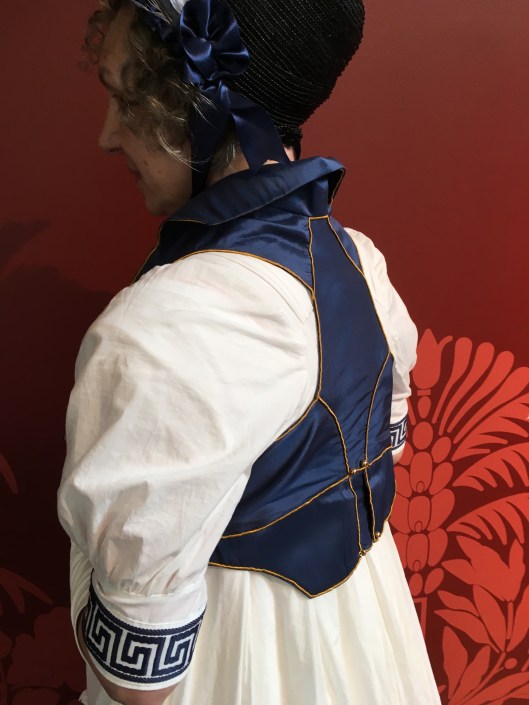
The armscye sits way back over the shoulder blades

The set of the armscye didn’t coordinate with the white gown I made two summers ago, so a new item would be in order. I thought this would be the case in the muslin, but when I basted up the blue silk (selected because I had enough material to make a waistcoat and a cap), it was clear something new would have to go underneath.

The original waistcoat’s date of ca. 1797 helped narrow down my choices, and a 1799 fashion plate helped as well. Blue over white: pretty snazzy. I sketched up the plan for the white wrap-front gown, re-imagined that when I got batiste after asking for voile, and figured I’d be fine. A blue silk cap trimmed in black wool lace or gold silk cord still seemed like a good solution.


But the fashion plate showed a black hat or bonnet, and whilst trolling Etsy with a Manhattan in hand, searching for an 1830s-appropriate buckle, I took a look at one of my favorite shops, just to see.

Reader, I saw.

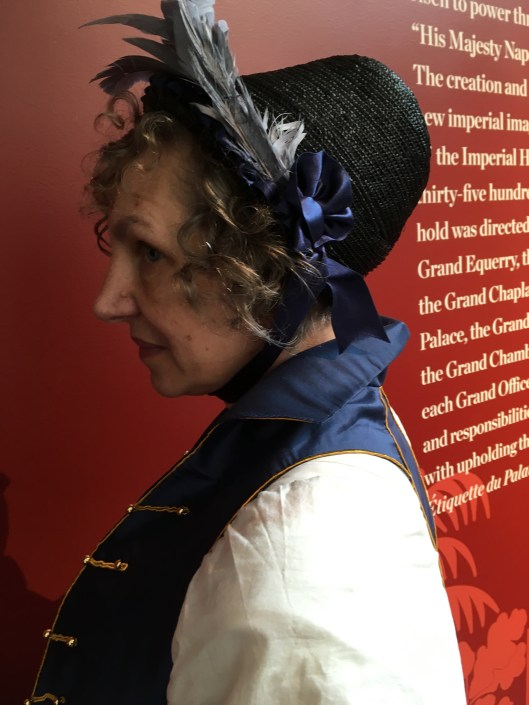
The “overly honest milliner” confessed that this style would not flatter everyone. Challenge accepted! In truth, though, I have a small head, and having cut my hair short for the summer, can (must) wear a slightly different kind of headware. I’ve also tried on enough of Anna’s millinery to know what will and won’t work for me, so I was pretty certain this bonnet would suit me well.

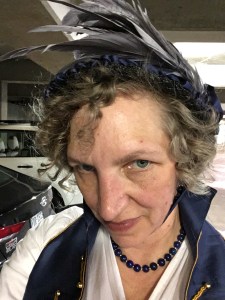
I trimmed it with some blue silk double-faced satin ribbon recovered from a failed bonnet attempt of several years ago, and then cast about for something else. Something different. Wednesday found me steaming feathers– as you do– while Drunk Tailor pulled KP duty. I hid the feather quills (more or less) with a ribbon rosette, and the considered fastening. Many early-nineteenth century bonnets don’t tie under the chin, and in any case, I didn’t have enough ribbon left to pull that off.

Parking lot selfie, with sweat, curls, and feathers. I like the way the feathers contrast with the curls.

The solution? Another rosette. On the feather side, I stitched the straight tail of the ribbon to the bonnet. The second rosette attached to the ribbon, which I then ran under my chin and pinned. Bonnet secured, more or less, though the feathers necessitate caution when exiting a vehicle.