Carriage and Morning Dress, 1832. LAPL Fashion Plate Collection
So, about that 1833 thing…
No, it’s not that I’m reconsidering. It is merely that as I consider the options, the fashion plates are a bit overwhelming. On the other hand, I am getting really good at recognizing the look of the 1830s in undated portraits. There’s an upside to everything.
Extant garments are fairly plentiful in the Usual Suspects’ Collections; there’s even a Tumblr. There’s a Tumblr for everything.
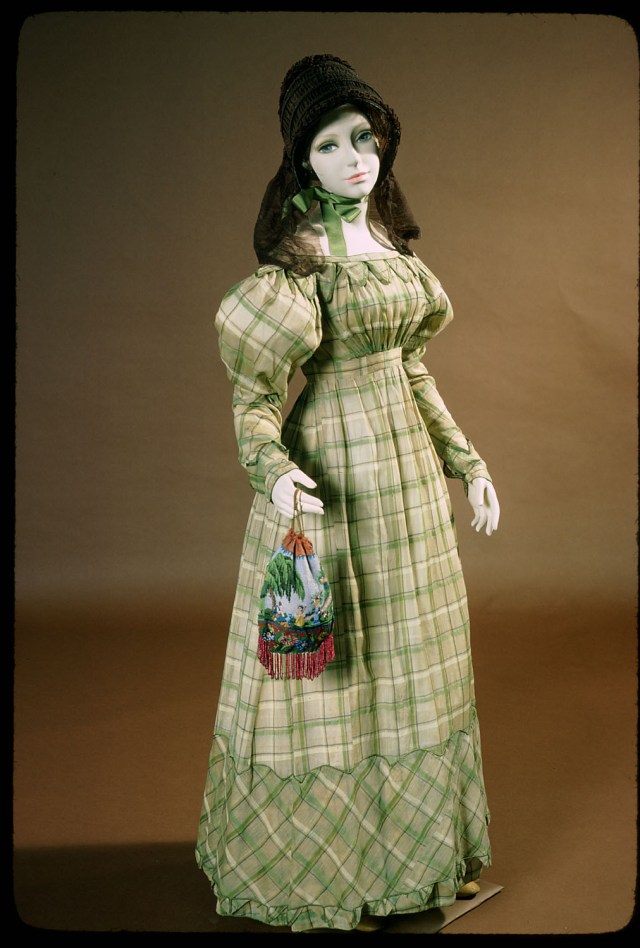
Woman’s Green, Tan, Yellow and Blue Striped/Plaid Gown. OSV, 26.33.63
Fortunately, there are some tamer garments out there, with sleeves less likely to result in flight in a high wind. Bonus: not floral, and not silk. Printed wool seems to have been fairly common, but the weight is just impossible to find. I did some looking in New York, but nothing convinced me with print or price.
This is a milita muster, so there will be time outside. I’m toying with a habit or Amazone (hard to resist a garment with that name) though the most I know about horses is that they have four legs. It’s tailoring that attracts me, not use. Also, wool. Mid-September might warrant wool, even if that’s hard to imagine today. (The downside, of course, is that there’s menswear to be made, too, so a simple dress is surely the best option.)
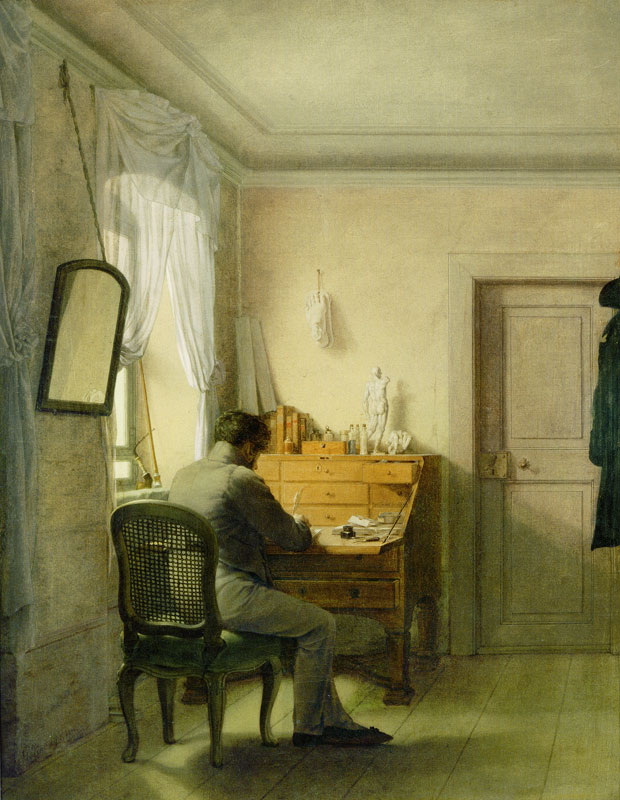
Georg Friedrich Kersting, A Man (artist) at His Desk. 1811. Klassik Stiftung Weimar, Goethe Nationalmuseum
1811 caught my eye and stopped my Twitter scrolling. Kersting never fails to please, luminous watercolors and delicate details. Summer is here, along with events in so many years I feel quite distracted.
1780 this weekend (L’Hermione in Boston). 1775 a few weeks later. 1814 in August. 1833 in September. You could get whiplash looking at waistlines and sleeve silhouettes.
What I need is to take the time to sit, like Kersting’s man, to reflect and to write and to make a plan. I’ve fallen behind on the garment-a-week program, and need to catch up quickly. The faster I sew, the less like the Young Mr can outgrow the garment before it’s finished.
One of the best things about Genesee last weekend was a roof. After driving through torrential downpours on Friday, we were grateful for a house to sleep in, instead of a tent. I’ve never woken up to find my hip planted in a drainage channel (Saratoga was stormy) but Friday night would have provided ample opportunity for somnolent soakings.
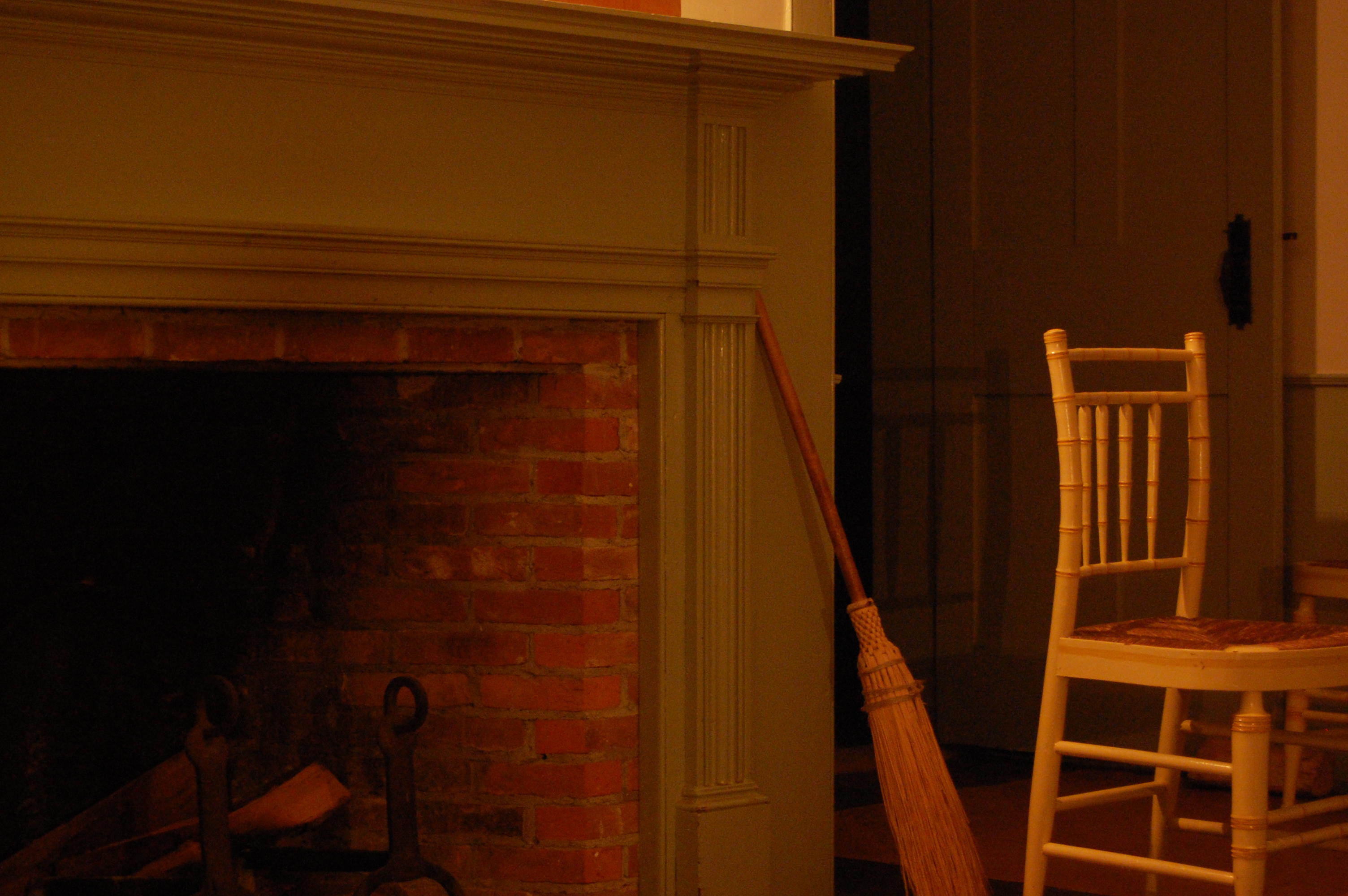
Foster-Tufts House, photo from Genesee country Village & Museum
So we were set, right? Each of us had bedding (many thanks to Mr JS for the loan of a linen sheet: I still regret the vintage sheet I did not buy) and a real bed, a pretty plush situation, really. The only tricky part was getting into bed, and then adjusting yourself once you were on the mattress. It’s not that the bedding was going to rise up and cast us out. It’s not that the accommodations were exceptionally uncomfortable to modern, bed-spring accustomed sleepers.
It was the noise. The bed sacks were filled with packing peanuts and other inorganic materials that crunched and cracked and popped and creaked and grumbled with an and tiny movement. There was a solution, though. There’s always a solution.
Weekend billet: pretty swank, actually
Synchronized spinning. Without thinking about it too hard, though with deference and consideration for fellow occupants, we quickly learned to turn simultaneously. As soon as one of us cracked the wall of sound, the other two would shift. Problem solved.
Mercury is retrograde and the schedule is tight, even for me, as I made the plans I’ll put into action at the end of this week: a special event Thursday night at work, followed by mad packing and a drive pretty far into New York.
I did say sheer.
Yes: I am going to Genesee. It’s a long drive from here, so I’m happy to be picking up some friends in Albany (neither of whom live there) for company and some relief behind the wheel. Of course we’re taking our car: it’s the Quartermaster cart.
Yes, I am a little crazy, but it does make life interesting.*
Finished –even hemmed– days before the event!
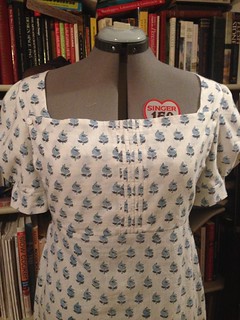
The gown is made from fairly sheer block-printed Indian cotton found on eBay. The pattern is based on one in Nancy Bradfield’s Costume in Detail with a bib front and tucks in the center back. To help with measurements, I also referred to the bib-front dress in the back of Bradfield’s book, as patterned on the fabulous 19th US site, as well as Janet Arnold.
The first bib-front gown I made ended up a little slanted: your mileage may vary, but I find patterning on opioids is not recommended (I sewed while recovering from hip replacement surgery). This one seems a little better, though the fabric came in for some commentary when I was working on this in a room full of light infantry “men.” We devolved from “chicken on flower” to “Seagull on a bush” in describing this buta-like shape. I only bled a small amount on the tucks, despite texting while sewing.
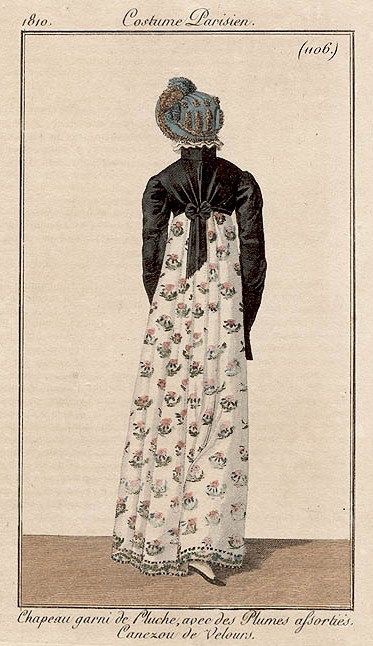
Canezou de Velours, 1810
Inspired by this 1810 fashion plate, I made a black velvet Spencer as well. That’s finished, save for the buttonholes, though there will be no texting while button holing.
Men’s waistcoats often have cotton or linen at the CB neck.
It got pretty matchy-matchy when I did the lining.
You will note that the plate describes a “Canezou de Velours.” Canezou was new to me, and while I don’t trustthe internet too much, here we are with Larousse:Vieux. Corsage de femme en lingerie.
Huh. It seems to be a lightweight-bust length garment for women.
Here’s the OED:
Oxford English Dictionary
canezoucanezouHist.
(ˈkanzu)
[Fr., of unknown origin.]
A woman’s blouse-like garment of muslin or cambric. Also attrib.
1827Lady’s Mag. Sept. 510/2 A canezou spencer of embroidered muslin. Ibid. 511/1 Muslin canezous over high dresses. 1893 G. Hill Hist. Engl. Dress II. 241 A cambric canezou..with sleeves full to the elbow. 1898Daily News 26 Sept. 6/4 When the Restoration came in 1815,..Fleur-de-lys appeared on everything… The canezou replaced the hideous spencer.
Ah, the hideous Spencer. I rather like them, myself.
*A very long time ago, I had a drawing teacher who said there is never an excuse for being bored. There is always something to do, to see, to observe. That was my first lesson in being present. Perhaps I take this statement a bit too literally.





 Kirsten Hammerstrom
You must be logged in to post a comment.