Experiencing Eastfield Village

The Young Mr on site.

Mr Hiwell, the Young Mr and I ventured out to Nassau, New York this weekend to be part of Founders Day Celebration at Eastfield Village. The gents were part of the 1833 militia muster, while I traveled out intending to interpret tailoring with Mr JS, and to provide meals for the militia.

It’s an interesting assemblage of buildings, and we were pretty curious about what the site and the experience would be like. While OSV and Genesee are also assembled villages, they’re museums, with different missions and guidelines; they’re also larger, with electricity and flush toilets for visitors and volunteers alike. That means they’re lovely, but not nearly as immersive as the pitch-dark privy experience.

The back of the Benjamin Culver house, or, our dining room for dinner.
Wear all the patterns possible, please.

There was a lot to consider at Eastfield, but I’m tired from driving back and will stick to the simple things for now.

I was incredibly fortunate to have a bed—indeed, the entire 1787 Benjamin Culver house—to myself for sleeping. Friday night, after changing into period clothes, we went up to the Yellow Tavern to eat our supper (pasties brought from home, with hard cider for Mr JS and myself). The candle lit taproom was cozy, and I understand from Mr JS that the sleeping quarters upstairs were even cozier.

We cooked our meals in the Yellow Tavern kitchen, and ate sometimes in the taproom, and sometimes standing in the kitchen, except for dinner, which was served picnic style on the grass behind the Culver House. (Saturday supper was provided by Eastfield Village and prepared by Neil DiMarino with able help; that deserves a post all its own.)

Cozy is as cozy does.

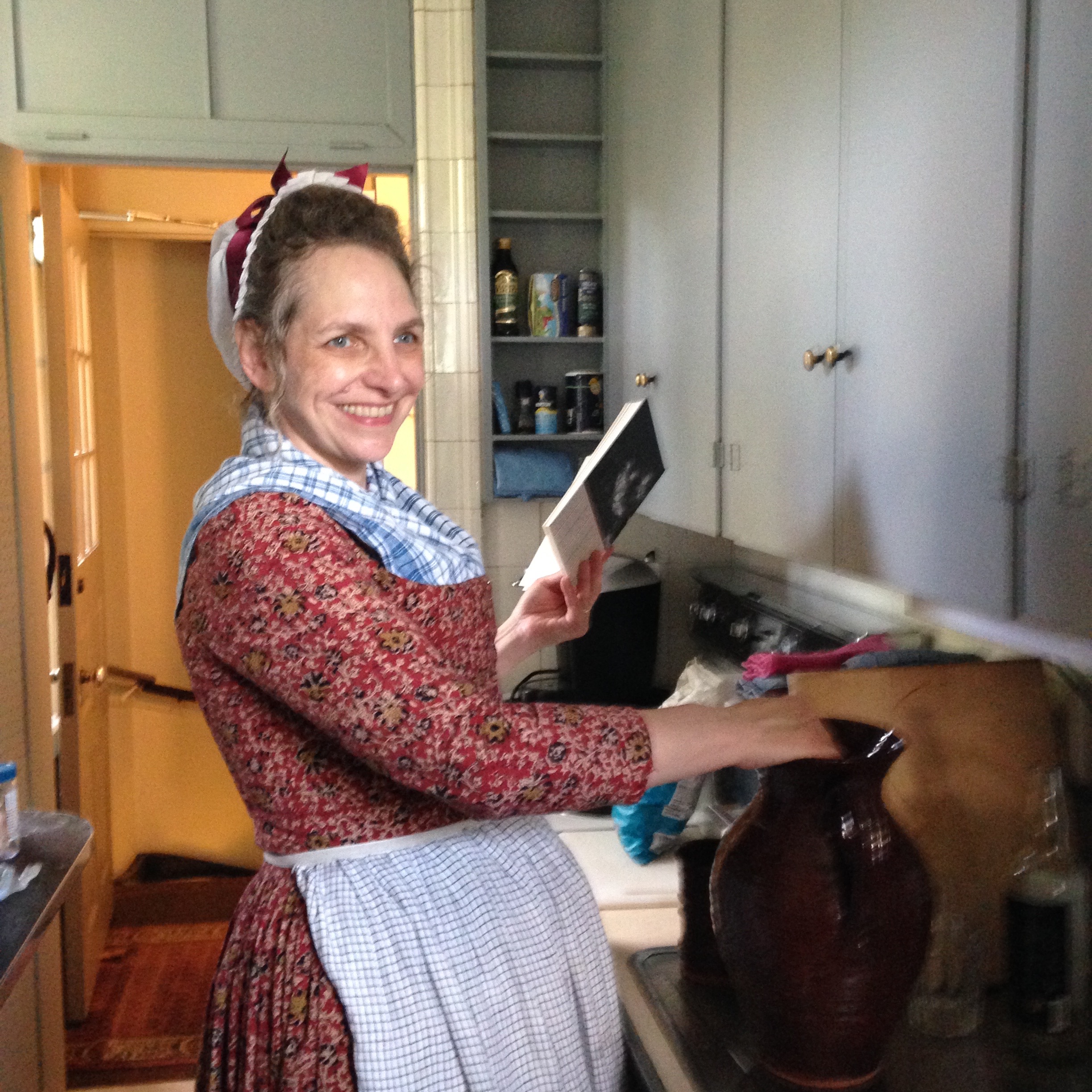
Much of time was spent on women’s work, interpreting daily tasks to a stream of visitors travelling through the house from front door to back, and sometimes upstream. The scullery—for want of a better word—had a soapstone sink which drained through the wall, which made dish washing pretty plush, and provided entertainment for all who cared to witness it. No chickens were present, but from washing dishes at Coggeshall Farm, chickens would have enjoyed the ground beneath that window drain.
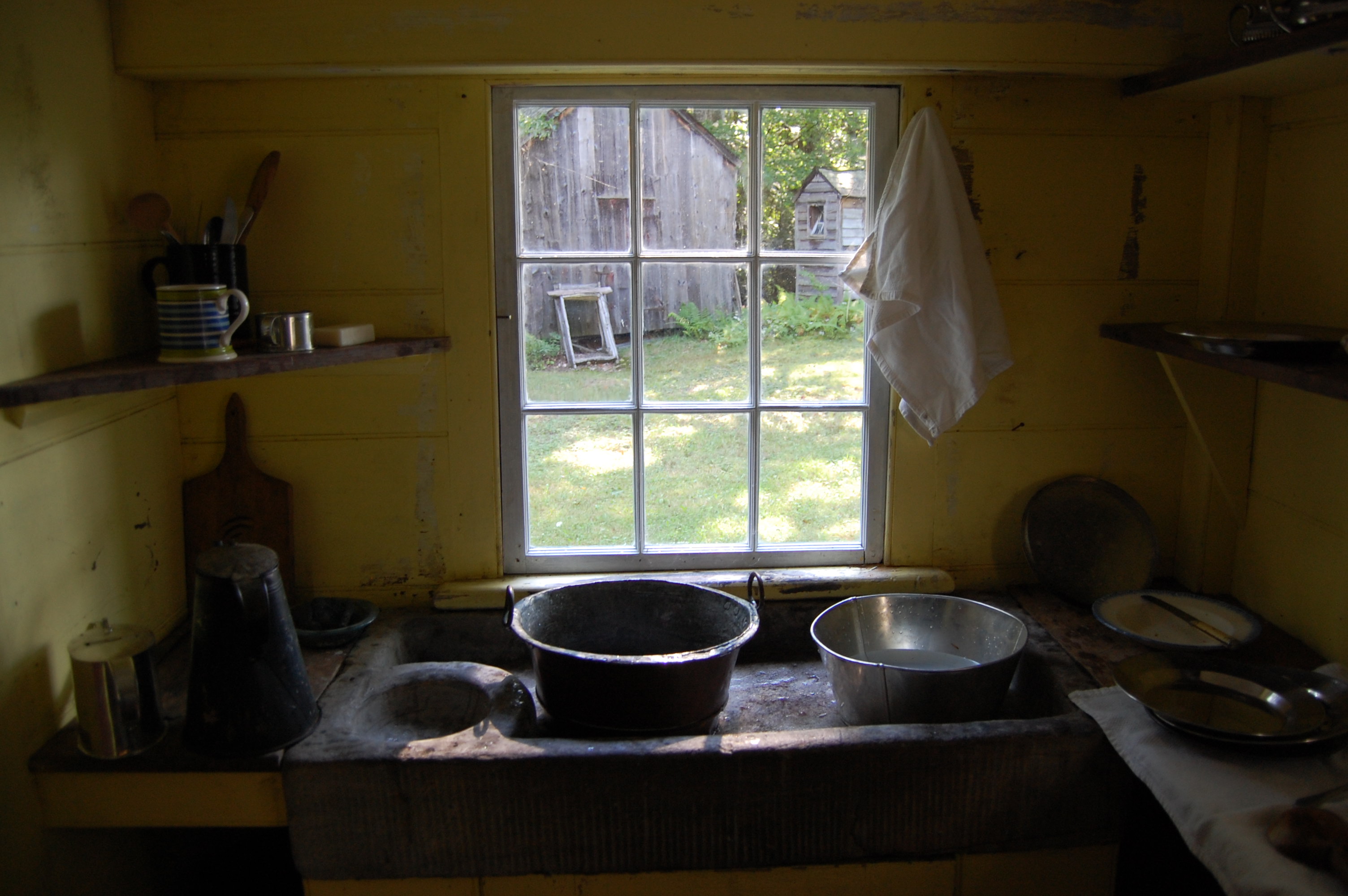
The view from the scullery: not bad, really.

There are always curious questions, from “Is this a house?” in a tone of wonderment, to “Where did you get the water?”

Gentle reader: these stumped me, briefly, until I was able to gather my wits enough to reply, “Yes, it’s a house, built in 1787,” and to assure the visitor that people had, in fact, managed to live in it. The water question was somewhat more perplexing.

I started with, “Well, I got this from the hose, but they would have had a well,” when the visitor stopped me. “No, I mean, how did you get it hot?”

The kettle had been over the fire in what would be the kitchen room where Mr JS and I were set up to sew, and the fire was still producing heat, albeit from coals. Then I realized she had not been among the clump of people watching me remove the kettle from the crane so that I could pour hot water into my basins. I pointed to the kettle, and said, “Over the fire.”

Fire hot.
Fire hot.

It’s hard: there’s so much we take from granted in our own daily 21st-century lives, let alone what we become accustomed to when we inhabit the past. Interpreting between the two worlds, things can be lost in translation.

I’m always curious about what I’ll learn when I travel to a different century, and I think what I learned, again, was that I find it hard to find a way to interpret women’s lives and work in the past that does not reinforce stereotypes of “life was hard” and “roles were constrained.” Enough! I tried explaining the greater freedom some women enjoyed in the early Federal era, in contrast to the pre-Revolution and post- Great Awakening eras, but that wasn’t entirely successful, and would you believe that story from a woman washing dishes?

What I may really have learned is that I’ve done enough time in the kitchen and the scullery; I’d rather be the tavern keeper than the cook or scullery maid. Women were in business, and while never on the scale of partnerships like Brown & Francis, women as merchants, tavern keepers, landlords, and, yes, tailoresses, are underrepresented. It’s easier to talk down the scale than it is to talk up the scale from the washbasin to the shop or tavern, so it’s time to leave the wash basins aside for a bit.

Done with dishes for now, thank you.

Punch-Drunk Love

No, Love: I didn’t get drunk and punch someone.

Worst. Housekeeper. Ever.

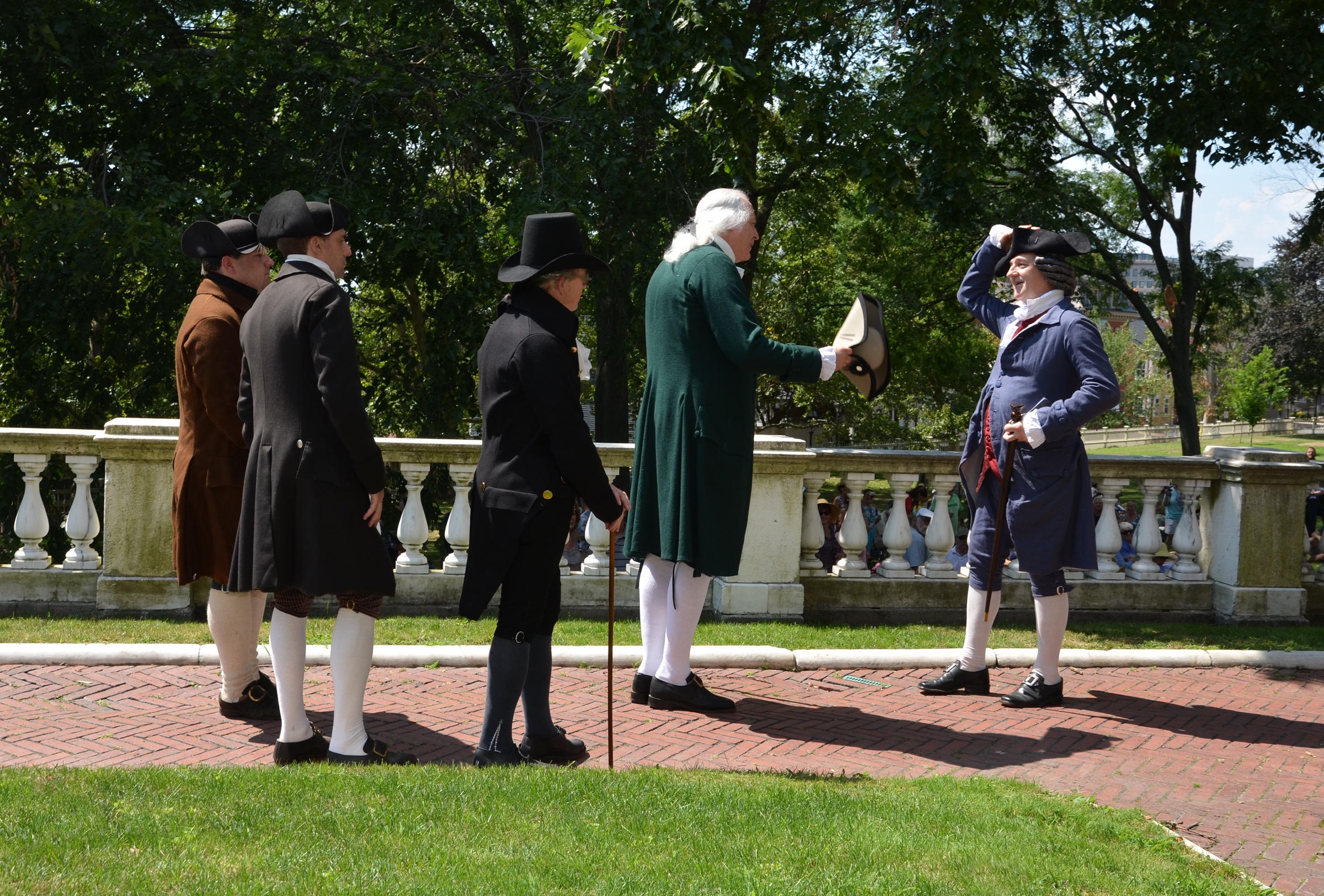
On Saturday, we commemorated the 225th anniversary of President Washington’s visit to Providence after Rhode Island finally ratified the United States Constitution on May 29th, 1790. We like to take our time with these things, to be sure that we will have all the rights we’re accustomed to. Happily, we did decide to go along with this United States of America business, and as a reward, His Excellency President Washington made a formal visit in August, 1790. It rained then; this time, we had sultry summer weather.

Once again, the housekeeper spent the day running back and forth and up and down the stairs. Fortunately, I didn’t trip on the gown too much: it’s longer than I usually wear, but I did catch the hem on my shoe buckle, so some tweaking will be required.

Mr Brown greets the President

There was the kind of ceremony and formality you would expect, with very little drama, which made for a simpler day than we often have. The afternoon was warm, the speeches were short, and the toasts were drunk.

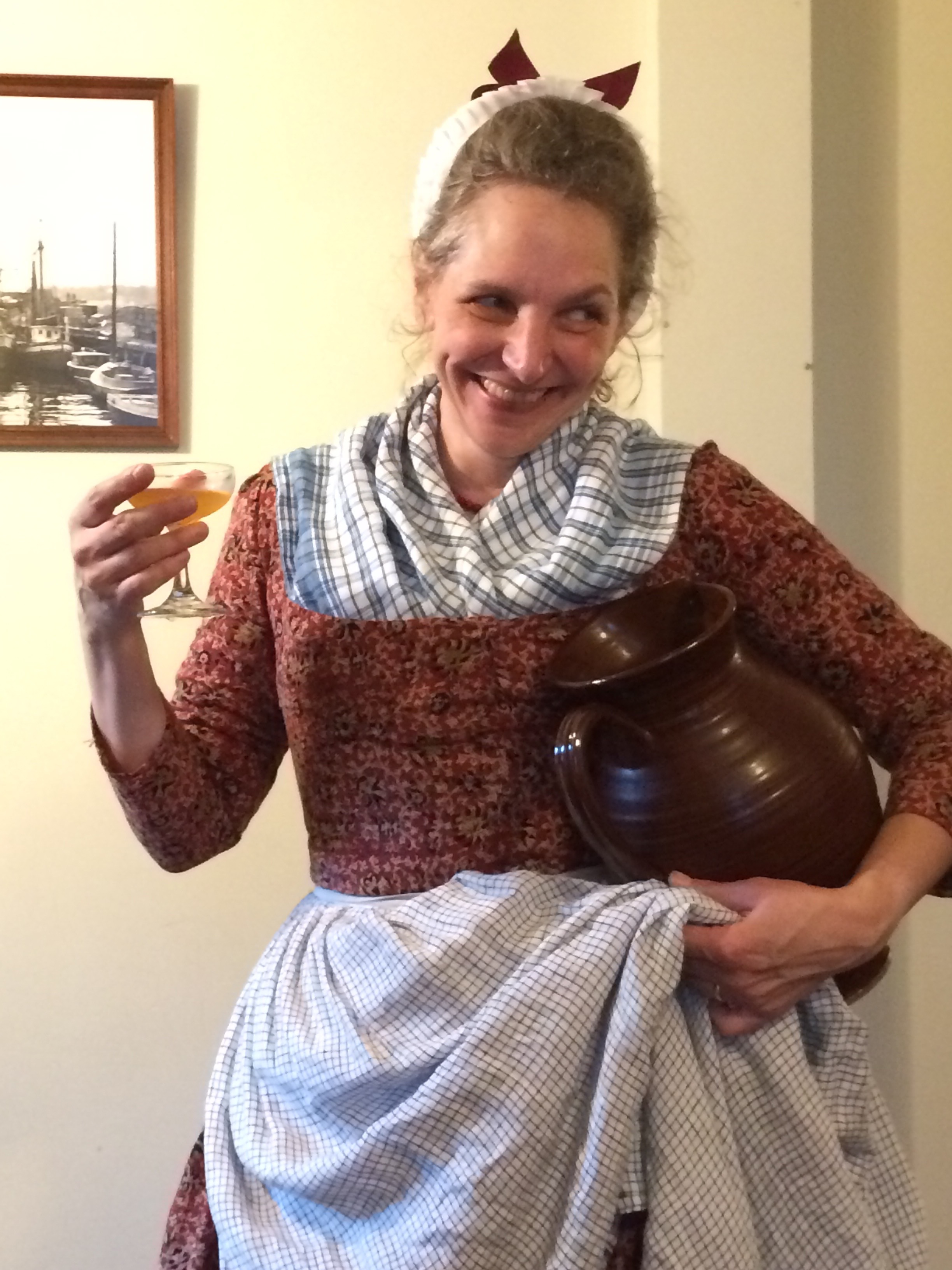
Of course, you have to look out for John Brown’s housekeeper, who is all too happy to spend her afternoon reading and making punch. Unlike a real 18th century person, I had no idea where to start with punch beyond the basic: rum. I turned to my friends for assistance, and got some solid advice, including a reference to Punch: The Delights and Dangers of the Flowing Bowl.Chapter VIII helpfully turns to “How to Make Punch, or the Four Pillars of Punch.”

Mmm, punch.
Mmm, punch.

I don’t always manage to read all the way through the directions I am meant to be following, but the oleo-saccharum was relatively straightforward, since the instructions were entirely on one page. Lemon peels, sugar, mashing. These are simple things that you can handle even in a week when the workplace van has been stolen and recovered, and you’ve had conversations in which someone asks you to find a photograph for them, even though they don’t know where they saw it.

No, I won't say how many cups I've had.
No, I won’t say how many cups I’ve had.

That went well enough, but I got distracted along the way by the excitement in the house, and added the correct ingredients in the wrong order. I don’t think it mattered. Water, black tea, lemon juice, and a bottle of Smith & Cross rum all went in to the redware pitcher and wafted up the back stairs, giving the servants’ quarters a festive ambience.

While the partakers did not know, the bowl from which they ladled punch had once been used in cleaning the Mr Brown’s house– but that only meant it was quite clean, and thus suitable for use. The bowl was nearly emptied and replenished once, by which time Mr Brown’s housekeeper had sampled quite enough of the concoction.

Rumours of Bore

Detail, The Letter. Pietro Longhi, 1746. Metropolitan Museum of Art, 14.32.1

My time-travel was cut short this weekend after a trip to eight-nine-teen-something in Salem, as I had a trip to the Central Fly Over* for work instead. Still, through the magic of telephony and the interwebs, I heard about the Sunday OSV Experience and the Great Drawn Sabre of Saturday. (Caution: Strong language) One presumes and hopes that aside from whatever disciplinary action OSV will take– and they will–the CL commanders will address this clear safety violation.

The news photos show the usual collection of baggy menswear (are those painters’ pants? is this 1812?) and the Bodice of Myth and Legend (St. Pauli, anyone?) along with obligatory musket firing and “gotcha” shots of fallen soldiers sneaking peeks at the action. I don’t even have to say what we all think when we see those images.

But the Sunday report that struck me the most was this: The tactical went on for 45 minutes, very few soldiers fell, and the public began to leave before it was over. Got that? They got bored. As the teller of this tale said, The magic is gone. You can consider that a public endorsement of either more civilian events or a re-imagined tactical. I prefer the former, you may prefer the latter. But either way, if you’re going to use The Public as your justification for playing armed dress up on a hot day, you’d better engage that public. What that could mean will have to wait for another time, but when people head for the exits, the show won’t last.

* More on that later

Frivolous Friday: Festive but Frigid

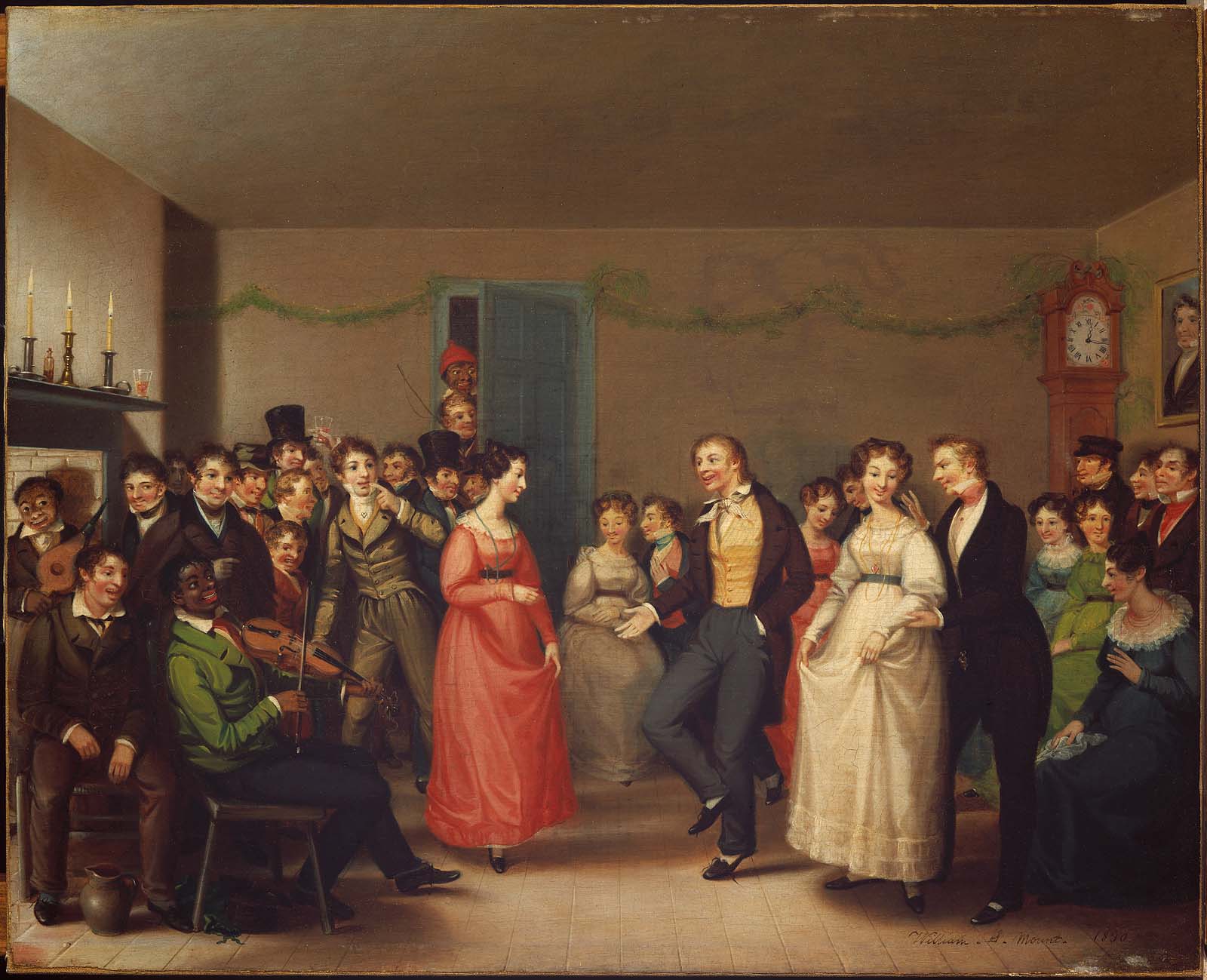
Rustic Dance After a Sleigh Ride, 1830. William Sidney Mount MFA Boston 48.458
Rustic Dance After a Sleigh Ride, 1830.
William Sidney Mount MFA Boston 48.458

I don’t know about your weather, but we’re in full summer in New England, sultry and humid, with the occasional thunderstorm and power outage to enliven the evening. A sleigh ride sounds like fun today– and I know we all just finished complaining about the snow of February– but a brisk ride followed by a dance would certainly round out this week.

1833 approaches faster than expected, so it’s time to pick that back up and get serious. Not just a gown but petticoats and, ideally, a new shift should be made. This may be the project that breaks my resolve and finds the Bernina back on my table for cording a petticoat.

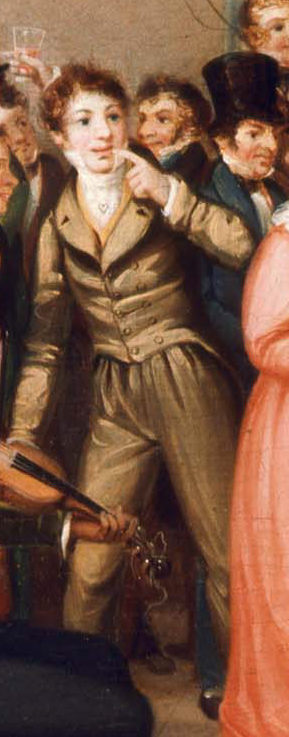
Detail, Rustic Dance After a Sleigh Ride, 1830. William Sidney Mount. MFA Boston 48.458

This image helps define the look of the early 1830s: not nearly as exaggerated as the fashion plates, these dresses and coats seem to fall into a progression from the 1820s– as you’d expect this early in the decade.

The gentleman at the back, in the drab colored suit, sports an interesting pair of trousers. I don’t think I know anyone ready to bust out the cossacks, but Mr Drab may be sporting a slightly modified pair. The collars and lapels show a shawl-shape that seems new, and modified from the more serpentine form seen in fashion plates– or else not yet as developed. There’s a range of headwear, too: tall hats on the left, a soft cap on the right. The Ladies’ Workbook has a pattern for one of those caps. Wonder how hard they are to make?

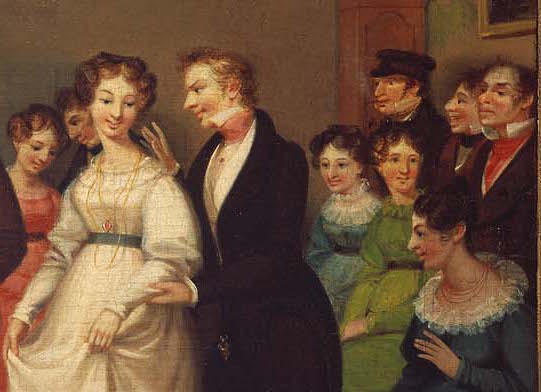
Detail, Rustic Dance After a Sleigh Ride, 1830. William Sidney Mount. MFA Boston, 48.458

In the detail, we can also see the women’s hairstyles, less exaggerated than the fashion plates with their high top knots, and within the realm of possibility for those of us not practiced in historical hairstyle recreation.

So much has carried into this decade: colored neck wear, ruffles or chemisettes under women’s gowns, men’s hair brushed forward. As always, it’s the details that count. Tall shirt collars, rounded lapels, ladies’ sashes, the shape of sleeves. This should be a fun decade to represent.