
Massacres and Mondays

March 5, 1770: Sound familiar? The Boston Massacre.

Happened on a Monday, by the way: how ironic is that?

But here’s the thing: if the Monday is emphasized, the Massacre stands out. Focusing on the normal makes the unusual ever much more so. And in the case of Monday, March 5, 1770, the usual is actually unusual.
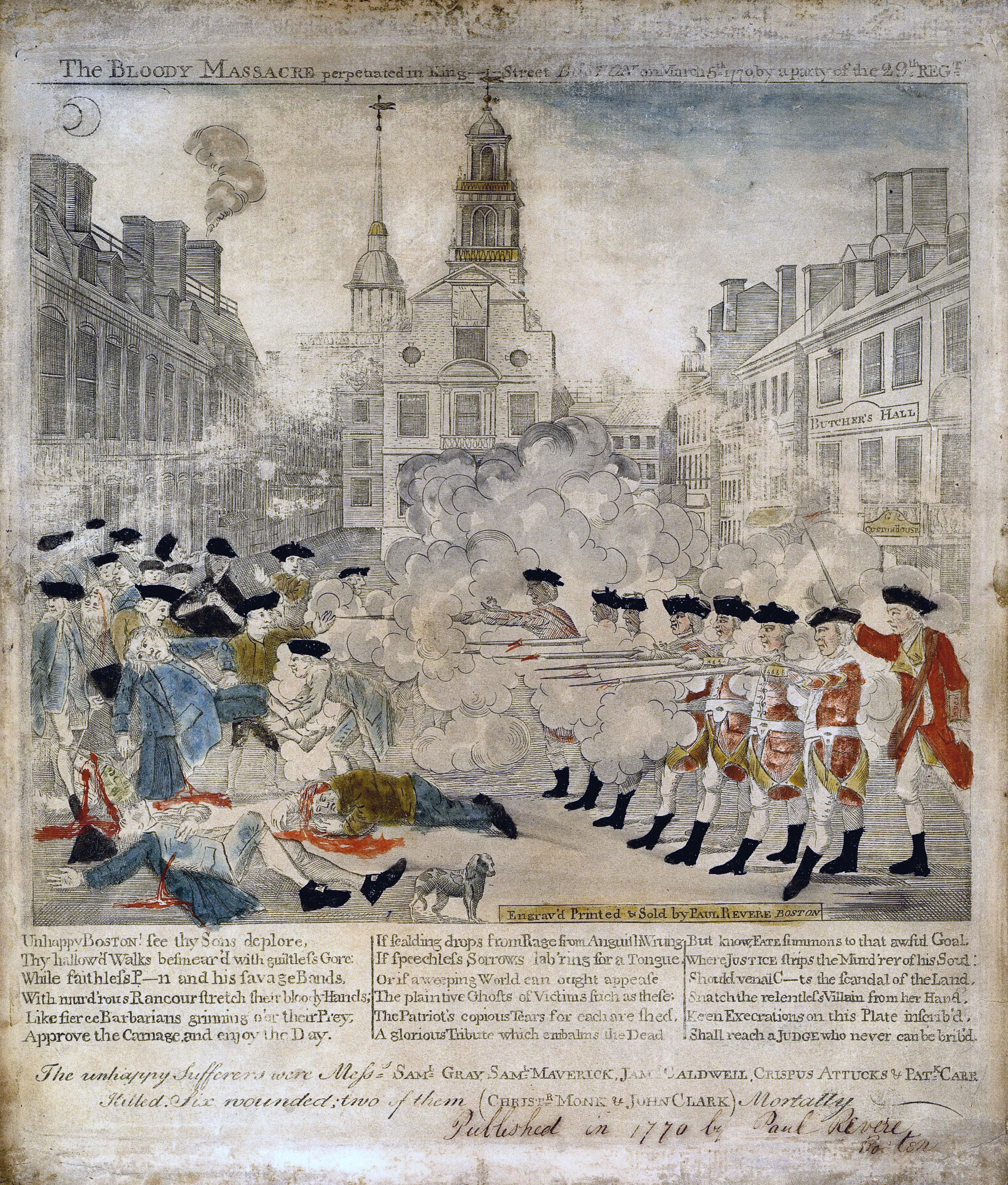
Paul Revere, “The Bloody Massacre in King-Street, March 5, 1770.” Boston, 1770

Over the course of the month leading up to Saturday’s event, Drunk Tailor and I spent a lot of time talking about the night watch, peddling, food supplies to Boston, population, and what I might call “the texture of everyday life” in a meeting at work. Any reading you do forces you to realize that the key to the Massacre is how very abnormal everyday life had become in Boston that winter.
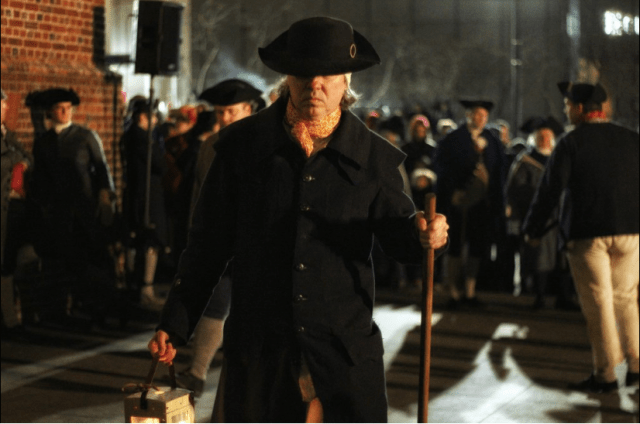
Edward Langford, disaffected nightwatchman. Boston Str
Edward Langford, disaffected nightwatchman. @BostonStrolls on Twitter

By 1770, Boston was an occupied city: Ferguson comes to mind, or Ramadi. Soldiers and watchmen patrol the streets, civil and martial structures clash, and the Sons of Liberty chafe under this control– or attempt at control. Scuffles, fights, brawls, break out. A boy is shot to death– accidentally– and tensions mount higher.  Sailors and soldiers alike commit acts of vandalism. Women are assaulted. Normal isn’t normal anymore, and Boston was always expensive to live in. Even in a city occupied by “friendly” forces, gathering supplies and going about one’s daily business became harder.

People are scared. This is a tense city. Lots of people are just trying to survive. Lots of those people are children. Roughly 16,000 people, and if the estimates are correct, 2,000 soldiers and 4,000 men (white, African, other, free, indented and enslaved), which means about 4,000 women and 8,000 children under 16. Let that one sink in: lots of children, lots of teenagers. I don’t know about you, but a city with a large population of teenagers is going to be tense under the best of circumstances, even in an era before the rise of youth culture. Hormones, man. The kid can’t help it.

So imagine this: instead of a mobile monument and a commemorative ritual that substitutes fists for muskets, the Massacre commemoration expands to include the day, and not just the night. Monday and a Massacre.

Townspeople hurry home as dark falls. Women lug laundry back to customers or to the washhouse, or trundle barrows home, empty, after a day of hawking cats’ meat, oysters, or fish. Tired cordwainers trudge the streets, hoping for meat at supper. A mother scavenges firewood to warm her rented rooms, keeping an eye out for the watch. Those are not Mr Hutchinson’s fence posts, truly.

Photo by Tommy Tringale (Claus' Rangers, 2nd NH, 3rdMA and HMS Somerset)
Photo by Tommy Tringale (Claus’ Rangers, 2nd NH, 3rdMA and HMS Somerset)

Women look over their shoulders, nervous at the sound of hobnailed shoes on the streets. Older men skirt closer to buildings, out of the way of soldiers in the street. Apprentices mock an officer, a sentry responds.

Insults, a scuffle, a boy knocked down. A mob, soldiers, a woman shoved, shots fired, men killed and wounded, blood on the snow.

Murder in the midst of the mundane. More horrifying (in truth, I have never heard Boston so silent as I did on Saturday night) within its context than set apart.
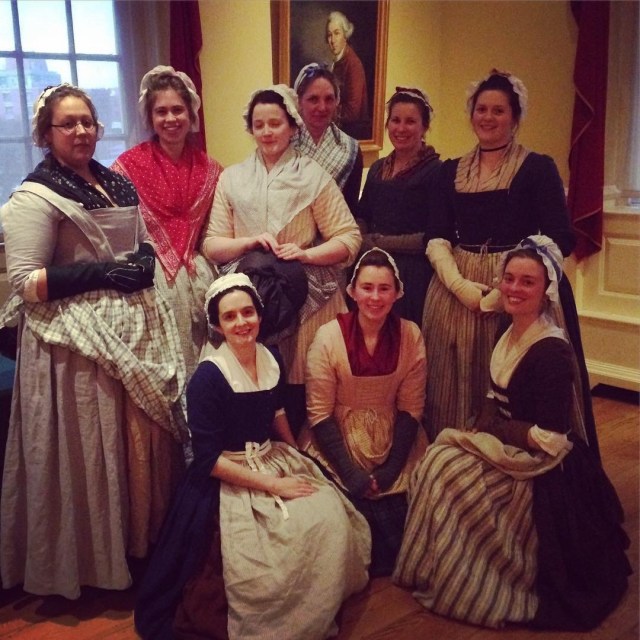
The Women of the 2017 Boston Massacre commemoration. Photo by Drunk Tailor at the behest of Our Girl History

The benefits?
A more complete picture of life in 1770 that puts the events of the evening of March 5, 1770 into deeper context and thus a sharper contrast.
A recognition that history isn’t just about men and conflict.
Understanding that what made living under occupation so hard was more the living– trying to be normal–than the occupation.
And, yes: more for women to do.

Writing for the Weekend

Johann Ender, Woman at her writing desk ca 1820

or, Women’s History at Washington’s Crossing

I haven’t dropped the peddling question, I promise! But I’m busy writing a paper for this coming weekend’s women’s history conference (yes, I know: but I’ve read that procrastination fuels creativity, so those digressions into the Canton voyage of the Ann and Hope were totally worth it).

Georg Friedrich Kersting: Briefschreibende Dame im Biedermeier Interieur, 1817
Georg Friedrich Kersting:
Briefschreibende Dame im Biedermeier Interieur, 1817

If you’re curious about the process I go through developing characters for living history programs, or best practices for women of the Revolutionary War-era armies, among other topics, there are some tickets left, and you can register online here.

But before I can compile what I’ve found about food markets in 18th century Boston, I have to go back to writing for this weekend.

Those Providence servants don’t research and describe themselves, and the housekeeper is particularly unreliable.

Peddling a Myth

Paul Sandby RA, 1731–1809, British, London Cries: Last Dying Speech and Confession, ca. 1759, Watercolor over graphite on medium, cream, slightly textured wove paper, Yale Center for British Art, Paul Mellon Collection

Every now and then, I reach the dammit! point of my research, where I am forced to realize that Everything I Assumed Was Wrong. I try to make those moments a cause for celebration, even though they’re often deeply frustrating. Do not pass GO, Do not collect $200, Go directly to the Library.

What now?

Well… Boston ain’t London. And the North American colonies ain’t Great Britain. The business structure, the size of the cities, is different. Distribution of goods is different, thanks to tariffs and non-import/export laws. Which means?

Peddling. It’s not a thing. Or it’s a very difficult thing to document.
Which means that all the things I’d thought about doing for the Massacre (day or night) are probably wrong. (Remember, this is when we celebrate!)

Hey, I’m not the only one rethinking my approach.

But there it is: I’ve looked in the Boston Selectmen’s Minutes for 1768-1771, and while there is plenty of small pox (yay!) and many lemons being imported (yay! punch!) and there are licenses being granted for selling strong drink in inns and houses, there are no peddlers licenses. There are no licenses for street vendors of any kind. Hmmmm….

I’ve also read the Dublin Seminar publications Itinerancy in New England and New York (1984) and Life on the Streets and Commons, 1600 to the Present (2005). Not looking good here for street vendors and hawkers pre-1800.

While I never particularly trust early 20th century monographs and articles without footnotes, the somewhat entertaining Hawkers & walkers in early America : strolling peddlers, preachers, lawyers, doctors, players, and others, from the beginning to the Civil War informed me that street vending was not common in North American British Colonies, and in fact, was not commonly seen until after 1800.

What the ever-loving heckers?

I found peddlers’ licenses in Philadelphia for 1770: all men. But so far, nothing in Providence, Boston, or Newport (or Connecticut). The theory is that itinerant sales people didn’t pay taxes the way merchants did, and that merchants therefore lobbied against them. In Providence, the earliest mention I’ve found thus far is a lobster and fish man at the Great Bridge in 1818.

Just as the watch of Boston differed from the watch in London, so too, it seems, did the petty retailers. I still can’t quite believe there were no street peddlers and hawkers in colonial cities, but I’ll need a new way to approach this question.

Undocumented but Not Alien

Cherries. The Itinerant Traders of London in their Ordinary Costume, from Modern London; being the history and present state of the British Metropolis. Illustrated with numerous copper plates - British Library
Cherries. The Itinerant Traders of London in their Ordinary Costume, from Modern London; being the history and present state of the British Metropolis. Illustrated with numerous copper plates – British Library

Sometimes it’s hard to know how a riot gets started; other times, the cause is pretty clear. I’ve started one or two myself. The latest stems from Our Girl History’s musings on the Massacre.

There’s a lot to unpack, and it’s been happening online and in private conversations. Yes, children, Aunt Kitty pays attention, even if she’s silent. This is a tough topic: how can modern feminists represent historical women in a patriarchal culture without losing their minds? How can events better reflect the actual past? The population has, historically, always been about 50-50 male-female. We understand why there aren’t women on battlefields. We get that traditional events (by which I mean the ritualized commemorations of battles) have ridiculously gender-segregated and inauthentic roles. We get that it’s hard to adapt to new ideas, even free, documented ones.

The irritation and anxiety I feel as I expand the kinds of events I attend is actually reassuring: that’s how I know I’m learning. The frustration we feel means we’re banging up against a wall that we can break down with research.

Paul Sandby, London Cries: Black Heart cherries... ca. 1759. YCBA, B1975.3.206
Paul Sandby, London Cries: Black Heart cherries… ca. 1759. YCBA, B1975.3.206

It’s not easy research: women not married to or otherwise affiliated with prominent men are poorly documented. We may never know their names– or we may have a name from a census, newspaper ad, or city directory, and nothing more. But we can fill in the gaps with interpretation. (As it happens, I’ll be talking about this very idea in just a few weeks. Come taunt me in person.)

There’s a lot to think about in recreating the past, in particular at this event. The organizers have done a phenomenal amount of research, gathered the details, sorted them out, assigned roles, scripted and timed an event, and recruited a chorus of characters that reflects the texture of a tense city in 1770.

Building an event, even one that recreates an actual moment in the past, is as much as work of theatre or fiction as it is of fact: character development, motivations, costuming, setting, all of those combine with the documented words to create a scene that conveys an interpretive point for the public. It’s similar to a museum exhibition– it’s interpreted.

Traditionally, living history has interpreted the past with a bias to men’s roles (that’s the nature of our society, folks) and with a tendency to assign roles and activities by gender (again, the nature of our society for centuries). Our task in breaking that pattern is not to right the injustices of the past, for we cannot, but to interpret them.

Playing the game at quadrille : from an original painting in Vauxhall Gardens. London : Robert Sayer, ca. 1750. Lewis Walpole Library, 750.00.00.14
What about the people in the background? Playing the game at quadrille : from an original painting in Vauxhall Gardens. London : Robert Sayer, ca. 1750. Lewis Walpole Library, 750.00.00.14

One way to do that is to bring the undocumented, or poorly documented, people of the past to light. I tried to do that in exploring Bridget Connor. I’ve tried to do that by interpreting a late 18th/early 19th century servant. It’s a long and frustrating process, reading letters and diaries for scraps of information, usually casual references to servants and cooks.  But in the frustration lies the promise: we will find the people on the margins, and bring them in to clearer focus.