Civil War and Uncivilized War

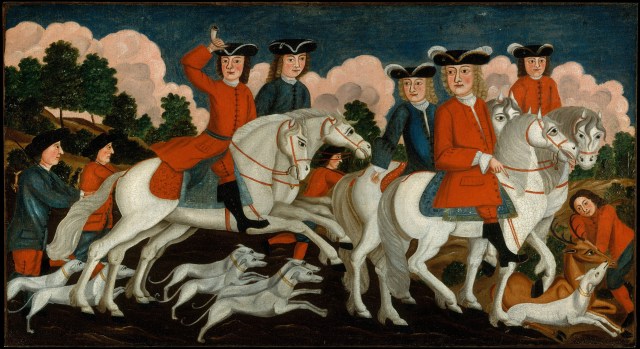
The Hunting Party- New Jersey. oil on canvas ca 1750. MMA 1979.299

Slightly turbulent and busy days chez Calash have resulted in a lack of postings, but work proceeds: Genesee and then New Jersey lie ahead, with some extra-interesting interpretation at Monmouth in late June. For a time, I despaired of figuring out what to do to occupy the time and interpret what was essentially a civil war in Monmouth County. The Craig House, while interesting, is no longer a working farm, so we couldn’t farm a not-farm. Then there’s the tedious issue of the not-home not-farming Craigs: on the day of the battle, John Craig is with the Continental Army and Ann Craig has taken off with wagons of chattel, two slaves, and her child. This began to seem a lot like interpreting the John Brown House without John Brown: they are more present by their absence.
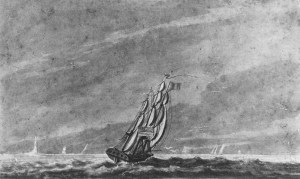
Full Sail off Sandy Hook- Entrance to New York Harbor. watercolor and gouache by Pavel Petrovich Svinin, MMA 42.95.2

What to do? Read more, of course, and talk and talk and talk with Drunk Tailor, who discovered the Association for Retaliation (yes, exactly what it sounds like: vigilanteism) and the Pine Robbers. Much satisfaction there, and finally I listened when he said, “Why can’t we all be refugees?”

Sometimes, you just have to give in to reality. The “London trade” flourished between New York and New Jersey, Sandy Hook providing ready access to the city and Staten Island, where so many Loyalists fled the radical Whigs of New Jersey. Male slaves ran away to join the British army, and the most fearsome and feared in New Jersey was Colonel Tye. The Retaliators promised “a man for a man” for every depredation Whigs suffered, while a similarly-chartered Loyalist association promised the same in return. Chaos reigned and people of all kinds fled the civil war and the uncivilized war. It promises to be an interesting weekend.
A Request from the Academie

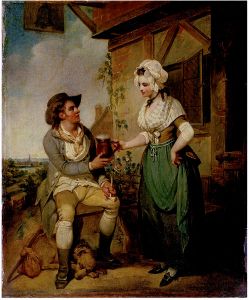
At the Inn Door, oil on canvas by Henry Singleton, ca. 1780, V&A Museum 1834-1900

Gentle Readers, Living History Enthusiasts, and Rev War Junkies: Your assistance is requested. Mrs. Boice’s Historie Academie is looking for your input for future hands-on learning weekends.

There are some interesting topics in the list– brewing? I certainly enjoy the results of brewing. Dairying? I like cows and love the local dairy farm. Language and speech patterns? I could certainly do better. Professions? Hmmm….I’ve considered several. Much to love in this list, and I’m looking forward to learning more.

Go forth, and register your opinion.

15 Ways to Have a Bad Living History Event

The Enraged Musician. Chaos has a long history, and often I am for it.
The Enraged Musician. Chaos has a long history, and often I am for it. But not always.

For Organizers

  1. Do not advertise. Having no audience makes an event super-lame.
  2. Have no attendance limits on a closed site. Intense crowds and no security makes an event scary. Add alcohol for intensity.
  3. Do not publish participant standards or a schedule. Confusion and laxity breed chaos.
  4. Publish standards, but do not enforce them uniformly. Creating the appearance that standards are only enforced for people you don’t know erodes trust and credibility and discourages participation, reinforcing adolescent clique behavior.
  5. Do not highlight (or provide) participant amenities like water, toilets, or dry firewood.
John Greenwood, Sea Captains Carousing in Suriname. Good times, no?
John Greenwood, Sea Captains Carousing in Suriname. Authentically bad behaviour.

For Participants

  1. Don’t bring your own lunch, water, or powder.
  2. Don’t follow the rules at a new event. Standards are for chumps. Text your friends while minding a rope line and acting as an interpreter.
  3. Get drunk. Who doesn’t love an inebriate around gunpowder? Safety, schmafety. Besides, drunkenness is authentic.
  4. Smoke cigarettes on the field. You can always hide your hand behind your back, next to your cartridge box…what can go wrong? The captain will never notice.
  5. Make critical comments about the public and other reenactors just within their hearing. Don’t smile.

For the Public

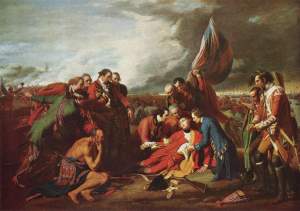
The Death of General Wolfe, Benjamin West. NGC
What, no dogs? The Death of General Wolfe, Benjamin West. NGC
  1. Bring a dog. Dogs love guns, drums, and cannons. “Cry Havoc! And let slip the dogs of war,” right?
  2. Ride your bicycle through the crowd. Make disparaging comments about the crowd interrupting your ride.
  3. Touch things and people. Touch reenactors’ tools, weapons, clothes, children, food. Heck, use their tools. It’s not real, it’s history, so it has to be safe–right?
  4. Interrupt people answering your questions, or better yet, someone else’s questions, and answer yourself.
  5. Get drunk, especially on a hot, humid summer day or night.

Stop.

Breathe.

Think.

Then speak or act. Think about what you’re doing. Is it sensible? Is it kind? Is it how you would like to be treated? Does you behaviour foster a pleasant and welcoming environment?

If not, don’t do it.

Criss Cross, or, My Checker’d Past

Every now and then I look up from what I’m doing (tiny stitches, usually, though sometimes budget math) and realize that Objects in Mirror are Closer Than They Appear. Oops. It was just yesterday I was daydreaming about miniatures, and now I shall want a paintbox and brushes in a mere six weeks– and those six weeks are punctuated by a courier trip, a couple of exhibits, not to mention shepherding The Young Giant through prom and finals.

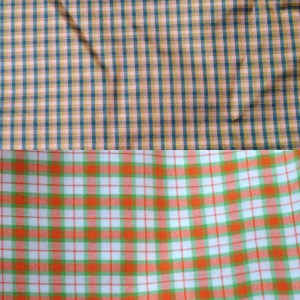
Top: check silk taffeta, Artee Fabrics Bottom: check cotton, Mood Fabrics
Top: check silk taffeta, Artee Fabrics
Bottom: check cotton, Mood Fabrics

This weekend, thanks to the SFR hunt for collar interfacing of an appropriate weight, I realized I’d better get a wiggle on my own sewing, and managed to hunt up the orange check from hell, pop it in the washer, and hunt up the pattern I intend to use.

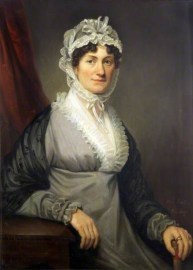
Mrs Catherine Morey oil on canvas by Michael Keeling, 1817. (c) Walker Art Gallery; Supplied by The Public Catalogue Foundation
Mrs Catherine Morey oil on canvas by Michael Keeling, 1817. (c) Walker Art Gallery

I’m stuck on that 1817-1819 range because of someone’s eventual and particular Mode of Transportation, so I was super pleased to find this portrait while trolling the BBC’s Your Paintings site. Actually, I’m pretty over the moon about this image, since it places that cross-over front firmly in 1817. I’ve made a version of this form already, so I can but hope the next iteration will be even closer to correct for the period, once I tweak the pattern a bit.

The pattern: therein lie so many rubs, often going the wrong way. Still, I remain enamored of the check and of the cross-front gown. Any checkered doubts were dispelled when Alison for reminded me of the sort-of-cross front check gown at the Met, whose catalogers are hiding behind circa 1820 which allows leeway back to 1815. Behold, of course, the ruffled neck of the bodice (I do expect mine will fit a bit better since I am squishier than a mannequin, and possess appropriate infrastructure).

Speaking of infrastructure, the appropriate stays are finished, entirely hand-sewn, and ready for deployment in pattern fittings before they debut at Genesee.

File_000 (1)

Six weeks to Genesee: at least one 1817 dress, another sheet, a portfolio and paint box, followed immediately by 18th century stays, a front-closing gown, and a bucket repair. Surely that’s all manageable, right?