This look seemed achievable, once a few compromises were made. To begin with, I scrapped the notion of replicating a silk taffeta gown: too dear for so short a time. I felt some comfort in this decision as I think the sleeves indicate a rather later date than 1824, and I am, in fact, striving for an Arcade-opening-appropriate dress suitable for about 1826.
So, what to do? Well, thank goodnessmen like to shoot at plywood and win feathers. My plan is to wear the brown striped gown with the existing belt and accessorize with a new antique lace pelerine-collar type device, I also plan [hope to] make a new extreme jellyfish cap and possibly a new bonnet.
I have the supplies. Do I have the time and will power? Stay tuned for the next installment of, “Yes, I may be overbooked.”
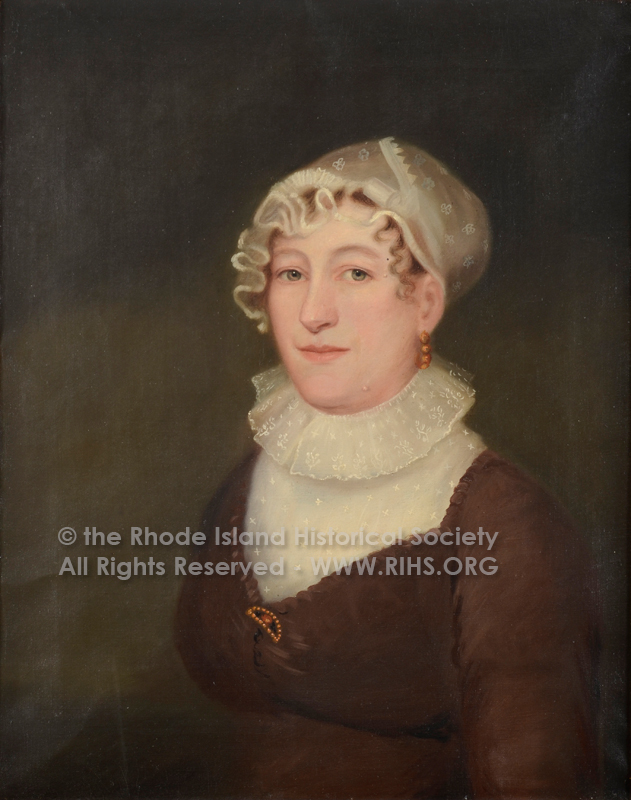
Mrs William (Jane) Pabodie. oil on canvas, 1813. RIHS 1970.60.2
Jane Jewett Pabodie, born around 1771, died 23 March 1846 is buried in Swan Point Cemetery on the Seekonk River in Providence. She was the wife of William Pabodie– which one? Well, it’s hard to tell until I really dig into the genealogy. At the moment I am so besotted with this image that all I can think about is what she’s wearing!
What she’s wearing….about that. I have some work– and some thinking– to do. The cap is slightly confounding. It’s a chance to learn a great deal more about early federal caps, which is good. I don’t understand it, which is unfortunate. The asymmetrical nature of the cap is new to me- or at least I cannot think of another example, so feel free to school me, people. But really: it is asymmetrical! With a ruffle on what is the right side of her head, and a… pinked? Van Dyked? Prairie pointed? band that runs from her left ear around to the back of her right ear? I’m confused. It would make more sense if the cap had slipped, but why would the Pabodies pay for a painting that recorded such a thing?
Honestly, I think the only way to really understand the cap is to make the cap. In muslin first, thankyouverymuch, I’m not that crazy.
Detail, Mrs William Pabodie. Oil on canvas, 1813. RIHS
The chemisette is more straightforward, being made of a sheer figured or embroidered cotton with a slightly gathered collar embellished with floral whitework embroidery. That I think can manage, at least in the basic construction (fabric, well, I’m looking).
Of course, why do I feel the need to manage all of this, with a deadline now less than eight weeks away? For a program, of course– I have only to write the copy for it. The idea (for me, anyway) is to replicate a portrait as closely as I can. Now, Mrs Pabodie and I are not exactly the same age, but I think I can pull this off…the cap, more troubling.
It’s an interesting project for me, not so much from the sewing point of view, but from a conceptual standpoint.
How close can I get? What does exactitude mean?
If I want to represent a character, what’s more important: understanding the clothing, or understanding Jane Pabodie? Constrained as I am by modern materials, unable to match these exactly, how do I navigate choices based on suppositions of what an artist meant to represent? Just my kind of conundrum.
“Useful occupations: Women’s work, sewing, spinning, washing, ironing etc,” illustration from Basedow’s ‘Elementary Work’, 1770. Etching by Daniel Chodowiecki — at LACMA
Mrs. Boice is at it again, folks: you can register now for a workshop in just a few weeks where you can learn more than you thought you’d ever want to know about getting ready for winter, laundry, caps, games, and dancing. Thought honestly, I think you can never know too much about these things, which is why I keep trying!
Yes, it’s what I think about: how did women prepare houses for winter? How did they get things clean? It was a lot of hard work, and is often underrepresented in historic sites both domestic and military.
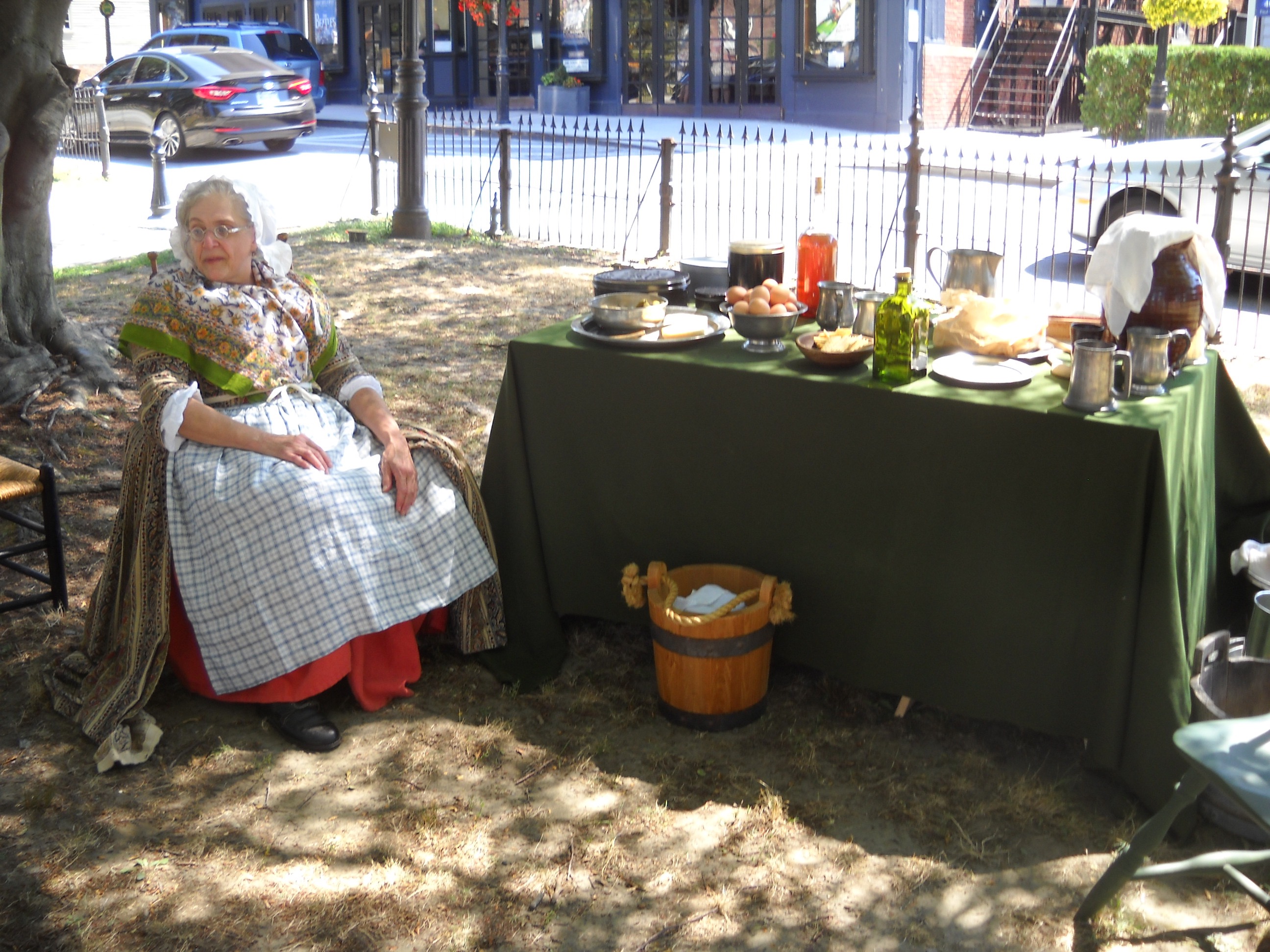
[Not] Mrs Guernsey and Mrs HolsteinThe wags will quip and Mr M certainly did, to my delight, though I might more properly have been Mrs Fjäll, but that’s neither here nor there.
We offered games, beverages, and tavern food as best we could in the makeshift setting of Washington Square in Newport and served as the site of an impressment riot based on incidents involving sailors from the Maidstone in June, 1765. Custom had been brisk before the Royal Navy so rudely imposed upon our establishment, and dragged off some of our best patrons– leaving their debts unpaid, of course.
Barmaid. Bouncer. Bobby.
We resorted to more gaming, though even that was risky: a young, possibly motherless thief whose trousers barely contain his calves made off with our winnings, and had to be chased down. Fortunately, despite her propensity to smoke, the barmaid was able to apprehend him and, money restored and apology made to Mistress B, we allowed him at our table– I believe we are a better influence than the company he had been keeping, as our trade is honest even if modest.
Much was on offer in town on Saturday, and while Miss C had advertised Hogarth and Sandby throughout the morning, by late in the day, she still had no offers, and the pair were advertising themselves effectively. ‘Tis a pity, for with fish unsold, another day passes and Miss C’s gown remains in pawn, and her shiftless husband’s shoes as well– even the Navy did not want him, for he professes never to work and affects half-wittedness that conceals his natural wit.
Despite hiccups along the way, setting up a tavern on the green, even in this kind of makeshift way, allowed us to do something I’m always excited about: interpret the history of working women. Serendipitously, one of my favorite books delves into the history of women and business both large and mostly small, and examines Newport. The Ties that Buy, by Eleanor Hartigan-O’Connor is one of the best books on 18th century women’s history that I’ve read, making clear that women, despite their restricted legal status, conducted business, had lines of credit, sued for non-payment of debts, and participated in expanding consumer networks. This book, in addition to research into punch, alcohol, Rhode Island taverns (and I’ve got ready access to tavern ledgers) grounded the interpretation of the Sign of the Two Old Cows. The best part of the intersection of living history and research is bringing actual people from the past to life, and reshaping the way the public understands and appreciates history. For Two Old Cows and a book, I think we did pretty well.




![[Not] Mrs Guernsey and Mrs Holstein](https://kirstenhammerstrom.com/wp-content/uploads/2023/03/45c6e-dscn4461.jpg?w=640&h=480)



 Kirsten Hammerstrom
You must be logged in to post a comment.