Looking for a Ship

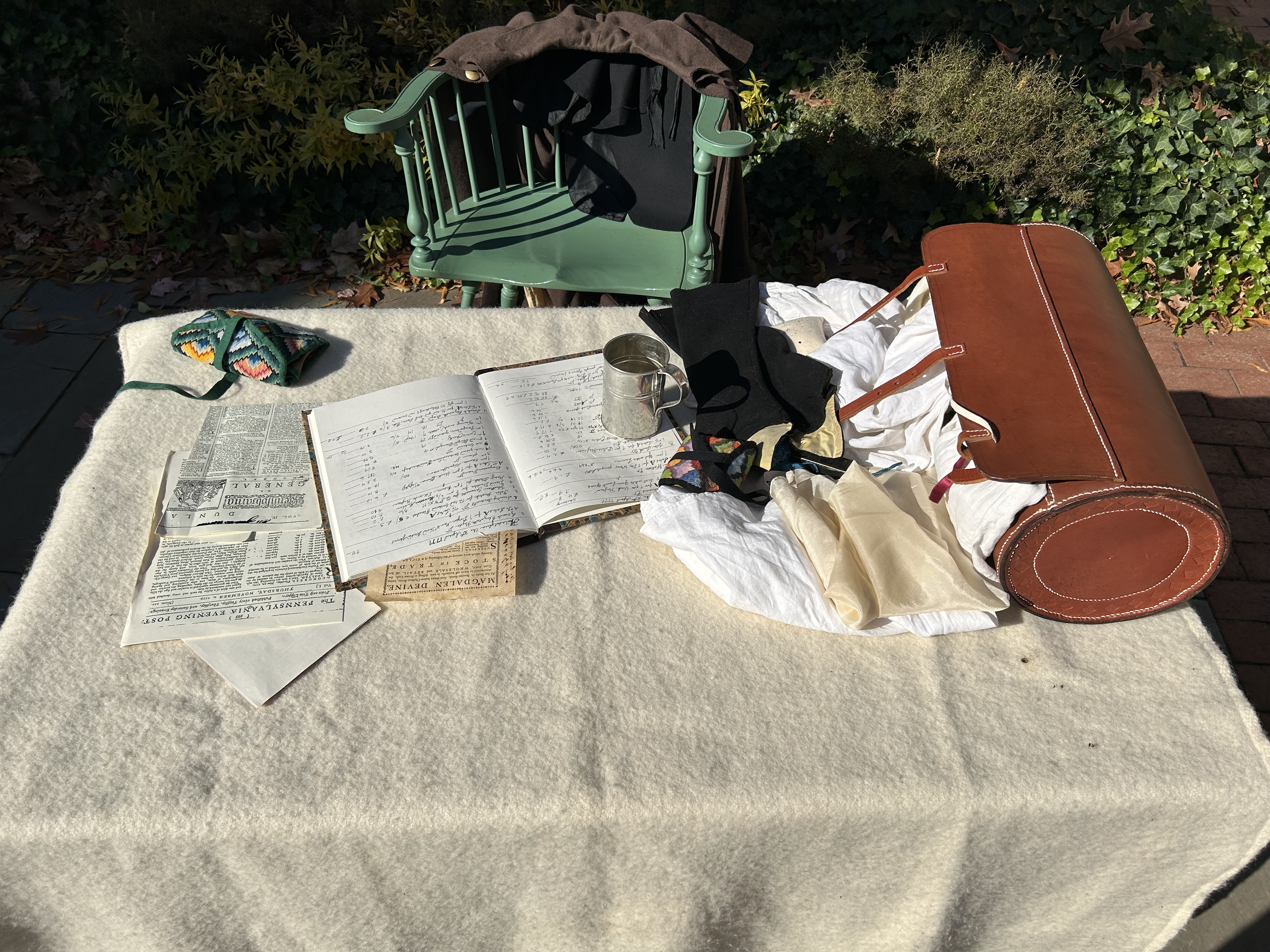
a table covered by a blanket with reproduction newspapers, a ledger book, and a leather bag
Collecting debts and packing up.

This past weekend (November 1-2) at the Museum of the American Revolution’s Revolutionary City (Pre-Occupied) event, I was pleased to represent Magdalen Devine, a feme sole trader in Philadelphia who ran a mercantile business between 1762 and 1775. Devine’s situation in 1775 reflects the tensions and uncertainties felt by many at the start of the American Revolution, and continues to resonate today.

a printed broadside advertising textiles for sale by Magdalen Devine in 1775
Broadside, Magdalen Devine, printed by John Dunlap, n.d. [1775] Historical Society of Pennsylvania, Ab[1780]-16

In 1775, Magdalen Devine, “being determined to leave off business,” advertised that she was selling “at Prime Cost, for CASH ONLY, WHOLESALE AND RETAIL, all her STOCK IN TRADE.” Devine first appeared in a Philadelphia newspaper ad in September 1762, selling imported goods with her brother, Frances Wade. By the following spring, the siblings had dissolved their partnership, and Magdalen had set up her own shop in Second Street between Market and Chestnut.

Devine’s ads reflected a keen sense of merchandising, including woodcuts illustrating printed and check fabrics and tightly wound fabric bolts. For more than a decade, Devine imported and sold goods on Second Street, eventually moving into a house she owned that was equipped with “two show windows with very large glass,” probably among the first instances of London-style shop windows in Philadelphia. 
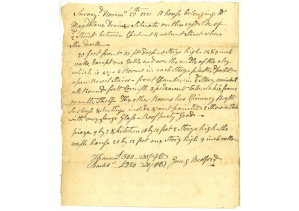
Fire Insurance Survey, “A house belonging to Magdelane Devine.” Insurance Survey S01561

For more than a dozen years, Devine traveled between Philadelphia and London, selecting, importing, and selling “a large and neat assortment of European and India goods.” The chintzes, linens, cottons, and woolens that Devine imported represented the wide range of textiles available, many with specific applications from jean cloth for clothing enslaved workers, tickings for mattresses, and hair cloths for sieves along with the chintzes, taffeties, and superfines that dressed the city’s elite. 

By April 17, 1775, she had “determined to decline business, as she intends for England shortly” and published ads in the Philadelphia newspapers calling in debts. Although she initially gave debtors two months (until mid-June), in August she was still in the city and advertising her intention to put debts “into a lawyer’s hands” if not paid within two weeks. An August 30th paper reprinted her ad of August 1, suggesting that the debt collection was not going as she’d planned in April, and the weeks and months kept stretching ahead. The ad placed on August 30th suggests she planned to leave not later than September 15th.

This slideshow requires JavaScript.

Unfortunately for Devine, mid-September saw a slowdown and stoppage of ships coming in and going out of Philadelphia. By September 18th, no ships were reported outward bound from the city. Magdalen Devine was stuck. 

A woman in a brown eighteenth-century dress with a straw hat and a white apron, standing in front of a painted door set into a brick wall.
“Magdalen Devine” dressed in brown silk with a new straw hat.

Did she get out on an early September ship bound for Cork or Dublin, and make her way from there to England? Perhaps, but it seems more likely that she miscalculated and was caught in the city as insurers, shippers, and sea captains struggled to make sense of the news from Boston, Providence, and London. Newspapers published English threats to burn all the port cities of the American colonies, and warships plying coastal waters from North Carolina to Maine surely made sailing seem unwise. 

Why did Magdalen Devine decide to close her business and leave Philadelphia for England? Just one year before, in 1774, she had acquired the shop with the “two show windows.” What made leaving a good idea? The threads are hard to find, let alone pull, but perhaps her childhood and young adulthood in Dublin suggested that the violence the British were willing to use against a rebellious colony. Famines and strikes in the 1740s prompted British reprisals against a country that served as a laboratory of colonialism.
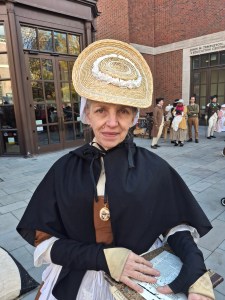
a woman in a straw hat and short black cloak
With my ledger in hand– and a fabulous new hat.

In the absence of passenger lists, it is hard to know whether Devine made it back to England in 1775, or whether she had to wait until 1783. We know she made it to London, because her death is recorded there in late 1783. 

Resources on the English in Ireland 

http://www.sneydobone.com/webtree/history-ir.htm

https://www.tcd.ie/news_events/articles/2023/how-ireland-served-as-a-laboratory-for-the-british-empire/

https://www.nam.ac.uk/explore/timeline-ireland-and-british-army

https://daily.jstor.org/britains-blueprint-for-colonialism-made-in-ireland/


Le retour au Baltimore, 1824-2024

The Marquis came back (or his analog did, at least) last October 7, and we were there.

two men in 1820s clothing stand in front of Baltimore harbor. They are wearing tall hats and long coats. The man on the left stands astride a red velocipede.
Hell’s Dandies at Fort McHenry

Way back in January 2024, Mr. K and I were asked by the Museum of the American Revolution if we would be interested in joining them (and their tents) at Fort McHenry to celebrate the Lafayette Centennial in Baltimore at Fort McHenry. Of course, I said yes, figuring that 10 months or so was ample time to prepare. 

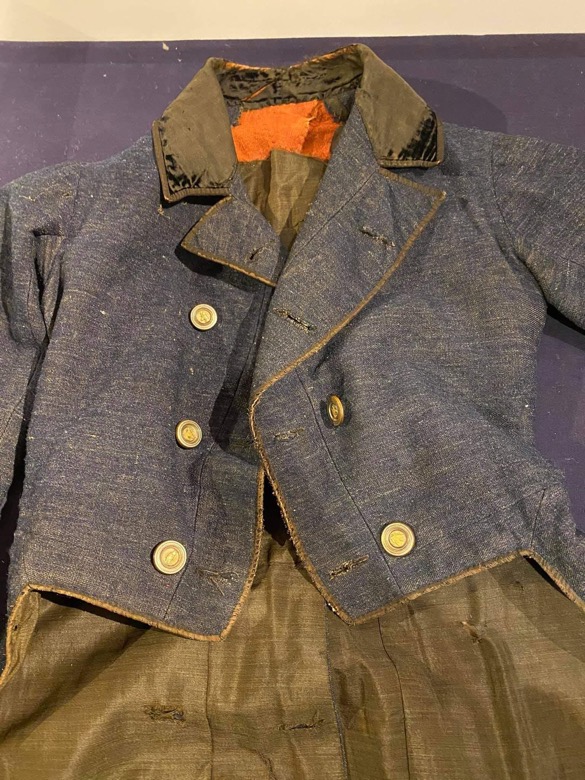
a blue denim coat with a very worn black velvet collar
The coat, posted on social media in February 2021

Reader, I began a dress in a workshop in May. I made another dress to wear and finished it the evening before the event. Why am I like this? (ADHD, I think.) Mr. K needed a new coat, so I patterned one for him to stitch from an older Burley & Trowbridge homespun. In 2021, someone (Genesee Country Village & Museum, maybe?) posted a fabulous image of a coat and waistcoat, which was the primary inspiration, along with coats including a blue broadcloth number at the DAR seen in the An Agreeable Tyrant exhibit. (Sadly, not in the online gallery.)

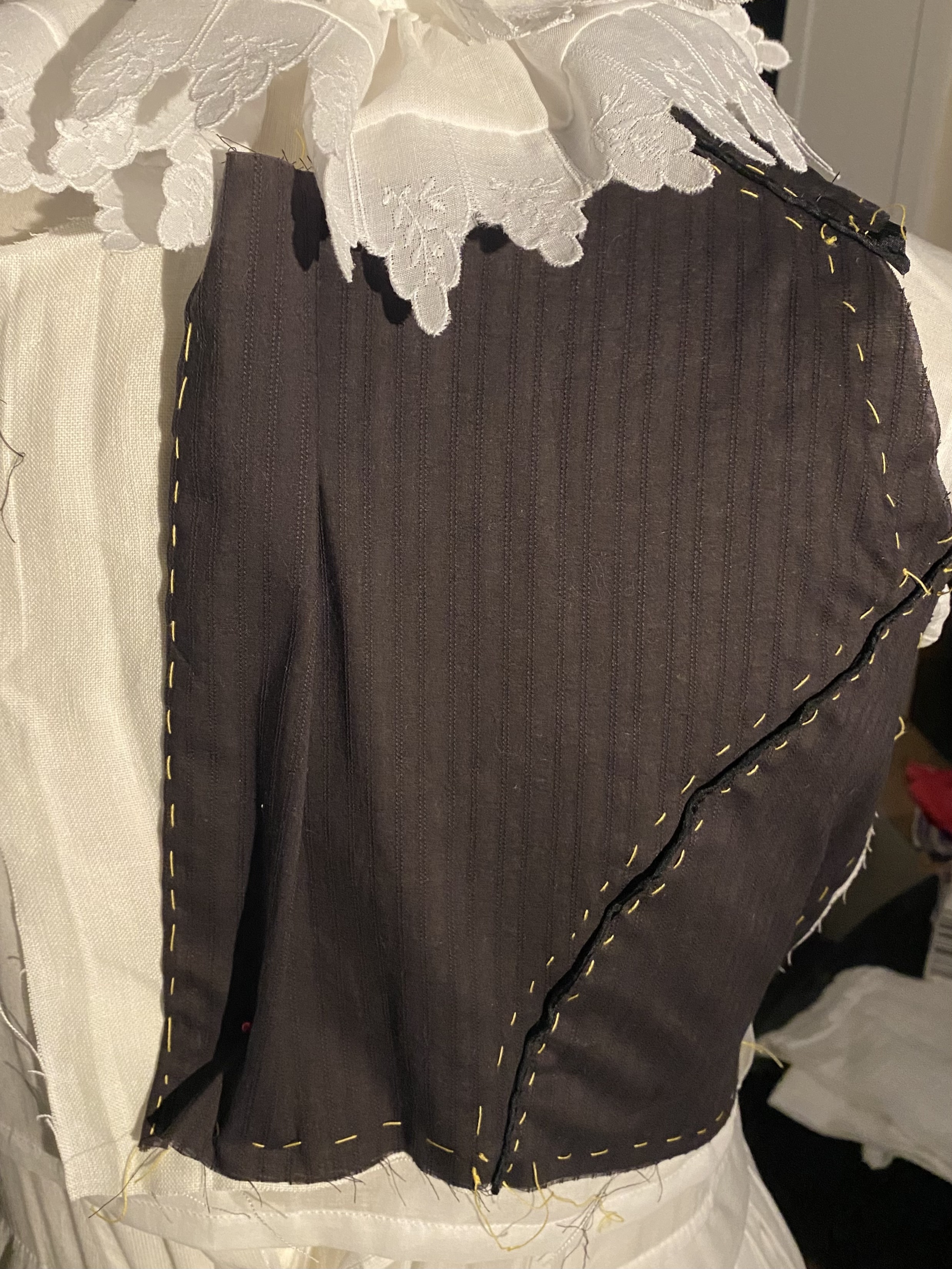
a purple cotton bodice back on a female mannequin, with a frothy chemisette with a pointy collar underneath
In progress: bodice back with piping in place

An Agreeable Tyrant also provided the inspiration for the dress I wore. I had almost too little sheer purple cotton fabric with a woven stripe, purchased at Lorraine Mill in Pawtucket a very long time ago. I meant to make an early 1800s gown, and had even started on the bodice around 2018 when life began to go very sideways and I stopped. I loved the fabric, though, and the deep color. 

I started on Sunday, September 22, and finished on Sunday, October 6. I have a full-time job and am in graduate school, so I’m not entirely sure how I managed to do schoolwork, work-work, and gown-work but I’m pretty certain the One Weird Trick was to do no housework. It’s embarrassing when the cat’s fluffy tail picks up thread and lint, but it is a reliable measure of how much vacuuming is needed. 

The bodice closes in back with a drawstring, which is much the easiest method for me– I did not have time to fuss with the fittings buttons require. The front panel is a gathered rectangle with a band at the top, piped on both the top and bottom edges. A waistband joins the bodice and skirt. The sleeves and skirt were based on shapes I drafted in the Burnley & Trowbridge workshop (I swear I’ll finish that dress). The sleeve has a piped petal cap, which was a pain to make but very gothic, to go with the points that decorate the bodice neck edge, and of which I have no images. Since I had the space at B&T to draft the skirts full-size, they actually work now– astonishing– and make a satisfying conical shape. I’ve struggled with skirts since 2014, and it’s nice to have that solved after a decade! 

gold colored geometric shapes on a white background show the layout of skirt pieces for a historical garment
1820s gown skirt layout

I’ve started using Illustrator to figure out layouts when I am short on fabric. In this case, I only had a little more than 3 yards of fabric, but managed to get what I needed out of what I had. Sure, bigger sleeves would’ve been nice, but I managed long sleeves and that seems like an accomplishment.

a man on a red velocipede followed by a boy on a foot bike
Riding School at Fort McHenry

Mr K. was able to debut his very apt and very dangerous velocipede, another project a decade in the making. We picked it up in February in Williamsburg. It is a handsome and impractical beast, tough to ride, but fun all the same. Charles Willson Peale and his sons had the first velocipede in the States, in Baltimore, so the Fort McHenry “1824” was truly appropriate. We entertained spectators, saw Mr. McC (who also took a turn about the site), and spent the day as very decorative appendages to the Museum’s tents. All in all, a day well spent. 

A Dress for Red Hook

Portrait of a Couple in the Country, Josef Reinhard, 1809

We recently returned from an event months in making, as all the best ones are, with many people making new clothes and venturing into a new era: the early Federal period. Initially, I expected to portray a widow, but ended up portraying a milliner suing for damages resulting from a breach of promise of marriage. This afforded Drunk Tailor an opportunity to be caddish and impatient, and gave me the chance to be aggrieved, which I do enjoy.

Because I initially thought I was portraying a widow, I checked through my stash for appropriate fabrics, and, finding only yardage already designated for future projects (coming in March! yay!), I ordered black gauze from Renaissance Fabrics. The local fabric store failed me, and somehow I got fixated on transparency and weight: I wanted a particular drape that a heavier stuff could not provide.

I looked at fashion plates of mourning wear but came across an 1809 painting by Swiss painter Josef Reinhard and fell in love. Still, here I was on the train tracks to mourning attire when I was portraying a forsaken milliner. Fortunately, the event organizers provided documentation from local newspapers, and a plausible case could be made for being in mourning for my recently deceased father– adding another layer of poignancy to my abandonment and financial precarity.

The gown I made is my third run at an early 19th-century surplice front.  The pattern I scaled up from An Agreeable Tyrant was a reasonable place to start, though my shape has changed somewhat in the nearly three years since I first started on that. In the end, I found that the shape of the lining or base of the canezou was a better starting point. Using that back and the general shape and grainline of the front, I re-draped the front bodice pieces to my current size, adjusting the line over the bust and adding an underbust dart, based on darts seen in period Spencers.

It took about three muslins before I had a bodice that fitted well; then it was on to the sleeve. Thankfully, that only took two muslins to rework the curve of the sleeve head and the shape of the underarm, and adjust the grainline to correct the drape of the arm.

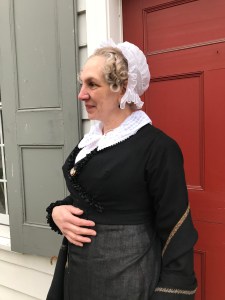
I like the contrast between the white chemisette and the black gown

The surplice or cross-front gown appears in many images; it’s a comfortable form, and uses relatively little fabric to achieve the effect. It would also be a good form for nursing mothers, and while that was not a consideration for me, I do like the way the neckline can show off a chemisette.

I wore this over a pink wool petticoat and the white bodiced petticoat/gown that I wore under the canezou; I’d prefer a black petticoat but the one I is made for 1790s gowns and required shortening. In the future, I’ll make a black or grey silk taffeta to wear under this gown. But first I’ll need new linen petticoats since two have disappeared.

The hem edge, as always for me, was little uneven despite measuring carefully multiple times, but a ruffle solved that and added weight to the hem, helping the skirts hang and move better. The trim is based on a drawing in the Nantucket Historical Association collection and uses a quantity of black silk ribbon (which I can buy wholesale thank goodness!).

I’m generally pleased with this pattern and the finish of the gown. The lessons I’ve taken from this experience are about packing lists (and not putting the box of bonnet behind the door where it is invisible) and accessories. Once you have a pattern that really works for you– a well-fitted bodice or waistcoat, coat, and trousers– what you need to round out your look are accessories. Those are the pieces that can expand your wardrobe, dress it up or down, and generate multiple looks from just a few pieces. If that sounds like capsule wardrobes or fashion magazine advice, well, just because you saw it in Mademoiselle or Glamour doesn’t mean it isn’t useful advice.

Winter Chores

Here we are, on the cusp of winter: the season is (mostly) over for living history events, the days are short, and what is there to do but pine until the season starts again? Chores, gentle reader: chores.

Before you pack your kit away for the season, or even if you never do, there are some tasks you can undertake to make it better. You don’t need a major overhaul to improve your experience, just some simple maintenance. (These tips are applicable in pretty much every time period.)

Nasty, right? This is why you wash your apron!

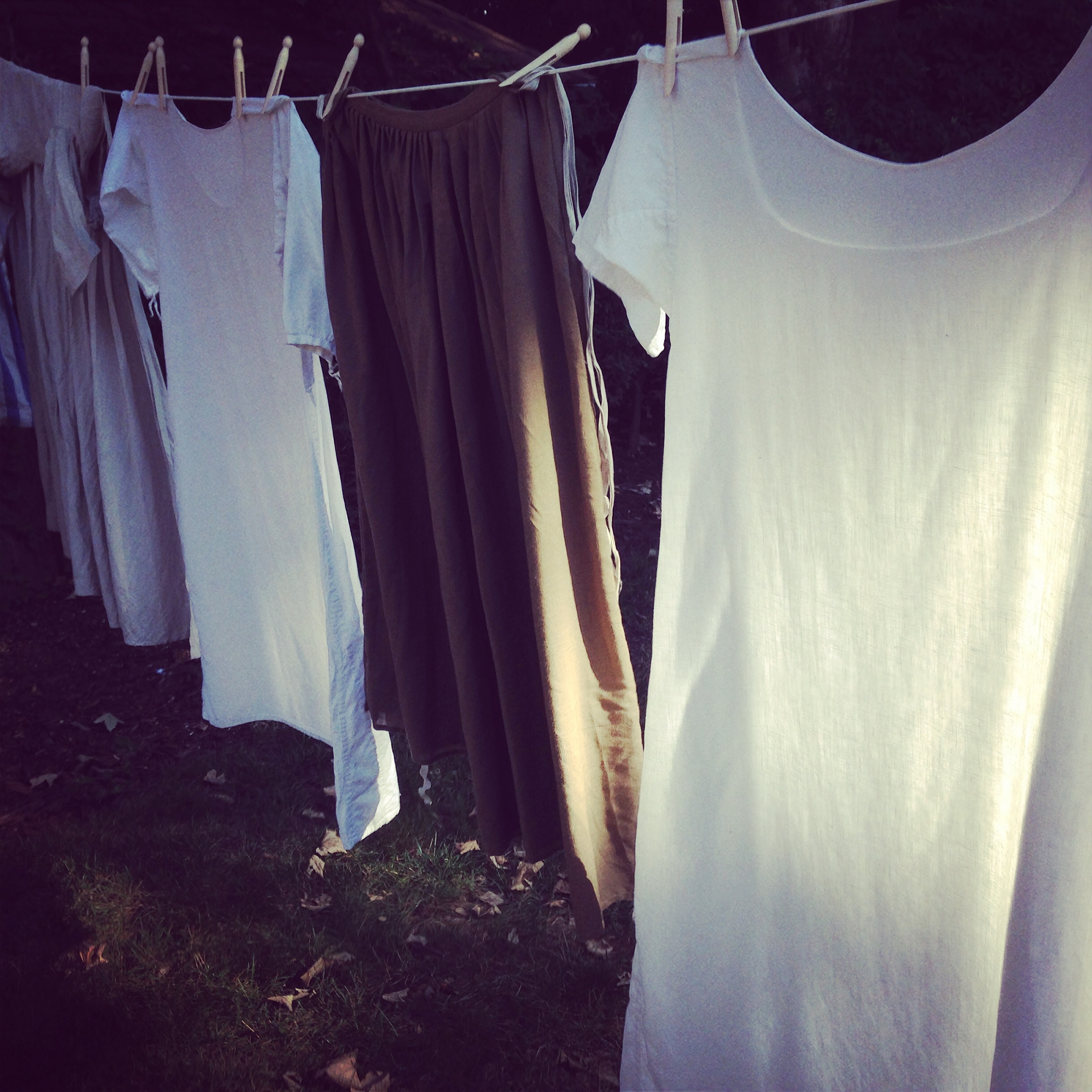
Wash your body linen. Please. Shirts, shifts, neck handkerchiefs, rollers: wash them. And your caps! They washed them, and so can you. I prefer to wash before I mend, but I hand wash my linens. We have a large kitchen sink that I can plug, so I fill it with hot water and wash my aprons, shifts, and stockings with lye soap. (I like that it does not smell like modern detergents; Drunk Tailor bought a lot of it for making white ball so we might as well use it.) Whenever possible, I hang my clothes to dry outside, preferably on a sunny day. You may also choose to spread your things out on the grass (if you have it); this helps whiten linens. We lack grass, or a clothesline, in our yard so it’s hangers in the trees or on the shower curtain rod for me. There’s no shame in that– it’s just not as picturesque. If you want to know more about laundry, Madam Johnson obliges.

Wash your stockings. Your feet will thank you. These are another handwash item; if you have wool stockings (I recommend Sally Pointer if you can get in the order window), handwashing is essential. Again, I use the kitchen sink, lukewarm water, and lye soap. Madam Johnson does not recommend using soap on worsted stockings, and she has a point: too much soap, heat, and agitation will felt your stockings. To dry, put down a towel, and reshape the stockings in the center of the towel. You may need to make sure the back seam is centered, and the feet correctly shaped. Fold in the edges of the towel and roll it. This will safely squeeze out the water. Dry flat (again, I like to put mine outdoors, but the guest bed will do in a pinch, or anyplace I can keep cat-free).

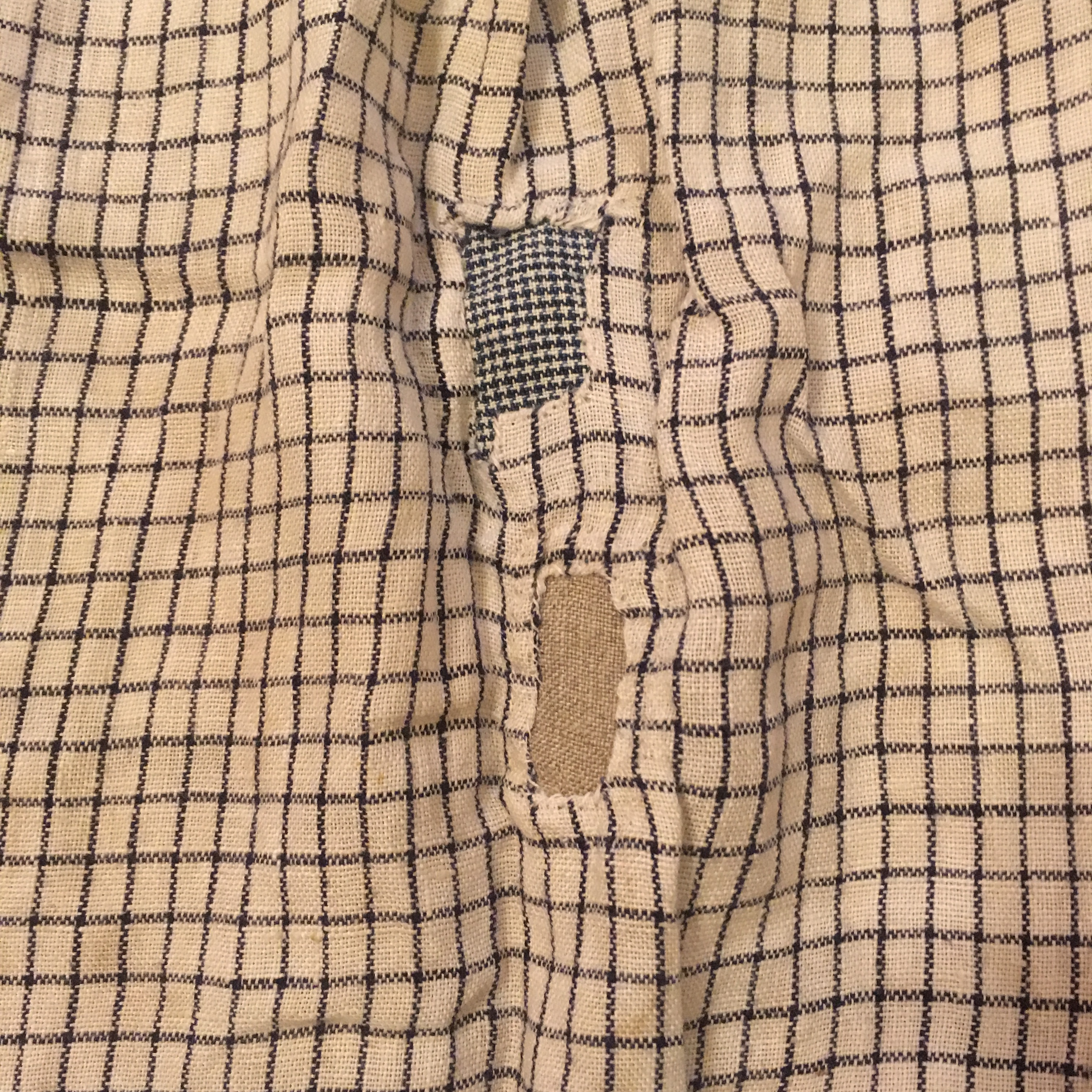
Patches that match are preferable.

Mend your linens. Underarms, collars, cuffs: they all get worn. Aprons get burned. Once you’ve gone over the garment to note the areas that need work, you can assemble your mending supplies: needle, thread, beeswax, and linen as close to the original as possible. Patch the holes neatly from the underside, making a small turned hem from the front. (This is not unlike needle-turned applique, but there are tutorials and guides. Turn or replace collars and cuffs. This is work I need to do on one of my shifts, along with restitching a neckline hem. It has taken several years to reach this point, but no matter the age of your clothes, it’s worth checking seams and hems and making repairs now.

Mend your stockings. These are often too expensive not to mend, plus, it’s period correct. There are tutorials for this, but the tools are simple: wool in weight similar to your stocking, a yarn needle, a darning egg, and patience. (Just use smaller yarn than shown here!) If you haven’t got a darning egg (and they’re pretty affordable, so…) a smooth, oval object will do (kitchen timer, small stone, a lime if you don’t poke it).

shifts and petticoats on a line
Living history laundry

Brush your outer garments. I have only laundered one of my gowns, and that was because it got very ashy and greasy. For the rest of my clothes, I brush off the dirt before I hang them up or pack them away. Greatcoats, regimentals, frock coats, breeches. Gowns, petticoats: all of them can benefit from a brushing. (This applies to your modern wool clothes, too.) There are a range of options, from brushes made in Sweden by the visually impaired to classic English options and German brushes for everything. Brush your hats, too! They get dirty, too. For all of these, if your garment is napped, brush with the nap, not against it.

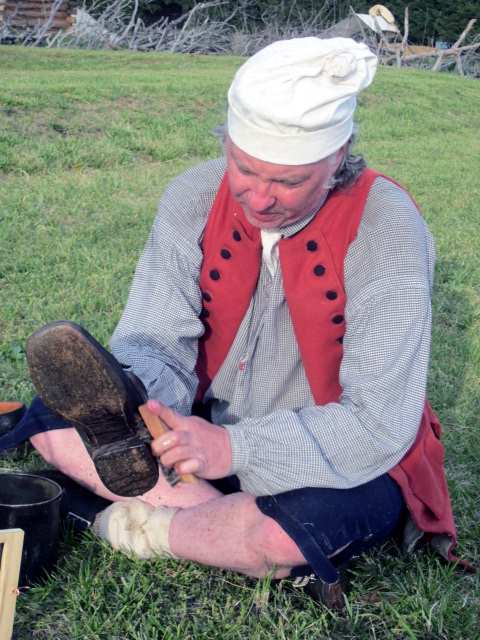
Drunk Tailor cleaning shoes

Clean, grease, and reshape your shoes. You may covet one of these shoe brush kits, or you may have some standard brushes already– they were available even at the grocery store in my long-past childhood. Redecker brushes– and there is a brush for everything shoe-related on these seven pages— take a little finding but last. First, brush off the mud and dirt. Then, wipe the shoes down with a damp washcloth or towel. Let them air dry. Never put your leather shoes directly on a heat source! Then treat the leather. (Tutorial here.) You may want to use black ball, or a colorless polish, depending on your shoes. Drunk Tailor has made it, though not blogged about it, but you can start here if you really want to dive into this. When I’m done, I put shoe trees in my shoes, or stuff them with acid-free tissue paper so they keep their shape.