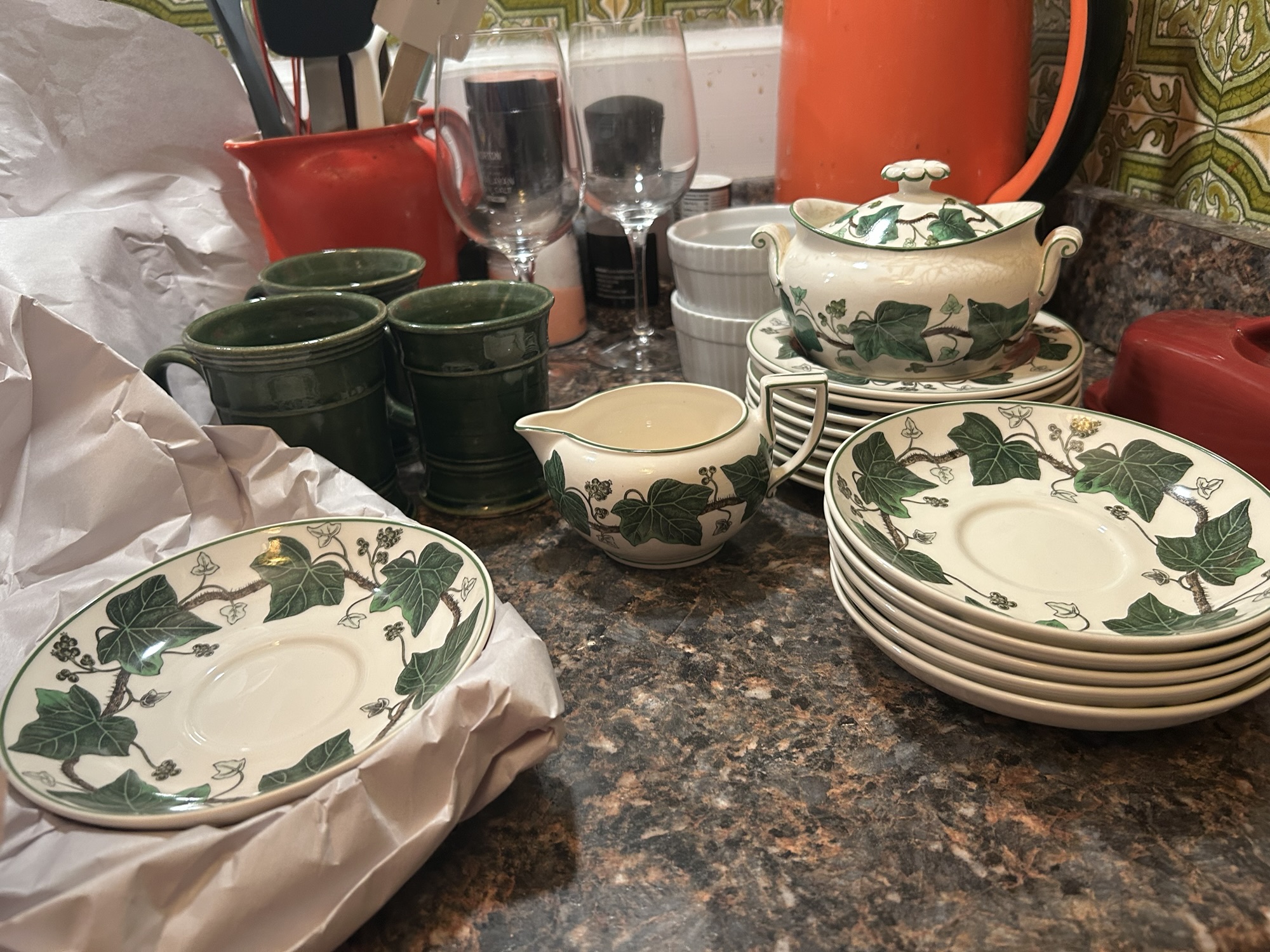
I’m standing at the sink in the kitchen in my Baltimore apartment. It’s the smallest kitchen I’ve ever had, but I’m unpacking Wedgewood plates, cups, and saucers. There’s a creamer and a sugar bowl. What on earth am I going to do with these? We will eat from them, but how ridiculous is it to stand at the sink, some 30 years after receiving the wedding present, washing a service for eight? There are no longer 8 of everything– some have chipped badly, some broke in use– and I wonder how hard it is to get replacements. They’re available, if I want to spend $70 to $90.
This is crazy! No one will care if the plates are chipped. We’re in the collapse right now, and things are not going to improve unless there is drastic (unlikely) change. We will be lucky to have food to eat, who cares about plates?! But still I ordered three replacement plates, because I hate chipped plates, and well, why not? Why not have nice dishes as the world we know changes forever, irrevocably?
A nice table won’t stop the fascism (that takes other work). Does a nice table affirm our humanity and our dignity? Am I mimicking the disaffected and the royalists who clung to sensibility as the American Revolution swirled around them? Maybe. For now, our dishes will be pretty and clean, and the cat will get her special meals, and we will be as normal as we can be, knowing all the while that nothing is normal and nothing ever will be.
We all love things, don’t we? Things in the literal, corporeal, piled-in-a-heap sense: plates, shoes, books, chairs, necklaces, models. But what makes us love them? How deeply do we really love them?
Someone posed the questions, What would you take if you had to pack in a hurry to leave home forever? What will your kids remember you by?
Those are hard to unpack: how will other people remember us? Often, we have no idea what we mean to other people, even the ones closest to us. It’s easier for me to know what I would take or keep to remember someone else by– a single sleeve link; a wooden train engine; a stainless steel spoon; a necklace of handmade beads. None of those things reflects what is truly meaningful to me about them, that is, without my knowledge, these aren’t particularly interesting or aesthetic objects. What makes them special is the story I attach to them.
That is, of course, the key to interpreting objects in a social history context: the story is what makes the object more interesting, more important, more compelling. It’s the difference between a provenanced and an unprovenanced object, between a roundabout (or corner) chair in context, and one out of context.
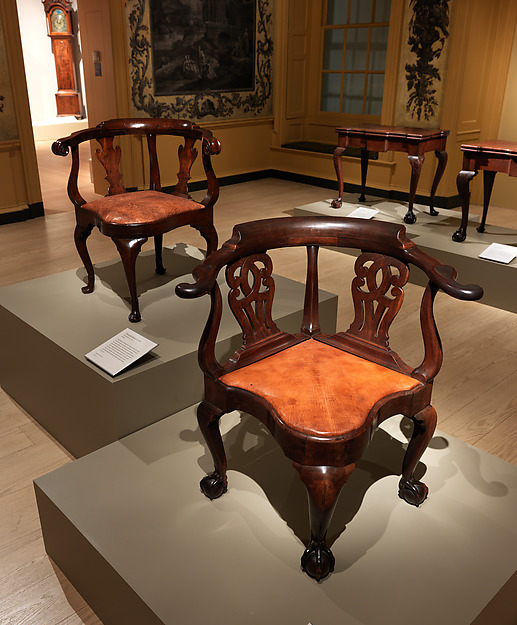
Corner chair, probably John Goddard. Metropolitan Museum of Art, L2014.9.1a,b Lent by the Wunsch Collection, 2014
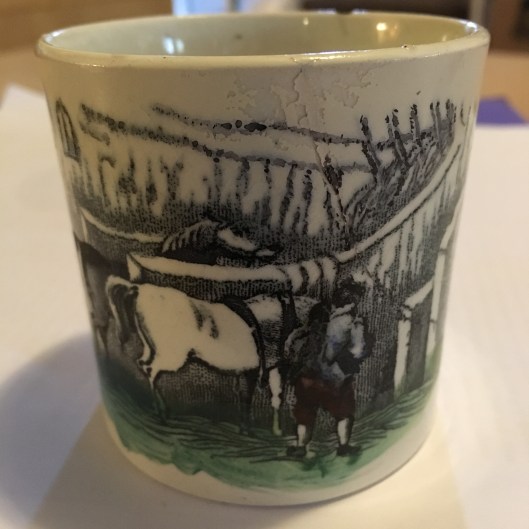
This is not to say that beautiful things are without value removed from context, but what makes that Goddard chair more compelling is knowing who made it, who it was made for, and when– knowing that it was part of a set of furniture ordered to furnish a house for Providence newlyweds, made in Newport by one of the hottest makers of the time. It’s the people who make the object more interesting, who make it worth having, seeing, holding on to– whether it’s a $6 million chair or a $25 mug, memories and stories make things compelling beyond our associations with them.
Part of a museum curator’s job is understanding those stories, placing objects in context, and connecting them back to their stories, to their makers, users, owners, and keepers. We may buy things because they’re beautiful or useful, but often we keep them because of their meaning– which is, more often than not, about people. Unprovenanced objects have less meaning; an object sold outside, or without, its context will not fetch as much. Value resides in people, not in things.
I think of this not only because a portion of my work is to recreate or reestablish the human contexts and connections for things, but because there is a human instinct to grab onto something tangible (like an object), rather than something ethereal (like a memory), even though what will sustain us in the end is not things, but other people, and our memories of them.
Recently I’ve had more than my share of time to think about museums and objects, and what they mean to me and why I love them, and have dedicated my life to them, albeit a bit accidentally.
Transferware in open storage, Metropolitan Museum of Art, May 2013.
In the hours I spent alone in a curatorial office, listening to the murmur of school tours on the other side of the door, I began to see that curation and registration are means of managing the evidence locker of the future. We collect, tag, and maintain the means by which the future will understand the past, and it’s our job to be a neutral as we can—to refrain from laying the thumb of our prejudices on the scale—as we collect objects, images, and documents. It’s a game of forecasting, trying to guess what will best explain us and our time to the future, as well as Monday morning quarterbacking as we both weed and augment what was collected in the past to better reflect how we understand history now.
I was always a stickler for good data and record editing (and have raccoon-eyed photos of a catalog launch to prove it), and I make unkind sport of museum databases on a regular basis when I see misidentified and misdated objects. Good data matters—it’s everything, really—because if you don’t know what you have, and where it is, you might as well not have it. But more than that, compendia of data can show you things you didn’t expect to find.
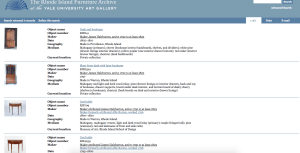
RIFA Record 4925
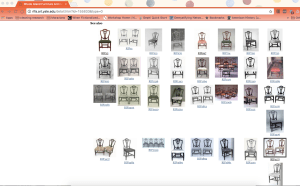
Yale’s Rhode Island Furniture Archive is a good example of how a massive amount of data can be used. Take this record of side chair possibly made by John Carlile and Sons, and scroll down. That’s a lot of associated chairs. And they all look very similar. Examining the materials, especially secondary woods, of a labeled chair and comparing the style, make, and materials with other very similar chairs can help identify chairs, associate them with a maker, and provide a sense of Carlile’s production volume.
And Carlile’s easy! Looking at hundreds of pieces of furniture with some location provenance, reading probate inventories and other documents helped untangle James Halyburton or “Ally Burton” as a maker.
James Halyburton in the RIFA
When you can see enough things at once, you can discern patterns and better understand exactly what it is you’re seeing. Good data makes that possible, makes concrete what was once solely seen as connoisseurship, and helps bring unknown stories, unrecognized people, to light. Data analysis is a powerful tool for better understanding the past: that’s why museum collections matter, and why I think it’s so important for museums to make their data accessible. It’s one of the ways we understand our collective past.
Historic American Buildings Survey, George F.A. Palmer, Photographer, 1937 DETAIL OF PARLOR FIREPLACE. – Jeremiah Dexter House, 957 North Main Street, Providence, Providence County, RI
Last weekend, Drunk Tailor and I delivered the Giant to his new life as a college student back in New England, and paid a call on of my oldest friends, a 96-year-old former OSS agent and descendent of the Dexter family. My eldest friend had something she wanted to give me: a souvenir of the Dexter House, in recognition of the hours I’d spent working with her identifying and organizing several hundred years of family papers.
In the photo at left, the coffee pot on the mantle is now in a museum collection, as are the miniatures, the bellows, and the pipe box (which is now on display in a historic house museum). What my eldest friend gave me is not in the image of the house, but resembles the plate to the left of the fireplace: a Staffordshire transferware “Village Church” pattern plate with a wild rose border, ca 1825.
Transferware soup plate ca. 1825. Unknown maker, Staffordshire, England.
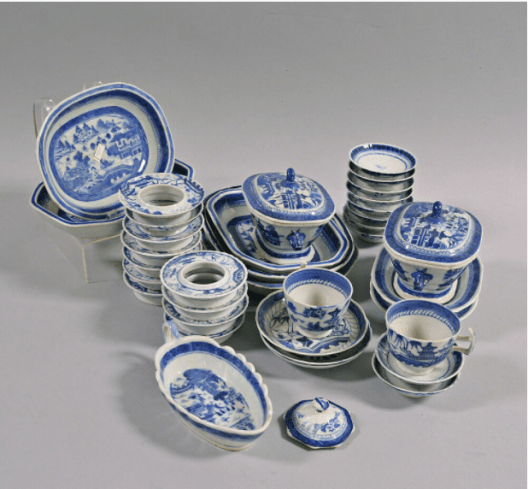
I’m a fan of blue and white china, and while I prefer earlier Canton ware, this plate is more special to me than the ones I’ve bought at auction or in New Bedford antique shops: because of course it’s not a plate, it’s memory, or an emotion, made solid.
Drunk Tailor and I spent an early Sunday afternoon on my friend’s porch listening to stories about her children, in particular about her daughter Mary, now an artist living in Mexico. Is it a comfort or an annoyance to learn that schools have been misjudging children since schools were invented, trying hard to fit round pegs into square holes? Mary, always more interested in drawing than in lectures, once left a classroom when the teacher said, “If anyone doesn’t want to hear this lesson, then they can leave now.” Out Mary went, three other girls following her out to play on a beautiful spring afternoon.
That story, and many others, aren’t apparent in the plate with its crazed face and discoloration. Only my memories (and anything I write down and keep with the plate) make the associations. But it is always the stories about the objects that make them important (even big-ticket dec arts items, like Plunkett Fleason easy chairs.)
Last night, before Drunk Tailor and I watched The Maltese Falcon, we watched Adam Savage’s TED talk on his obsession with objects. The TED talk is worth a watch for anyone interested in material culture and objects. Our human fascination with things goes beyond the shiny surface of new things (tabernacle mirrors or iPhones) as they become repositories of memory, symbols of feelings or moments.
War correspondents and personnel of the Office of Strategic Services, leaving from the Railhead, Camp Patrick Henry, Virginia, enroute overseas. NARA. National Archives Identifier: 542171 Local Identifier: 336-H-17(E8671) Creator: War Department. Army Service Forces. Office of the Chief of Transportation. 3/12/1943-6/11/1946
This: In my desk drawer, I have a buckeye Drunk Tailor picked up and handed to me in a garden in New Jersey. It’s useless: inedible, too light to be a paperweight, but it reminds me of that November afternoon, the soft green of the garden, and how shy I felt. Anyone cleaning out my desk would toss that bit of organic matter, even as I keep it as a talisman of one of our first dates: the places, the smells, and the feelings.
And this, too: My friend is 96. I may never see her again, though when I left her, she was healthy and cheerful, making plans for the fall with her children, grandchildren, and great-grandchildren coming to visit. Given my reticence and her old-fashioned New England reserve, I may never be able to tell her how much she means to me (I try), or how interesting I think she is. (“I’m not interesting, dear, I just worked hard,” is what she says when I try to convince her to donate her personal papers to an archive.) But I have a plate that was in a house that had a great deal of meaning to her, and my best guess is that her gift of that plate to me means she knows how much I like and admire her. It reminds me of her, and reminds me of how little time there is before all that’s left is the plate and my memories.


 Those are hard to unpack: how will other people remember us? Often, we have no idea what we mean to other people, even the ones closest to us. It’s easier for me to know what I would take or keep to remember someone else by– a single sleeve link; a wooden train engine; a stainless steel spoon; a necklace of handmade beads. None of those things reflects what is truly meaningful to me about them, that is, without my knowledge, these aren’t particularly interesting or aesthetic objects. What makes them special is the story I attach to them.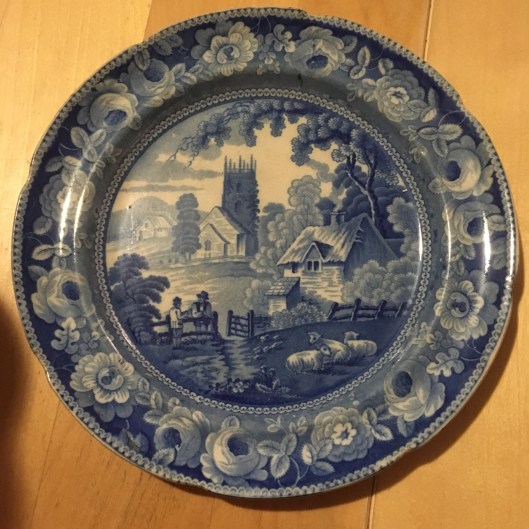



 Kirsten Hammerstrom
You must be logged in to post a comment.