What to wear for 55-degree weather? Suddenly, “red and black and white calicoe” seems…foolish. The Cursing Sewing Mommy may have words for not having gotten her act together to make the red short cloak from the Wm Booth remnant. But there is a blue wool cloak (based on one in the RIHS Collection) that lacks only facings, but when I dress early next Saturday morning, will one layer of wool over cotton be warm enough? Hard to be certain, but I am not confident. And what does this mean for Nathan Hale? Is it past time to drop the cotton and drag out the wool?
None of this panic has anything to do with questions of fit, of course, or the schedule for today, which starts with boiler men and ends with a board dinner. Yes, that is sarcasm.
I’ll haul “red and black and white calicoe” in to work and perhaps while babysitting boiler men I can work on some of the issues—or if not, at least get the second sleeve set and the cuffs done. If I can make it passable, I can wear it over my black wool petticoat, and bring the wool jacket in my runaway-with-the-army bag.
The overall buttons are in progress, and I have chisels for buttonholes, but that will have to wait until tomorrow. One really can’t whack holes in clothes on private club tables…not if one wishes to keep one’s job.
Layout, 8:00AM. Started after cutting out the last parts for the red calico gown
Many thanks to Sew18thCentury for the Sewing with Babies award. I’ve seen the badge on people’s blogs and thought, How charming! At least I don’t sew with a baby anymore… the Young Mr is, after all, very nearly 14. But aside from some safety issues (pins are slightly less hazardous, as they only get trapped on the size 13 feet, not potentially ingested), sewing with a school-age child is sewing with someone who needs (wants) your attention.
Sewing With Babies was created by Sarah W. from the blog A Most Peculiar Mademoiselle to recognize, “mothers who try (and now and then fail) to find time to create something beautiful and/or useful with needle and thread, between feedings, nappy changes, laundry, nursery rhymes, and baby kisses.”
I have been sewing with and for the Young Mr since before he was born; the day I went into labor, I was home with a sinus infection, contractions, and seated at the sewing machine frantically making…Christmas stockings for our family, including the cat. After all, my mom was coming for Christmas! Clearly, while I was in the grip of something strong, what I really needed was to get a grip.
What did I do after he was born, when he was the Monkey and not the Young Mr?
Like most moms, I sewed during naptime, or gave him a creative, not-too-messy activity to do alongside me. Caution was in order, because at about 18 months, he did climb onto the table to ride the sewing machine like a horse.
I took handwork with me to sew at lunchtime—and I still do this. Since 1999, I have sat in buildings under construction, hand sewing or quilting. It’s a good thing to talk about if you’re babysitting a lobby during a members’ open house, or while men screw heat detectors into ceilings in rooms without internet access, and you may learn new words to use when sewing goes awry.
Mostly, I get up early. When he was the Monkey, the Young Mr woke up before the New York Times was delivered. People, that was just unconscionable—and worse in the dial-up internet era. St. Louis at 4:00AM was a lonely place. After I got him back to sleep, I was wide awake waiting for the paper, so I started planning pieces, cutting patterns, and sewing before Mr S got up and we had to get ready for work.
I still get up early, sometimes 4:00, usually 5:00, and have sixty to ninety minutes before the rush to work and school begins.
I’m struck by the mothers who sew for their children, and wish I had been able to sew historic clothes for the Young Mr when he was little. So even though some of these folks have been nominated, here’s another vote to keep on sewing.
Romantic HistoryI especially like historic clothes for boys…now that I’m stuck making man-size clothes for my boy. (How did that happen!?)
Dana Made ItWhen my son was younger, I wanted to quit my job and sew for kids. Didn’t work out that way, but it’s great to see fresh ideas for sewing for kids.
Sewing with Kids This is how I started, felt animals and tense embroidery projects.
Still, from layout commencing at 07:59AM today to the cessation of sewing machine hostilities at 16:42PM, we have a garment. The words I have heard carpenters, electricians and pipe fitters use came in handy when the thread was– I swear–possessed by demons. Fabric wandered like it had grown legs, not been cut into legs, and I thought about how our mechanic said, “The Devil has many feet, Mr. S” when pronouncing the old Subaru unfit for resuscitation. I tossed the bad thread, rewound the bobbin, ate a sandwich, and started over. It was worth it to get to hand-finishing work, which is portable.
Now, it’s time for a beer (the cursing mommy would approve), and to switch to another project. Before I laid out the overalls, I cut out the stomacher and cuffs for my gown, and organized the finish work for that. Yesterday I decided to attempt to make a coral necklace, and that might be a good project for this evening. My thumb muscles need a rest.
What Cheer! Day is a week away, and exactly a week from now, at 6:30 AM, I will get into my B&G guy’s truck and head into the site. We’ll measure and tape out camp sites, fire pit sites, and safety lines, bring wood and gear out from the woodshed and basement. We’ll put out the handicapped parking only sign in the parking lot, drop the orange cones (I love the thick flexible plastic of a traffic cone), and drink some coffee. I haven’t decided at what point I’ll start to fret in earnest that day, but the trick to not fretting will probably be to get dressed in 18th century clothes as soon as we are done carrying items upstairs, because then I will have to take off my watch. Watches lead to fretting: there’s administrator time, and re-enactor time, which is more like artists’ time. Better to take off the watch and get closer to the past.
Half-pleated skirt, sleeves in progress
At the School of Instruction, I thought the “People of the Brigade” program worked well; at OSV, I really appreciated the Military Fashion Show (I did not make it to Runaway Runway). Using these models, and knowing about the School of Instruction’s Women’s Dress program, I thought we’d combine these ideas. I don’t have a good name for the program yet, but the reason I’m going so nuts about the dress from 1774 is that I plan a “History Dress-Tease:” starting in shift, stays, stockings and shoes, I’ll demonstrate all the layers my runaway wore: 2 petticoats, pockets, dress, stomacher, apron, cap, bonnet.
Any soldiers I can convince to get down to small clothes and layer up with waistcoat, coat or frock, canteen, cartridge box, bayonet scabbard, haversack, knapsack, hat and musket, will demonstrate the gear they carried. I thought about a weigh-in, to record how much it all weighs, but my scale is a pathological liar, and varies by 4 pounds from one side of the room to another.
All this work has an educational, and not merely sartorial, purpose. Now, if only the public will come…
If the museum date is mutable, what to do? How to take non-illustrated Vogue for the Lower Sorts and turn it into an actual plan for a garment? By using period images.
Anne Carrowle runs away in 1774 in “an India red and black and white calicoe long gown,” but what does that mean?
Start with the negatives: It means she is not wearing a short gown or a bed gown or a jacket. She’s probably wearing what we most commonly think of women wearing, an ankle- or near-ankle length dress, open in the front (remember that the petticoat is described!) that pins to a stomacher or is fastened with bands or a band over a handkerchief. (Excellent info on the topic At the Sign of the Golden Scissors blog.)
When I start thinking about a gown for 1774, I start looking for earlier images. Not too much earlier, but a range. In this case, Anne left England in 1769, so 1769-1774 seems like a reasonable time frame. I made a Pinterest board for 1765-1774 ideas, which is easier than posting them all here.
To the left is a robe that’s clearly open: it’s hanging open. Laundry-work, women washing at Sandpit Gate, Paul Sandby, 1765; watercolor. Royal Collection.
1765 gets us closer to the time period, and it is before Anne left England, and it’s likely from the class she was born into. But it is early.
The two prints above are both from 1774; on the left, note the maid’s gown, which hangs open and has robings. On the left, the old woman asleep wears a gown laced over a stomacher.
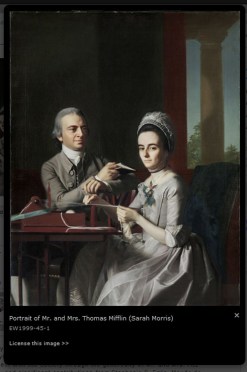
But best of all perhaps is this image, of Thomas Mifflin and his wife, Sarah Morris Mifflin, painted by Copley in 1773. Thomas Mifflin (1744-1800) and his wife, Sarah Morris Mifflin (1747?-1790), were the only Philadelphians painted by John Singleton Copley. Mifflin was an ardent patriot and by the time this portrait was made, had established himself as a successful merchant; later he rose to the rank of major general in the Continental Army, and was elected the first governor of Pennsylvania after the United States achieved independence.
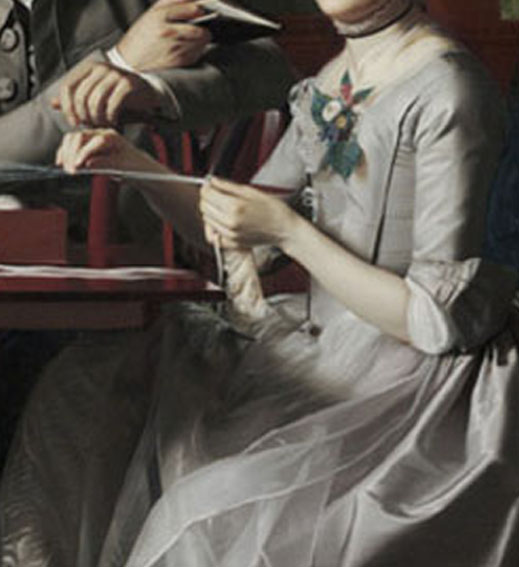
Why does this work for me? Because these are Philadelphians, and my woman ran away from the Philadelphia area. The detail really shows that Mrs. Mifflin is wearing an open robe with robings and stomacher over a quilted petticoat with a filmy white apron. This is multiple tiers above Anne Carrowle, but the style is what I’m aping, not the materials (obviously silk).
Another Copley portrait, of Mr. and Mrs. Isaac Winslow, depicts a woman in a gown with robings and a stomacher. Jemima Winslow is 41 in the painting, putting the style into my ballpark, and better still, the gown is of a patterned fabric.
Below is a detail of the fabric and stomacher. Though it will be a vastly simplified version, I think I have a model for my dress.




 Kirsten Hammerstrom
You must be logged in to post a comment.