Dresstory: The Green Eyed Lady

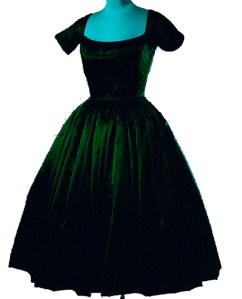
Almost my dress, thanks to PhotoShop

I didn’t know then that it was called changeable silk; what I knew was that the skirt rustled when I walked, and spread out like a plate when I twirled. Irresistible. Probably homemade, I would have found it in a junk shop on South Broadway in St. Louis, or at the Veterans Village thrift store on Natural Bridge Road, a place white girls like me had to be careful (respectful) about going to.

Square neck, tight waist, full skirt, side zip: at one point, I was skinny enough to pull it over my head without opening the zipper, as long as I wiggled just right. The only time I clearly remember wearing the Green Taffeta Party Dress was to the KWUR Student Radio end-of-year party at the Women’s Building on the Washington University Campus. April or May of 1987, probably, though possibly 1986, before I went to Skowhegan on a summer scholarship.

My date was my on-and-off boyfriend, another sculpture major, working on his master’s if it was 1986, and newly graduated if it was 1987. He had a shambling walk, shuffling, a little hunched over, as if 6 feet were too tall for the spaces he occupied, though the city was large enough. Sneakers, jeans, an Army fatigue jacket, a smile waiting for reactions, waiting to deploy. Patrick was the son of a firefighter and a nurse, and I stole him from his college sweetheart.

Rosemary Clooney in White Christmas. Velvet, but very similar.

The green of my dress was like the green of his car, dark and forest like. We made installations together, layering found objects and drawings in the small gallery in the studio building where we worked. We drifted into a relationship: his girlfriend visited every weekend, driving up from the smaller college town where they’d met. Red haired, pale-skinned, in burgundy beret, Roslyn sat on a stool and watched Patrick work. Across the wide wood shop, I watched her watching him, and smirked. Reader, I was unkind. My friend Jane and I played Raspberry Beret on repeat every time Rosyln visited, hard to do in the pre-CD era, but we managed.

My style icons at the time were Joe Strummer, the Beastie Boys, and Lydia Lunch and when we weren’t taunting Roslyn with Purple Beret, I was inflicting 8 Eyed Spy on my studio mates. Reader, I was a snob. Paddock boots and ankle-zip jeans; white high tops and baggy Marithe et Francois Girbaud trousers; and the occasional 1950s evening gowns comprised my idea of campus-appropriate dress. My wardrobe came from thrift stores, gifts from my mother and grandmother (the Girbaud trousers), and practical work wear I bought with money I earned in the summers (high tops and paddock boots). In winter, I had a ca. 1950 Army trench coat with a button-in lining, which I insisted upon wearing to a Fortnightly dance in Chicago my senior year of high school. It is amazing my mother lived through all this sartorial humiliation, and amazing, too, that I was harassed as little as I was on the streets of Chicago and Saint Louis.
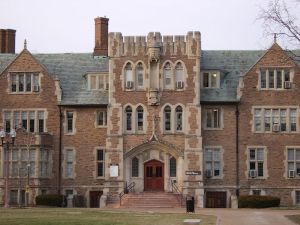
Wash U Women’s Building. KWUR was in the basement.

The KWUR Prom was in May, though I think of that evening as summer, so I would have needed nothing over the dress. I wore it with a gartered corset, black fishnet stockings, and Johnson motorcycle boots styled like paratroopers boots, leather soles slick from walking, and good for dancing. By May of the year I met Patrick, he’d broken up with Roslyn. We started making art together on a dare, and in our rambles collecting window screens, broken chairs, old medicine cabinets and other detritus, we grew closer, stopped being adversarial and became friends, and then lovers, until we were not. I wonder about Roslyn sometimes, and what became of her; I know where Patrick is, though we have not spoken since 1991. I broke his heart, for a time, after he broke mine, and now he lives where I began.

Frivolous Friday Returns: Dressed Intentions

Every morning, I sit at the table in the main room of our townhouse in the dark with my SAD light. To my right, I watch the sun rise over the fence, and every morning the orange-blue-pink-purple morning sky delights me. This hasn’t been the easiest year, but it has been bittersweet, cold and warm, like a winter sunrise. Lady Cat’s death was dreadful, and the last memory I have is ugly but goading. She fought so hard to stay alive, every single moment; remembering that, I am ashamed any time I verge towards the hopeless, and try instead to reach for the light.

So, despite the creeping feeling of hopelessness that lurks around the edges of something I want very much, I thought I would carry on with a partial fulfillment of desire. Three weeks ago, I more-or-less asked Drunk Tailor to marry me.*  This was exciting, and pleasing, and generally felt like a good thing to finally express. The hopelessness creeps in because, after an unhappy afternoon and evening of calculations, the truth is we can not afford to marry until I land a job with health insurance benefits.** However, that doesn’t mean we can’t have a party of some kind at some date-and-place-to-be-named.

The sunrises make me think of fabrics and dresses, colors and textures. What began as an idea for a wedding dress has morphed into a party dress, which was easy enough because I never intended a “traditional” dress— unless we are talking about being in an enormous pile of Turkish Angora kittens, white floof isn’t for me.*** The sunrise colors appealed to me, and I ordered swatches from Silk Baron, planning on a dress-and-jacket combination.

I played with combinations for a while before settling on two groups. I’ve narrowed those down, I think, to cordovan silk velvet with winter sage taffeta. Cross your fingers there’ll be enough in stock when I can afford to order the fabrics! In the meantime, any Vogue pattern called “Average” is likely to create excitement in fitting and sewing– plus, a zipper! I haven’t set a zipper in years, so this project should have all the funs.

One way I thought I could cheer myself up and make the best of this intractable situation was to make this a blog-able, documented project. It’s outside my usual time zone but within my style preferences — you say bolero, I say Spencer– so why not make it a project I have to do? Pretty clothes can be a way to get joy out of disappointment, so from muslin to finished garment, let’s do this thing.****

*More-or-less because in the written proposal I made, I recognized that marriage might be a financial impossibility.

**This revelation capped a pretty awful seven day stretch that began with one day of excellent news, followed by multiple job rejections, frightening health insurance premium calculations, and the now-quarterly revelation that my workplace cannot afford to pay me for the hours I’ve already worked this month (and possibly not through the end of the year).

*** The best nap I ever had was in the back of a Subaru Outback, on a stack of bayonets. I dreamt I was in a pile of kittens. It was a warm spring afternoon (kittens) but I was getting poked by sharp things (bayonets, also, kittens).

**** Pending supplies. $212.50 for fabric is right out of my budget scheme at the moment– that’s a lot of chickens, cat chow, or half a health insurance premium, depending on the metric you prefer.

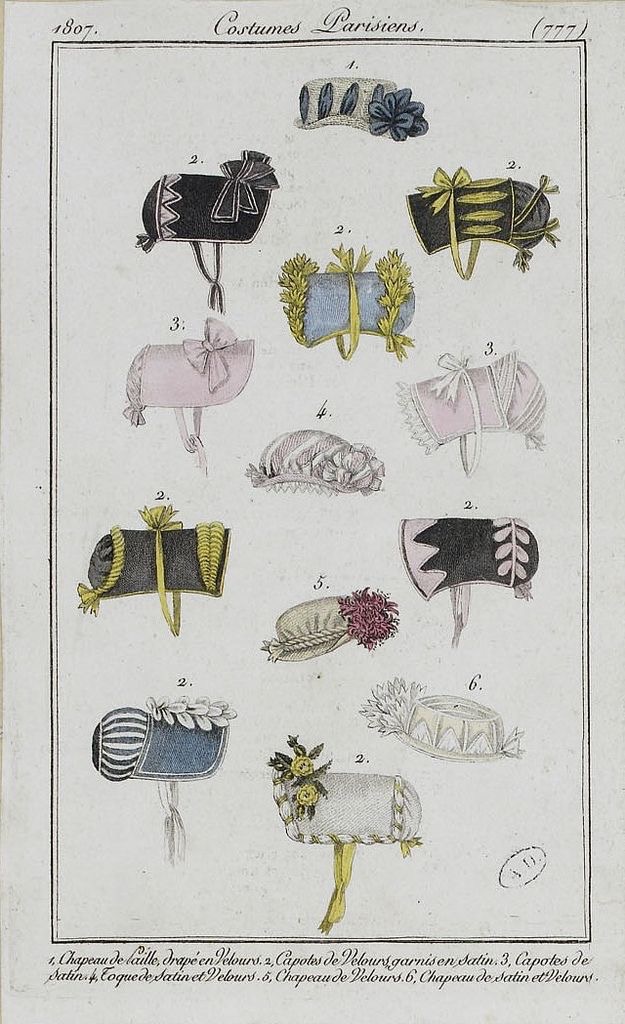
Capote de Velour garnis en satin

Costumes Parisiens, 1807

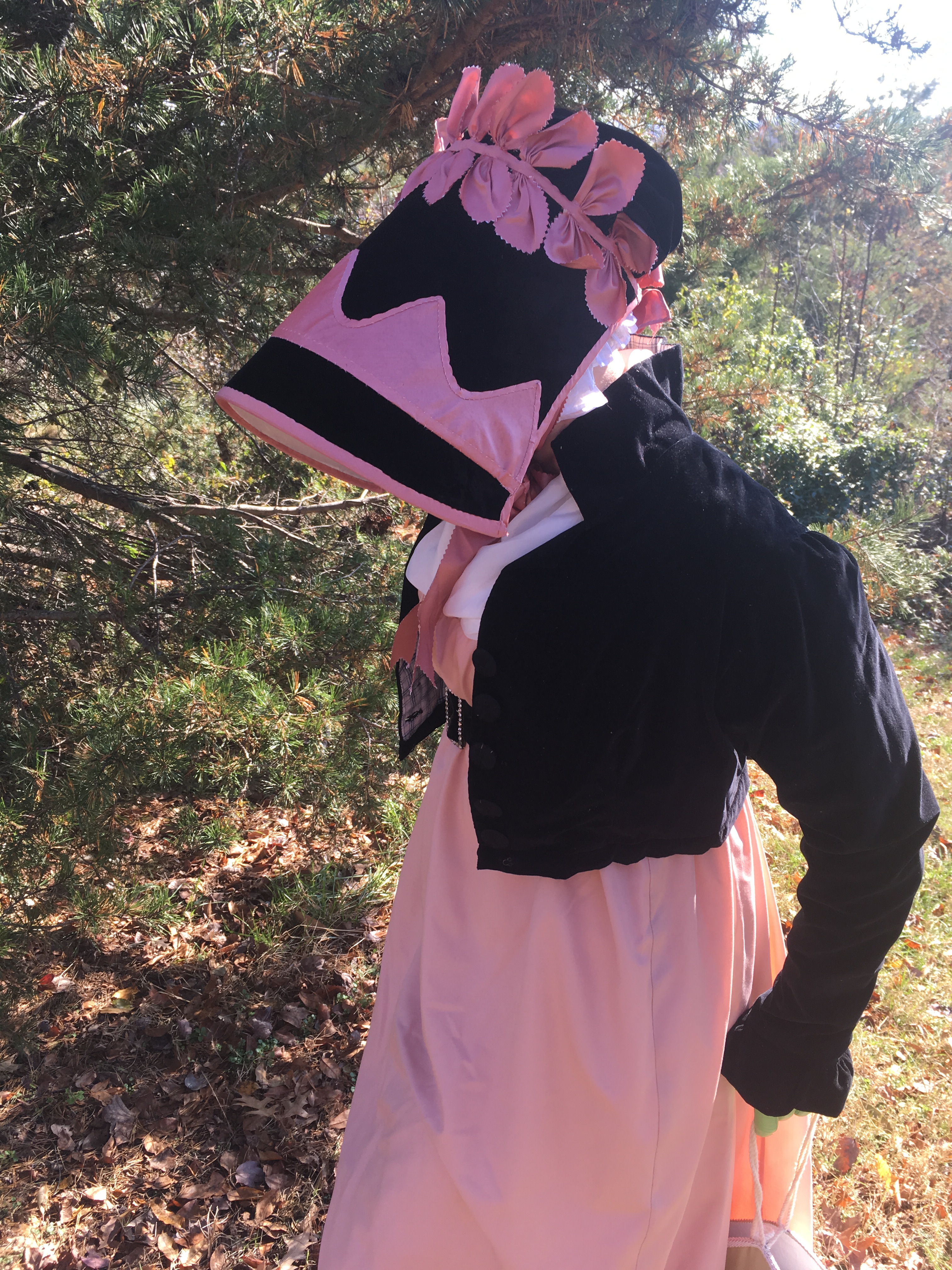
This plate has stuck with me for years: those mailbox shapes, in velour! In 1807, velour was not what we think of today (and I don’t mean Zapp Branigan). Valerie Cumming’s Dictionary of Fashion defines velour as “Wool or wool mixture cloth, soft and smooth with a closely-cut pile or nap resembling velvet.” Not having access to wool velour in the scrap bins at work, or in the fashion aisles at the local fabric store, I opted for velvet; the scrap bin provided pink silk taffeta, which I thought made a nice contrast to the texture and finish of the velvet. It is true that “velure” dates to the 17th century, and describes imitation velvet. The wool velour I’m familiar with from upholstery is too dense and heavy to drape well over a bonnet (it’s really made for sofas and armchairs), so erring on the hand of the fabric seemed a reasonable choice. Wool velour with silk satin would be an amazing textural contrast, but with this color combination, almost any fabrics will give a pleasant optical shock.

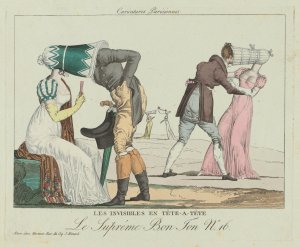
French 19th Century, Les Invisibles en tête-à-tête (Tête-à-Tête with Poke Bonnets), c. 1805, etching with publisher’s hand coloring in watercolor on pale green laid paper, Katharine Shepard Fund 2015.49.4

Shaping the brim was an exercise in paper and pasteboard, winging it a bit until I achieved a length and width that was mailbox-like but not too drainage tunnel. The cartoons of the period make clear that these are deep brimmed bonnets. I do like that the bonnet on the left is trimmed so like the ones in the fashion plate; the one at right is probably corded or reeded, judging by the ridges.

The trickiest bit was shaping the silk to the compound curve of the brim. Three patternings got me there– until I realized the silk needed body to hold up to binding, and took a short cut. Ask not of the sin of fusible interfacing, for I have learned my lesson. Yes, the silk piece shrank and no longer curved evenly from the front edge. Thank goodness Drunk Tailor was watching The Pacific, so any foul language I may have used was disguised by movie dialogue. The binding is bias-cut silk, easy enough. After the debacle of the Vandyke trim, I opted not to cut and bind the leaf shapes, but rather to cut the ovals with pinking shears and attach them along a silk band. Would I do it differently another time? Possibly, if only because I like to imagine the different ways an American milliner might interpret a French fashion plate.

Once I settled on making the bonnet, I decided it was time to finish a pink wool petticoat I started in 2015 after a trip to Mood. It’s a tropical weight Australian wool, according to its selvedge, and has a high-waisted bodice with a drawstring closure. I covered the bottom drawstring (and added some bling) with a black velvet belt closed with a period paste buckle. (Every now and then someone doesn’t know what they’ve got, and lets it go for a price I can afford.) On top, the gathered back cotton velveteen canezou/Spencer made for my first trip to Genesee. Having a wardrobe extensive enough to mix-and-match almost the way I do from my modern closet is pretty satisfying, if a little crowded.

This isn’t a bonnet for wearing while crossing a busy street, though it will successfully shelter the wearer and a cat from any sudden downpours, and one is unlikely to get sunburned wearing this. I didn’t find it distracting to wear– but I didn’t go far, and I had a companion. But what price fashion?

I Want [peppermint] Candy

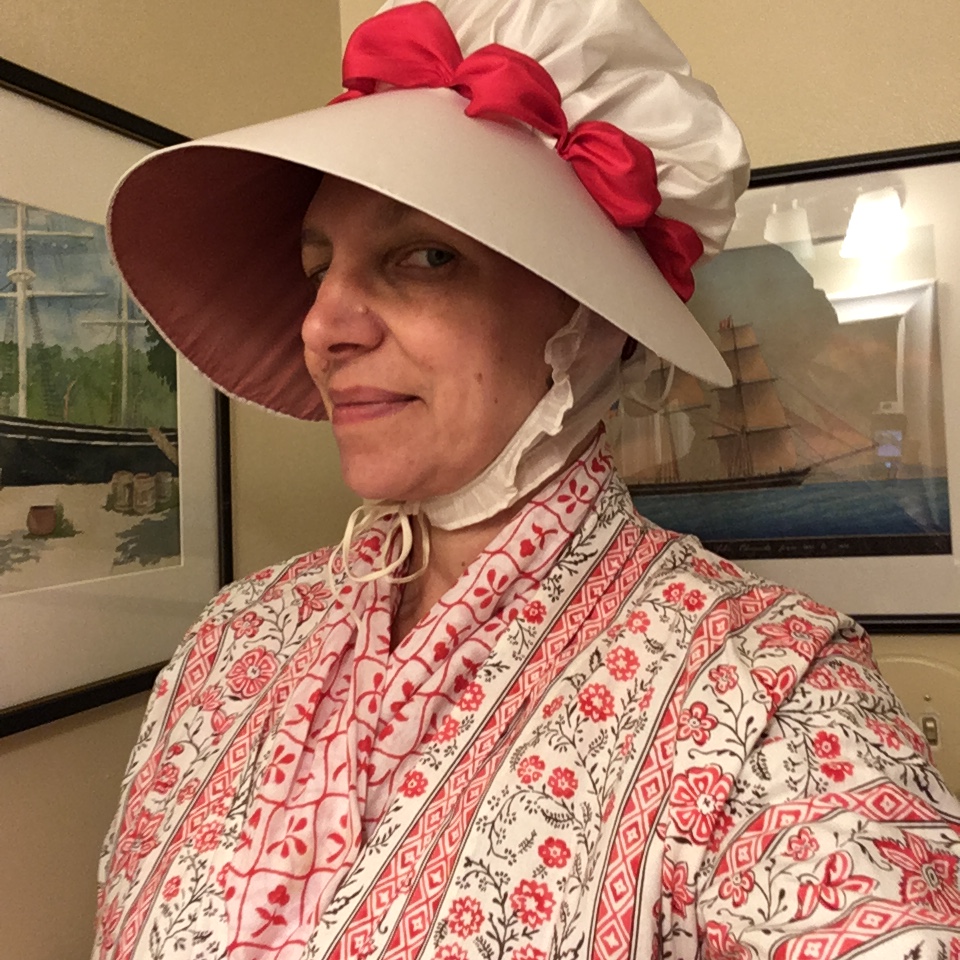
A friend regularly sends me bonnet descriptions from the inventories she’s researching; one description was of a white silk bonnet with a red cherry silk lining from Rowan County, N.C. in the 1770s. Hot stuff, right? Less hot if you made it in white linen, but even North Carolina has winter sometimes. I made two, of course, in sightly different shapes.

Bonnet Number One

Strawberry shortcake? Whipped cream and cherries? You tell me, but I always maintain that bonnets are the cupcakes of costuming: pretty, fluffy, low-calorie and quick to make. 

Once she’d sent me the description, I got hung up on finally finishing my wrapping gown. 

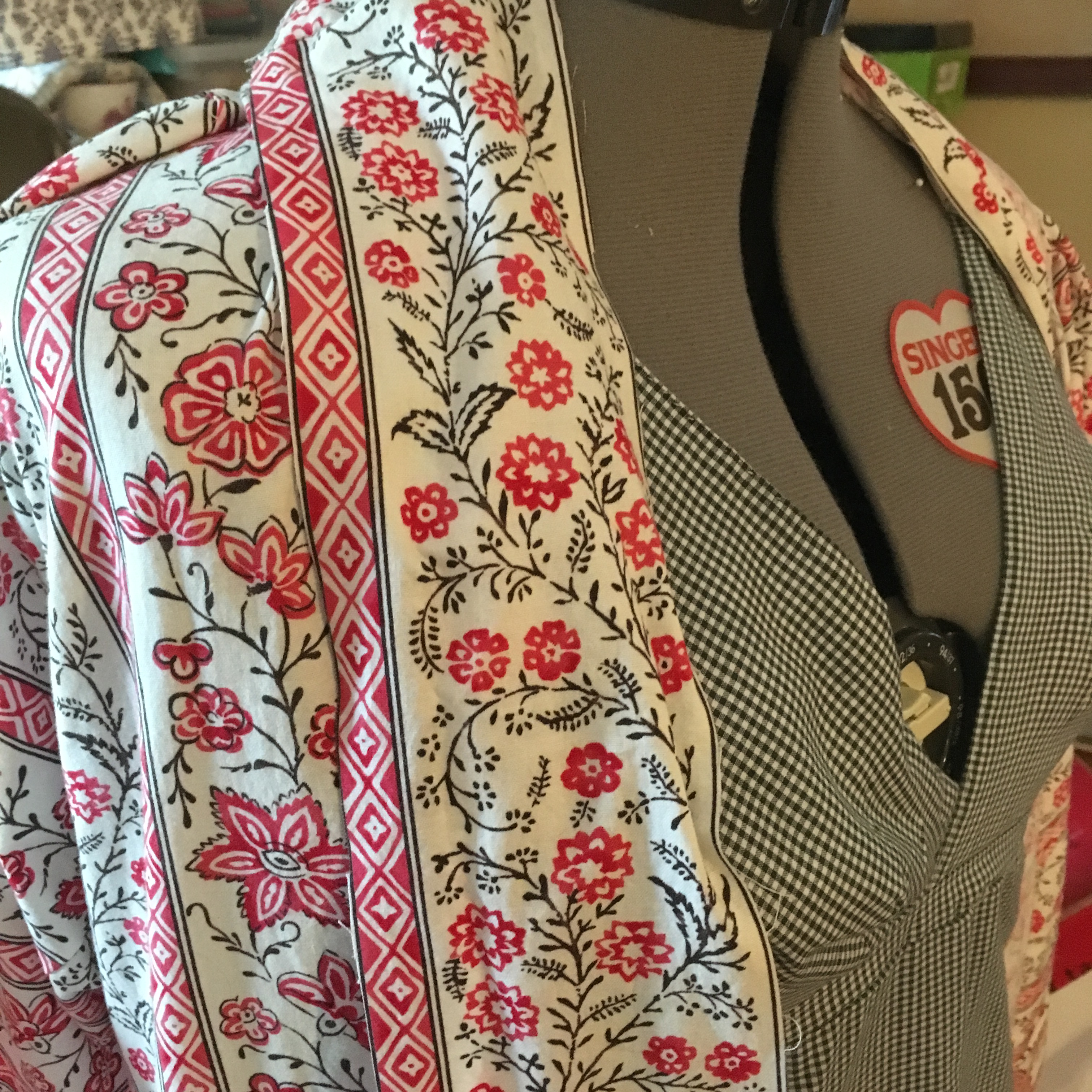
There are enough events where I sleep over that a wrapper for the morning is a useful thing. My characters don’t rate the silk of the one I made for Potts Grove Manor, but I used the same pattern with a reproduction cotton print from Burnley & Trowbridge. I love it– but I do feel a bit like a candy cane. 

Bonnet Number Two, Lampshade Style

Because I’ve seen so many instances of sun shade bonnet (herein known as “lampshade,” making one up in that form seemed like a good idea– and the crowning glory to the red and white striped wrapper. 

Now I really need a cherry red silk quilted petticoat to wear with this ensemble. Some other autumn, when I have more space and time perhaps.