You know the fabulous 1797 wedding gown from the Danish Museum? It turns up on blogs as the Tidens Toj gown. Many of the links to the pattern and the gown are broken now, but fear not, it only moved. Wouldn’t know anything about museum website links changing…
The Fashion History- Future Clothing exhibit is still up, and many of the garments have PDF patterns. There is a pretty post-RevWar era “English Dress,” which also has a pattern. The translation that Google provides is a trifle (no, actually, quite) hilarious. Don’t trust it…you’ll end up with sweaters and wrinkles instead of Brunswicks and pleats.
Practice: that’s the key. That’s the only key. Just keep stitching…and eventually, the stitches will get smaller and you will get faster.
I spent the week transforming last Monday’s stack of pieces into overalls. This sewing business is amazing! Flat pieces turn into something wearable, and it’s all made out of string in various arrangements. (I may need to get out more…)
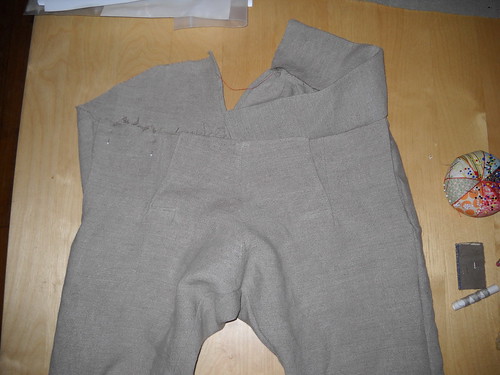
The pattern from Henry Cooke goes together very nicely. The pockets are a nice element, and their installation is simpler (I’d call it elegant) than other breeches or trouser pockets I’ve made thus far (this is pair six of breeches/overalls/trousers, pattern four).
That sounds like a lot, doesn’t it? Here’s the spool of thread I bought 18 months ago on the left, and the new one on the right. Along the way, I’ve also used up several spools of colored linen thread, a couple of silk and a few of cotton. The new spool is 1150 feet of linen thread, which seems like a lot to start with. It goes fast, though. The used-up spools were smaller, but when you aim for 10-12 spi, that’s a lot of stitches. Best not to count.
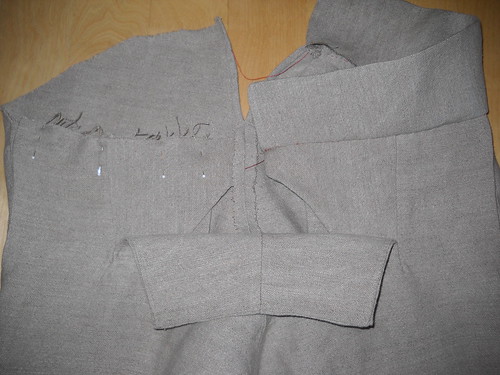
With the fall dropped, you can see the bearer/waistband connection
Very cleverly done, this pocket-bearer-waistband arrangement. My sewing has improved, and luckily for me, these are heavy plain weave linen (acting as osnaburg, here) rather than heavy drill. Heavy drill kills my hands, but this has been pretty pleasant to stitch thus far. Who’s to say what fresh hell the buttonholes will bring–but that’s another week away, at least.
And then it will start all over again on pair number two…but not before I’ve altered the frock coat and possibly breeches, made a jacket and a hunting shirt, and, I hope, a gown. Six weeks to go!
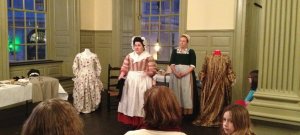
There were excellent questions from children (I loved, “What would you wear for pajamas?”) and adults, including:
If you were not a wealthy woman, or you were an enslaved woman, what did you wear on laundry day?
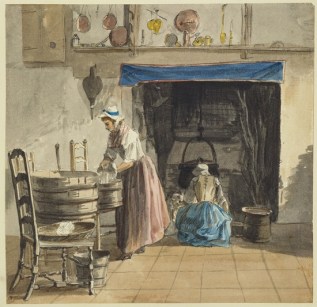
At Sandpit Gate, Paul Sandby, 1765. RCIN 914329
The image that sprang into my mind was Paul Sandby’s women at Sandpit Gate, doing laundry work. They’re wearing their shifts, stays, petticoats, neck handkerchiefs, caps and shoes. (I particularly like the woman working at the tub; you can see the angle of her stays diverging from her spine as she bends forward; it’s a fine little detail and very accurate.)
So women wore one of their shifts, their stays, petticoat(s), stockings and shoes.
And that brings us to the question, How many shifts did they have?
Several months ago I had the luxury of doing some research in the manuscript collections at work, and found MSS 957, the Stafford Family Papers. In those papers there is an undated estate inventory, thought to be from ca. 1780-1799. It’s extensive, and while I have a hand-writen transcription of the whole, I’ll quote the most relevant entry:
5 shifts [illegible]
Yes, five shifts. A woman who owned five slaves had five shifts. They were not for her slaves (though that leads to yet another set of questions about people who were property owning property…and where might that be enumerated?). And if she was laid out in a shift, or wearing one when she died, was it counted, too?
With five shifts, this unidentified woman could have worn each for two days and managed a washing every week–or rather, managed for another day or two or three while her slave women washed, dryed, and ironed her clothing.
In The Dress of the People, Styles points out in Chapter 2 that the largest differences between what the rich and poor wore lay in “numbers, quality and value,” (p. 31) and tables in the back lay out the different number of shifts lost by different women in a fire on an afternoon in May, 1789, in Brandon, Suffolk, England. A blacksmith’s wife lost six shifts, the mantua maker lost one. We can’t know if that emphatically means the mantua maker had but two shifts, or if she saved more than the blacksmith’s wife; one servant lost seven shifts! What we can tell is that women had more than one shift.
We can’t take one undated inventory as typical of 18th century clothing inventories in Rhode Island, (more research lies ahead of me) but counting shifts would be an interesting exercise. Based on my own experience, I can verify that one wants more than one shift. I think it likely that inventories will turn up multiple shifts for women, and shirts for men, no matter where we look, and that this will probably hold true even for slaves. Styles reminds us that the differences are not just numbers, but quality and value.
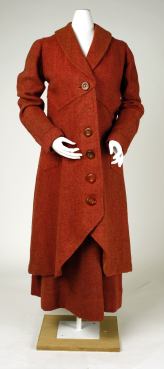
Yes, I am as shallow as stereotypes might suggest: I see shoes, I often want shoes. Even my current co-workers know about the red leather Cuban-heeledAdrienne Vittadini pumps I passed up when they were on post-Christmas sale at Marshall Field’s way back in the Dark Ages. They would have gone nicely with this red wool suit from the Met.
There’s a Steam Railway in Essex, CT and when we went on Staff Day, we were told the train car was from 1914, an excellent year for fashion–at least before that August. It seemed like a great plan: make 1914 clothes and ride the train again next fall, possibly carrying vintage luggage or a basket with a delicious picnic. Really, who’s in? Let’s book it!
The World War I era has fascinated me for a long time, from Vera Brittain to Siegfried Sassoon, from Wobblies (perhaps because I grew up in Chicago) to war memorials, so the Steam Train Outing in Period Dress was particularly tempting, and I started a board for early 20th century costume. Downton Abbey fans will enjoy it, too, and while I tired of Swedish murders and finally caved to Downton’s charms, my film choice for the period is Testament of Youth.
Libby Hall Dog Photo from flickr
When I saw the American Duchess pre-order for Gibson shoes, I was sorely tempted. (They’re quite similar to what the lady on the right is wearing.) Fortunately, I am saved by my pedal extremities, for which my size is not yet available.
But what really holds me back is the thought of sewing the corset. It’s like the hip surgery I don’t want to have: I know how painful it is, and how inescapable. There is no way to properly dress in the past unless you do it from the skin out. But shoes–and those fantastic Edwardian hats–might just get me to make that corset. Shallow, isn’t it?





 Kirsten Hammerstrom
You must be logged in to post a comment.