Monmouth Millinery

New hat!
New hat!

As Eloise or her Nanny might say, It is rawther warmer than I care for. Lucky for me, I have a new hat. It’s a black straw hat of a kind you might see called a bergère, along with 4 yards of silk ribbon, purchased at Burnley & Trowbridge’s tent at Monmouth. Jim and Angela and their assistants were very helpful, and this was rawther a splurge for me, as I mostly buy my ribbon from Wm Booth’s remnants, when they are available. (We are tenant farmers. Mostly.)
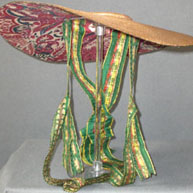
Coromandel Coast lined hat, from an auction.

But in this instance, I wanted a lady’s hat, so I pleated up about two yards of green silk ribbon, and added a bow. To get the multi-vector bending effect, I stitched millinery wire from Abraham’s Lady around the brim. The inside of the brim is lined with pieced scraps of the purple “Fleurs d’Inde” I used for a jacket (also made from a Wm Booth remnant). It ties on with yet another yard or more of ribbon. This is really a frivolous hat, for me. There are extant examples of straw hats lined with chintz, as you can see.

As luck would have it, I got to wear it right off, the very day I made it. How often do you get the chance to do without panic and pain? We attended the Saturday version of the Rochambeau Tea on Joy Homestead, an event which has its dedicated fans.
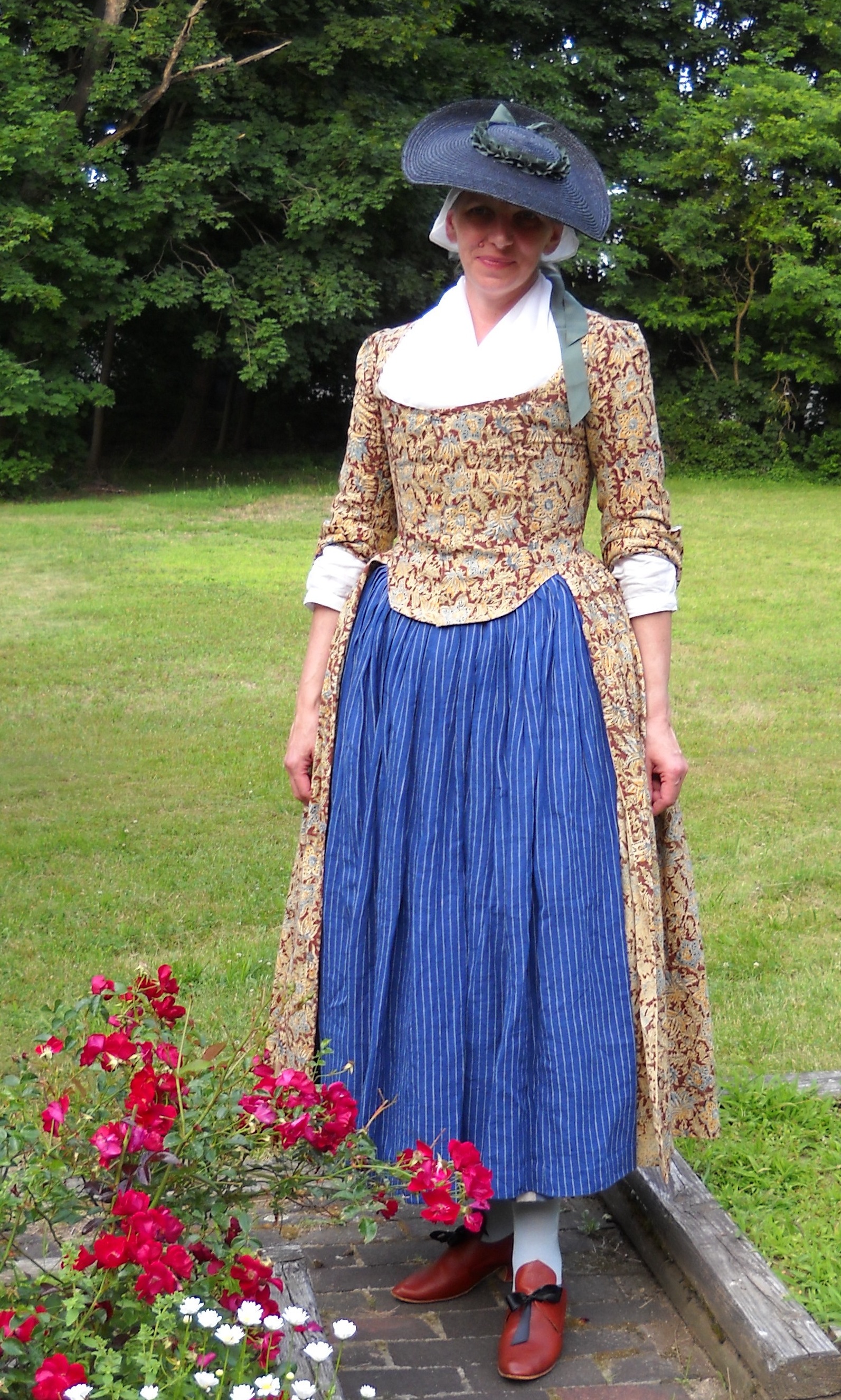
First hat outing
First hat outing

I wore this same gown last year, and to Nathan Hale; to my delight, I am enjoying it more each time I wear it. I think this petticoat is the right one; madder was too close and black too contrasty. Since the Rochambeau Tea “year” is 1780, this dress passes (ahem) muster; for many of the events I attend, it is too fashion forward.

London Cries: the Fishmonger. Paul Sandby ca. 1759. YCBA B1975.3.210

This hat will, I think, also work for the 1763 event, as the woman in yellow here is wearing a similarly dual-plane twist hat. I’ll never have a yellow gown though: I look pretty horrid in yellow.
To Wash or Not to Wash

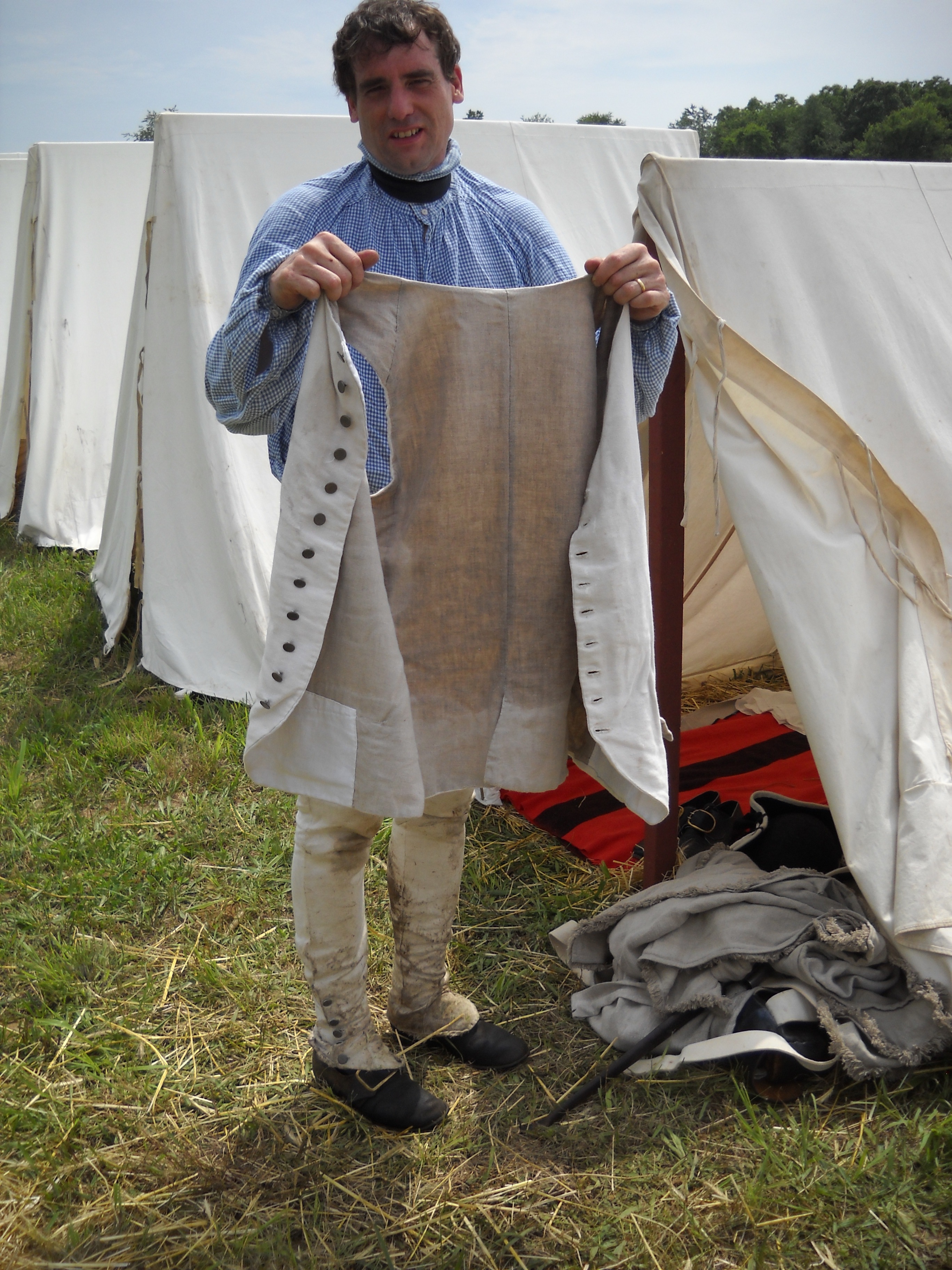
Mr S and his waistcoat at Monmouth

Sometimes I can almost hear, “Good God woman, what are you thinking?!” but so far I have only seen it in a man’s eyes. This is usually in regard to laundry.

I erred once in asking if one wanted his hunting shirt laundered, and I had planned only on cold water and hand washing, as the item seemed a bit crunchy and crumpled to my eye and hand. But, no, some other woman had washed that shirt some time ago, and it had taken considerable time—years—to reestablish fringe from fluff.

Well patinated now, formerly embarrassingly white.

Now, I give you Mr S’s waistcoat and overalls. Mr S’s waistcoat was completed on the New Jersey Turnpike in November 2011 while headed to Fort Lee. Since then, it has a acquired a smattering of powder specks, a patina of grunge, a stain or two of greasy beaver (curry, actually) and, most recently, spots of toothpaste. This is where I draw the line: the toothpaste spots must go, as they are inauthentic.

Shirts, shifts, stockings, aprons, and waistcoat

One doesn’t want one’s clothes too clean for reenactments or living history events: you’re “living” in the pre-detergent era, but that doesn’t mean you should never wash your clothes. We know that the armies employed women to wash clothing, and we know that linens–shirts, shifts, and drawers–were washed more frequently than outerwear like breeches, waistcoats, and gowns. It’s not so different from today, when we don’t clean business suits as often as we launder shirts or underwear. Still, we do clean our clothes, and there comes a point when those overalls will get washed. Right about when you figure you need gloves to handle them…

5 Days till Monmouth

This is not Cassandra's idea of a nice frock.
This is not Cassandra’s idea of a nice frock.

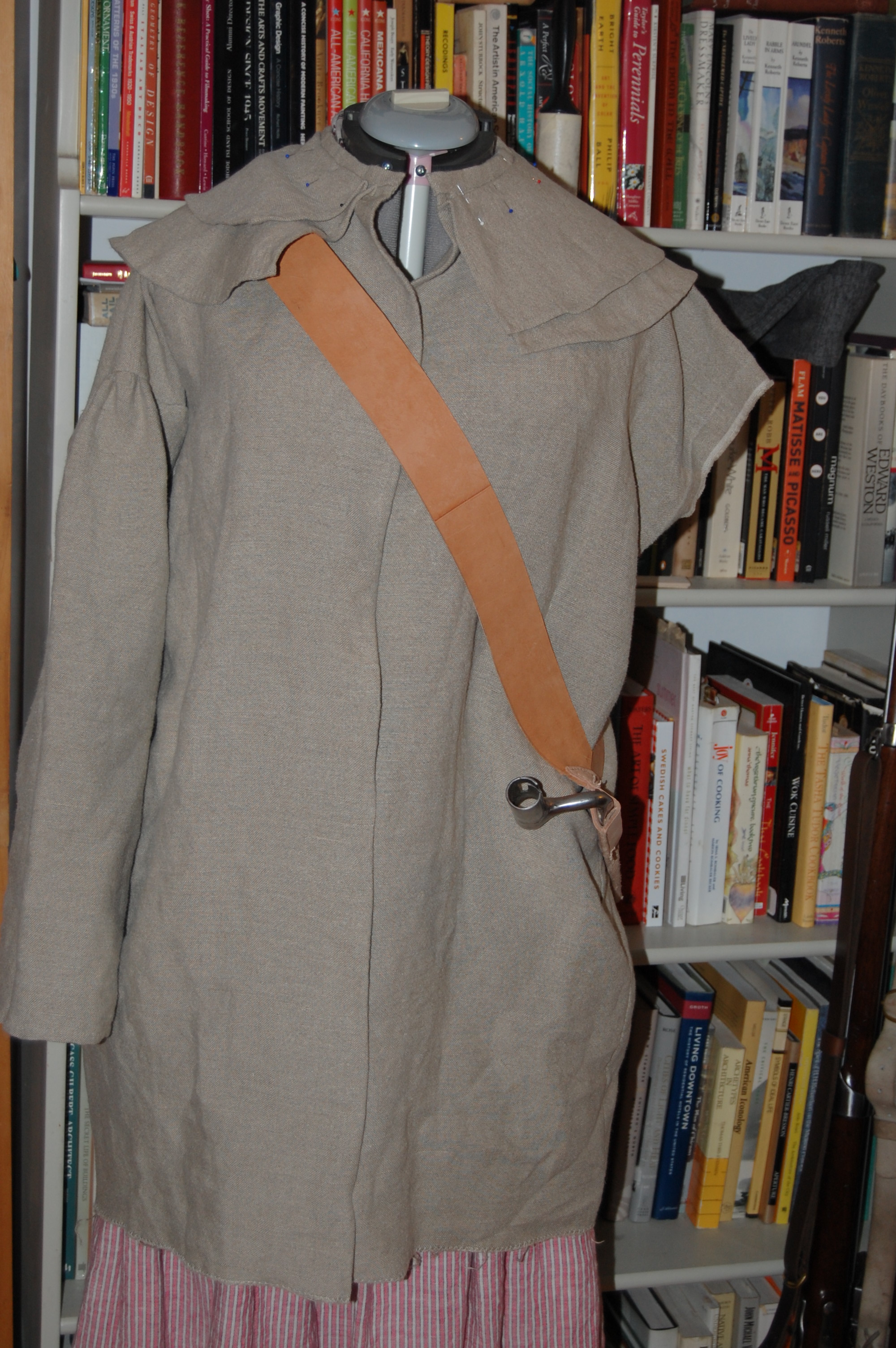
Cassandra doesn’t like wearing uniforms and bayonets. She wants to wear a dress. She will have to be patient. (Actually, she is wearing a chintz jacket in need of a hem, and if I revolt against buttonholes, I might finish that tonight. More fringe must be made this evening for the hunting frock.)

I switched to Mr S’s overalls for awhile, and we’ve done the first fitting, which gets us to buttonholes and then re-basting the inseam and outseam. In the process, I discovered that he does, in fact, have a twisty leg. I do not think it is statistically probable that the two pairs of overalls I have cut for him and the pair cut by Mr Cooke would all include the same slightly on the bias leg. So I reversed my plans to get those done, and will stick with getting them to fitting number two. They will need a master’s hand and eye for fitting.

Sunday: One last strip o' fringe required.
Sunday: One last strip o’ fringe required.

But I think I have a plan for food for Monmouth, have confessed to Mr S that, based on the Monmouth sutler list, we must leave room in the car for possible additions to the Strategic Fabric Reserve, and have convinced the child to try learning a new song on the drum. I also started a new pocket, but I’m not sure if my hands can take the backstitching. Slipstitching and whipstitching aren’t too painful, but backstitching proved quite painful last night. It’s totally annoying, because it’s pointless to post a photo until it’s done and right-side out!

You can see the binding, but not the stripes. Silly!

But this will be a panicky, intense week of samplers, reference, grant applications, and event prep. I suppose that’s not too different from many other weeks…though the last time I had this combination, we were only going to Sturbridge. I took comfort in the idea of how close we were to home, the way the cat knows how long it takes to dash to the basement when the doorbell rings. From Monmouth, it’s a long way back to my own basement.

[Another] Wild & Crazy Idea

Fashions, 1841. Fashion Plate Collection, Ella Strong Denison Library, Claremont College

Perhaps the Young Mr is correct: I may be crazy.

I have agreed to, at the very least, explore a project and grant funding to recreate an April 17 1841 Suffrage Parade for my workplace. We still have to decide to what lengths we’ll go, but the idea is so appealing that I want to give it a shot. (Orator positions opening soon?)

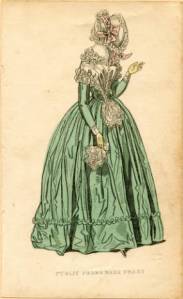
Public promenade dress, 1842. Claremont College
Public promenade dress, 1842. Fashion Plate Collection, Ella Strong Denison Library, Claremont College

Why is this crazy? Another year-specific event, with the event part to organize, plus wardrobe for at least some people? Pure madness, utter delight. Blame it on the Godey’s Lady’s Magazine paper dolls I bought at the Chicago Historical Society all those years ago. It could even mean another corset, and we all know how much I love making corsets. But I was thinking about how at my age in 1841 I’d be accustomed to an earlier style…but the key, as always, is looking. And looking tells me I need more of a waist than I can perhaps achieve with the stays I have in hand.

To my Pinterest board (thanks for so many wonderful leads, Cassidy) mix of extant garments and accessories, I’ve been pinning from fashion plate collections, including the well-cataloged collection at Claremont College Library.

Fashion plates are one of the sources you have to be careful with. Like Vogue, in fact exactly like Vogue, these are high-style images that are as mannered in their rendering as fashion images are today. Waists will be slimmer and skirts rounder, but the silhouette and shapes will be recognizable in extant garments, painted portraits, and thankfully, photography.

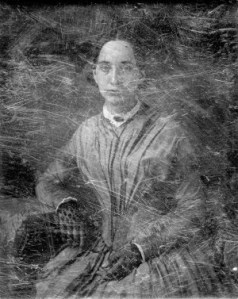
Mrs. Thomas Easterly. Daguerreotype by Thomas M. Easterly. Missouri Historical Society, PHO:17434

The year of the Suffrage March, 1841, is early for photography but not impossible (thank you, M. Daguerre). It’s not the right state, but there is a fantastic collection of images in Missouri. These portraits give a good sense of what people were actually wearing, and what shape their bodies took inside their stays and corsets. (Hot tip: don’t clear daguerreotypes with Scotch-brite pads.)

This is, really, a mad scheme that goes far beyond dress. But a banner painted with an ox and the slogan “I die for Liberty” carried by butchers? A wagonload of disenfranchised Revolutionary War veterans? Enlisting students (not in costume) to follow along behind costumed interpreters marching the known route of the 1841 parade? It’s too tempting not to try.

Bonus: Patterns and plaid!