Saturday to Saturday

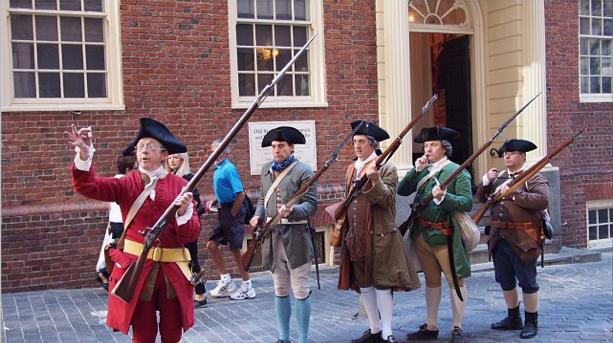
Demonstration at the Old State House

That’s last Saturday, outside the Old State House, for the “People of 1763” event. Sew 18th Century and I provided a material culture/ladies’ clothing presentation in the Hands on History room. The guys drilled outside, had their photos taken, and represented the militia. The Bostonian Society had over 1200 people in the museum last Saturday, which is a pretty respectable number for a small place. It can also leave you feeling somewhat overrun. (All my photos turned out fuzzy: all I had was a shaky hand and my phone. Chalk it up to needing more sleep.)
Gossip!
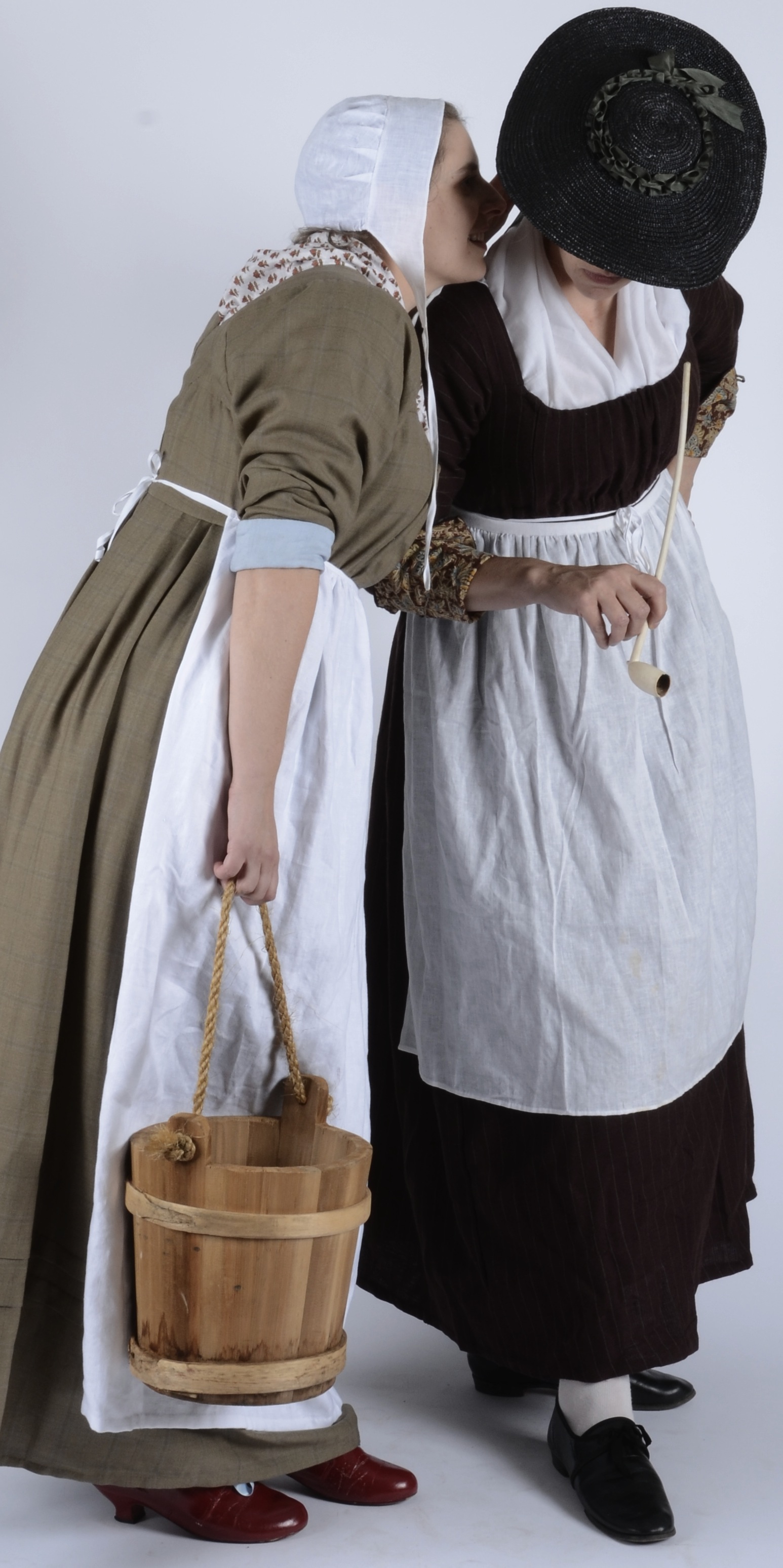
Gossip!

This coming Saturday is What Cheer Day at the John Brown House Museum, and my sewing and research and house prep continues, if not apace, at a steady pace. Mannequins have been put away, furniture moved, and the accents practiced. By the time we were trying to say, “These are not the droids you’re looking for” with 18th century Maine vowels, we knew it was time to go home. Why this and not “I’ll put the kettle on to boil,” I do not know.

It’s still hard for me to get a handle on my character, and not so much her background as her attitude. I’m not very good at being servile or lady-like, which is why, if I’m still working for the Browns, I must be a relative of some kind.

My husband’s dead; he died in 1788, not long after the Browns moved into their new house; wounded in the Revolution, he never quite recovered and despite the best ministrations of Dr Bowen, Mr S succumbed at last. My son, now 18, was born not long after Mr S returned from the war (Mr S enlisted ‘for 3 years or the war’). Curiously, the chaplain of his regiment is also the pastor at the Congregational church in Providence.

I am a nearly non-observant Anglican, but I recognize Reverend Hitchcock, and know the work he has done in support of free public education. Mr Brown and his brother disagree on many things, but they have at least agreed upon the importance of free public education. My son and I can read, but if Tom had been better educated, perhaps he would not have gone away to sea.

Next I have to think about my cousin from Newport, and the Brown women, and what I think about them.

And there’s still the small matter of sewing two hems, three buttons and three button loops and hoping the whole business will fit properly. At least my friend finished my cap for me. I get just so far, and then I hate caps.
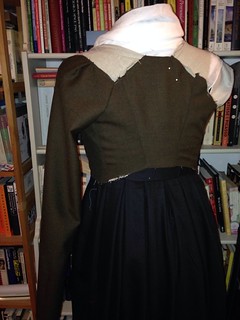
Always the Lady’s Maid, Never the Lady…

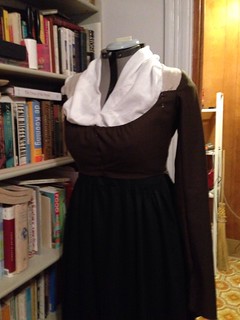
Testing the bodice and sleeve

but that’s fine, actually. I like to get dirty. The red Virginia cloth dress is now clay-splashed, and while it was made especially for the “People of 1763” event, it may no longer work. Fine for cherry-sellers, fine for hand-bill hawkers, it will not do for a lady’s maid, and I don’t especially want to clean it. Hope I can get my stays wrangled back into shape and that my cross-barred gown fits…but if not, I’ll be a recently promoted lady’s maid.

From the back.

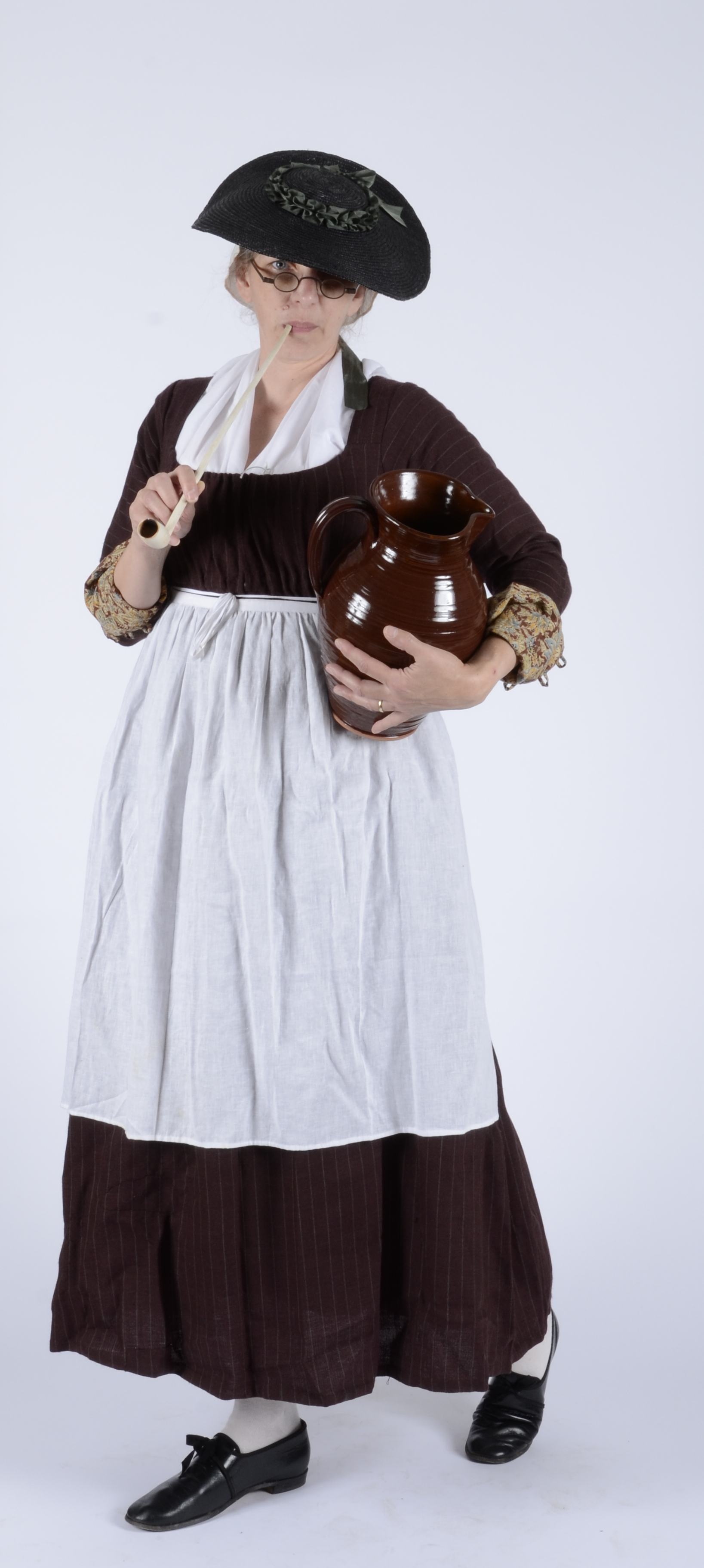
My other upcoming role as a maid will be at the John Brown House Museum, on October 5. This has required quite a bit of thinking and stewing about appropriate clothing and realistic background. I finally settled on a black-and-brown combination of petticoat and open robe, with the style of the open robe based on Paul Sandby drawings and extant garments, but determined by the scant three and a quarter yards of brown worsted that I was able to find.

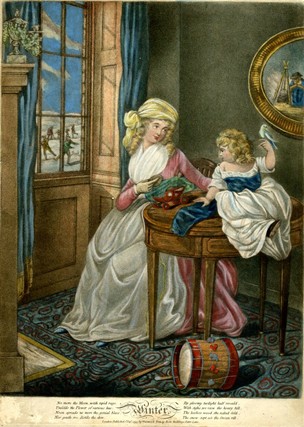
Winter, 1795. The British Museum, 2010,7081.509

The bodice back is based on the 1795-97 cross-front gown from Museum of Costume in Bath shown in The Cut of Women’s Clothes. The front is meant to be transitional: a little bit of gathering at the neck, but not a great deal, with the edges still pinning closed. The sleeves are long and slim, and will button at the wrist once I’ve gotten the length worked out.

The skirt will pleat, with fullness centered on the back triangle and decreasing to the front. For the black petticoat, I used the double inverted box pleat of the 1790s open robe in Costume in Detail. As you might imagine or just plain hope, they work! I’ve also made a small pad to help lift the skirt in the back and create the right profile; I’m thinking of adding buttons and loops so that it can migrate from gown to gown.

What (Cheer) to Wear?

JBs HousekeeperIt’s 1800. Do you know what your housekeeper is doing? I don’t. Or, more accurately, I can’t decide.
I’m hung up on stays, and not wanting to make another pair. I’m indecisive about style, and though Mrs Garnett has her charms, it’s her bonnet I love more than anything.

Here’s what I’ve found, in servant-land:
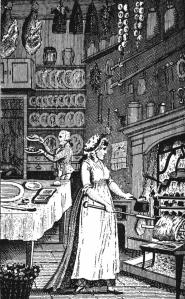
18th-century-kitchen-servants-prepare-a-meal-jane-austen-cookbook-cover-page

Note that this woman is, in the kitchen, wearing an open robe and quilted petticoat.The style of her bodice–which looks  like a cross-over bodice–and the train of the robe suggest the 1790s. Score one for style.

That open robe, where have I seen that before? Why, yes, Mr Sandby showed us that style for a nurserymaid. (It’s interesting, too, that both images show women with their hair quite visible under their caps, and not pulled up and out of sight.)
20130109-061710.jpg

Why does “robe stye” matter? Because I only found 3 and a quarter yards of a brown fabric I like, and even with the most careful cutting, that’s unlikely to make a full gown. However, I have some lightweight black wool that will make a decent petticoat. The bodice style is a bit of a stumper, though: the wool has good drape, so it might work for something other than the usual bodice I make. I did consider whether a very smooth, edge-to-edge, front-closing style of the 1780s would be more appropriate, but I think that I can move the bodice style forward, style-wise, and be correct.

138263

Brown gowns are a fine tradition in the sartorial habits of questionable servants. This young housemaid twirls her mop dry while wearing a brown gown over what could be a dark blue or a black quilted petticoat. The red “bandannoe” is a nice touch, though I don’t think I’ll wear one myself for this event.

In all this there is a compromise: using fabric I like, in a style I know I can make and document, perhaps even without having to make new stays. That would be ideal, because although it’s four weeks to the event, I’ll lose a week of sewing time to other commitments. Three weeks to pattern and hand sew a petticoat, gown, apron and cap seems just manageable.