About that Spencer…

It's better on a human than on a hanger.
It’s better on a human than on a hanger.

Take my Spencer, please.

I’m close to being finished– all that remains are closures, but the sewing is done. It fits, though I haven’t yet tried it on over stays.  It looks less wretched in the mirror than it does on a hanger, I will give it that.

The wool is a yard and a quarter worsted remnant, and while it has a nice hand, it was sometimes annoying to press. It may have been the fault of the silk, though; I used a very light weight silk–even lighter than Booth’s “persians”– and that was probably a mistake.

DSC_0405
Last-minute peplum and button additions.

The Swedish Spencer closes with clasps, and while hooks and eyes are pretty common for center-closing garments (men’s and women’s) “clasps” was new to me. The double-breasted riding habit coat in Janet Arnold (from the Salisbury Museum, no photos online) closes with covered buttons. That seems reasonable for this worsted trial garment. I’m beginning to wonder if the Swedish Spencer is really finished, or if the clasps might be a later addition. Time to write a letter, I think…

Bust darts from Hell

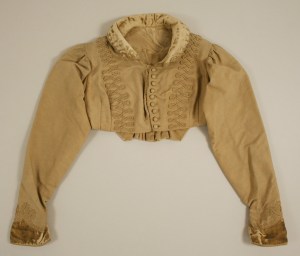
Spencer ca. 1800. MMS 1991.239.2

It all started out so well, in the muslin, but in the wool, not so much. I cut up a remnant, proving that a yard and a quarter of 60” fabric is enough for a Spencer, even for my arm length (but not less, thanks to that arm length and a respect for the grain).

The pattern I’m using has bust darts, which I haven’t sewn in years. They took some tweaking with the steam iron.

In 18th century clothing, one doesn’t see bust darts; there are some above the bust, shaping gowns at the robings, but for the most part they aren’t needed. Think cones, thanks to the stays. And later in the 18th century, a lot of work is done by gathers and drawstrings, as in the white and black  ca. 1800 French spencer at the Met.

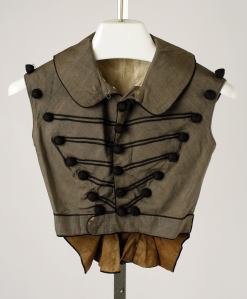
Spencer ca. 1818-1819. MMA 1982.132.3

But if you’ve got an endowment of the non-fiscal kind, and you want your military-inspired garment to fit smoothly over your endowment, what do you do?

In this example, you hide the bust dart under braid and buttons. Check out that diagonal seam—and that the fabric appears to have been cut on the bias.
Brilliant, right? Gain ease by using the stretchy quality of the bias and hide the shaping under decorative elements.

Here’s an extreme detail.

Spencer, 1813. MMA C.I.39.13.48

In the garment below, of wool, three bust darts of the same length help shape the front. And again, decorative braid hides the shaping. 

It’s only cataloged as “wool,” with no weave given. There is a detail image of the darts and braid as well; I think that might be serge, and not superfine broadcloth. Still, three bust darts help achieve a smooth fit.

The Swedish Spencer at the museum in Lund has but one grainy photo: it’s hard to imagine that it doesn’t have bust darts, but the photo leaves much to the imagination.

Projects and Deadlines

Here’s what needs to be made, or that I want to make, in the coming months.

Yes, there is a tent on that list. Madness, but what a thing to make! There are also some wool items for November, because Fort Lee tends to be cold.

Project For Due Date Event
Red wool short cloak Kitty 11/22/13 Fort Lee
White shirt, coarse Young Mr 11/22/13 Fort Lee
Blue wool gown Kitty 11/22/13 Fort Lee
Red wool cross-bar kerchief Kitty 11/22/13 Fort Lee
“Quilted” silk petticoat Kitty 11/22/13 Fort Lee
Silk Sacque & petticoat Kitty 1/15/14 Grand Ball, Stetson Hall
Pocket hoops Kitty 1/15/14 Grand Ball, Stetson Hall
Sleeve ruffles Kitty 1/15/14 Grand Ball, Stetson Hall
Fancy cap Kitty 1/15/14 Grand Ball, Stetson Hall
Wool frock coat, 1770-1780 Mr S 1/15/14 Grand Ball, Stetson Hall
Silk waistcoat, 1770-1780 Mr S 1/15/14 Grand Ball, Stetson Hall
Plush breeches, 1770-1780 Mr S 1/15/14 Grand Ball, Stetson Hall
White shirt, fine Mr S 1/15/14 Grand Ball, Stetson Hall
Breeches or trousers Young Mr 4/18/14 Battle Road*
Waistcoat (striped, sleeved?) Young Mr 4/18/14 Battle Road*
10MA Regimental (1781) Mr S 4/25/14 BAR School of Instruction
Wool waistcoat (white, welted buttonholes) Mr S 4/25/14 BAR School of Instruction
Knapsacks Mr S 4/25/14 BAR School of Instruction
Tent Young Mr 6/1/14 Monmouth*
Kettle bag(s) Camp 6/1/14 Monmouth*
10MA Regimental (1781) Young Mr 6/1/14 Monmouth*
Wool frock coat, 1790-1800 Mr S 10/24/14 What Cheer Day
Breeches or trousers, 1790-1800 Mr S 10/24/14 What Cheer Day
Green wool Spencer Kitty none None
Shirt/chemisette Kitty none None
*Presuming it happens again

Green Indeed

Regency Green: Kochan & Philips + Robert Land = Matchy-matchy.

As expected, Mr Najekci dispatched the K&C wool before the Hook, so last Thursday evening when I arrived home after Gallery Night, there was a box of delicious waiting for me. And, also as expected though mostly hoped for, the wool and shoes were super simpatico. This will be a fun project when I get myself sorted to it.

I have not yet had the time to put all the projects into a spreadsheet, but I think it would help keep things organized and on schedule. For example, I have:

  • to work out the details and rationale of the sacque, vis-a-vis date and style
  • to finalize the Spencer pattern
  • to pattern and fit a frock coat, waistcoat and breeches for Mr S ca. 1775
  • to ask about the regimental for Mr S, which will be wanted eventually
  • to face making a tent by next summer
  • a plan for kettle bags, since I’d like us to pack lighter & more authentically
  • to fix my stays situation
  • an inordinate desire for a splashy bonnet to go with that Spencer
  • two shirts to make up for Mr S and the Young Mr
  • a red short cloak, for easier movement

Once I have a schedule and a plan, making things by deadline is somewhat easier. It’s “bridge” season now, between cooling and heating, summer and winter fashion collections, and that’s as good a time as any to work out plans for the winter. There’s nothing the guys must have for an event that they haven’t got already–for Fort Lee, they can wear their short wool jackets under their 10th MA hunting frocks and be perfectly authentic and warm. (The brown and green coat is 1777, and the Fall of Fort Lee is 1776. The blue and white short-tailed regimentals are 1781. No coat for you!)

So it’s worth taking the time to regroup, even as I rush headlong into projects…and considering I have jury duty (no scissors!) this week, maybe I should add hand-knit stockings to that list.