And by TBT I mean Titano-Boa Thursday. Putting on the clot-preventing stockings is a lesson in patience, creative language use, and wriggling. Thankfully I can bend more this time around and can thus pull these suckers up– not that they really pull, it’s more that they suck and adhere to your leg and you coax them off your flesh–and get dressed in under an hour. I don’t fully understand the principle by which extremely constricting legwear prevents clots, and at this point, I don’t think I could. My best grasping right now is lunch time and a bottle of Tylenol.
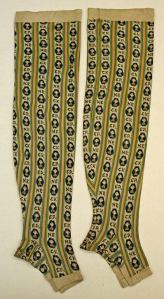
Stockings, 1788-1793. French. MMA 26.56.124
In lovelier legwear, I do have some of American Duchess’s silk stockings, and look forward to wearing those again in the nearish future. Still, you’d think the TED people could have a little fun, perhaps with replicas of these astonishing stockings? They’re toe-less, just like my TEDs.
Portrait of a seated young lady, watercolor on paper by Anna Maria von Phul, 1818. Missouri History Museum, 1953 158 0013
Ladies’ Monthly Museum, v. 5, plate 71. July 1, 1816. Casey Fashion Plate Collection, Los Angeles Public Library
Anna Maria von Phul’s delicate watercolors of Saint Louis in 1818 (example at left) remind us that cities in the hinterland of America have never been as far behind the times as coastal dwellers might imagine. As a former resident of the Great Fly Over, I know how defensive people can be about their relative sophistication, and that could be why our Young Lady here appears slightly defensive in her posture.
The young lady is certainly fashionable in that white gown, and literate, too, though we cannot see what she is reading; perhaps Maria Edgeworth.
It took some doing to find a similarly posed and dated fashion plate with a book, for fashion has always been more fantasy than reality.
The Ladies Magazine, v/ 4, plate 53, Wednesday July 1, 1812. Casey Fashion Plate Collection, LA Public Library
I don’t know which I like best: the green and white bonnet, the green silk Spencer, or the suspicious and candid glance of the woman on the left. Perhaps its the date: mere weeks before the purported milliner’s store this coming August. Have I already purchased green silk and white cotton organza? Of course I have. Never let a fashion plate or an event keep you from a new and slightly mad project to make something new.
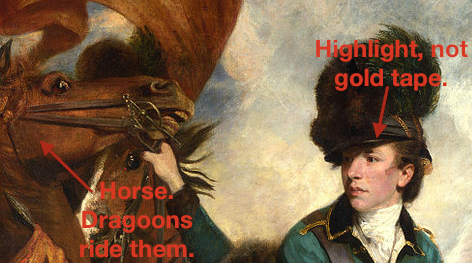
Portrait of Sir Banastre Tarleton (1754-1833) by Joshua Reynolds, 1782. National Gallery (UK) See update below!
By 9:00 on Sunday, I was asleep and missed “Turn,” which Mr S wasn’t even watching because, as he declared, “It’s just a bad show.” On Monday evening, I made it through the opening of the show and gave up for good. But those minutes made me think of the Banastre Tarleton portrait by Sir Joshua Reynolds, and the suggestion on Twitter that “Turn” had no historical consultant.
It occurred to me, as I stared at the rather curious headgear worn by Captain Tallmadge (I think it’s stretch lycra over a “Roman” gladiator costume helmet glued to a baseball cap visor and edge-taped with gold foil) that perhaps the people doing the costumes simply lacked visual literacy. This could explain the refugees from Fort Lee who looked like they stepped out of an Emma Lazarus poem, and it could explain the very unfortunate helmet.
Let us look at Banastre Tarleton, hunky bad boy of the British dragoons: he came to mind on Monday night, and what visual relief he is.
Note the light edge of the visor: this is a highlight. The leading edge of a polished surface will shine, and helmets, even of leather, will be reflective. Over time, the edges will polished by wear if not on purpose. I cannot speak to the helmet habits of the horse-mounted, but I know from paintings, and that edge is a highlight.
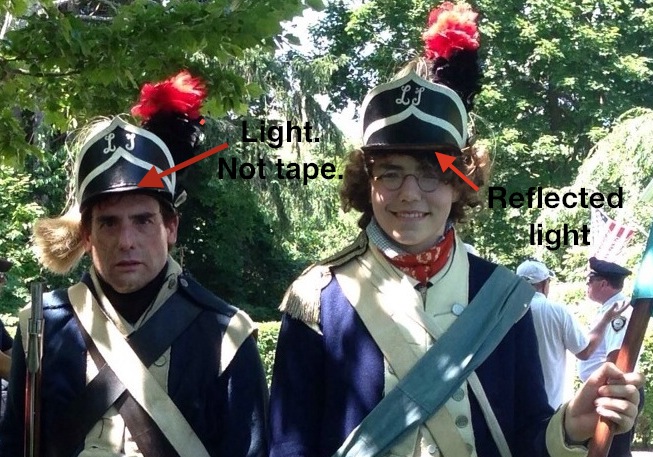
The Boys last July. Look, shiny, not-taped visor edges.
Reynolds painted what he saw, and just as the Young Mr’s cheekbones are reflecting light off the underside of his visor and Mr S’s helmet edge is shining in the direct light, so too is Colonel Tarleton’s helmet edge shining.
(Yes, there are both mounted and unmounted dragoons within a unit; but I just can’t help feeling that an officer would be mounted more often than he has appeared to be thus far.)
ETA: Heather has graciously pointed out a very nice blog on Turn, which is doing a far more even-handed and informed job of watching and commenting on the show. Thank you, Heather!




 Kirsten Hammerstrom
You must be logged in to post a comment.