
Does Accuracy Make Cromwell a Dull Boy?

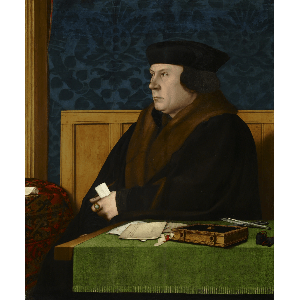
Thomas Cromwell, Hans Holbein the Younger. The Frick Collection,1915.1.76

My personal interwebs have been hating on Sons of Liberty, but I’ve left it alone, largely because I haven’t found the forty-syllable German word for “enjoying watching someone else enjoy hating something.” My FB feed exploded with meta-schadenfreude, but really: hating on that show is so easy it’s cruel.

Still, all that chatter did get me wondering: what about Wolf Hall? No, I haven’t yet gone proxy server and watched it on the BBC iPlayer, but I have been following along on the Twitterz and this turned up in my TL: Wolf Hall May be Historically Accurate, but it’s also A Bit Dull.

Except I think the author destroys the accuracy bit. First there’s this:

Peter Ackroyd audaciously asks us to imagine pre-Reformation London as the street markets of Marrakesh. Cheapside would have been a bustling surge of traders and customers, alive with noise and smells, packed with barrels and panniers of fish, fruit and spices, more like a bazaar than the modern city. Equally, to imagine the interiors of English churches in the 1520s, think Andalusian gaudy rather than Hawksmoor’s classicist austerity, the walls covered in brightly painted scenes, the chapels filled with statuary and icons.

Fete at Bermondsey, 1569. Joris Hoefnagel. Private Collection, UK. Colorful, right?

And this:

Early Tudor London was a bright, brash and bustling place, unlike its whitewashed Protestant successor, and its inhabitants behaved in similarly extravagant fashion. Foreign ambassadors were surprised by Englishmen’s capacity to weep openly and publicly at the slightest provocation. Satirists condemned the aristocracy and burghers for wearing too much bling: flaunting their status in chains of gold so heavy you were amazed they could walk at all.

Then this:

the costumes, beautifully designed and no doubt scrupulously researched, make Tudor society less, rather than more, intelligible. Only Cardinal Wolsey (a melancholic Jonathan Pryce) and Henry VIII (Damian Lewis on imperious form) are allowed bright colours. Everyone else, aristocrat and commoner alike, wear gowns in muted blacks, browns and greens, and so all look much the same – especially as so many scenes take place in near-darkness.

The past sure was a drab place, at least as seen on TV. That’s how you know it’s history! And if the show was so well-researched, why are the costumes so wrong? Because they’re costumes.

Cassidy has gone into good detail about how costume design for a movie or TV programs isn’t about accuracy: it’s about interpretation. And that’s where Sons of Liberty, Wolf Hall, Pride and (or &) Prejudice or Your Favorite Hobby Horse diverge wildly from interpretation in living history. We’re interpreting the past, they’re interpreting a script. (Yes, a script: Sons of Liberty is no way a documentary.)

So I’d save your ire for historic sites and museums and documentaries: what you see on TV is all drama, and just drama. The costuming (and, often, material culture) will in no way be accurate, because it is always designed to further the dramatic goals, and not the accurate depiction of an moment in time.

And that’s why Wolf Hall can be accurate and dull, correct and incorrect. Costume and production designers and directors want us to get the point of the story, so they’ll create dullness where there should be color to make sure we can “read” an otherwise unreadable scene. Now, between you and me, I think good writing can explicate all those class and origin relationships, and that actions large and subtle will show me the emotional relationships, but that’s asking a lot of people who wrecked Mantel’s amazing writing.

In the novel, Mantel has master and servant embrace each other in fleeting triumph. When the dukes go, Wolsey turns and hugs him, his face gleeful. Though it is the last of their victories and they know it, it is important to show ingenuity; 24 hours is worth buying when the king is so changeable. Besides, they enjoyed it. “Master of the Rolls”, Wolsey says, “did you know that, or did you make it up?”

In the adaptation, on the other hand, Wolsey stays seated and Cromwell stands, invisible behind him.

– Did you know that, or did you make it up?
– They’ll be back in a day.
– Well, these days 24 hours feels like a victory.

In the end, I may skip the BBC’s Wolf Hall and re-read the novels. It’s a lot less shouty.
Frocks Coats in Providence

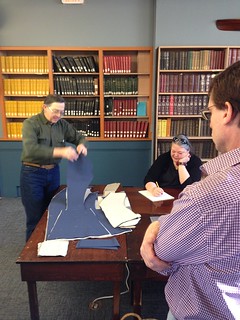
Saturday last saw the launch of History Space, the collaborative project of the Rhode Island Historical Society and the Newport Historical Society designed to help living history practitioners and reenactors acquire the clothing and skills needed to bring the past to life.

Many parts to a frock coat.

Scheduling being what it is, we plunged right in to hands-on work with Easy Grace and Comfort, a two-day man’s frock coat workshop with Henry Cooke. We saved enormous amounts of time in the workshop by having Mr Cooke cut coat kits for participants, and I know it was well worth every penny.

There is much less on-body fitting when Mr Cooke cuts a coat for the kid than when I do. (I think the Young Mr grows while I am trying to figure it out, but Henry cuts fast enough to head him off.)

Buckram and button stands

The most painful part of the whole thing (if fitting is largely done) is stitching on the buckram interfacing and the button stand. The zig-zag stitch as demonstrated by Henry was fairly easy to get the hang of when you caught the rhythm, but the tightness of the Red Edge stand tested my needle and even my fingertips.

There were some complaints at one table, largely voiced by the Fifer Formerly Known as Lambchop, who awaits his 10th Mass name.

Sleevils!

We made it all the way to sleeves, which is impressive, considering that some of the gentleman had not made more than a haversack or knapsack before. But if you can backstitch, and have some help with your fitting, you can make a coat.

I happen to like sleeves, myself, stitching them up and setting them in the garment. I think it’s the three-dimensionality of them that appeals to me– and I like a good challenge.

And here we are: sleevil one.

It’s critical to pay attention, though, so you make one left and one right sleeve, and to keep track of them as you set them to the garment body. I sometimes mark mine with chalk, and have even pinned notes to the pieces when feeling especially daft.

I’ve made it to an assembled coat body and sleeves, with one sleeve basted on. Before Saturday, I plan to baste on the second sleeve and test fit sleeve set on the boy. I’ll also try to get pocket flaps made. Since I have a talk to write and a bedgown to finish as well, I’m probably dreamin’ big.

When this suit is done, the Young Mr will have a very nice blue ensemble that includes breeches (join in the fun here) and a waistcoat. I think he’ll look rather nice, and better than he has previously. I still want to make lower-class* clothes for him, but first he does need a nice suit.

*I said urchin, but Mr Cooke said urchins can’t be over 6 feet tall. Basking sharks are big, but in this blue-grey suit, perhaps the Young Mr will finally be a grey reef shark.

[Not Quite] Good Enough Coat

When not working on the Unified Theory of Living History,* I’ve been sewing for the February program in Newport. You know about the skritchy brown gown, and then there was the Great Coat Obsession. Well, here it is, in unpressed previews.

The photographer and I had barely achieved emotional détente by the time these were taken after a foray out of doors in the late afternoon, but we survived on willpower and the promise of strong beer and here you are. Two and three quarters yards were not quite enough at this length, though perhaps the coat does not have the close in the skirt. For $13, I think I’m still okay with where this is headed, though buttons will be the very devil.

My finger tips are so calloused that working touch screens is getting hard, and silk thread practically shreds when I try to make deaths head buttons. It’s still too early to give in and buy buttons, but there will be swearing ahead.

Back to the coat: there is enough wool for a cape or two, if one is pieced or false. It’s hard to tell how warm this will be, until the buttons are on and the body lined. Wearing it outdoors on Sunday did make me think about the wool flannel shift in a collection near me, and how nicely cozy that would be for winter.


*Stewing about recreating the past

Drapers, Sutlers and Other Sources

Shopping with swatches: it’s what I do.

The biggest difference between sewers is location: I have access to resources here that people in the Midwest don’t, but friends in New York have the garment district, which is just a little too far for me.  For a lot of my projects, I’m buying from the reputable sources we all know about: Burnley & Trowbridge and Wm Booth Draper. They’re supplying people who want accurate fabrics, they do their research, and the goods are well described. But how to choose among the offerings? And where else can you go?

Wools
The creme de la creme are Kochan and Philips wools. I have some bottle green I haven’t cut yet, which I got from Roy Najecki because he’s local, he’s got the stuff, and he has other stuff my household uses (like cartridge box clasps and quarter-inch mohair braid).

Wm Booth and B&T’s wools are also good, and you can get samples. What you buy will be dictated by what you are making. Broadcloth for suits and cloaks, stuff (worsteds) for gowns and waistcoats. Buy the best you can afford: this is an investment. Divide the cost of the fabric by the number of times you’ll wear a garment, and look at the per-wear cost, the way you might look at a suit for work. (I have no regrets about that Saratoga coat, which has now been worn on at least 5 separate occasions, making the per-wear cost $25 after 18 months, and I know it will be worn again.)

Once you’ve felt and seen good-quality, period-correct wools, shopping locally is easier. Take a swatch with you and compare to what’s in the stores and you’re likely to find yourself shopping online. You’ll want 100% wool, and that’s expensive pretty much everywhere. Here in Rhode Island, I do have access to mill stores and remnant tables that make a difference in my costs and allow me to be a little more frivolous in my sewing. Sewfisticated in Framingham and Somerville and Lorraine Fabrics in Pawtucket both have remnant tables with reasonably priced goods with pretty accurate fibre labels. They’ve been the source for many a garment, but have no online sales. I don’t recommend JoAnn’s wools: they’re not as tightly woven and they’re over-priced. Wm Booth and Burnley and Trowbridge are a better value.

Silks
Here again, it’s unfortunate, but my local sources come into play. Artee, Sewfisticated and Lorraine all have both discounted taffetas and tantalizing remnant tables, but Wm Booth and Burnley & Trowbridge have fabrics the local shops do not carry. I don’t have a local source for what Booth calls “persian,” but taffeta can be found– though color choices can be limited.

The trick with silks is slub. Much of what is sold today is silk dupioni. It is not universally bad for all historical applications, as by the 19th century, silks were being sold in several grades. If it’s right for your impression (i.e. not upper class), and you can find a pretty fine dupioni, you can use it. But the really slubby (bumpy) stuff should remain in this century.

Crisp taffetas from the bridal department can be your friend, though home decorating can also yield good results. Some higher-end home dec departments do stock wool, linen and silk fabrics, as the best designers and manufacturers use them. You’ll pay for it, but again: it’s an investment you’ll enjoy over time. Online, there’s Hyena Silks, too, which has supplied some friends. But my silks are pretty much locally bought, at $9/yard.

Cottons
Here’s the biggest trouble spot for a lot of people. The mantra is that today’s quilting cottons are nothing like the cottons of the past, and while that is true in part, it is not the whole, or nuanced, truth. Quilting cottons are stiff and crisp, and generally do not drape as well as apparel fabrics. But what’s more correct is to say that the range and hand of cottons available today in historically correct or acceptable prints do not come close enough to the cottons of the past. Still, you can find good analogues for late 18th and early 19th century cottons (1750-1825) if you’re careful.

Aside from Wm Booth and Burnley & Trowbridge, I buy from Reproductionfabrics.com. She has been a good source for Indian print cottons. Time Travel Textiles no longer has a functioning web store, but the articles are still there, and useful.
Regency Revisited sells via phone and Facebook now, and has an interesting range of prints, though I have not bought from them…yet…as I am trying hard to sew down the strategic fabric reserve.

But again, I buy locally from the bargain loft at the mill store where I can feel the goods. It’s worth ordering some swatches from Burnley & Trowbridge just to get a sense of the hand of different goods. That, along with printed resources, can serve you well in an actual store (presuming they still exist near you).

Linens
Again, much of my trade is with the main two sutlers, but I buy linen in quantity from Fabrics-store.com. It’s not the best of the best (see the main two) but it gets the basic job done.

For really nice and perfectly correct linen, in every sense, Justin Squizzero’s hand-woven linens are the way to go. I’ll get a hand-woven neckerchief one of these days– actually, I want one for February– but have yet to make the leap to buying hand woven linen shirts and shifts.