Frivolous Friday: Checkin’ it Out

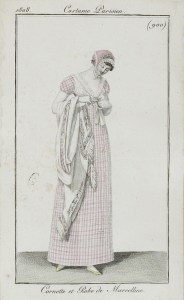
Costume Parisien 1808 Cornette et Robe de Marcelline
Costume Parisien 1808
Cornette et Robe de Marcelline

One gets ideas. I often get ideas about checks. In particular, I get ideas about loud checks. The gown in the fashion plate is appealing, when you’re looking for checks, and all the more so when you know how similar it is to an extant garment in your actual location.  The cornette I can do without– that’s the headgear, which looks like she’s crammed a sugar Easter egg on her head– but at least it could hide a short hair cut or the melting pomade of humid summer.

Costume Parisien 1808 Chapeaux et Capotes en Paille Blanche et Rubans
Costume Parisien 1808
Chapeaux et Capotes en Paille Blanche et Rubans

But wait! What check through yonder tastefulness breaks? It is the fashion plate, and  the checked bonnet is my sun. My goodness, that bonnet on the lower left is satisfying. It appeals to me the most because it is by far the most check-heavy bonnet I’ve seen, and making it would not involve plaiting straw, which I know nothing about. It’s a direct trip to obnoxious via silk taffeta, and that’s a trip I’ll buy a ticket for.
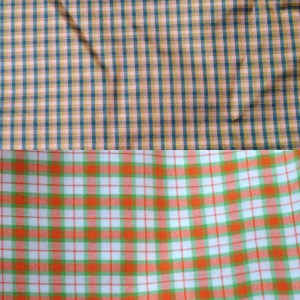
Top: check silk taffeta, Artee Fabrics Bottom: check cotton, Mood Fabrics
Top: check silk taffeta, Artee Fabrics
Bottom: check cotton, Mood Fabrics

Actually, as the result of a train ticket last August, I am the proud possessor of some delightfully bright lightweight cotton check in search of a fashion plate. The year I’m targeting (which is not 1808, but 1818) hasn’t yet provided published inspiration, but there are more places to search. In any case, an orange check gown with a blue check bonnet is pretty much crying out to be made. Bring your hanky, in case your eyes water, but make sure it’s check, too.

Reflecting Fashion

Whilst serving as the commandant for a research-paper writing prison*, I spent some time perusing the Met’s digital collections, in particular the Costume Institute’s collection of Men’s Fashion Plates, because, you know, stuff.

I stopped at Plate 002, because I knew I’d seen that coat somewhere before. Why, yes: at the MFA in the Art of the Americas Wing, where I recently spent a pleasant afternoon with the Drunk Tailor. After some initial joy at discovering dust on a teapot, we got down to the business of setting off proximity alarms, reading labels, and contemplating  the occasional neck stock.

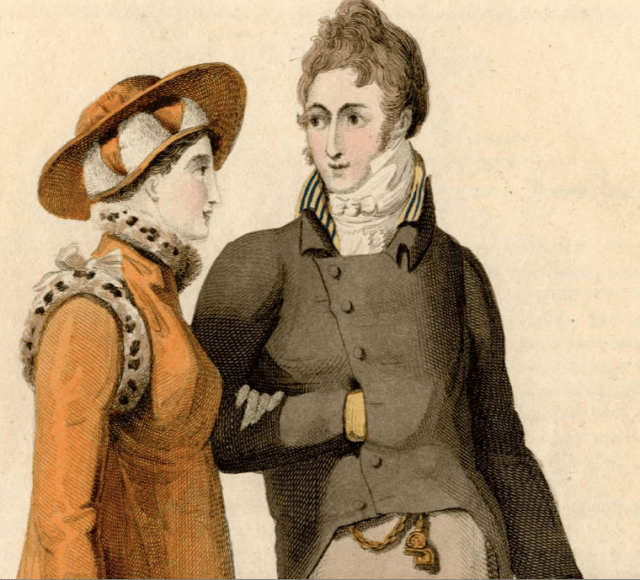
Mr Myers stopped me, though: what a handsome coat. High shoulder seams, long cuffs, buttoned all the way up. Nifty high-waisted grey trousers, too, and what seems to be a yellow waist coat. The portrait is dated 1814, and the fashion plate 1807.

Detail, 1807 fashion plate

Hmmmm…

Men's Wear 1790-1829, Plate 005, 1807. Gift of Woodman Thompson, Metropolitan Museum of Art
Men’s Wear 1790-1829, Plate 005, 1807. Gift of Woodman Thompson, Metropolitan Museum of Art

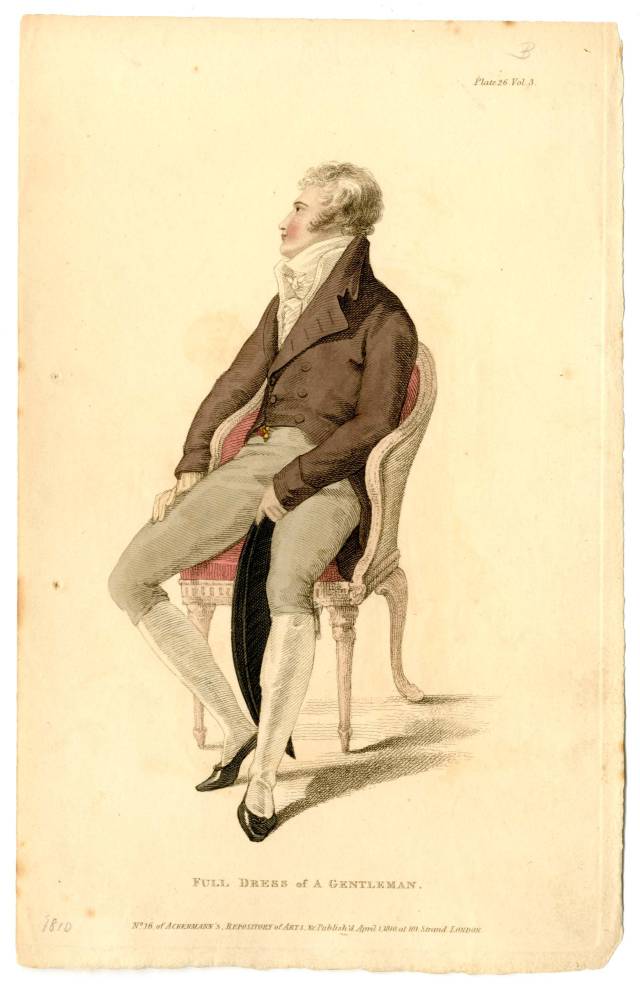
The brown M-notch collar coat is clearly a thing in 1807. It’s popular in 1802. So popular. 1802 on the left. On the right, 1812.


And our friend Sully paints one in 1814.

After seeing Copley and other early American painters use English prints as references for portraiture, I wondered if Sully was at all influenced by fashion plates, and then to what degree American men and their tailors were influenced by published fashion plates.

Portrait of the Artist. Thomas Sully, 1821. Metropolitan Museum of Art, 94.23.3

Brown coats are clearly classic: Sully’s got one himself in 1821. I’m sure there’s a dissertation out there somewhere on the influence of fashion plates on American men’s  fashion and representation in portraiture–  I can almost remember stumbling across the reference. So that echoes and re-echoes and reflects through time even as I recall not just the the folk wisdom about brown suits, but the significance of well-tailored suit. Maybe from 1802-1821, brown is the new black.


*Ah, teenagers. The Young Mr failed to complete a paper by the due date, so I spent some quality time ensuring he got back on track.

Sometimes a Great Notion

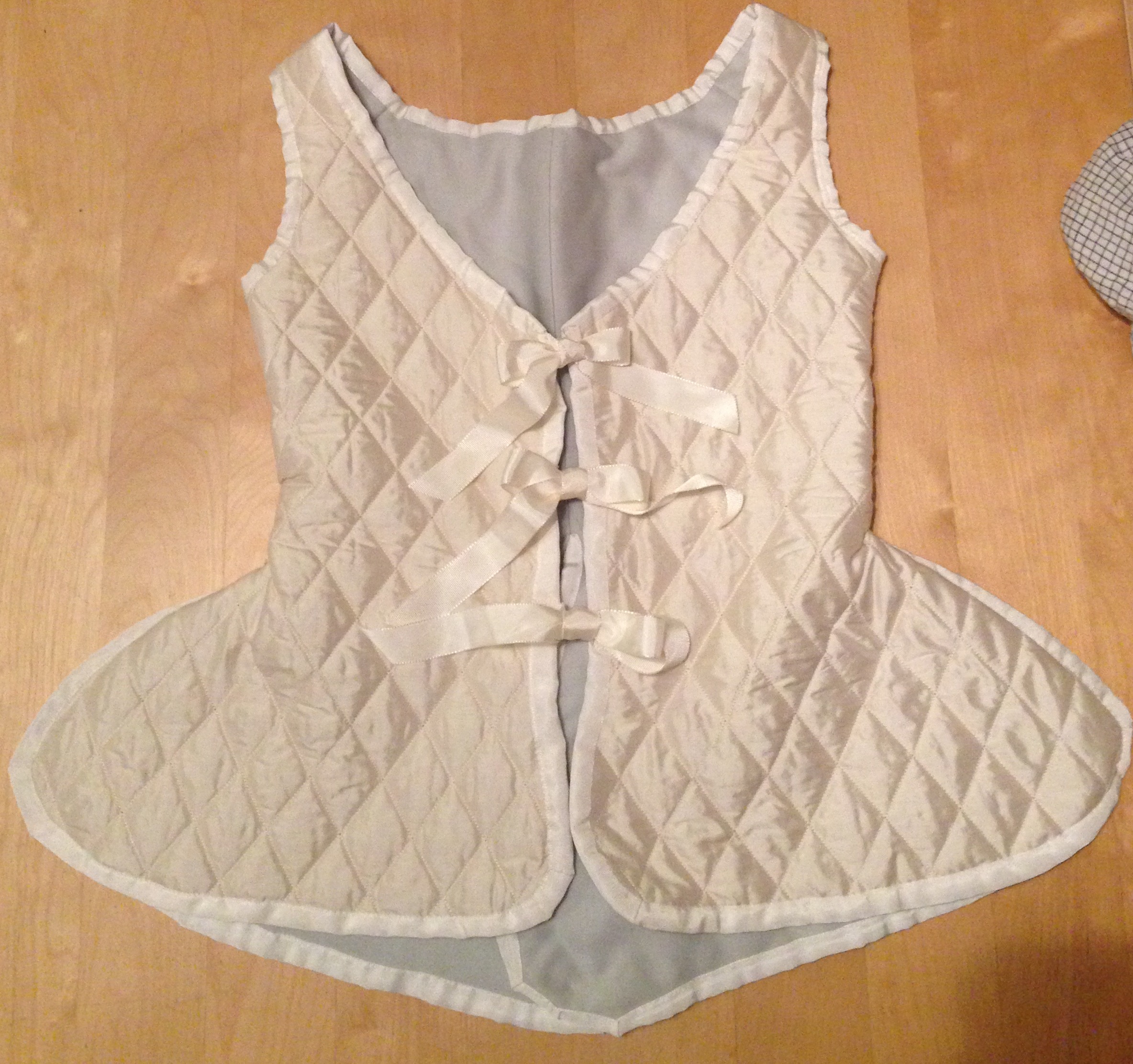
Finished! Cozy, too.

(Think Lead Belly, not Ken Kesey.)

No, I did not take a notion to jump in the river, but I did take a notion to sew slightly more than the quilted waistcoat.

I couldn't resist.
I couldn’t resist.

I got this unshakable great notion, you see, about some wool from the remnant table in Framingham. It was a lovely olive color, and paired up with some plain weave I already had, it reminded me strongly of World War II-era Army uniforms from the ETO, which I had been packing recently in Rhode Island’s alpine north. And yes, if I find a pinker tan for a petticoat, I will procure it.

Since I already have an olive wool petticoat that will also work for this notion, I started on the gown last week, cutting it out on Wednesday night so the table would be clear for Thanksgiving dinner.

The wool was a little slippery to pleat, and the twill slightly dazzling with its sheen. Let’s pretend it’s shalloon, shall we?

A week into the project (after a brief annoying detour attempting to correct my mitt pattern), I have only half the hem and the bottom of the robings to finish. Not too shabby, thanks to a holiday weekend and hours of The Pacific, Band of Brothers, and The Purple Plain. Homage to the color, I suppose.

I'm never not smirking, so thanks for not smacking me.
I’m never not smirking, so thanks for not smacking me.

It fits– which always seems like a miracle, even with a tested pattern– and better yet, it fits over that plush waistcoat.

The rustle of the silk and the swish of the wool are unlike anything I’ve ever worn. I think I shall feel quite fancy– let us hope I shall also feel quite warm.

Packing Meat

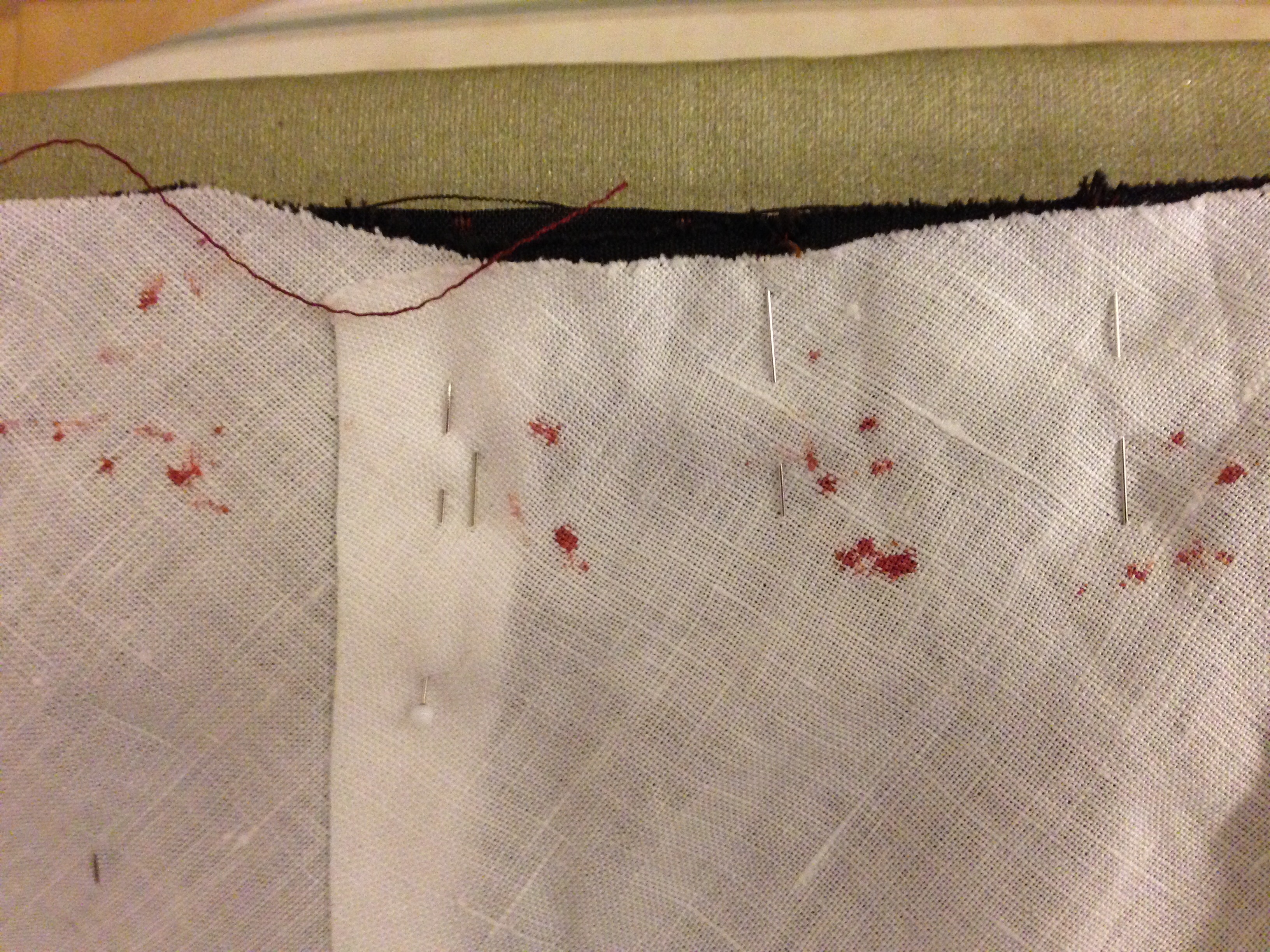
If it bleeds, it leads.
If it bleeds, it leads. Waistband pinning is surprisingly dangerous.

Sometimes you end up doing things for reasons you don’t entirely understand. Remember that brief flirtation with the 1830s? Well… we met again, and this time, I said yes to the dress.

Several friends are on the “shoot meat, win a target” program at OSV this weekend, and I agreed to go along. Yes, it’s a gun show. Yes, I’m compromising again.

Gentle reader, it gets worse. While I had not planned to dress, I rethought this choice last week. Awake in the early morning hours of November 11, I thought about dress patterns, wool petticoats, and the contents of the Strategic Fabric Reserve. One of my wool petticoats fit the waistline of my 1820s dress better than the 1800 dress I made it for, so I figured I was on my way towards being warm outdoors in November.

Spot the error. It's the dyslexic '30s.
Spot the error. It’s the dyslexic ’30s.

I have 1830s patterns, and a muslin was quick to make. Worse yet, once the muslin was made up and tried on over stays, it needed no alteration beyond a slight shoulder seam adjustment. Can you imagine? That hideous decade fits me? Doom or destiny, you be the judge: I had enough striped wool blend to cut a dress and a pelerine… so I did.

The other sleeve's stripes are just slightly off.
The other sleeve’s stripes are just slightly off.

The bodice went together quickly, and the sleeves were fairly easy at the shoulder and arm scye (I really enjoy setting sleeves). It was the length and width along the forearm that threw me, and I ended up having to piece on the lower sleeve. Twice.

The sleeves are where the meat comes in: you say pork chop, I say leg of lamb, the fashion plate says gigot. I did reduce the arc a bit, which makes this a more late-1820s style than firmly mid-1830s. Since some of the folks I’m going with will be wearing a mix of late 1820s and 1830s styles, slimmer sleeves seemed reasonable.

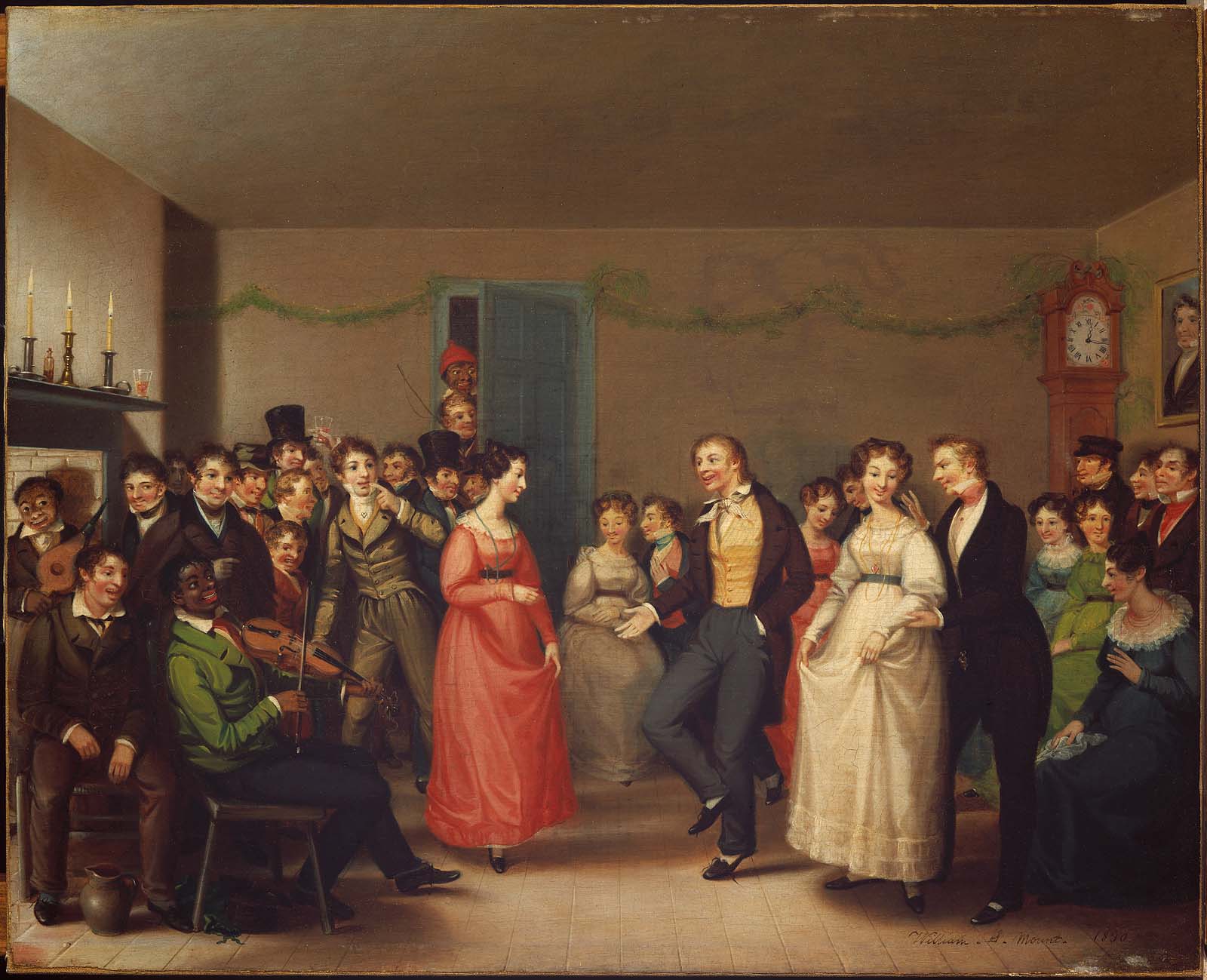
Rustic Dance After a Sleigh Ride, 1830. William Sidney Mount MFA Boston 48.458
Rustic Dance After a Sleigh Ride, 1830.
William Sidney Mount MFA Boston 48.458

More seriously, I’m taking cues from the William Sidney Mount painting I’m so fond of. The women in this 1830 painting have less flamboyant sleeves and possibly achievable hair. Honestly, the things I get into when I lie awake and think. I ought to know better by now…but every decade is a new adventure.

What remains to be done? Backstitching the waistband and waistband lining, hooks and bars at the back closing, the ever-popular hem of enormity, and a final pressing. Achievable, I think, with focus and some lunchtime sewing.