Criss Cross, or, My Checker’d Past

Every now and then I look up from what I’m doing (tiny stitches, usually, though sometimes budget math) and realize that Objects in Mirror are Closer Than They Appear. Oops. It was just yesterday I was daydreaming about miniatures, and now I shall want a paintbox and brushes in a mere six weeks– and those six weeks are punctuated by a courier trip, a couple of exhibits, not to mention shepherding The Young Giant through prom and finals.
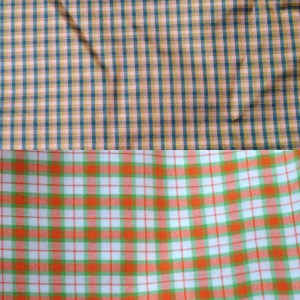
Top: check silk taffeta, Artee Fabrics Bottom: check cotton, Mood Fabrics
Top: check silk taffeta, Artee Fabrics
Bottom: check cotton, Mood Fabrics

This weekend, thanks to the SFR hunt for collar interfacing of an appropriate weight, I realized I’d better get a wiggle on my own sewing, and managed to hunt up the orange check from hell, pop it in the washer, and hunt up the pattern I intend to use.

Mrs Catherine Morey oil on canvas by Michael Keeling, 1817. (c) Walker Art Gallery; Supplied by The Public Catalogue Foundation
Mrs Catherine Morey oil on canvas by Michael Keeling, 1817. (c) Walker Art Gallery

I’m stuck on that 1817-1819 range because of someone’s eventual and particular Mode of Transportation, so I was super pleased to find this portrait while trolling the BBC’s Your Paintings site. Actually, I’m pretty over the moon about this image, since it places that cross-over front firmly in 1817. I’ve made a version of this form already, so I can but hope the next iteration will be even closer to correct for the period, once I tweak the pattern a bit.

The pattern: therein lie so many rubs, often going the wrong way. Still, I remain enamored of the check and of the cross-front gown. Any checkered doubts were dispelled when Alison for reminded me of the sort-of-cross front check gown at the Met, whose catalogers are hiding behind circa 1820 which allows leeway back to 1815. Behold, of course, the ruffled neck of the bodice (I do expect mine will fit a bit better since I am squishier than a mannequin, and possess appropriate infrastructure).

Speaking of infrastructure, the appropriate stays are finished, entirely hand-sewn, and ready for deployment in pattern fittings before they debut at Genesee.

File_000 (1)

Six weeks to Genesee: at least one 1817 dress, another sheet, a portfolio and paint box, followed immediately by 18th century stays, a front-closing gown, and a bucket repair. Surely that’s all manageable, right?
Frivolous Friday: All of Everything

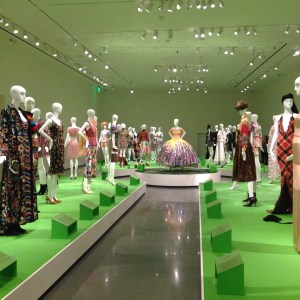
All of Everything: Todd Oldham at the RISD Museum of Art

Some days were made for a bit of hooky. This week, it was Tuesday– though how much can you consider a museum visit hooky when it’s the business you’re in? We took an outing down the street to the RISD Museum, long one of my favorite places in Rhode Island. The Costume and Textiles curatorial staff mount some amazing exhibits, from Artist Rebel Dandy to this latest, All of Everything: Todd Oldham Fashion.

Every time I go to the RISD Museum’s exhibits, I have serious wants, whether mochaware coffee pots or the Chinchilla Outfit– which my grandmother would also have coveted. There was a tinge of nostalgia in the visit, since most of us had lived through the 1990s, and recognized the styles that eventually leached into ready-to-wear from couture. Cropped sweaters. Shrunken jackets. Embellishments. Pattern mixing. Hey– I still dress that way!

Unknown artist Horace Vernet French, 1789-1863 Illustrations from the Journal des Dames et des Modes, ca. 1810 Engraving on wove paper, hand-colored Museum collection INV2004.506
Journal des Dames et des Modes, ca. 1810
RISD Museum INV2004.506

And legit it is, this pattern mixing. Funny how we stick to the same shapes and forms once we find what we like; so much of what I make and wear are variations on similar themes, no matter the century.

For some, dressing in the past is the only time they’re dressing up; their daily style is almost aggressively (or passive-aggressively) anti-style. But when the top hat comes out, look out: they’re dressed to the nines.

Stay Thy Hand

IMG_6784

Stays. They’re infrastructure: absolutely necessary, a major time commitment, and decidedly unsexy. I am in dire need to two new pairs, one for late 18th century use and one for early 19th century, and each with deadlines looming.

I can manage 19th century attire and Genesee with the chopped-and-dropped corded stays I already have, but New Jersey will not happen at all unless new stays are made. It was like a weekend of penance chez Calash, two straight days of stay mocking up and making.

Of course I bled on them. That’s how I know they’re mine.

IMG_6786

And let’s get this out of the way: I thought backstitching the back seam was a little more difficult on this side, but ascribed it to sore fingers. Wrong! I failed to notice that I was stitching through all the layers, and not leaving one free to fold over and finish.

IMG_0806

A glass of cider and an hour later, I’d rectified the error. These are now fully bound along the bottom edge, and ready for the top edge binding. Somewhere there’s coutil for the straps, and then numerous hand-sewn eyelets later, I will have a finished pair of hand-sewn stays.

New stays deserve a new gown, and since I found this lovely image, I know what that new gown should look like (as well as a portfolio).  Happily, there’s a dress in Cassidy’s book that will serve as a reasonable basis for recreating this image. I’m still pondering the portfolio, and what it might be made of: paper or leather covered pasteboard? As the clock ticks down to June, I suspect I will be using a portfolio I already have on hand.

And then there are the the 18th century stays, with their history of woe.

File_000

I’ve gotten this far with the new 18th century pair, and an interesting business it is. I altered the front side pieces and the stomacher, but cannot see the back well enough (even with a camera and a mirror) to adjust it by myself, so further changes will have to wait until I have some assistance.

The tabs aren’t right in the back, and while the advice is to shorten the stays when the tabs flare this way, I found the fronts were still too low, once again riding at nipple-cutting height. Finally it occurred to me that the problem– slippage–might actually be one of waist. I lengthened the fronts half an inch and nipped the waist in, and found the fit more pleasing.  I suspect the back pieces need to be trimmed a bit before they’ll fit (they’re stitched closed in this version, so you know they’re too big).

Another weekend of work awaits– with focus, those early 19th century stays may be done by then, if there are no more finger injuries.

Bustin’ Out

tightlacing_lg
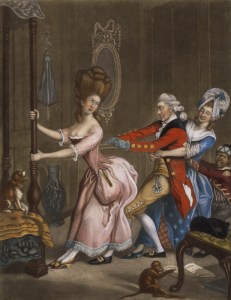
Tight Lacing, or, Fashion before Ease

Grand weekend, right? Spent a happy day cleaning, missed any hints of the reported near-fracas, inappropriate hostility, or snide commentary, and thus had a perfect weekend, you think.

Almost…except of course the whole thing nearly derailed into a visit to the Princeton Art Museum. Why, you ask? The Great April Stay Failure.

Confessions of a Known  Bonnet Wearer are what we’re all about, so here you go: Despite a quick stay alteration that appeared to solve the too-big shimmy, the Stays of Yore continue to chafe and annoy.

Turns out that lacing yourself up the back is nowhere near as effective as having someone else lace you up. Leverage: you don’t has it the way another person standing behind you does. And if that person naturally possesses greater upper-body strength than you, well, there you are. You will find yourself experiencing a great deal more containment than you might find desirable. Actually, the stays were more like nipple guillotines, as the fault shown here made itself all too well known.

Yes: the fool things were not made properly in the first place, exacerbating any fit issues that can be ascribed to weight loss, fabric stretch, or general high-level-of-activity use. Reader, I am up against it.

Not only do I have a pair of 1800 stays on the table needing to be finished, I have a banyan to make up and a bedgown to finish, all by April 21 for a program at work. A mere two weeks later, I will need really serviceable and decently-fitting stays if I plan to go back up to Fort Ti. Quickie torso measurements, anyone?

It tried, and did well, considering the circs.

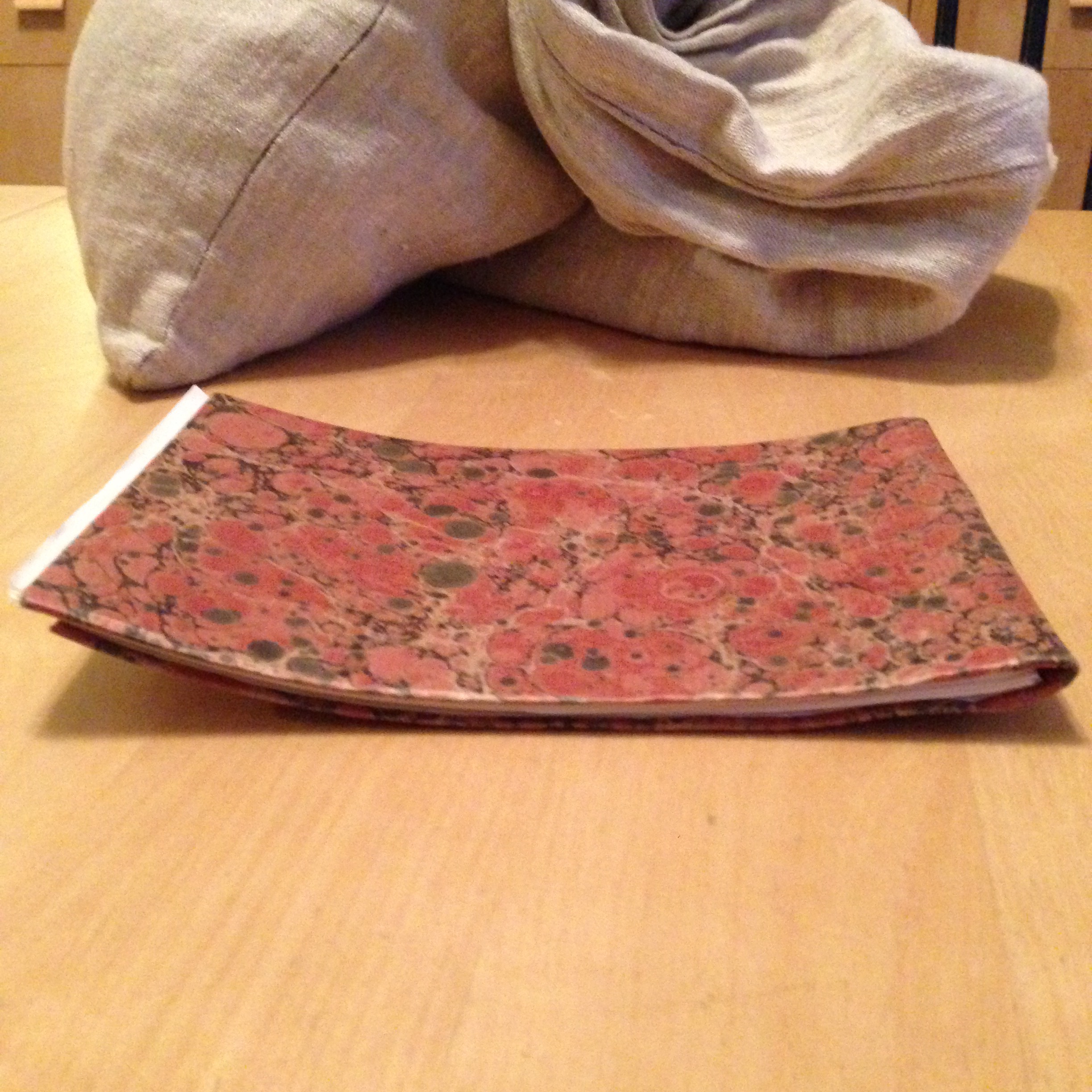
Of course, the thing is that these ought not to be done quickly, but correctly. I recognize that after four years of wear, these imperfect stays made of modern (linen and caning instead of wool and baleen) materials could legitimately be wearing out. But the really important thing is this: They turned out to be so (literally) painfully wrong that turning them around and wearing them backwards was better. No, that was not an ideal solution. I have a sizable bruise on my left underarm area and a red wear spot on the right and my poor handmade (just finished!) sketchbook is bent from use as a stomacher/busk.

Granted, I do have the materials I need to make new stays, but what I lack is more critical: time and a second pair of hands to help me measure torso length. I suspect that even a new pair (of wool and linen, thank you for reducing stretch) will take more alterations than I currently credit. Hilariously, while these pattern pieces may require some lengthening, the 1800 stays needed shortening to fit properly. So on my table sit one pair, shortened, and another pair, seemingly in need of an opposite alteration. Get fit or die tryin’, right?