Reap what you Sew

Too big!

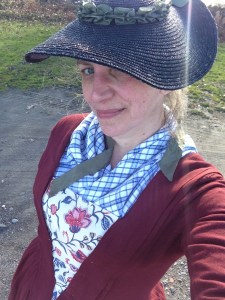
Lampshade: She’s been the Holy Grail of bonnet making.

There were several failures in the winter of 2016, and some revisiting of the Whale-Safe Bonnet as I tried to figure out the brim and the caul. My first efforts made a caul that was waaaaay too small. That’s not necessarily a bad thing, as I’ve made plenty of too-big bonnets. (Too small did not make the move from RI to VA, but trust me: too small a caul was far too small.)

This morning, I took another look at George Stubbs’ paintings of working women. I know the lampshade-like bonnet is pre-1770, but where are we at the end of the Revolutionary War period? Well, BIG was in, obviously. (We can have a healthy debate about the likelihood of these gowned women depicting actual working women, but for now, let’s stick to bonnet brim shapes.)  They’re a little cone-like, aren’t they? With generous (yuuuge) cauls, though.

Now, I have gone about this all a bit backwards, which is to admit that I picked up the shellacked brim of yesteryear that did make the move down to VA, and decided to make it up as a bonnet yesterday. The brim is easy– trace and cut with a seam allowance– but the caul? I winged it, using a selvage edge for the inside of the back drawstring (I like my headwear to be adjustable and pack flat) and economized on fabric to leave plenty of taffeta left over. So there’s nothing particularly well-researched about this, except for all the years of looking and thinking and drawing and making that came before the moment I threw this all together yesterday afternoon watching North by Northwest and drinking a Manhattan.*

Making this up raises more questions: how individually fitted were bonnets to wearers? Did caul and brim size vary depending on wearer? What’s the class line below which a woman doesn’t have a bonnet, but only a hat? How quickly did styles change? The sort-of-conical black bonnet is seen on “older” women in paintings well past the height of the style. But as I’ve asked before, what do we really understand about the portrayal of age in art? Are we really reading the symbols correctly? How well do we grasp the semiotics of the 18th century? All of those questions are present when we try to replicate the past using only visual sources. Yes, there is an extant 18th century black silk bonnet at Colonial Williamsburg, and we can use that in conjunction with images to make the things we wear. But pondering all of these questions makes me think it’s time for another troll through collections in Great Britain, just in case new cataloging has put old bonnets online.

*See my other blog, TipsyMilliner, for more.
Draping and Dreaming

Why have just one dream project when you can have more than you can possibly achieve? Here, in no particular order, are things I’d like to make or achieve but probably never will:

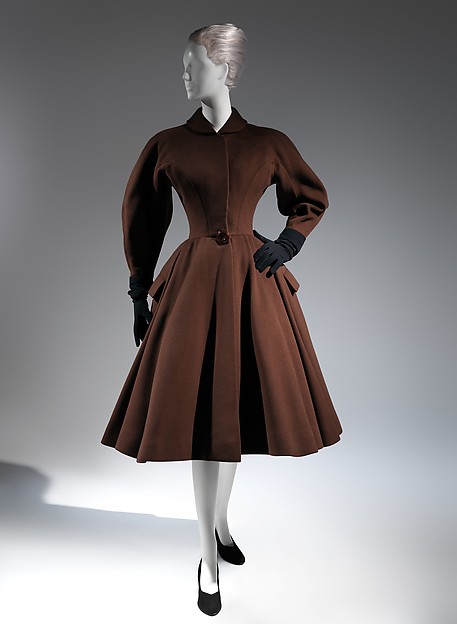
Charles James (American, born Great Britain, 1906–1978)
“Cossack”, 1952
American,
wool; Length at CB: 46 in. (116.8 cm)
The Metropolitan Museum of Art, New York, Brooklyn Museum Costume Collection at The Metropolitan Museum of Art, Gift of the Brooklyn Museum, 2009; Gift of Muriel Bultman Francis, 1966 (2009.300.402)

Charles James: American master of draping fabric. I have nowhere and no reason to make or wear this coat, but the lines and fabric appeal to me. This skill level is currently beyond me, but I recognize that I have enough historical clothing that I could get out of the 18th and 19th centuries to concentrate on learning the couture techniques of the 20th century. Many muslins went into making this, and a deep understanding of fabric. One of the best things about the Met’s Charles James collection is the large number of muslins. Costume and clothing designers’ sketches, muslins give us a good sense of how a designer thought, and what steps went into a garment.

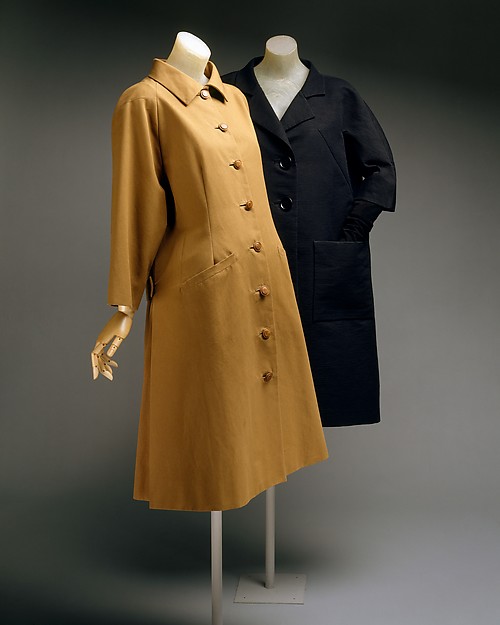
Balenciaga is another favorite. Evening gowns, suits, and coats, all deliciously draped.

House of Balenciaga (French, founded 1937)
Rain ensemble, fall/winter 1965–66
French,
cotton ; Length (a): 42 1/2 in. (108 cm) Length (b): 24 in. (61 cm)
The Metropolitan Museum of Art, New York, Gift of Rachel L. Mellon, 1987 (1987.134.23a, b)

Lest you think I only like coats, the “Tulip” dress is equally interesting.

House of Balenciaga (French, founded 1937)
Evening Dress, 1964
French,
silk ;
The Metropolitan Museum of Art, New York, Gift of Baroness Philippe de Rothschild, 1973 (1973.21.8)

Thanks to the V&A, there are digital animations of the construction of the tulip dress, which has deceptively simple pattern pieces. The video was created in support of teh V&A’s Balenciaga exhibition, which I am sorry not to be able to see.

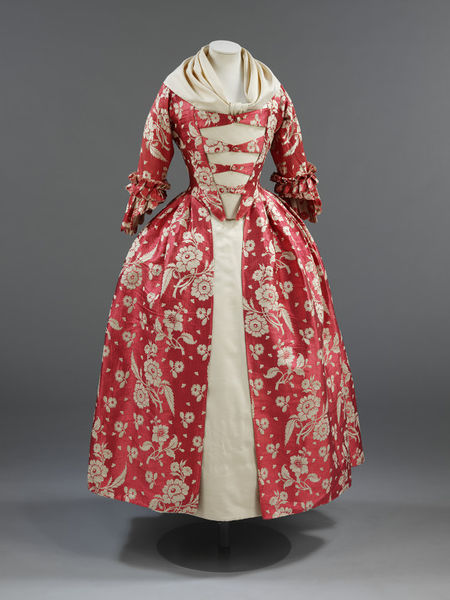
Equally out of reach is this: a remodeled silk lampas gown. The idea is to make the first gown– that is, the gown suitable for the fabric’s earliest date (which is probably not 1790, but closer to 1740-1750) and then alter that gown to the late 18th century style.

Unknown maker. Gown, 1790. French, silk, The Metropolitan Museum of Art, New York, Purchase, Irene Lewisohn Bequest, 1964, (C.I.64.32.2)

This last “dream” project is more achievable, though somewhat academic. Silk lampas fabric can be found, and there’s a simpler alteration project in lampas at the V&A

Gown, Spitalfields silk, ,
1740 – 1749 (weaving) 1740 – 1749 (sewing)
1760 – 1769 (altered) 1950 – 1959 (altered)
Given by Mrs H. H. Fraser Victoria and Albert Museum, T.433-1967

.

Goose Me, Baby, One More Time

Ironing en plein air: Mr Hiwell with Voldemort

Pro tip: PRESS. Press ALL the things.

Press the seams, the sleeves, the joins, the skirts. Press it good. Press it again.
Press as you go, and your clothes will fit better and go together more easily.
Press your clothes before you wear them, and they’ll look better.

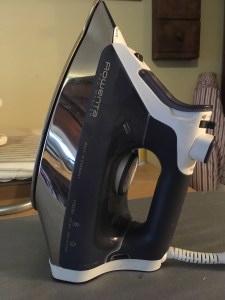
I have a Rowenta iron affectionately known as “Voldemort” for its tendency to hiss and belch when waiting to be used. The iron is so noisy that my son once said, “Gesundheit” reflexively when it sat between seam pressings.

Voldemort himself

It’s a “Pro Master” model, from a clearance rack at Bed, Bath and Beyond (which is why I could afford it).  While it’s not the top of the Rowenta line, it’s heavier and steamier than my previous Rowenta, which was knocked to the floor by someone else too many times in early morning shirt-and-tie pressing sessions. That iron developed a nasty over-heating habit, and was eventually chucked into the yard where it burned a neat iron-shaped hole in the grass… don’t drop your irons, kids.

In addition to the Rowenta, I have a Sunbeam  with a retractable cord,  purchased to replace the overheating Rowenta. It, too, is heavy and steamy, and was my go-to iron until I used someone else’s better Rowenta at a sewing workshop.

The best steam iron you can afford is worth every penny for the difference it will make in the drape and finish of your garments.

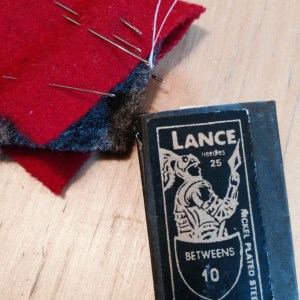
Lance needles: the best I’ve used.

Bonus Pro Tip: Use the smallest, sharpest needles you can work with. Smaller needles = smaller stitches.

Frivolous Friday: Favorite Fabric

Favorite Fabric? Are you kidding? Is it fabric? It’s my favorite.

Dat neckhandkerchief, tho’

There’s the hand-woven handkerchief made by a friend that is my absolute favorite textile accessory.

There’s silk taffeta, and the occasional silk satin, for bonnets.

And linen for shifts and linings.

But my all-time favorite fabrics are Indian block print cottons. I have multiple yards in storage, and multiple yards in the accessible Strategic Fabric Reserve. I try not to look at them in the online shops, for I cannot afford to be tempted.

My favorite three gowns are made of Indian block print cotton:

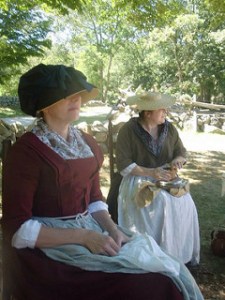
The Milliner in Red

The Bib-Front Tailoress

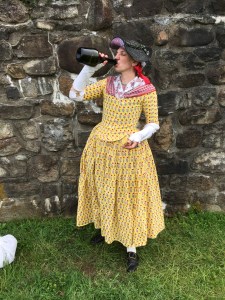
And the somewhat noticeable Nancy Dawson.

It was hot. And humid. That’s only water.

There’s an early red, white, and black calico based on a Philadelphia runaway ad, too, and though I’ve not had it on in a while, it may be due for a renaissance.

Once upon a time in Connecticut…

Oh, and while it requires some shoulder strap adjustments, there’s the brown Indian print I wear as a unsatisfactory Philadelphia servant and Boston sight-seer…and the red print I wore for a 1790 Providence housekeeper.

So, yes, pretty much my favorite, and of the prints? Nancy Dawson, hands down, though I was skeptical at first, for the yellow was so very bright. Made up and worn, though, I love it.