
New England Spencers

You may recall how tortured I was (sort of) about making a Spencer for What Cheer Day, concerned that Spencers could not be documented to Rhode Island, let alone New England. I had the same worry about the Not-Quite-Good-Enough Coat.

JDK_8210_1

Things will come to those who wait, and what came this week was the long-awaited Proceedings of the Dublin Seminar for 2010, Dressing New England. In it I found an article by Alden O’Brien, Federal New England Fashion in the Diary of Sylvia Lewis.

Sylvia Lewis [Tyler], Diary (1801-1831), MSS 2899 in the Americana Collection of the NSDAR provides the basis for O’Brien’s article and my joy. It begins routinely enough with my favorite stuff– spinning!– and carries on to knitting: stockings, mittens, gloves, a hat or two, and even “comforters,” or scarves. Shag, or thrummed, knitting is mentioned, so at least those of us interpreting the world of 1801 and later can be war.

The real excitement comes on the third page: in the winter of 1803-1804, Sylvia Lewis cuts and sews a greatcoat. Then, in 1806, she makes a green Spencer, and in 1808, a black one.
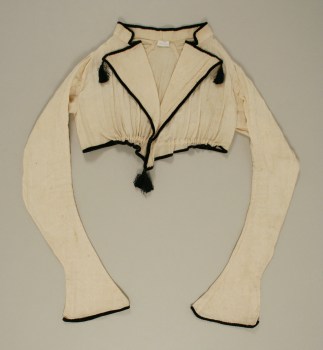
Spencer ca. 1800 French. silk. Purchase, Irene Lewisohn Trust Gift, 1991 1991.239.2
Spencer ca. 1800
French. silk. Purchase, Irene Lewisohn Trust Gift, 1991
1991.239.2

1806 is still later than I wore my Spencer. They’re shown in fashion plates of the 1790s, and here’s a pattern, too: so they’re clearly worn in Europe earlier than 1806. The similarity between the French silk spencer at the Met and fashion plates gives me confidence that they are being made and worn in the 1790s and early years of the 19th century; Spencers are also mentioned in tailoring manuals of this period.
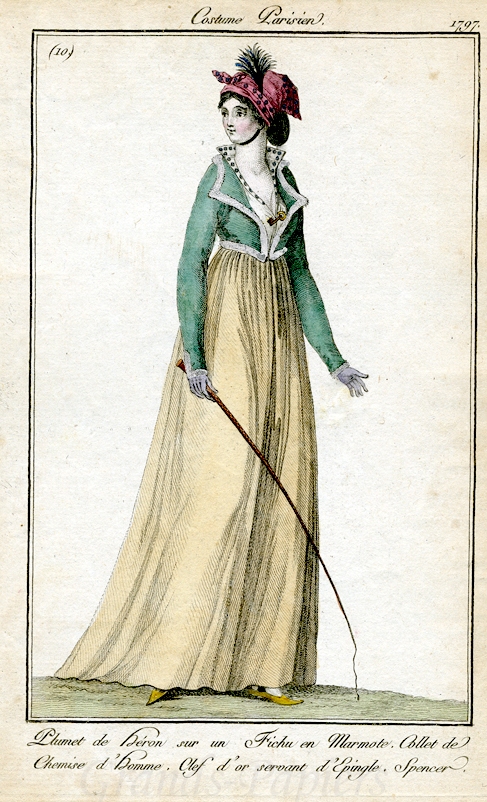
1797, with a similar shape to the Met's French silk spencer.
1797, with a similar shape to the Met’s French silk spencer.

They’re placed in New England with written documentation, but how early are they here? And what did they look like? I know of one in a private collection which I am slavering to see, based on the description of the wool. The MFA has a few that seem to be local to Lexington, and there is one in Maine with a catalog record that shines with passive aggressive crankiness, and delights when compared to another in the same catalog. And no, I’m pretty confident that gentlemen did not wear spencers, or tailed spencers, at any time.

But there’s really good stuff in Sylvia Lewis’s diary for anyone who wants to know more about clothing production, use, and costs in early Federal New England. Even if your Library doesn’t have it, your Librarian can get a copy of the article for you through ILL or you can buy the entire proceedings here.

Fabric Selection Resources: Printed & Online

Jackie asked about fabrics: how do you choose?

I’m going to start with prints, cottons, linens and silks; the second part will cover wools and sutlers.

There’s no substitute for feeling up the real thing, or samples, and while I do not have the book, I’m told by a very reliable source that it is worth buying Swatches from Wm Booth or from Hallie. I also order Burnley & Trowbridges swatch sets, which are often  more extensive than what’s on their website. Those samples help me gauge fabrics online– comparing the actual square with a thumbnail online is helpful.

Barbara Johnson: a typical page
Barbara Johnson: a typical page, this from 1803

Where else can you look for guidance? One of the best books that spans a wide range of living history time periods is the Barbara Johnson book of swatches. Owned and published by the Victoria and Albert Museum, A Lady of Fashion is out of print, but the pages have been scanned and are available online. The print version is better– it’s big!– but you can download the images and get a better sense of the scale of the samples.

What is particularly useful is that Barbara Johnson dated the samples, and wrote down how they were used. You can’t get better than that!

Susan Greene’s Wearable Prints is neither small nor cheap, but it is extensive, covering 1760 to 1860. This is a very hand book to have to help sort out typical looks for different time periods, and the likely range of colors.

Textile Sample Book, 1771. Metropolitan Museum of Art. 156.4 T31

Other museums have digitized sample books: the Met, for example, has multiple images of woven fabrics from a 1771 sample book online.

What you need to remember here is fibre: those homespuns at JoAnn will not behave the way linens behave, even if they look the same. Hand and drape are everything, and cotton, or cotton-poly will not do want linen does. Buy the linen, it’ll look, feel, and wear better.

There are many more sample books, but you have to be careful: some are dated only “19th century.” Great. That’s where Susan Greene and Barbara Johnson can help you sort out which *part* of the 19th century you’re looking at.

Swatch book, 1763-1764. Victoria and Albert Museum, T.373-1972

For silks, you can see a very specific and detailed range of silks in Selling Silks, which reproduces another sample book at the Victoria and Albert. Not all samples are 1763-1764; you will need to read the descriptions, but this can be helpful in figuring out how to use fabrics. I have come into some red silk damask that I can make into a gown; it’s vintage silk from France, probably pre-World War II. The pattern is large, replicating a 1740s fabric, but when I make up my gown, I think it can be 1760s, but not a lot later.

Part of looking and buying is understanding how textiles might be bought, saved, made up, reused and repurposed over time.


Anachronisms, ahoy!

Deborah Sam[p]son (Gannett), oil on paper by Joseph Stone, 1797. RIHS Museum Collection, Gift of Jesse Metcalf, 1900.6.1

There’s a petition circulating in certain government circles in support of a campaign to give Deborah Sam[p]son her very own stamp. This is, in part, fueled by the upcoming 250th anniversary of the founding of Sharon, MA.

I’ve got no problem with that—commemoration is something we humans do and need. And Deborah Samson’s is an interesting story, but possibly not for the reasons cited in the letters from officials who shall remain nameless. They describe her as “a pioneer of promoting women’s rights and eliminating gender barriers” and “a trailblazer for gender equality,” phrases that would have been just about nonsense in the Revolutionary war period.

And that’s my problem with it: the anachronistic representation of a woman’s story, bent to the purposes of the present. Don’t get me wrong—I’m a feminist, I’ve enjoyed Deborah Samson’s story since I read about her as a kid in one book or another, so I sympathize with the Stamp Movement.

What makes me crazy is bad history.

Hannah Snell, as depicted in an excerpt from "The Life and Adventures of a Female Soldier," the narrative of the most famous cross-dressing British soldier of the century. It appeared in Isaiah Thomas's New England Almanack (Boston, 1774). Printers recycled the image on other imprints. American Antiquarian Society.
Hannah Snell, as depicted in an excerpt from “The Life and Adventures of a Female Soldier,” the narrative of the most famous cross-dressing British soldier of the century. It appeared in Isaiah Thomas’s New England Almanack (Boston, 1774). Printers recycled the image on other imprints. American Antiquarian Society.

In Masquerade, Alfred Young tells Sampson’s story well, busting myths that both we—and she—created. (This short bio is a good overall sketch of Deborah’s life. ) What struck me the most about Deborah Samson’s life was the lack of certainty, stability, and material comfort. We’ll never know the specific circumstances that led her to enlist, though Young does yeoman’s work to unearth everything he can about her life and circumstances, and the context in which she lived.

I’m not an unbiased reader—I did get a little shouty on the third floor when I read “trailblazer for gender equality,” and that phrase has lingered and grown tattered as my colleagues and I have chewed it over—but Young’s point about women of the lower sorts is well taken.

Here’s an excerpt from an interview with Young about the book:
“In cross-dressing, Deborah was like a good many other plebeian women we are discovering who were in flight: to escape indentured servitude, to avoid the shame of a pregnancy, to get out of the reaches of the law, and so on. But to explain why she carried it off so long, you have to fall back on her skills and resourcefulness.”

So much for that pioneer of promoting women’s rights—Samson was a pioneer in skillful deceit (no mean feat) and in using that deceit to further the main chance, that is, Deborah Samson’s chance. What’s wrong with that? I like that better, and that’s my bias and my interests.

Reading about Deborah Samson helped me think about Bridget Connor and the women like her, probably less skilled and less educated than Samson, probably even more impoverished. It’s a mysterious mix of personality and circumstances that drives us all, but considering what we can know about Deborah Samson helps us understand her not so much as a pioneer for gender equality but as a self-interested human being acting for herself despite the barriers of class, education, and gender. And that can help us understand the people we can know even less about, like Bridget Connor.

For a taste of historical prose, you can find an annotated version of Samson’s story written by Herman Mann here, at Harvard University Library’s digital page delivery system.

Book Notice: Wearable Prints, 1760-1860

This just in, literally, from the mail carrier: Susan W. Greene’s long-awaited book, Wearable Prints, 1760-1860. It’s discounted (and out of stock) at Amazon, but should be shipping soon, since I have one right here on my desk.

It’s fair to call this book lavishly illustrated (1600 full-color images in almost 600 pages), and while I have access to a copy at work, I am seriously thinking of buying my own copy, based solely on about 10 minutes skimming the book. There are images not just of fabric samples but also of garments, paper dolls and illustrations that help put the fabrics into context. Images of garments from collections I can’t get into? Delicious! Information to help me understand how to use a printed cotton? Even better.

The book is organized in three main sections: Overview, Colors, and Mechanics. Appendices include timelines, prohibitions, price comparisons, print characteristics, and more, as well as a glossary and an extensive bibliography.

The photographs are amazing, and show a range of print designs of greater variety than we may have credited heretofore. Particularly useful is the section on evaluating and identifying printed dress fabrics, and the questions one should ask about fabrics. I think that the criteria could be used forensically on modern as well as historic textiles, and we could think more critically about the fabrics we use.

ETA: I wrote this while the downstairs room was being painted with oil paint, and it’s loopier than I expected. The book is still an excellent resource, and I highly recommend it. While it’s heavy for carrying to the fabric shops, it would be dead useful while shopping online. I have definitely seen bolts of fabrics very similar to those illustrated in Greene’s book. As Anna notes on her blog, Ms Greene’s collection is now at Genessee Country Village.  Wow. It’s amazing. If you can’t get there easily, well, the book will certainly help, and the images will you visual access to a plethora of collections.