Since I moved to Virginia, I have made more use of the local public library than I have since I was a kid. Not only do I go there to write when home is too distracting (some tasks need to be finished in a cat- and fridge-free zone), but I go pretty much every week. Traveling to DC gives me ample time to read, and I can finish a book or two every week just reading on the train. Among the titles I read this year are some that might interest readers of this blog (and could make a good last-minute holiday gift if you need some ideas).
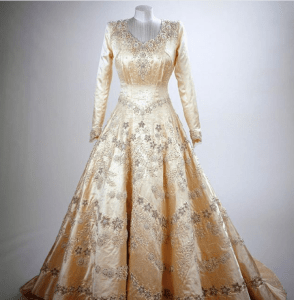
Princess Elizabeth’s wedding dress, by Norman Hartnell. Royal Collection Trust
The Gown: A Novel of the Royal Wedding by Jennifer Robson (William Morrow, 2018) was a little outside my normal range. I don’t usually read historical fiction and this veered into historical romance fiction and that’s just not my thing. And yes, if you read the reviews on Goodreads, those folks make some valid points. I did read the whole thing, but what really held my attention were the descriptions of working in the couture houses of Paris and London, in particular at Norman Hartnell. Hartnell’s gowns for the queen were marked by detailed embroidery. The wedding dress was made while Britain was still under rationing, which meant that then-Princess Elizabeth used her rationing coupons for her dress; thousands of women sent her their coupons, too, in a curious gesture that is noted in the book. There are some obvious plot twists, and some trite moments, but on the whole, this was a good summer read that got me thinking about the hidden labor that goes into clothing, and ways to make that visible.
Dress in the Age of Jane Austen: Regency Fashion by Hilary Davidson (Yale University Press, 2019). I have one gripe with this book: the type is printed in grey, not black, ink so it is difficult to read at night in bed. Otherwise, this is a solid, comprehensive look at late-18th and early 19th-century clothing. The focus is Great Britain, which is clear from the title, but the information is still useful to those interpreting early 19th century America and Europe. Davidson makes excellent use of written sources along with extant garments, fashion plates, and portraits for a well-rounded examination of what people wore.
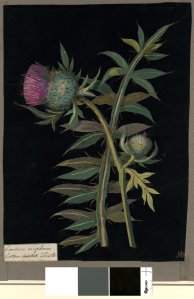
Carduus Eriophorus, formerly in an album (Vol.II, 62); Cotton-headed Thistle. 1781. British Museum 1897,0505.163
The Paper Garden: Mrs. Delany Begins Her Life’s Work at 72 by Molly Peacock (McClelland & Stewart, 2010) I knew Molly Peacock from her poetry, but stumbled across this book at my local library. Mary Delaney’s handwork included needlework and painting, but her most incredible creations were the cut paper flowers she made in the 1770s. Her life story is a good example of the choices that were (or weren’t) available to upper-class women and widows in the 18th century, and of the creative ways they spent their time.
I read plenty of other books this year, from Scandinavian murder mysteries to histories of Roanoke to histories of the suffrage movement, but aside from novels by Colson Whitehead (whichI cannot recommend enough) these three stuck with me.
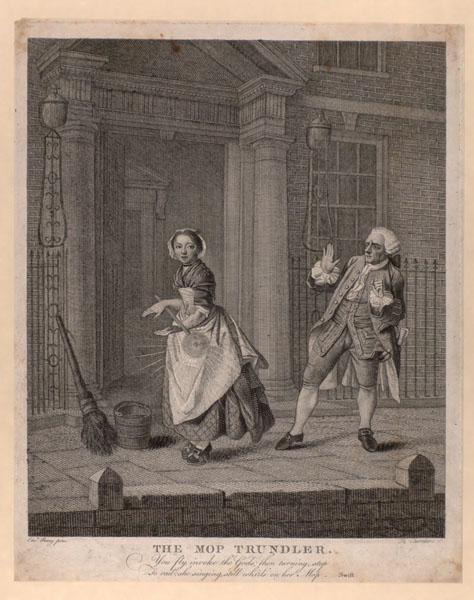
The mop trundler. Chambars after Penny. Bodleian Library, University of Oxford: John Johnson CollectionPhoto by J. D. Kay, 2013
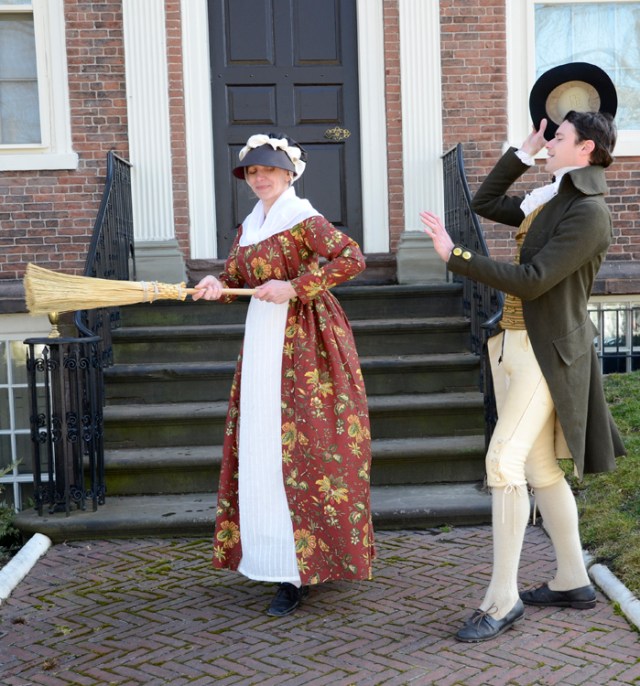
I love this image, and the original on which it is based. I love it so much that we’ve recreated it (in a later time period) whilst fooling about during a photoshoot.
But what does it really show? The image in the print depicts a passage in Jonathan Swift’s poem, A Description of a City Shower,
Such is that sprinkling which some careless quean
Flirts on you from her mop, but not so clean:
You fly, invoke the gods; then turning, stop
To rail; she singing, still whirls on her mop.
Here, in the Macaroni Provider, we have what is “Probably a portrait of some (alleged) notorious procurer; perhaps Thomas Bradshaw whose portrait he somewhat resembles.” We have a pimp, folks.
The Macaroni Provider / Macaronies, Characters, Caricatures & designed by the greatest personages, artists &c graved & published by MDarly, 39 Strand. 1772 (Vol.3). British Museum
So, with this information in hand, let’s look again at The City Shower. We have a maid– one of the few classes of women found in city streets unaccompanied, and a class of women often associated with prostitution (along with street vendors and market sellers). The fashionably dressed man recoils from the spray from her mop– is he rejected the literal filth, or the implied filth of a “maid of all work,” who may have a venereal disease? Is it reasonable to wonder if Swift is using double entendres in the lines Such is that sprinkling which some careless quean
Flirts on you from her mop, but not so clean, so that the mop is the woman’s pubic hair, and not so clean suggests she is diseased?
I don’t know, and absent intensive research or a time machine, I may never know. But once again I wonder how we use and understand these images, and think that they pose more questions than answers. McCreery’s book (based on her dissertation) helps get at some of these issues, and is well worth a read. (I found the Amazon review hilarious, myself, once I had the book in hand. No, it’s not a compendium of prints; it’s an analysis.)
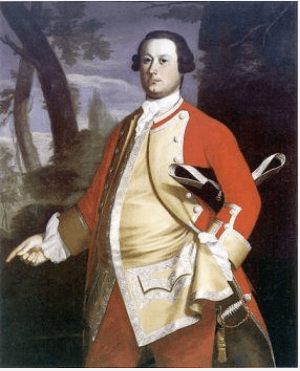
“Hanging in his quarters at Fort Lawrence, Winslow’s portrait in uniform would have served as a subtle reminder of his valuable connections. Copley’s three-quarter-length portrait lavishes attention on the young officer’s silver lace and pulsing red coat, a uniform more elaborate than the one he likely wore. The painter seemingly delights in the play of light upon shining surfaces, from the buff-colored sateen pulled taut across Winslow’s ample waist to the golden braid and tassel dangling from his silver-hilted sword.” (pp 56-57; emphasis added.)
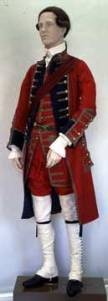
1760-65 Uniform of Captain Thomas Plumbe of the Royal Lancashire Militia.I missed that bit about sateen last night when I read this aloud to Drunk Tailor, so let’s roll back to the part that first set me off: the young officer’s silver lace and pulsing red coat, a uniform more elaborate than the one he likely wore.
Granted, Plumbe’s uniform is later than Winslow’s portrait, and Plumbe was a Captain and Winslow a Lieutenant, but the difference between them is rather less than, say, a private and a captain. Why does Kamensky assume that Winslow’s uniform is not the one he wore? Is it the lace? Winslow held a commission, and served as paymaster and commissary, roles Kamensky describes as “relatively modest.” Yes, Lieutenant isn’t Colonel; it’s the baby of officers, but it’s still commissioned officer and reasonably responsible (and, one might imagine, relatively remunerative if one was hooked into the Boston mercantile network). And uniforms were ornamented with tape, in gold, silver, or wool– see below, in Morier’s painting of two privates. (I further wonder whether it’s reasonable to describe a portrait of 50″ x 40″ as subtle, but perhaps it was placed in an enormous room.)
William Brattle, oil on canvas by John Singleton Copley, 1756. Harvard Art Museums/Fogg Museum, Partial Gift of Mrs. Thomas Brattle Gannett and Partial Purchase through the generosity of Robert T. Gannett, an Anonymous Donor and the Alpheus Hyatt Purchasing Fund 1978.606Fanciful? Fancy to our eyes, yes. Fanciful, no. Brattle was eventually a Major-General, so the uniform portrayed here, when he was likely a captain (same rank as Plumbe), seems pretty reasonable. If we were considering replicating a Massachusetts officer’s uniform ca 1755, we would consider Brattle and Winslow’s biographies and ranks, compare the two portraits of two men, probably both captains at this time, and, cross-referenced with Plumbe’s amazingly extant uniform and the 1751 warrant, begin to form an opinion that we would be making a coat in scarlet superfine broadcloth faced with buff, with buff small clothes, gold tape, and domed buttons. (Sateen is a weave structure, and wool sateen was not used in military uniforms.)
But that’s now how Kamensky is approaching this, of course, and why would she? She’s a historian, not a curator, material culture person, or a reenactor. Why does she assert that the uniforms worn by Winslow and Brattle are fanciful, and “more elaborate” than what they wore– without a footnote to back that assertion? And why does she then describe Major George Scott’s portrait “as the meticulously rendered uniform of his parent regiment, The Fortieth Foot” in contrast to “the fanciful, half-imagined costumes of Winslow and Brattle”? (p 58)
Major George Scott (detail), oil on canvas by John Singleton Copley, 1755-58. Private CollectionThe sitters’ biographies are footnoted, but nothing appears in the notes about the uniforms. Kamensky makes a great leap to the “fanciful,” which I find curious, considering that most male portraits are rendered carefully if flatteringly, and many female portraits are made for the male gaze, and are more likely to be “fanciful” or “fancy dress.”
I find myself wondering how it is that historians and art historians can write so confidently about images without understanding the material depicted. It’s as if they are all context and no content, while many reenactors/costumers favor content over context. In any case, having encountered these speed bumps in the book, I’ll certainly be reading it with a dose of skepticism when portraits are dissected.
Adam Stephen’s Waistcoat and Gorget
Date: ca. 1754
Catalog #: 12197; 12199 gorget Accession #: 52984
Credit: Division of Military History and Diplomacy, National Museum of American HistoryEdited to add:Drunk Tailor reminded me after I posted this that the NMAH possesses an actual officer’s waistcoat from the 1750s. Here’s the General History note in the online exhibit: “In 1755, the officers of the Virginia Regiment received orders from Washington to provide themselves with a “Suit of Regimentals” of good blue cloth. The coat was to be faced and cuffed in scarlet and trimmed with silver; they were to wear blue wool breeches and a scarlet wool waistcoat with silver lace.”
Scarlet wool waistcoat with silver lace. Sure does resonate with those portraits of Winslow and Brattle, and makes me all the more uncomfortable Kamensky’s assertions of “fanciful” depictions.
I like Styles because he helps us understand the why of people’s clothing, and their wants. For me, context is key (I harp on this a lot) so insight into how many shifts are usual, the fashion for pocket watches, and the activity of the second hand clothes market is really helpful. So despite my love of shiny satin gowns and fashion of all eras, among the few books I didn’t send to storage when I moved was The Dress of the People. I think that’s a strong recommendation.




 Kirsten Hammerstrom
You must be logged in to post a comment.