How deep were my pockets?

Warning: Museum-related Digression

Not deep enough, not by half.

Lot 194, hammer price: $22,500. Estimate:$4,000-$5,000

On November 13, Augusta Auctions held a sale in New York that included some really wonderful things, and chances are good that if you read this blog, you know about some of the items, like the British consul’s coat, some very lovely leather trousers, and my personal favorite, the Rhode Island man’s day suit.

That suit! I’ve heard about that suit from a couple of people, but I’ve never seen it in person. I’ve made a jacket from a pattern taken from the coat, but until the photos turned up on the auction site, I didn’t know what the original looked like. It’s not flashy. You think, it’s a plain brown linen suit, no big deal, until you start to look at the simple, direct construction methods (which I have seen in other Rhode Island garments), and the rather elegant lines. This seems, from the distance at which I have to observe it, very like the boy’s jacket at Connecticut Historical Society. They share similar lines, are similar in color, and probably represent the most common everyday wear of the middling sorts of southeastern New England.

Historians and curators increasingly recognize the importance of the “common everyday” people and their material world, whether it’s Jill Lepore on Jane Franklin Mecom or whoever bought this suit. There are and were more of the 99% than the 1%, and to really understand the past, we have to collect what we can to document the daily lives of the majority of the people.

So of course I wanted this suit very badly. I looked up previous auction results, I poked around in other museum’s catalogs, and looked at our own collections. I prepared a case statement and took it to the Board committee that oversees Collections– when we spend large sums, we have to get approval. The Board committee authorized me to bid, but set a limit based on our acquisitions budget, which is funded from prior sales of duplicate or unrelated material in our collection. (Things like 20th century oriental rugs and mid-Atlantic corner cupboards– we can’t use them, they weren’t made or used in Rhode Island, but were acquired to furnish our house museum, until it was over-furnished. Then we went through a lengthy and formal deaccession process.)

Watching the online bidding, I could tell the sale was hot: there were folks with deep, deep pockets bidding, and I knew early on I would not get the suit. By the time it was all over, the hammer price was $22,500 (it’ll be $27,000 with the buyer’s premium) for a suit with a $4,000 – $5,000 estimate. I should say that it did rawther well, considering, but even in a different budget year, I would not in my wildest dreams have gone as high as the winning bidder did. Every result in this sale felt new, and dangerous, the way the Betty Ring sampler sale prices felt new and dangerous.

These prices feel dangerous because they skew the market and the past in a curious way: when the objects of the everyday become this valuable, this expensive, how can a museum with a mission to interpret the past of a specific people ever hope to compete? I can’t, not even with a concerted effort to develop a donor base that would support an acquisition at more than four times an estimate. What does that do to the market? It puts it squarely in the realm of the 1%.

That 1% is not just oil barons, it’s museums with enormous endowments and revenue streams, like the Met. I’ve posted before about the difference in museum revenue streams and endowments, and how a place like the Met can gross over a billion dollars in revenue in a fiscal year. With money like that, $22,500 is nothing. Museums like the Met and the MFA and the PEM and LACMA can out-bid smaller museums, vacuum up collections, and amass great hoards of material. What the little people have to do is to build relationships, and hope that they can get some of the material before it ever gets to auction. I didn’t have that chance, but it’s the only one I’ll ever have in what seems to be a new market for old things.

This sale also made me think that the museum world is increasingly a winner-take-all world much like politics or business, or even education. There are the haves, with large endowments and major gifts, attracting more gifts and endowments, and then there are the have-nots, with very limited funds and volunteer staffs. Those of us in the middle are feeling the same squeeze that the ever-smaller middle class is feeling, with similar income erosion as what our endowments earn buys us less, and as grant funds are ever harder to get. Programs are more competitive, and there’s less money for the big national endowments (NEA, NEH, IMLS) to give away.

Capitalism and market forces are at work, changing collections and changing how museums can and will operate. We have to radically and rapidly rethink how museums function both in acquiring collections (if we can continue to acquire them at all– there’s a cost not only to acquiring but to keeping) and in making them accessible. The smaller museums have to make better cases for mattering more to their audiences, or culture will be increasingly sequestered in larger, richer places.

‘Visual Arts Crush’

I’ve been following the Times’ Arts Crush” series, and one of the best, and best-written, in the series has been Holland Cotter’s piece on poetry and the MFA. Cotter’s writing is always elegant and accessible, with an amazing ability to render high concepts simply. (I wish he’d taught my graduate seminars in art theory…) The series inspired me to think about my first visual arts crush, and how it still resonates today.

I grew up on the North Side of Chicago, in the actual city, not Ferris-Bueller-land. By the time I was in high school, I had a pretty free-range existence thanks to the Chicago Transit Authority, and rode the bus anywhere and everywhere, even up to the southern edge of Bueller-land, also known as Evanston.

Mrs. James Ward Thorne American, 1882-1966 A17: Pennsylvania Kitchen, 1752, c. 1940. Art Institute of Chicago
Mrs. James Ward Thorne
American, 1882-1966
A17: Pennsylvania Kitchen, 1752, c. 1940. Art Institute of Chicago

Thanks to the CTA, and to the car my family drove only on weekends, and plenty of field trips in school, we visited most of the museums in the city: the Museum of Science and Industry, the Shedd Aquarium, the Chicago Historical Society, the Field Museum and the Art Institute of Chicago. That’s where I found my very first crush.

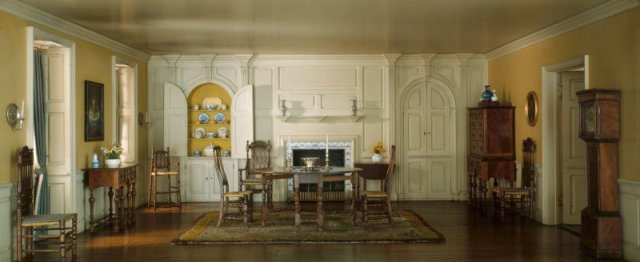
Mrs. James Ward Thorne American, 1882-1966 A3: Massachusetts Dining Room, 1720, c. 1940. Art Institute of Chicago.
Mrs. James Ward Thorne
American, 1882-1966
A3: Massachusetts Dining Room, 1720, c. 1940. Art Institute of Chicago.

There’s a lot to love in the AIC, from classic Impressionists to post-war Abstract Expressionists, but when I was in grade school, what really made an impression on me were the Thorne Rooms. The Thorne miniature rooms are meant to be the most accurate 1/12 scale representations of historical interiors. It will not surprise you that I pressed my 10-year-old nose against the glass of the early Pennsylvania rooms, or the high-style Rhode Island rooms, wishing desperately that I could shrink and slip through that solid membrane and inhabit the world the rooms depicted.

Mrs. James Ward Thorne American, 1882-1966 A11: Rhode Island Parlor, c. 1820, c. 1940. Art Institute of Chicago
Mrs. James Ward Thorne
American, 1882-1966
A11: Rhode Island Parlor, c. 1820, c. 1940. Art Institute of Chicago

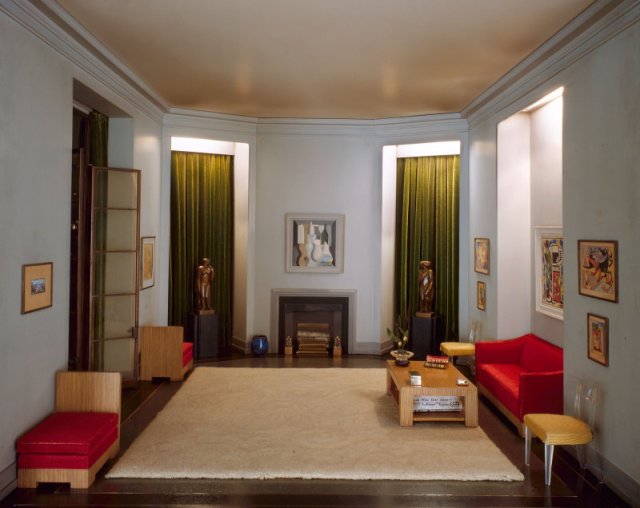
My mother and I would play a game: Which is your favorite room? Which one would you like to live in? And even if the rooms filled with tiny ball-and-claw feet were my favorite, or the chestnut-panelled keeping rooms, the one I wanted to live in (because somewhere there would be a telephone and a radio, and behind the tiny door, a well-appointed bathroom) was the Art Deco apartment. We were fairly certain this was a room you never saw in “Bringing Up Baby,” maybe the room on the other side of the bathroom where the leopard was kept.

Mrs. James Ward Thorne American, 1882-1966 A37: California Hallway, c. 1940, c. 1940. Art Institute of Chicago.
Mrs. James Ward Thorne
American, 1882-1966
A37: California Hallway, c. 1940, c. 1940. Art Institute of Chicago.

Accuracy and anarchy: those contradictory impulses have guided most of my life, from the work I made as an artist, to the work I do now. Getting details right, from citations to what’s on a table for a 1799 tea, matters; but once that’s set in motion, life takes over, the metaphorical leopard is loose, and we’re off to see what life was really like in all its emotive glory in 1799.

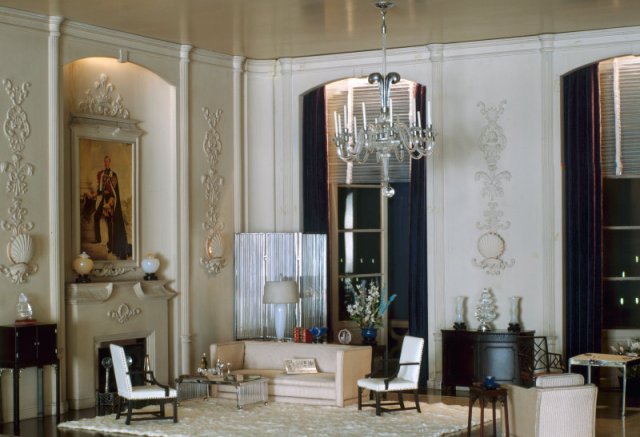
Mrs. James Ward Thorne American, 1882-1966 E-15: English Drawing Room of the Modern Period, 1930s, c. 1937. Art Institute of Chicago.
Mrs. James Ward Thorne
American, 1882-1966
E-15: English Drawing Room of the Modern Period, 1930s, c. 1937. Art Institute of Chicago.

And it all started in the basement of the Art Institute of Chicago, imagining what it would be like to live in each of the tiny worlds that ring the walls of the Thorne Rooms gallery.

Street

Street_featuredVideo art has often left me bored. It can be too schlocky, too stupid. Not that I don’t appreciate simple, silly work. The first piece of video art that made an impression on me was at the Museum of Contemporary Art in Chicago. It was  William Wegman’s  Heads With Tails, featuring the ultra-patient Man Ray. This simple video was an excellent introduction to conceptual for a 10-year-old. (I could not have been more than 10 or 12 to tolerate going to a museum with my mother…by 13 and 14 I was going on the bus by myself.)

Flipping a coin and turning a dog around, while hilarious, is not necessarily what everyone thinks of as art; for others, Nam June Paik is a more valid artist.

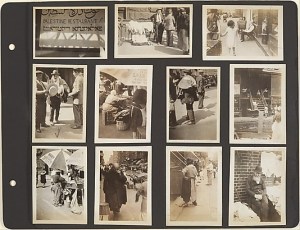
Album page, New York City. Bernice Abbott, 1929-30. MMA 1982.1180.106–.116

I give you James Nares, and his Street project at the Met (which closed 5/27/2013, sorry). There’s a short clip (2:17 out of 60 minutes) if you scroll down the page. This isn’t the section I stumbled upon, but it captures much of the essence of the piece. I think it was the best thing I saw all day, and even better, the video is bracketed by galleries of photos and objects selected by Nares from the Met’s permanent collection.

These are can be found online, though they are not divided or arranged the way they appear in the galleries. Still, you can see connections between the pieces.

For other interesting and rather less famous street still photographers, check out Vivian Maier, orJoe Sterling (who lived around the corner from us when I was growing up).

Please enable flash to view this media. Download the flash player.

Impressionism, Fashion, and Modernity

The authentic matters, the real matters. It is different. Great art leaps from the surface of the paper and lives. Photographs may burn into the paper, but in that depth, they, too, live and glow.

Gallery 2: En Plein Air

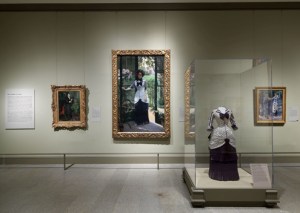
The Met’s installation of Impressionism, Fashion, and Modernity is worth seeing for the coalescence of so many real things in such a [relatively] small space. The monumental paintings, especially Monet’s Luncheon on the Grass in Gallery 2, En Plein Air, need to be seen for real, in the actual matter, to really be appreciated. The brushstrokes, the color, the enormity, all need to be in front of you to be appreciated—to be experienced. It doesn’t work any other way. (Click here for better views of the paintings and costumes; photography was not permitted.)

Gallery 5: The Dictates of Style

By way of an intimate contrast, consider the portrait of the gown and the gown itself in Gallery 5, The Dictates of Style. Here’s a lesson in the power of art, of paint, and an artist’s vision—and it’s Bartholomé, not Monet or some other genius, though a solid painter all the same.

Behold the cotton dress in conservator-approved lighting and yawn. Well designed, beautifully made, and real, right down to the stain on the upper bodice or collar, a pleat slightly misaligned at the hem. But yawn all the same. Now, the Bartholomé: bam! It’s not about the dress: it’s about light. This contrast is beyond a doubt one of the best lessons I have ever seen on the real nature of painting, and of impressionism: Light.

And if the authentic, the real is important, going to see the real thing is also important.

Here’s the Met’s catalog shot and record for a Degas drawing:

Degas
MMA, 29.100.185

And my iPad photo of the same drawing:

MMA, 29.100.185.

I’m not a wild fan of Degas; I’m more a Joseph Beuys/Caravaggio kind of art lover, but seen in person, this sketch was amazing.

This is an unfair comparison, and I had expected the catalog shot to be in color, because color is so important to this piece. In black and white, you miss the pop of the color contrast between the medium and the paper; you miss the bleed of the oil spot, more subtle in the black and white. You miss the way that image is fast and messy, the simmering tension between the artist and the sitter. Incredible as it seems, there is nothing like the real thing.