What’s behind that green suit?

The American School, by Matthew Pratt, 1765. MMA 97.29.3

Mr S. has a green linen suit in the making; that is, he has breeches which mostly fit, and a frock coat in need of serious alteration. Since I will need to alter this coat eventually (that is, take it apart, re-cut and re-assemble it) I have started looking for images of green suits.

Portrait of a Boy, probably of the Crossfield family. William Williams, MMA 65.34
Portrait of a Boy, probably of the Crossfield family. William Williams, 1770-75, MMA 65.34

The green linen the suit was made from is no longer available, so there will be no matching waistcoat. If I can get the thing tweaked to an approximation of ca. 1763, we should be set for the August event (if that happens) and for Battle Road next year, though I know he might want wool. The taunts of “bet you wish you had the rest of that coat” from this year linger in my mind, at least.

The jacket is, admittedly, too short. I begin to wonder if I need to cut it down even more, like a workman’s short coat; the Massachusetts line “Bounty Coats” are cut shorter, and similar to a coat at the Connecticut Historical Society (1981.110.0, search by number here, the links are not stable).
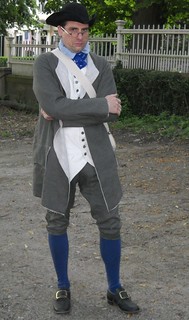
Mr S last June, in the unfinished 36-hour-frock coat

The problem with that plan, at least for 1763, is that the cuffs are clearly larger and coats longer, in 1763, than they are in 1775, at least for gentleman. I realize that this means I am better off starting over completely for the 1763 coat from a muslin up (which against all instinct and principles, I did not do for the 36-hour-frock coat). So I’m waffling here, as Mr S doesn’t always want to portray the day laborer/tenant farmer, but would like some pretensions to artisan and property owner. That means more fabric, and that means starting over completely is in order–breeches, waistcoat, frock coat and all. But wait, there’s more!

The events in the queue before the August 10th event for 1763 include Monmouth on June 15-16 (for which overalls and hunting frock are in production), Washington’s Arrival in Cambridge on July 14, which requires militia clothing, and Old Sturbridge Village the first weekend in August, for which a regimental coat is requested. Somewhere along the line, I’d like to make myself something…but it looks more and more like a summer of menswear. Perhaps cutting down that green coat and altering the breeches for July 14 is the most sensible plan…though where that will leave 1763, or the regimental coat, I do not know.
Museum Madness and Things to Make

After a day at the Met on Friday, I went to work at my own museum on Monday. We moved paintings, rounded up miniatures for photography, and packed an ax for transport.

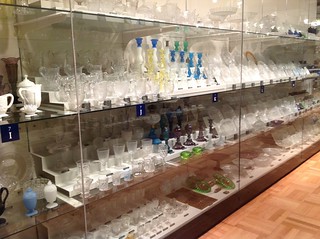
Glass at the Met. I hate this stuff.

On Tuesday, I took the MBTA up to Boston to deliver the ax (tomahawk, throwing ax, ax comma belt in Chenhall) to another museum, at the Old State House. I think this show will be very nice, and I had the pleasure of meeting someone whose wife I know through the interwebs: behold the power of the interwebs, and the small size of the reenacting community. Also, my state.)

Then, because I cannot get enough of this stuff, I took the Green line over to the MFA. By now you’re thinking, Kitty, really? How many museums do you need to visit in five days? Should we get you help? But the thing is, objects get me really stoked. Paintings, sculpture, heck, even glass– and I hate glass– make me pretty happy.

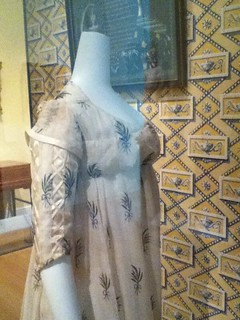
1998.96, overdress or tunic. MFA Boston

I’d just been to the MFA in July, so this trip was to visit some friends among the Copleys and Greenwoods and Blackburns. But I also know that the textiles have to rotate often, and there are dedicated mannequins in the Art of the Americas Wing.  My reward for a return trip? This lovely over dress or tunic.

I love the fabric, and thought immediately of Quinn’s Tree Gown. Hmm. As you can imagine, I will be hot on the trail of something like this fabric as soon as I am done with the menswear on my list. (There is a lot of menswear, but that doesn’t mean I can’t do some real thinking and research in preparation for this tunic…which is all I can do for now.)

It does cross over in the front, and the floral motifs line up across the layers.

There are more photos of the overdress in the MFA set on flickr, and I have a lot more thinking to do about this tunic. It does have a cross-over front, which I like, but the lacing is really striking. This may take another trip to the MFA with a better camera.

Oversleeves, cross front, lacing, diamond-shape piece in the back like a keystone…there’s a lot of detail, and lot to love (and eventually curse while making) in this tunic.

Chintz? Check!

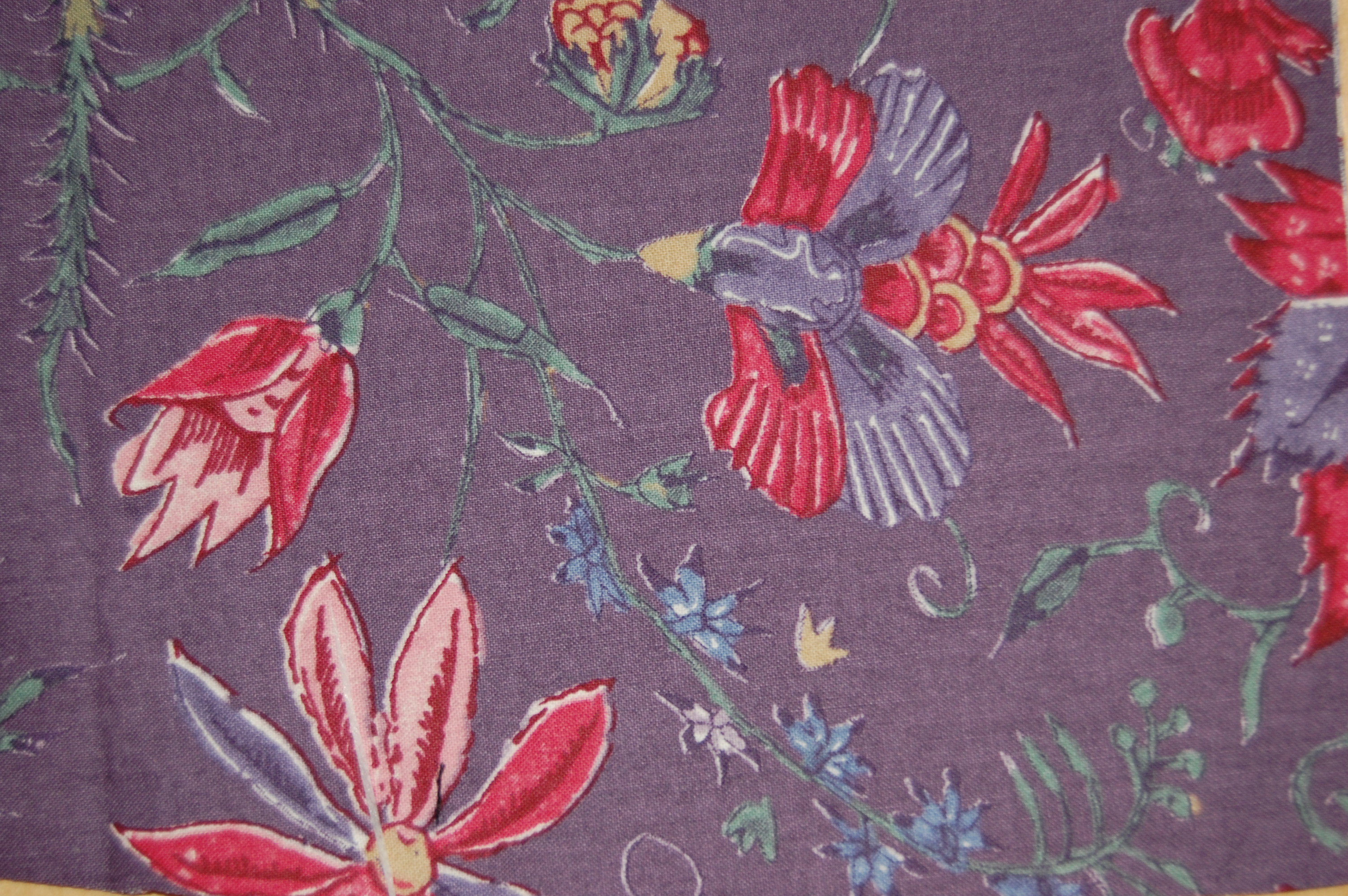
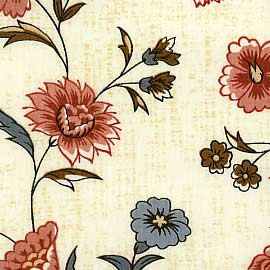
Les Fleur d' Inde
Les Fleur d’ Inde: delicious!

Because I am prey to a pretty print as much as the next princess costume blogger tenant farmer’s wife, I thought I should go  looking for evidence before I launch into any cotton sacques, and to justify the use of the print remnant I’m stitching up into a jacket. (Apologies in advance to my friend who bought enough for a gown, because you know we’ll wear them to the same event…)

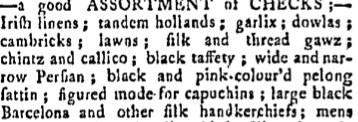
Providence Gazette and Country Journal, March 16, 1765

American Historical Newspapers to the rescue, once again. Here’s an ad for Alexander Black and Archibald Stewart, from the Providence Gazette and Country Journal of March 16, 1765.  Chintz and calico: it’s here in Providence in 1765. I knew there were merchants selling calicoes and chintzes in Providence in 1768 (including Samuel Young, who printed his broadside in red).

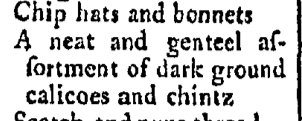
Chintz and chip hatsThree years later, Joseph and Wm. Russell at the sign of the Golden Eagle are selling (lately imported from London and Bristol) “A neat and genteel assortment of dark ground calicoes and chintz.” This ad runs to four columns in the Providence Gazette and Country Journal, 1768, April 9. It’s a tantalizing list, and no, I did not miss those chip hats and bonnets!

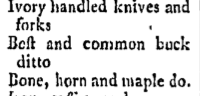
forks!

Digression: I was attracted to this bit about forks as I recall being told by a historic house tour guide once that “forks were not in common use until the Civil War.” It’s an early house, maybe he meant the English Civil War, but I think forks were here to stay and be bought for a variety of prices long before the American Civil War. How else to explain those archaeological finds that show forks of some kind at Rev War forts and camp sites? /Digression. New digression: OMG, knitting needles! /New digression.

William Eliot

Back to chintz: Here, in 1771, is William Eliot, selling chintzes in Providence, and advertising in the Providence Gazette and Country Journal of June 1, 1771. He also has “flowered and sprigged lawn in aprons,” and Kenting and check handkerchiefs.  (Kenting was a fine linen fabric)

In the limited search I ran (1754-1783 newspapers), plenty of references to chintz appear in Providence alone (there were 166 hits, but the ads repeat). This completely unscientific approach in which I stopped looking in 1771*, has turned up 5 merchants, if you count the RIHS Library’s broadside for Samuel Young. Chintzes and calicoes were everywhere. Dark grounds were “genteel,” checks and spots and stripes are popular and common.

Paul Sandby, London Cries: Black Heart cherries... ca. 1759. YCBA,  B1975.3.206
Paul Sandby, London Cries: Black Heart cherries… ca. 1759. YCBA, B1975.3.206

I begin to see 18th century Providence, if not all of the Colonies, as a variegated, kaleidoscopic place of pattern and color. I think there was more than we realize, even if only in small amounts.

Look again at the cherry seller: her petticoat is yellow and blue, if not yellow, blue, and white striped,  her apron is blue, her stockings brown or faded reddish, her cap is affixed with a pink or red ribbon, and she wears a checked kerchief. She’s poor and sort of faded, but she’s colorful–more colorful, perhaps, than we have credited.

*I do have to head out to work, but I can search again.

The 1763 Project

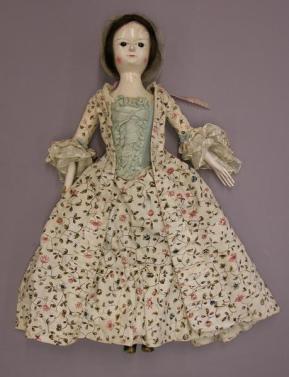
Doll, 1763. V&A, T19.36, T19P.36

Sweet, right? Who wouldn’t want to look (or at least dress–those pupils suggest something untoward, chemically) like this doll? And she’s 1763. Of course, my friend DC didn’t get the grant he applied for, so he has to try again.

Still, it seems the event will go ahead and I am stumbling on under the impression that I will have a chance to make myself something lovely for August. Of course, that comes only after I make the regimental menswear, so why am I typing and not backstitching? Because after a while, it’s just plain dull. Plus, doll! Printed cotton! Lightweight and lovely! And look: a hairstyle I can manage: birds’ nest.

Nice Petticoat.
Nice Petticoat.

What I like about this doll are her details. (The better written description is on the V&A website, but the better photos are at VADS.) She’s wearing a sacque (known also as a sack-back robe or a robe a la Francaise) and matching petticoat, a green silk quilted petticoat, a white linen petticoat, and a pocket that matches her gown.

The blue silk of her stomacher is used as trim on her sleeves, which are ornamented with flounces. Hallie Larkin goes into this well on her blog post about Changes in Cuffs. And that’s what stops me: the fine linen and the lace.

An actual reproduction, no less.

The gown itself, even a sacque, seems like something I can manage. (And yes, this is but one more piece of cotton sacque evidence.) A very similar fabric is available and if this sells out, there are variations on the theme. The blue silk stomacher can be managed: I have taffeta sources, and from making bonnets have learned the basics of the serpentine designs. I could make that. But those flounces–what about those?

Here she is from the V&A, ca. 1760, T.19-1936

Here’s the V&A description: “lace and cotton elbow ruffles.” Hmm. Cotton, perhaps that I can find in a fine, sheer weave. But the lace?

The more I think about this lovely gown, about the materials, and who would wear it, the more I think I’m better off sticking with lightweight wool and Sandby’s cherry seller...

I love a good challenge, but the lads need regimentals and their own 1763 apparel. Sandby’s woman wears a gown I’ve made before, so construction screw-ups will be fewer time will be shorter. And at least we can all wear whatever I make for various other celebrations and riots. New England had them in abundance in the 1760s and 1770s.