
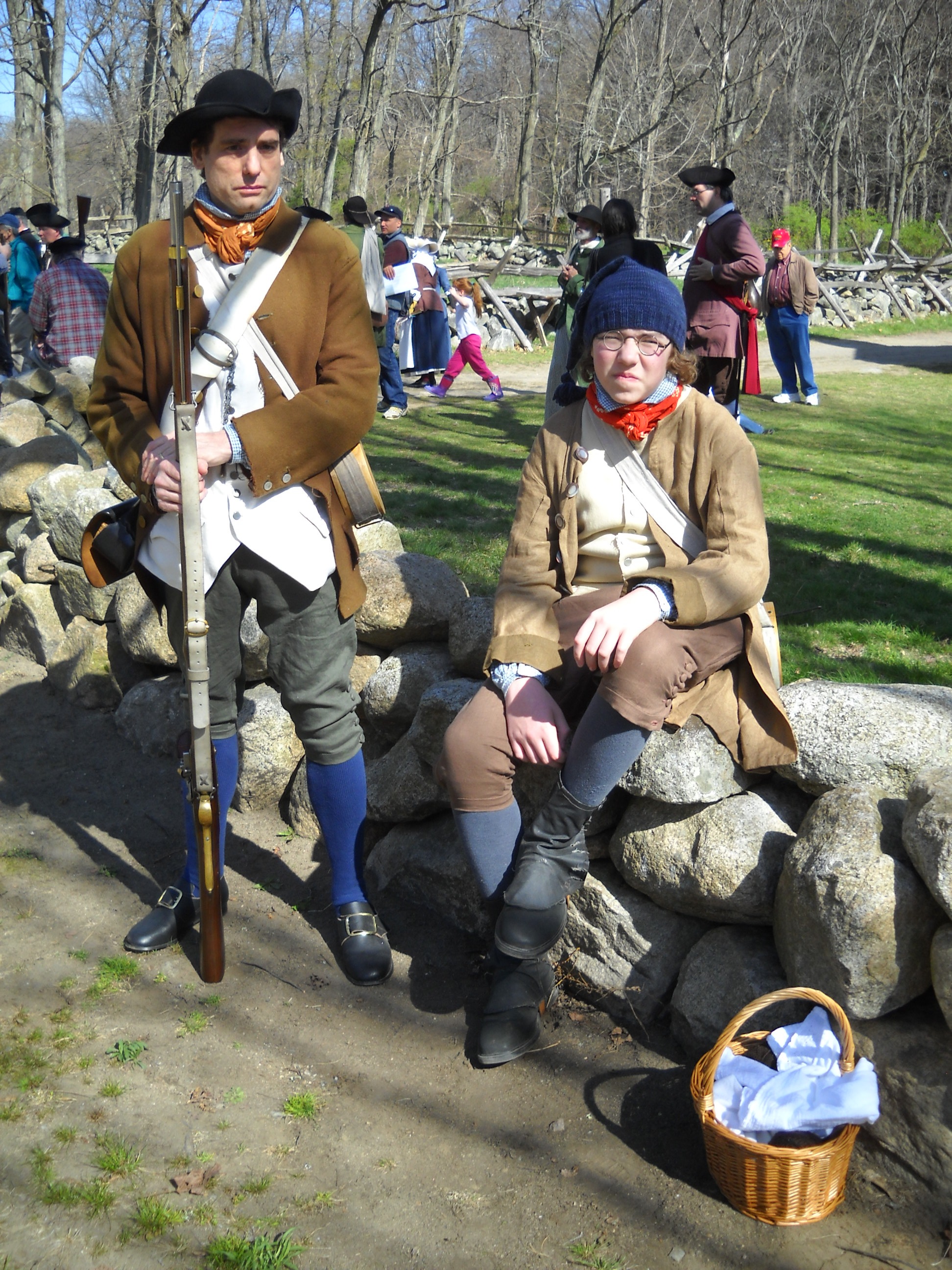
Clothing Criticism

Boys at Battle Road.

Standards, people. The list serves erupt at least quarterly on the subject of authenticity in reenacting. We must have standards.

Yes, we must. We must do the best we can to recreate the past, and to share the best history we possibly can. But that does not give us a license to hurt others with words.

The Captain told me Saturday that “It used to be so bad in the Brigade, and in the Continental Line, too, that women would come up to a newcomer like you,”—here he fingered my cloak, all hand-sewn, of Wm Booth 100% wool broadcloth in a color documented to a RI runaway, and patterned after a period cloak in a RI museum—“and say, ‘Is that machine stitched?’ and proceed to criticize what the woman was wearing. The woman would never come back.  She’d take her husband with her, and we’d lose a soldier forever.”

I had to tell him they still do that, just now they do it behind people’s backs, on list serves and on blogs. “I know,” I said, “because they’ve written about me.”  After that, I hunted up the documentation for the specific little fabric trick I’d done, and date it to 1785. Oops, OK, not appropriate to a Brigade event, being two years after the end of the war.

And then again, I’ve seen similar handling of fabric in a ca. 1760 child’s frock coat from RI…. But the stinger was in, and the gown, my favorite of but two gowns, is relegated to non-Brigade events.

So where does this leave us? I can be as bad a stitch counter as the next person, able to discern a machine-stitched pocket welt at 20 paces. Sometimes I can tell a seam is machine-stitched, too. And yet…

I will confess: Machine-stitched breeches were worn by my men at Battle Road. It was that or not go at all. The buttonholes are all hand-finished, as are the eyelets. Thank goodness Dana helped me with Thomas’s breeches, or I would not have slept at all that Friday night. Two pairs of breeches had to be made, a dozen eyelets and 30 buttonholes in total. The buttons were cheaters, too, fabric-covered, but for most I used the metal blanks fitted with metal backs. For some I used rings and gathered fabric around the ring to form the shank.

Those are the least of the problems with the breeches. Despite muslin fittings on squirming boys, the legs are too long and should be shortened. Dave’s are too loose at the knee, and his waistcoat is also too loose, now. Thomas ought to wear leather-soled shoes, and the gaiters he had were too small. His breeches, too, are too long, the knee band too tight.

I know all these things. Will I fix them? Not necessarily. Their overalls are in greater need of replacement, battles loom, and time is limited. Perhaps next winter I will be able to re-fit their breeches. Until then, we’ll muddle through with what we have, upgrading the necessary, and avoiding the egregious.

For the rest of the state where we live, I hope to emulate The Hive and create workshops to help educate museum staff members in the fine art of not dressing like a tavern wench. Educating is surely better than criticizing without offering alternatives.

Imag[in]ing the Past

Photographers in the background prepare to stalk their prey.

Last Friday, R. L. Fifield wrote about being in other people’s family albums. In the future, I think I’ll turn the camera on the crowd as she did at the Battle of Brooklyn. It is an odd thing to be an animal in the zoo, as the boys and I have been.

But what seems even odder is the how the public behaves.

I have not been shoved too hard myself, but I have been elbowed and ignored. I have seen grown men push their way through a group of chatting reenactors, shouldering past the men they didn’t want to talk to as if they were sleek as a cat. (Note to the Rude: If you give a speech at an event and state your name and organizational affiliation, perhaps you should not actually shove the participants aside later, even if they are “only” privates.)

Brian and Thomas, too oblique for the woman behind me.

I have heard a woman with a point-and-shoot camera yell at my son and the Regiment’s adult drummer, “Turn around! I can’t see your faces!” Really, I had no idea Brian possessed an Evil Eye, but it’s a good one.

I have watched an elderly gentleman with a large digital SLR pull and tug on my husband’s hunting frock to force him into a portrait with woman he did not know.

And that was all just on Saturday in a small town in RI. Similar behavior, with more foot-crushing and shoving, was on display at Fort Lee, NJ last November. (A NJ camera club came to the Fort Lee event, which was listed on their website as a good event for taking photos.)

We’re reenactors, not dolls.

Please,  ask before touching, or tugging. We’re happy to explain what we’re wearing and let you touch our clothes but we don’t like being pulled around to suit your aesthetics.

Please don’t step on the women in kit. We can’t be in the battle, but we like to watch it, too, and the guys on the field are our friends, husbands, sons, fathers…we care about them.

In short, remember we’re people too, and we’re happy, delighted—eager, even—to share the history with you. But let’s minimize the tugging, shoving, pulling, and yelling.

Being Here Then, or, Present in the Past

One of the best things about reenacting is that you are always present. It is almost ironic that trying hard to being in the past makes it easy to be present—the present of “being in the moment,” being here now.

I really mean mindfulness, but that’s not as good a pun.

Just be: it’s easier without a watch, without a cell phone. I am by no means trying to say that reenacting is a panacea or without politics, for it is neither. What I do know is that dressing in the 18th century manner, attending events at historic sites with other reenactors, and engaging in 18th century activities changes a person. It changes me, changes my husband and son.

We are lost to time, in time, and while we can usually estimate the time of the clock, we find ourselves knitting or sewing or walking without regard to time, but instead to light, or hunger, or tiredness. Around us, the 21st century site staff are running tours, checking watches, checking cellphones, and we are sewing, chatting, learning. We are stones in the rivers of other people’s busy.

Saturday we celebrated Rhode Island Independence at Nathanael Greene Homestead. It was a trial, in a way: poorly done history, misogyny among non-unit re-enactors (Civil War guys, get a grip!), and the Mouse Woman. But we went for a walk to the River, in quite the 18th century way. With this Regiment, you never quite know what will happen, though no one sang at us this day, and the fishermen ignored us.

We walked to the falls, dug in a pile for slag from Greene’s forge, chucked sticks in the water, and listened to the water.  Clear and so fast it seemed not to move above the falls, foamy torrents roared below the drop.

I came home grateful for the guys, for their patience, and for the day.

All Cleaned Up

We arrived at 8, and started cleaning at 10. We finished a little after 4, with three rooms and two light fixtures cleaned. Along the way, we learned a few things and answered some questions.

Following the advice of Hannah Glasse and Susanna Whatman, we began with the fireplace, and then started high and worked our way down. Dana pulled the logs from the formal parlor fireplace and cleaned the andirons, while I covered the sofette with a cloth and began to dust the looking glass. It soon became clear that no one had cleaned the looking glass in some time. I whisked the upholstered furniture (with reproduction fabric) while Dana polished the mahogany. These 18th century techniques definitely worked.

Using an 18th century cleaning solution of vinegar infused with lavender, we cleaned the glassware and china, and saw visible dirt residue on the rags we used to wipe, rinse, and dry the objects. We applied the same solution to the marble fireplace with similar success. We swept the floor with the round broom-corn brooms of the period and discovered just why the housekeeping guides suggested the use of damp sand, “thrown down hard onto the floor,” before dusting began. While we could collect piles of dust bunnies and dirt, they fled before the wind from our moving skirts and were hard to sweep up. Damp sand would have kept the dirt down and allowed us to sweep it up more easily—but that’s not how the floors Marsden Perry installed in the house were cleaned, so we used damp rags instead.

When we were finished, I noticed that although we had not swept the floors with herbs and sweet grasses, the formal parlor did have the faint odor of sweet broomcorn and lavender. The daily sweeping and cleaning a house with herbs, grasses, corn brooms and lavender would have been an excellent means of keeping the less pleasant smells of the 18th century at bay.

About our clothing, we were asked that most-often-asked question of re-enactors, Aren’t you hot in those clothes?

No, we’re not. We wear linen shifts next to our skin, under the stays and petticoat, dress and apron, and once the shift is damp with sweat, you tend to stay cool. If you stop moving, you can feel chilled. We began the day in jeans and t-shirts, and felt much cooler once we’d changed into 5 layers of linen and cotton.  (This is true inside and out; I have certainly felt cooler on an 80+ degree day at Old Sturbridge Village in 1775 dress than I have in modern blouse and skirt.)

When I got home, I discovered that the diagonal bones in my stays had worked their way through the linen binding—another argument for using the earlier method of binding stays with leather, and not with linen. The busk, or flat wooden panel running down the front of my stays to provide separation and support, was wet and warped. I didn’t notice the twist in the wood until I had loosened the stay laces, and then the front of my stays started twisting! The back of the busk was wet, and the front smelled slightly of vinegar, which I must have spilled. Now that the busk is dry, it has pretty much regained its original shape, with a slight twist along its long axis.  Baleen might have greater staying power than oak, but I will compare the busk I have with some in the collection to see if they, too, have twists from use.

~Kitty Calash